
Governments around the world are increasingly beginning to address how to regulate AI and deal with the mounting threats it could pose. For example, a June 2026 US Executive Order requests for the government to have access to AI models 30 days prior to their public release, citing concerns over cyberthreats. And, in early July, the Trump administration introduced a program dubbed “Gold Eagle” which would give the US government direct influence over which companies gain access to the latest frontier AI models.
OpenAI, Anthropic, and Microsoft have publicly called for stricter laws to reduce the risk of AI-enabled biothreats. The US government momentarily banned the use of Anthropic’s Fable 5 and Mythos models by foreign nationals. After an AI agent from OpenAI breached containment and hacked Hugging Face’s infrastructure along with several other companies in a multi-day hacking spree, employees from leading AI companies signed an Open Letter calling for International Coordination to control (or slowdown) of the pace of AI development.
Internationally, President Trump and China’s President Xi Jinping, have discussed guardrails on AI development and deployment, with a series of ongoing talks planned in the coming months. For its part, China has well established AI safety and governance policies and strategies in place–including international cooperation. Both Senator Bernie Sanders and President Donald Trump have posed the idea of a massive public equity share in AI companies. Several experts in the field have called for a global halt on the further development of AI altogether, until more safety measures can be taken and security proven. This trend will likely continue as AI becomes more capable, and highlights the growing need for international cooperation and coordination.
With this in mind, it makes sense to explore what forms of global coordination have succeeded in the past? Which ones have failed? And what insights can we take from these to ensure any future AI treaty actually succeeds?
Whether it’s scientific discovery, crisis management, product adoption, or processing grief, we tend to experience life in stages and cycles. The same is true for countries cooperating with one another. Each aims to position themselves as strong, capable, and independent; but when issues become potentially threatening, they find a way to the negotiating table.
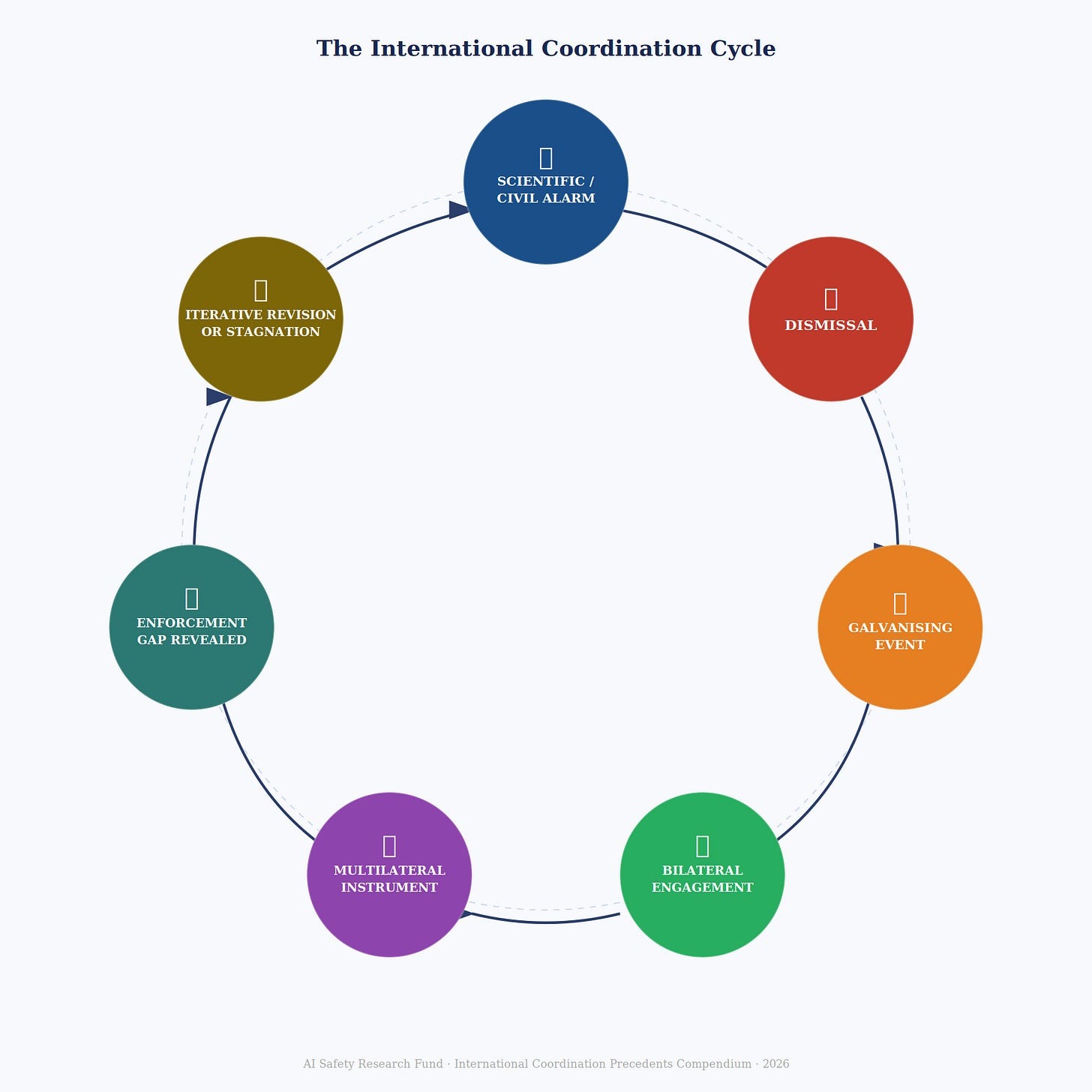
Image: graphic representation from the AI Safety Research Fund of coordination lifecycle stages
International coordination lifecycle:
1. Scientific / Civil Alarm: A technology or practice emerges that creates a new category of risk. Experts or others sound the first alarm. Example: Scientists first theorizing about the potential threat of a nuclear bomb before Chicago Pile 1 even occurred.
2. Dismissal: The alarm is initially dismissed or ignored by governments, media, and the public. Evidence accumulates but the world experiences it as a slow trickle. Counter-campaigns (Fear, Uncertainty, Doubt), low awareness of the public, and bureaucratic inertia delay action for years or even decades.
3. Galvanizing event(s): A shock makes the abstract threat suddenly visceral, collapsing the political timeline and shifting priorities. Such shocks can be an environmental catastrophe (Antarctic ozone hole), a capability demonstration (Dolly the cloned sheep), or a tragic event (the sinking of the Titanic). Unlike most of these stages, the galvanizing event(s) can appear at any point during the cycle For example, Hiroshima happened long before any global coordination.
4. Bilateral engagement: Superpower engagement usually precedes any global treaty. Historically, this has been the USSR and United State, but today would likely be the US and China. The Nuclear Non-Proliferation Treaty’s (NPT’s) breakthrough came when the US and USSR simultaneously tabled identical draft texts in 1967. Conversely, the Baruch Plan (an attempt in 1946 to rid the world of all nuclear weapons) failed due to the Soviet Union’s rejection.
5. Multilateral participation: A binding, or quasi-binding agreement eventually emerges, either in the form of a global treaty, new institution, or both. The new treaty typically contains wording that balances the tradeoffs of protecting state flexibility with the ability of enforcement.
6. Enforcement gap(s) revealed: Post-treaty implementation exposes the gap between the writing’s formal scope and actual compliance. This can be in the form of state actors finding loopholes (Iraq for the Geneva Protocol) or changes in the technology (such as somatic cell cloning).
7. Iterative revision or stagnation: States either iterate–amending the treaty, creating new bodies, or passing domestic legislation to close gaps–or the process stagnates. The Montreal Protocol (written to address the ozone layer challenge) has had four amendment rounds to keep up with new evidence.
The Overton Window opens in response to visceral shocks: The spectrum between a political idea being considered unacceptable, to becoming an accepted topic of discussion, before falling out of favor again, is referred to as the Overton Window. Typically, the window doesn’t open until a tipping point of public awareness or a galvanizing event occurs. Evidence alone has rarely been sufficient to catapult global coordination. For example: Molina and Rowland first published the CFC-ozone hypothesis in 1974, but action was stalled for over a decade. After the Antarctic ozone hole was discovered in 1985, things moved quickly, with the Montreal Protocol being signed just two years later. The
Bilateral superpower negotiations come in many flavors: The Montreal Protocol succeeded partly because the Reagan administration’s internal resistance reversed and partially because Secretary Hodel’s “hats and sunglasses” backfired–causing the United States to take a more aggressive stance. The Nixon-Brezhnev Moscow Summit enabled the creation of ENMOD. The Baker-Shevardnadze dialogue was vital for the Chemical Weapons Convention. Smallpox eradication was the result of the US and USSR working together, despite the Cold War. Conversely, the cloning moratorium never achieved a binding international treaty because superpowers couldn’t align on it. In short, the US and Europe disagreed about whether to ban reproductive cloning only, or to also include therapeutic cloning. China and Russia desired neither.
Critical thresholds are a compromise that don’t always work as intended: Most successful treaties specify a critical threshold or red line. Normally, the exact threshold is a balance between preventing bad outcomes and preventing the treaty from being weaponized against state actors. If the treaty is too strict, states have little flexibility, and are less likely to comply. If it’s too weak, then it becomes difficult to enforce. For example, ENMOD’s “widespread, long-lasting, and severe” triad prevents “trivial” environmental complaints. The Nuclear Proliferation Treaty’s Article VI is an example of red line flexibility failing. Its wording is extremely vague, simply asking for nations with nuclear arsenals to pursue “good faith” dialogues for disarmament in a “meaningful timeframe.” To this day, only South Africa has followed through on this. Since many actions can be interpreted as pursuing “good faith dialogues,” and “meaningful timeframe” could mean anything from a few months to a few centuries, Article VI has never been invoked. Similarly, the Geneva Protocol banned
It is likely that similar trade-offs will emerge in global AI governance, where capability thresholds or deployment restrictions will come against enforcement and political good-will.
Financing and equity enables participation of the Global South: The best-intentioned treaties can only succeed if properly funded and include voices from the westernized north and global south. For example, the WHO smallpox resolution originally had only $100k a year in funding (an order of magnitude below what was needed). In 1966, the budget increased to $2.4 million and later to several billion. Critically, it also enabled the development of a vaccine that poorer countries could produce domestically. By 1973, 80% of all vaccines used were being produced in developing countries instead of from northern donations. The Montreal Protocol created the
Taking our cues from history, let’s next review the elements that moved progress forward and held it back. This can help us stay informed, take action, and define success faster in scenarios that demand specificity and speed.
Scientists: Molina and Rowland were instrumental for ozone, while the Bulletin of the Atomic Scientists and the Pugwash scientists had a critical impact for nuclear. But this can be slow, with years of evidence accumulated, while it remains either dismissed or ignored. But scientists tend to produce the most technically sophisticated governance (e.g. the IAEA, OPCW verification).
Politicians: Frank Aiken: a small-state foreign minister from Ireland who aggressively pushed for nuclear non-proliferation, introducing resolutions for four years until the foundation of the NPT. Viktor Zhdanov is another: deputy health minister from the Soviet Union, who made the first Soviet WHO appearance in a decade to propose global smallpox eradication. His speech included a quote by Thomas Jefferson after the achievement of the first vaccine in 1806: “Future nations will know by history only that the loathsome small-pox has existed.”
Journalists: ENMOD was propelled by a 1971 column penned by Jack Anderson, and a New York Times story by Seymour Hersh, both disclosing the US weather alteration campaign in Vietnam. Their persistence drove the process from exposure to treaty in less than six years. This pattern can radically shorten timelines, since the shock is already public before governments have taken any action. But they can also be weak, since pressure from the public can result in sloppy or rushed agreements, lacking the technical work required. For example, ENMOD is notoriously weak, with an incredibly high ceiling for what counts as weather alteration. To this day, it has never been invoked.
Industry: Notable “Godfathers of AI” Hinton and Bengio has called for the slowing down and control of AI systems. Several CEOs of major AI companies signed an open letter calling the development of AI an existential risk, on par with the risk of nuclear weapons and biothreats. Most recently, many prominent employees of AI companies signed another open letter calling for the international slowdown and control on its development.
Terminology: It turns out that words matter quite a lot when it comes to international agreements. In terms of cloning, the sticklers were “therapeutic” vs. “reproductive” cloning. Negotiations collapsed mainly because France and Germany wanted to ban reproductive cloning while permitting therapeutic cloning research, while the US insisted on a total ban. The UK and China opposed any binding treaty. As a result, the UN Declaration uses deliberately ambiguous language, such as avoiding research that is ”incompatible with human dignity,” precisely because no agreement could be reached. The NPT has a smaller, but still critical problem. The NWS and NNWS have always disagreed about whether
Verification: In the Chemical Weapons Convention (CWC), the question of whether challenge inspections could include “anytime-anywhere” access vs. “managed access” blocked progress for almost a decade. The ENMOD troika tried to prevent verification from being weaponized, but ended up setting such a high threshold that it has never been formally invoked. In the NPT, the adequacy of IAEA safeguards has been in continuous dispute since its inception. Verification disputes consistently produce the most deadlocks.
Domestic ratification: The CWC was negotiated first in September 1992. But US ratification for it stalled for 4.5 years. It finally happened in 1997, only days before the treaty went into force. Without a last-minute bipartisan push, the founding of the Organisation for the Prohibition of Chemical Weapons (OPCW) may have failed. The UK Human Fertilization and Embryology Act took six years to be ratified because of resistance from Parliament regarding whether to ban all forms of cloning or simply reproductive forms.
Success requires planning for change
Most treaties which held over time were designed with an understanding that the underlying technology or science would change, and included the ability for revision to address that. Warnock’s Committee on Embryology wrote “the pace of scientific discovery is unpredictable” and designed a licensing authority specifically so that new techniques could be brought under regulation without requiring new legislation. The Montreal Protocol was designed with a built-in amendment process, and has been amended four times. The OPCW has a review conference with the authority to recommend changes. The most durable and effective treaties were designed by people who expected the technology to develop further, not for it to freeze in place.
Conversely, treaties that interpreted technology as static failed or stalled. The UK Human Fertilization and Embryology Act defined “embryo” specifically as the product of fertilization, unknowingly excluding cell nuclear replacement (the technique Dolly the sheep was created with) because the drafters weren’t anticipating somatic cell cloning. This required emergency legislation in 2001 after a High Court ruling exposed the gap.
Most prominent AI researchers agree that international coordination will be essential as artificial intelligence continues to advance. Historical trends give us a better understanding of what that might look like, and what would be needed for it to be effective. Currently, the AI governance situation sits somewhere between stage 2 (dismissal) and stage 3 (galvanizing event) in the lifecycle. But in order to make it to stage 4 (bilateral engagement), there are a variety of things we need to do now.
1. Stop waiting for the galvanizing event: Ypres (the first large-scale successful deployment of chemical weapons by the German Empire) was necessary before the Geneva Protocol. Halabja was necessary before the CWC. The ozone hole in the Antarctic was necessary before Montreal. In each case, this came at enormous cost.
AI is unusual in that the plausible galvanizing events—autonomous weapons, a model used to design a novel pathogen, or complete disempowerment or extinction of the human species—could be irreversible in ways that the ozone hole was not. If we wait for more “warning shots,” it might already be too late.
2. Commit to bilateral talks: The most important near-term action item is dialogue between the US and China on AI safety. This would mirror the Moscow Summit agreement to hold bilateral discussions on ENMOD, or the Baker-Shevardnadze talks that unblocked the CWC. The May 2026 Beijing Summit serves as a promising first step but much more will need to be done. A positive next move would be a US-China-led technical working group on AI capabilities and risks, based on the SALT working groups of the 1970s. It would focus on information sharing about training runs, dangerous capability thresholds, and incident reporting. This can be done before a galvanizing event. Like SALT, all it requires is the mutual understanding that coordination is better than the alternative.
3. Establish thresholds now, before a crisis forces bad ones: Most agreements include a threshold qualifier which is often negotiated under pressure. This results in flimsy or vague red lines. The AI governance community should be doing the analytical work now, before a crisis causes unnecessary errors or short-sighted decisions.
4. Build the Multilateral Fund before you need it: AI development impacts every country. Make compliance a win for developing countries despite not playing a dominant role in developing frontier AI models. Montreal and the Vienna Convention achieved 100% ratification. AI is dominated by actors in the US and China, but providing incentives for developing countries, such as a Multilateral Fund could have large state buy-in, since any treaty would require universal participation.
5. Avoid vague wording and use concrete terminology: The Council of Europe’s Convention on AI (first global treaty on AI) appears to be a binding international agreement with a set of rules that could be invoked if a country was found to be in violation. However, some of the wording is problematic. For example, Article 3(1)(b) specifies that for private companies within a signing nation, that nation must apply the treaty’s rules to its companies, or take “other appropriate measures.” Since “appropriate measures” is intentionally vague, it could mean anything. This results in no country ever being able to invoke the treaty if private companies violate it, because by its very wording, no true concrete violation can ever be found. Similarly, the Hiroshima Process International Code of Conduct for Advanced AI Systems uses incredibly soft language. Phrases such as “as appropriate,” “should,” “encouraged to,” “where feasible,” “where appropriate,” and “commensurate to the risk” can be found throughout it. As we have seen, vague terminology renders agreements ineffective . A truly binding treaty must have concrete terminology with proper definitions if it is to be formally invoked.
6. Design for revision: The most durable treaties have been designed to evolve and include a technical body with amendment authority. The body holds a review conference on a regular schedule to address new developments and suggested changes. This is more important than a technically precise treaty that lacks an easy path for amendment. The amendment process would also need to work on an accelerated timeline given how fast AI progress is compared to other technologies.
Being institutionally prepared, internationally coordinated, and strategically ready at the national level might be the difference between a successful AI treaty that binds nations and holds over decades, and something messy brought about due to urgency from incidents that can no longer be ignored.
As economist Milton Friedman once said:
“Only a crisis - actual or perceived - produces real change. When that crisis occurs, the actions that are taken depend on the ideas that are lying around. That, I believe, is our basic function: to develop alternatives to existing policies, to keep them alive and available until the politically impossible becomes the politically inevitable.”
With AI models now able to hack most major infrastructure, AI agents escaping containment and instigating their own autonomous campaigns to breach private companies, and the world as a whole becoming far more aware of the risks of AI, the crisis seems to be fast approaching, and we cannot afford to fail.
Torchbearer Community prepares people to engage with democratic institutions on AI safety topics so politicians can take action and make informed decisions. Whether a seasoned policy professional or concerned citizen, everyone has a role to play.
No posts
Comments
Nothing yet. Say the first thing.
Sign in to join the conversation.