
Friends,
I have been struggling for weeks to find the right way to write about what has happened since the war with Iran began and ended. The piece below is what came out. It is about a saying you have probably heard if you live here — mah shelo holech b'koach, holech b'od yoter koach — and about why a saying that began as army humor has become, I think, the most dangerous idea in Israeli public life.
Kol tuv,
Rabbi Zach Truboff

Around the time America signed its memorandum of understanding with Iran to end the war, I came across a quote in a weekly parsha sheet that caught my eye:
“In Israel, we negotiate everything from free refills on a burger meal to flight seating assignments. We are a people deeply uncomfortable with absolute boundaries.”
It was meant as an affectionate observation about Israeli chutzpah. But it also points toward something much deeper. Modern Israel has developed an almost instinctive suspicion of limits. Boundaries are not simply obstacles to navigate but challenges to overcome. If something appears impossible, we assume it merely hasn’t yet met sufficient determination. It is a curious posture for a society whose founding culture emerged from Judaism, for there are few traditions that place greater emphasis on the reality of limits—human limits, moral limits, and political limits.
Unfortunately, the refusal to accept absolute boundaries has caused many here in Israel to embrace a way of thinking that has disastrous consequences: Mah shelo holech b’koach, holech b’od yoter koach—”What doesn’t work with force will work with more force.” The saying originated in the Israeli army. A piece of equipment is stuck, a magazine is jammed, or a screw won’t turn, and the answer is simply to hit it harder. But its meaning today is far darker than that. In many ways, it has become the defining logic of Israeli strategy since October 7.
The phrase is so seductive precisely because nothing can prove it wrong. When force fails to deliver what is promised, the answer is obvious: we didn’t use enough force. It offers the one thing a people uncomfortable with limits wants most: the assurance that the limit was never real, that what looked like a wall was only a screw that had not yet been hit hard enough.
The Logic at Work
Once this way of thinking takes hold, it begins to shape strategy at all levels. Failure demands more force. Success invites more force. Even ambiguous results become arguments for more force. The wars since October 7 illustrate each of these possibilities.
Consider Gaza. The stated aim shifted, in the months after October 7, from rescuing the hostages and dismantling Hamas to nitzachon mukhlat—total victory—a phrase whose function is precisely that it cannot be falsified. When operations failed to produce it, the answer was never that the aim itself was wrong. It was that Israel had been too restrained, too slow to enter Rafah, too quick to allow humanitarian pauses, too constrained by international pressure. Each phase of escalation during the war was justified by the failure of the previous phase, for if total victory has not yet arrived, the explanation is always the same: we have not yet used enough force.
One might object that this analysis applies only when force fails. Surely genuine military success demonstrates its value. Lebanon suggests otherwise.
Lebanon was, on its own terms, a success. The pager operation, the strikes that decapitated Hezbollah’s senior command, the killing of Nasrallah—these were tactical achievements of a very high order. And yet this tactical success seemed to produce only an appetite for more violence. It wasn’t long before the frame had shifted from “deterrence has been restored” to “we must now finish the job—in Syria, in Yemen, in Iran.” The success of the pager operation was seen as evidence that Israeli force could work wonders when we put our minds to it, and that we had been holding back all along. What worked in Lebanon could work everywhere if only Israel were up for it. The logic does not need failure to demand more force. Even victory becomes an argument for escalation.
Iran completes the picture. By the time the strikes began, the logic had been operating long enough that the war aims could be set at their most extravagant: not merely degrading the nuclear program or restoring deterrence, but regime change itself. Anything less would be seen as a failure of nerve.
And so the predictable thing is now happening. The war clearly did not achieve everything it set out to do. The nuclear program has been set back by some unknown margin, but there are credible reports that the regime emerging from the conflict is more radical than the one that preceded it. And of course, the deal with America gives Iran access to funds it has long been desperate for. If Iran rebuilds and threatens Israel, it is because we stopped too soon. If Iran sprints toward a bomb, it proves the strike was necessary, and we must only hit them harder. If, for some reason, things remain quiet for a time, that means that the force was successful. There is no possible outcome that the logic does not already know how to absorb.
At this point, the obvious question becomes: if the logic is so circular, why is it so persuasive?
Why Violence Feels Like the Answer
The answer is that violence always does something to the world. It blows things up. It produces images of craters, collapsing buildings, destroyed convoys, and lots of dead bodies. It generates the unmistakable sensation that one has acted, and it makes us feel powerful in the process. When it fails to produce what we hoped for, we can always insist we simply did not use enough. It is the perfect strategy for a people who are deeply uncomfortable with limits.
There is a further danger, one that compounds over time. If all you have is a hammer, every problem begins to look like a nail. The more sophisticated and impressive the instruments of destruction a society has—the F-35s, the precision munitions, the intelligence apparatus, the cyber capabilities—the harder it becomes to imagine not using them. A question begins to whisper in the background: why have all this if we are not going to use it? The tool, once acquired, begins to generate its own demand.
Of course, the problems Israel faces are not, in the end, ones that can be solved with the barrel of a gun. They are ultimately political problems—questions of legitimacy, recognition, and the terms on which people are willing to live together.
The Logic of the Torah
Long before modern political theory, the Torah warned against the belief that military power could achieve all one hoped for.
“A king is not saved by a great army; a warrior is not delivered by great strength. The horse is a false hope for victory; despite all its power, it cannot save. (Psalms 33:16–17)”
Read the verse carefully. It is not a pacifist text. It does not say the king has no army or that the warrior possesses no strength. It says that the horse—the most advanced military technology of the ancient world—is a false hope. The danger lies not in the weapon itself but in what the weapon does to the one who wields it. It creates a confidence that nothing in the actual situation justifies. It convinces the king that he has been saved when he has only been temporarily armed.
I began with the observation that Israelis negotiate every boundary. The tragedy is that some boundaries are non-negotiable realities of life, no matter how uncomfortable that makes us feel. Military force can defeat armies, kill leaders, delay threats, and in some cases, create opportunities. But it cannot solve Israel’s most pressing problems.
My fear is that this lesson has not been learned here in Israel, even after three years of war. That the next war is already being justified by the last one. That we will keep hitting the screw until it breaks—or until we do.
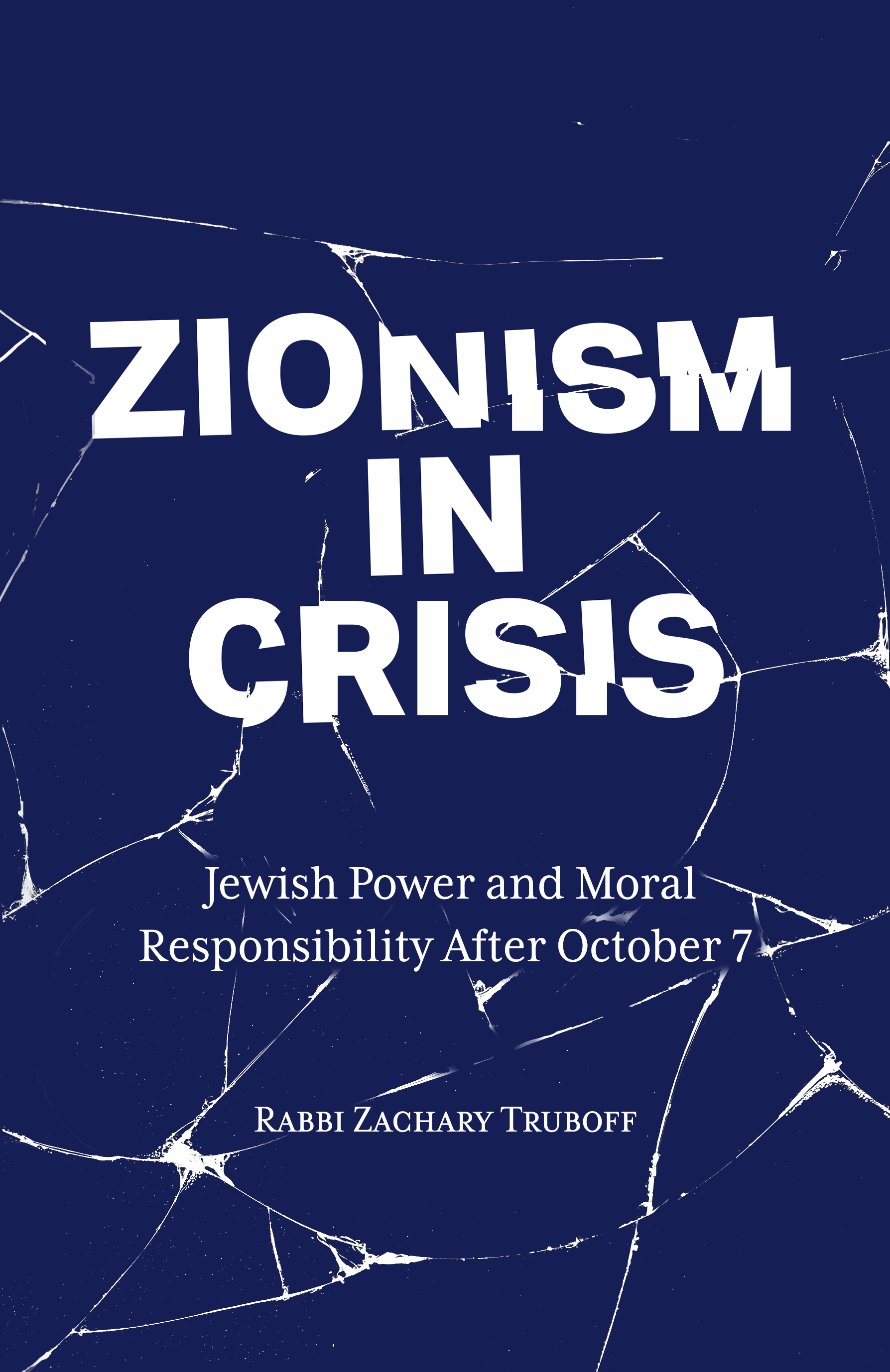
In the aftermath of October 7 and the war that followed, Zionism faces a moment of rupture. The trauma of the attacks, the brutality of the war, and the reemergence of antisemitism have made sustained moral and political reflection increasingly difficult. Even under these conditions, the failure to reckon honestly with Jewish power now threatens Zionism from within.
Drawing on Jewish theology, Zionist history, and contemporary political thought, Zionism in Crisis brings together essays that challenge sweeping defenses of Israel’s actions and total condemnations of Zionism. At its core, it is a call for teshuvah — a call to question whether the path we are on is the right one, to name what has gone wrong, and to change course before it is too late.
You can order the book here:
If you know someone for whom this book might be appropriate — someone willing to wrestle honestly with what Zionism has become and what it must yet become — I’d be grateful if you’d share this with them.
Comments
Nothing yet. Say the first thing.
Sign in to join the conversation.