
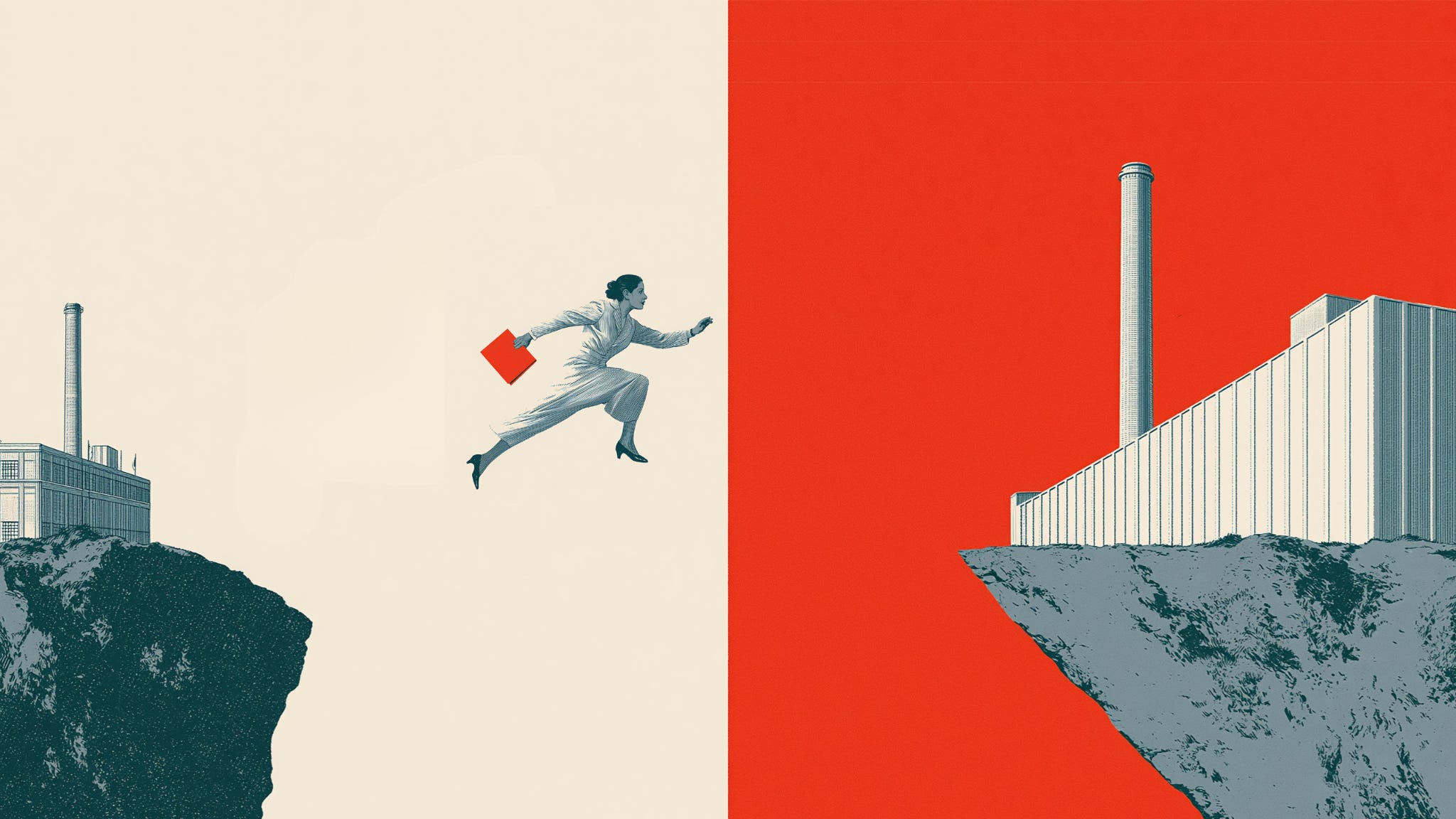
This week on Topline, we talked with Jaleh Rezaei, co-founder and CEO of Mutiny, about one of the hardest decisions a founder can make. Mutiny had built an eight-figure SaaS business before Jaleh decided to shut the whole thing down in favor of a bold new agentic direction.
For roughly three quarters, they tried to do both: keep the existing business running while building an AI-native company alongside it. What broke wasn’t primarily strategy or resource allocation. They had plenty of resources, a tight operating framework, and a system that had propelled them past $10M in revenue.
No, the thing that broke was the very essence of how the company had learned to operate. A scaled company depends on delegation, planning, and consistency. A zero-to-one company depends on founder intensity, rapid iteration, and a willingness to change direction in a second, sometimes multiple times a day.
Jaleh understood that in order to win — and win by the definition of her investors and the big game they were playing — she’d have to start all over and go all-in.
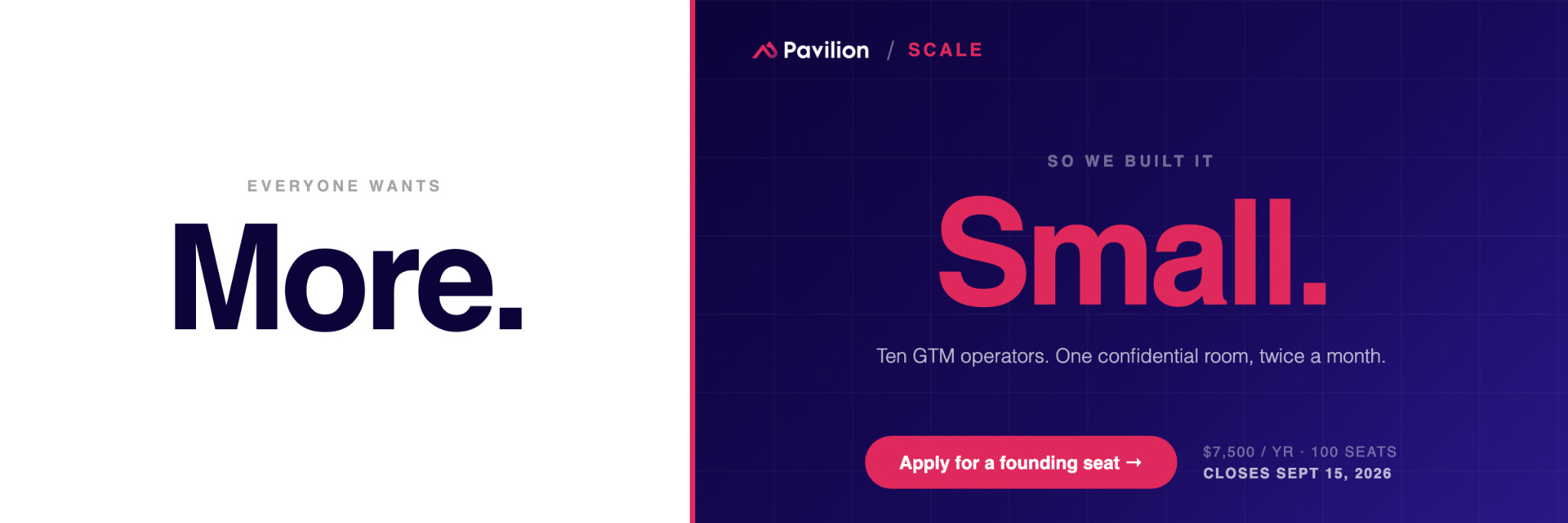
Pavilion Scale goes smaller on purpose: ten GTM operators, one confidential room, twice a month, led by a trained facilitator. You bring a real problem; your peers ask the questions you didn’t think to ask yourself.
Founding cohort, 100 seats, closing September 15.
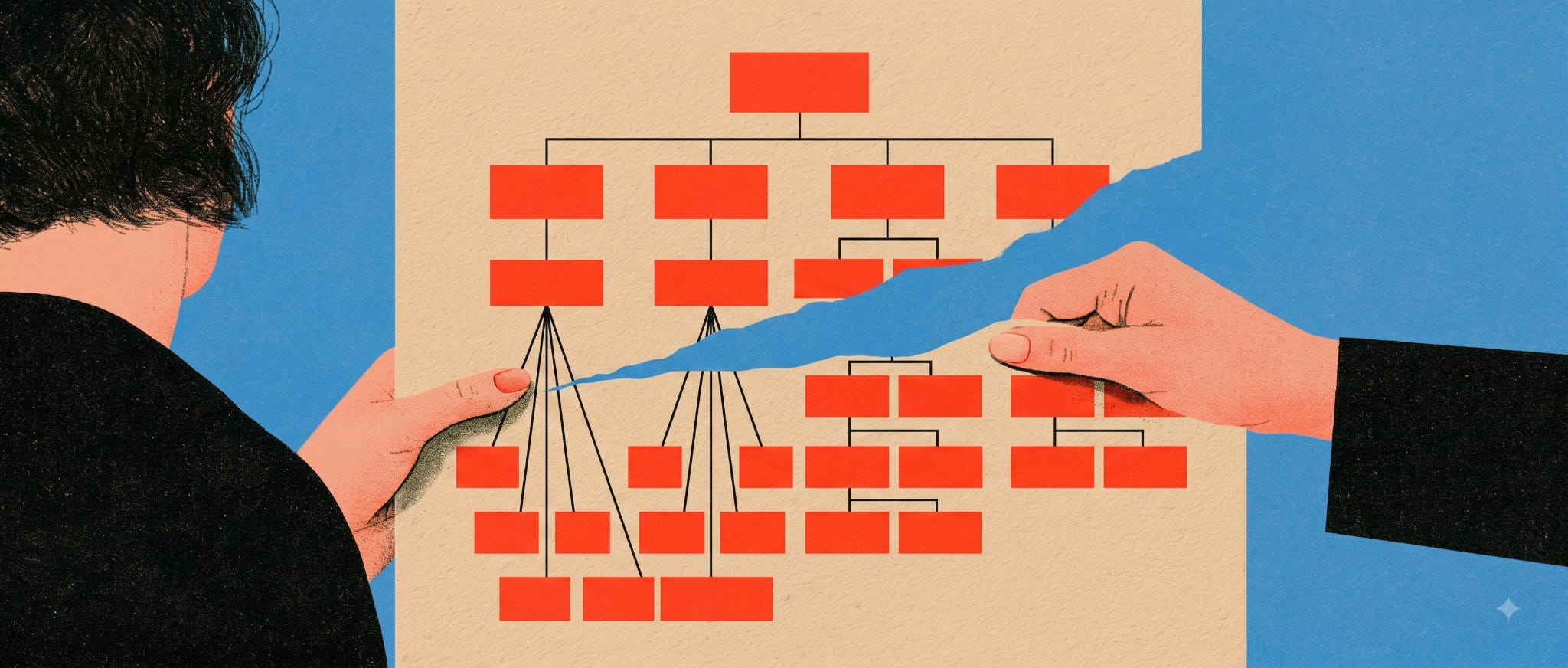
The obvious explanation for why companies struggle with reinvention is resource allocation. Existing customers need support. Existing revenue needs protecting. The org chart creates incentives, and the people protecting their fiefdoms become blockers. Some version of Clay Christensen’s innovator’s dilemma.
But I think Jaleh’s story points to something harder to change: culture. Companies develop muscle memory. Around how decisions get made, how much evidence is required, who needs to be consulted, how much risk is acceptable, and what good management looks like. Over time, those behaviors become norms. They become expectations. A deadline defaults to next week and then, the end of the month.
The pace of the business adjusts as you grow and that pace shifts the window of expectations. When that happens, it’s nearly impossible to change. Someone’s internal definition of “hard work” might move from being in the office from “9am to 6pm, five days a week” in 2019 to a few intense hours of remote work sandwiched between household chores in 2026. In both cases, the person can sincerely believe they’re working “hard.”
Organizational theorist James March described a version of this more than 30 years ago as the tension between “exploration” and “exploitation.” Exploitation is refinement, efficiency, and execution of what already works. Exploration requires experimentation, risk, and discovery. The better an organization becomes at the first, the more difficult it can become to do the second. Organizational routines create a boring kind of competent inertia. That boring competence is often the muscle necessary to generate predictable growth with a large team.
But then something like AI detonates across the industry and every old assumption collapses. The playbook stops working. And suddenly the company you spent years teaching how to grow up has to become young, urgent, and paranoid again.
Part of what makes this so difficult is that the behaviors required to run a scaled company are often the exact opposite of the behaviors required to reinvent one. In a mature business, changing your mind three times in one day is chaos. Centralizing decisions with the founder is micromanagement. Ignoring the planning process is irresponsible.
In zero-to-one, those same behaviors can be completely rational. The founder may need to be involved in everything. Priorities may change daily because new information is arriving constantly. A top-down, imposed speed matters more than consistency because the company is still trying to discover what’s true. This is what Jaleh meant when she described zero-to-one as a “benevolent dictatorship.”
The problem is not that one operating model is good and the other is bad. It’s that they’re impossible to inhabit at the same time. The old company keeps trying to turn the new company into itself.

Find out where Topline co-hosts Sam Jacobs, AJ Bruno, and a range of GTM experts sit on a selection of topics.
In our latest podcast, Mutiny co-founder and CEO Jaleh Rezaei weighed in on:
Quota attainment by the end of 2028: on the rise or set to hit a new low?
AI note-takers: engagement engines or memory sappers?
The end of money by 2041? Elon’s right or full of shit?
Listen in here:
There’s another reason Mutiny could make this decision: they had the balance sheet to survive it. Jaleh had supportive venture investors, including Sequoia, who were aligned around building the biggest possible company rather than protecting the current revenue stream. The company had enough margin for error to act on conviction.
A bootstrapped company with six months of payroll and no obvious financing path might reach the exact same strategic conclusion and still be unable to act on it. In that sense, one of the real purposes of venture capital is not simply to hire faster or spend ahead of revenue but to buy the flexibility to pursue the truth more aggressively when the world changes.
In both instances, as my friend and mentor Alexander Saint-Amand would often say, your balance sheet strategy is your business strategy.

The most interesting thing Jaleh said may be that Mutiny only started moving at startup speed once there was no backup plan. As long as the old product still existed, every decision had two constituencies. Optionality at the corporate level became ambiguity at the operating level.
The results so far suggest the decision created real momentum that only clarity and complete commitment can create. Mutiny released the new product in private preview in February, launched generally in April, and is already being used by more than 3,500 organizations. In its first week alone, the product generated roughly 1,000 signups, including people from companies like Google and DHL. Existing customers, including Snowflake and Uber, also began adopting the new product.
We ended the discussion talking about the differences between chronic pain and acute pain. As I wrote back in February, it’s often the choice between a slowly compounding dull ache that never quite sends you to the hospital until it’s too late and one fierce, unprotected moment of rupture that enables clarity, purpose, and growth in its aftermath. Phoenixes and ashes, etc.
Jaleh framed the CEO’s job with a useful question: Is there one really hard decision, maybe one that scares the hell out of you, that would make 50 downstream decisions easier?
Sometimes the hardest part of becoming a new company is deciding that the old company needs to die.
Sam Jacobs is the founder and CEO of Pavilion, the leading global community that helps GTM executives to accelerate their careers through education, community, and shared values. Sam is also a co-host of the Topline podcast and author of the Wall Street Journal bestseller Kind Folks Finish First. Before founding Pavilion, Sam spent nearly two decades as a revenue leader at high-growth companies, including Livestream and The Muse.
No posts
Comments
Nothing yet. Say the first thing.
Sign in to join the conversation.