
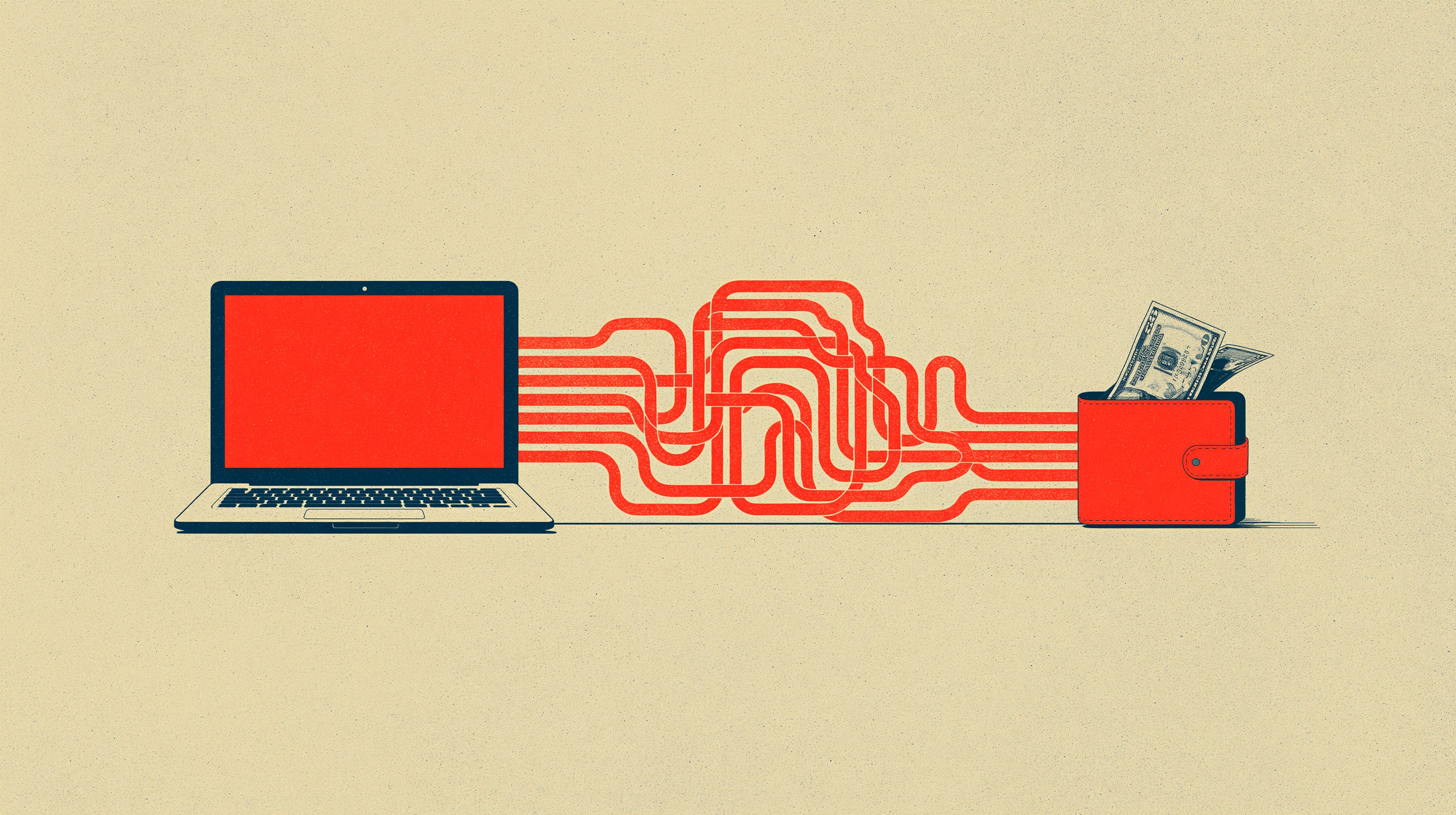
Everyone is talking about whether AI is going to take jobs. It will for some; it would be a disservice to pretend otherwise. But the bigger story is what this transformation looks like on the other side.
Organizations are changing shape fast, and whether your people make that jump is largely on you. Your job is to run the shift on purpose, before the market runs it for you.
Most leaders get the first move wrong. They point AI at automating tasks and workflows. They expect individuals to take action with AI. They ask ICs to do more with less. That’s the bottoms-up approach, and though it might make yesterday’s processes slightly more efficient, it’s not going to drive revenue in a meaningful way.
I’m a big believer that the shift must come from the top down: rethinking the entire GTM motion with AI, then rebuilding the roles and expected outcomes around an AI-first organization. Top-down moves the organization from a linear growth model to an exponential one. Top-down will drive revenue.
In the past, we built everything in GTM around the limits of one human, splitting the work into roles: SDR, AE, SE, CSM. Then we made the buyer bounce between them, and called it a funnel.
But AI doesn’t have time, recall, or capacity limits. It can rewire those roles and meld them together so that, ultimately, one human can take on the full journey.
In a sector where humans have a ~20%+ error rate, the bar is already set pretty low. Banking, healthcare, and other highly regulated industries demand deterministic perfection, and can’t afford even a 5% error, let alone 4x that.
Whether we like it or not, AI can recall and communicate better than a human — so we better embrace it, especially in the places it most earns its seat.

The first place AI earns its seat is where you never had a business model to put a human to begin with. You could never afford an SE on every SDR call, a deeply technical CSM on every check-in, or an FDE showing every customer how to get value inside the product. Now you can, and the buyer gets expert depth at the first touch instead of four handoffs later.
At 1mind, our Superhuman Mindy sources about 76% of our pipeline, with no marketing team behind her until recently. It’s 24/7 access to the product, company, and sales acumen of our best rep. Buyers get empathy, solutions, and deep technical expertise on every call, not a form to fill out while they wait for someone qualified. The result is higher win rates and larger ACV, not just more top of funnel.

AI takes away the grind, and it improves the buyer experience while doing it. Reps used to burn the week on busywork, scripted qualification, and endless internal chasing that never once made a buyer feel understood. What buyers actually want is the part I see humans skimp on most, which comes down to two things.
The first is depth. The buyer wants more than a passable answer. They want the right one in every conversation across the funnel, not just when the solutions expert happens to be on the call.
You never know where a live call will go; even the most well-prepared GTM exec can still get thrown off by a question they weren’t anticipating. That’s because no human, no matter how good, can pre-load the right slide for all of those “out of left-field” questions or have live demos ready to roll at any given moment. But AI can! Imagine being able to keep 10,000 case studies at the ready, and surfacing the single most relevant one for whoever is in the room. That’s the extra mile that AI can close.
The second is speed. “Let me get back to you” is a human latency problem. Meanwhile, the deal cools while a rep hunts for an answer that should have been instant, or worse, they never answer at all. AI ends the delay in seconds, not minutes or hours or days. That immediacy can make all the difference in the sale.

The big shift isn’t automating the jobs to be done. We still have humans at 1mind, but they’re elevated. Every role is given the support we could never budget for before. This allows those humans to get back to their core job: being human beings, with all of their empathy and relationship-building in full force. They return to being the connective tissue of a deal, capable of finding the real champion and knowing them inside out. It’s their judgment calls that save accounts and grow businesses.
Picture a GTM human who owns first human touch through to onboarding, support, and upsell: As crazy as that sounds, I’m bullish that it’s the future.
Break down the job. The tasks, we all agree, are getting eaten by AI. So is the transfer of information, whether that’s the sales pitch or the support answer. AI will give demos and onboard customers with tools like our live, in-browser agent. AI will answer the RFP, build the business case, and build the ROI calculator.
What’s left is owning the customer. Face time, caring, listening. Once AI carries the depth and the context, the old lanes our teams have always stuck to stop making sense. But that doesn’t lead to a smaller job — each person becomes responsible for more, not less.

Put AI in the places where the business case never existed. The coverage you already wrote off as unaffordable — the SE on every call, the CSM on every check-in — is the smart start.
Walk your funnel, listing every place a buyer needed an expert and didn’t get one. For example, the technical question on a first call. The security review. Onboarding for the long tail of accounts your CSMs can’t cover. The renewal nobody touched until 30 days out. Then list every “let me get back to you” in your organization. Those are latency, and they’re measurable. Rank them by deal value and close the expensive ones first.
Deploy a teammate, not a tool. Create an AI teammate that owns an outcome and carries context across the whole journey. Give it a name, a scope, and a number it’s accountable for, and review it in your pipeline meeting like you’d review a rep.
Fix the metrics before you fix the roles. Most GTM metrics measure human effort: calls made, demos held, meetings booked. Those stop meaning anything once an AI teammate is carrying the volume. Move to coverage, cycle time, win rate, expansion, revenue, and buyer experience at every stage.

Stop drawing the org around handoffs. Instead, draw it around the buyer’s journey, then ask what a human is uniquely capable of at each point.
The old chart split the customer into pieces. Give one person the whole relationship and let AI carry the depth underneath them. Every human gets a Superhuman teammate, not a license. Plan capacity by the coverage you owe every buyer, not by how many reps a pipeline number requires. And when a seat opens, don’t backfill on autopilot. Ask whether that role should come back in the same shape. Most of the time it should come back with a wider scope.
This compounds somewhere most leaders don’t look: hiring. The best people entering the market won’t do the job the old way. They don’t want to spend their days on manual, menial work a machine should be doing, and they can tell in one conversation whether you’ve built a company that respects their time. Give your team real AI and you become the place the best people want to be. Resist, and your talent bar slips from the inside out while, under the radar, the best talent stops applying.
When the hours free up, point your people at the human work: judgment, relationships, the end-to-end ownership the role is becoming. And stop hiring for the org chart you already have. Hire for judgment and strategic range instead.

Step past GTM for a second. As AI gets more capable every day, things are changing. That scares most people. But it doesn’t scare me. I’m excited for a world that finally values the work only a human can do.
Think about it: We pay people next-to-nothing to sit with the dying, to care for the sick, to hold a family together. I’m excited for the time where that flips — when machines carry the tasks, the workflow, and the selling, and the uniquely human work stops being what we overlook and becomes what we prize.
My oldest brother was a hustler and a CEO. Then one day he walked away from it to become a monk. Today he’s a chaplain. He makes almost no money. He sits with people as they’re dying in elder-care facilities and homeless camps, and asks them, “Do you want to talk to someone? Do you know what’s happening to you? Do you have a relationship with a higher power?” By every number that our economy cares about, that work is worth nothing. But by every measure that actually matters, it’s some of the most important work there is.
I want a world that leans into that. And for the people like me who love to build, the door stays wide open, too. I don’t know exactly what my job looks like in three years. But I do know that the leaders who start moving now, and who tell the truth about it, are the ones who’ll find out first.
Amanda Kahlow is a category-creating 3x entrepreneur, most notably as founder and former CEO of 6sense, and currently founder and CEO of 1mind, a company that melds the best minds across your GTM teams into wicked-smart, all-knowing Superhumans who can do it all. Amanda is a confident, brave, positive, passionate, and spiritual individual with an abundance of energy, love, empathy, and enthusiasm for life.
Thanks for reading! This post is public so feel free to share it.
No posts
Comments
Nothing yet. Say the first thing.
Sign in to join the conversation.