

Asad here!
Humans have prospered a great deal from learnings from the past. Lessons passed down to help us make better decisions today. It’s why understanding history is so important.
Those lessons often get boiled down into catchy phrases that are easy to remember and repeat. But, in the process, we’re left with over-simplifications that, lacking nuance and context, could be dangerous to act upon.
You have heard many of these familiar sayings: “Never give up!” (there are 100% things you should quit), “Be yourself!” (we can all do with some growth), “You can be anything you want to be!” (I can’t be a sprinter with my bad ankles).
Our ecosystem has its fair share of these lessons, and I have a theory that they’ve destroyed tons of enterprise value. We’re now in a platform shift, and it’s clear that the playbooks of the past have to be rewritten for the age of AI. It seems like the right time to question some of these lessons, to see which ones should make it into our new playbooks and which ones should be forgotten.
But… I’m not capable of this exercise alone. I needed help.
And so, I asked the great Dave Kellogg (EIR at Balderton Capital and author of Kellblog) to join me on this adventure — a man who has seen tech through multiple platform shifts, and one of the greatest thinkers in our ecosystem.
What follows is one of my favorite conversations of the year — enjoy!

Asad Zaman: When it comes to clichéd advice that seems dangerous, “Don’t worry about your competition, run your own race” is right up at the top for me. A conference hasn’t been held where someone didn’t say this, but as an operator it just feels like a weird way to operate. How does this land with you?
Dave Kellogg: There are so many things wrong with it, I don’t know where to start. First, it’s solipsistic. Second, generally, I think it’s bunk. Yes, if you’ve got a vendor who’s a tenth your size and they’re coming at you fast, only a fool would talk about them publicly. That’s a smart PR strategy, but don’t confuse it with what they’re saying around the executive table.
Zaman: As a founder, it’s comforting to hear when a successful founder says this. It makes you feel like it’s not as competitive as it actually is, that you’re not at war. But that’s not what business is like. It’s quite ruthless out there…
Kellogg: That’s what makes the advice so dangerous. In most categories, you are at war, and with some very competitive people. People will dismiss you externally, all while investing big to neutralize your product and go-to-market advantages. Survivor bias is also definitely part of the equation. They’re only getting asked their opinion because they won.
Zaman: From a strategy perspective, the goal is often to find a gap in the market. For that, you have to study the market and understand the competition, so you can see who to target, what to message, how to price, etc.
Kellogg: Yes, carving out a space is inherently market-facing. And, if you found the market opportunity, odds are that several other founders did, too. The difference here is between being competitor-obsessed, which is bad, and competitor-aware, which is good. You need to make a plan to beat the enemy. You don’t need to talk about it externally, and probably shouldn’t. But if you’re in a greenfield market with multiple VC-backed companies, it is war. The stakes are incredibly high. That’s why I often tell founders to hire barbarians — sales leaders who make you uncomfortable — because you need to go win the market.
Zaman: Often the same people who tell us not to worry about competition tend to tell us to trust our instincts. I find it difficult to make big bets off of instincts — it feels irresponsible.
Kellogg: Yeah, you do hear “Trust your gut, follow your instinct.” To me, that particular phrase is the most survivor-biased advice of them all. The corporate graveyard is full of founders who followed their instincts and trusted their guts. They just don’t do a lot of interviews.
I’m not saying to distrust your instincts, but I am saying to surround yourself with people who are immersed in the data and living with the customers. Then, discuss big decisions with that group.
Functional groups make better decisions than individuals. Trust the data. Trust your team. And trust your instincts. That’s the best way to make good decisions.
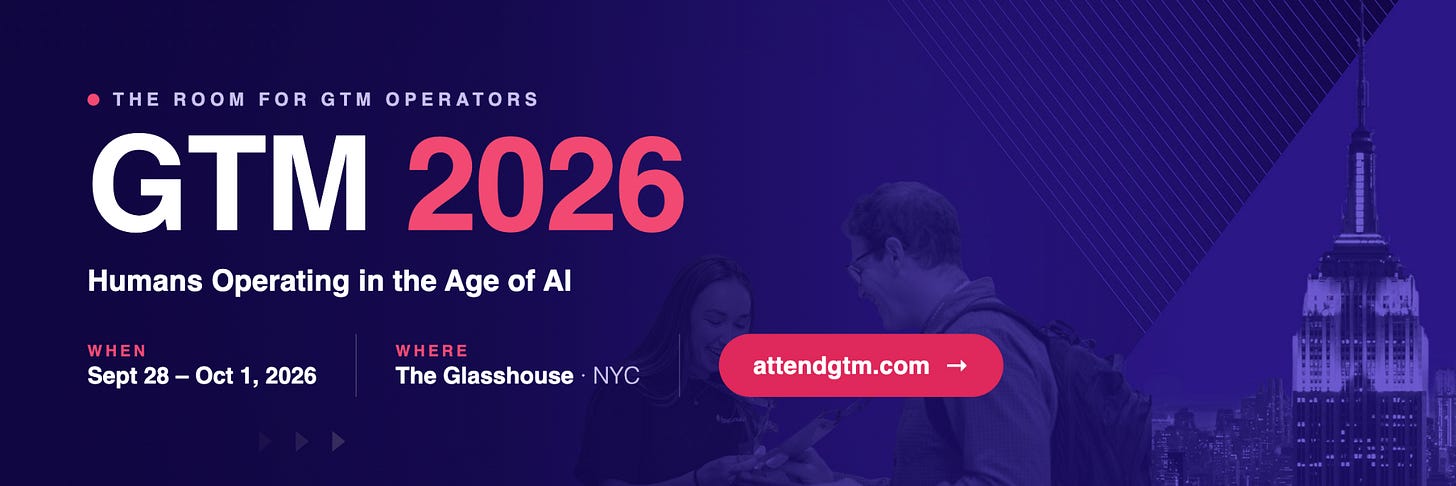
September 28 to October 1 — Join the Topline community, including Sam, Asad, and AJ, in New York City to celebrate the best annual GTM event of the year.
You’ll be surrounded by more than 1,000 of the greatest thought leaders and operators, including Geoffrey Moore (author of Crossing the Chasm), as well as Topline regulars like Amanda Kahlow (CEO, 1mind), Anis Bennaceur (CEO, Attention), and many more.
Grab your ticket before they sell out.

Zaman: A new phenomenon in our ecosystem is “founder mode,” which, at the gut level, really connects with founders. But in implementation it feels like a way to operate that will lead to a wall being hit.
Kellogg: I’m not sure it’s a new phenomenon, but it’s newly popular. Look, whenever people talk about “founder mode” the metaphor that comes to mind is that you’re in an airplane and there’s an emergency. The captain needs to grab the stick commandingly, take control, and fly the plane. In business, we think there’s no need for conversation — “It’s founder-mode time, leave me alone and I’ll fly the plane.” But a pilot taking unilateral control is precisely the way not to handle a cockpit emergency. The best crews — those with the best outcomes — maximize collaboration in these moments.
The truth in founder mode is that somebody needs to make a decision. But what happens before the decision? Do I fly the plane alone and not listen to anybody, or do I get all of my smartest people in a room and say, “Let’s really fight this out. I want everyone’s experience, everyone’s data-driven instincts, everyone’s opinion. Then, I’ll make the call.”
I don’t think that’s founder mode by the classical definition, but to me, that’s the right way to do it. And unlike Sully, you have a lot more than 35 seconds to make the decision.
Zaman: When founders are so aggressively focused in founder mode, pull the thread on what that means day-to-day, and they’ve often given up on experienced executives completely.
Kellogg: I would say that part of the founder-mode vibe is to not hire veterans. The thinking is that if the old playbook’s dead, veterans don’t have any value. It’s just not true. My general rule is, the more it’s about managing large organizations, the more you want a veteran. And you want a team composed of a healthy mix of veterans and up-and-comers.
Zaman: Look at the CROs of Anthropic, OpenAI, and Cursor — all big bets on experience. Each is a legend of enterprise sales.
Kellogg: Once again, there’s the talk and there’s the action. And CROs manage large organizations. The more people you’re managing, the more that experience helps.
Zaman: An extension of founder mode to me is everyone’s favorite Henry Ford quote, “If Ford asked customers what they wanted, they would’ve said faster horses.” So, you don’t need experience, and you don’t need to talk to customers. Basically, greatness is downstream of gut.
Kellogg: I like the Henry Ford quote, but it’s often misinterpreted. First, there’s little evidence Ford actually said it. Second, some people take it to mean, “Don’t listen to your customers.” But I always thought the art of the startup is to take what’s technically possible and intersect it against customer problems. To understand the latter, you have to understand the customers and their problems. “Fall in love with the problem,” as the book title goes.
Startups have always intersected customer problems with what’s technically possible — and AI has changed the latter dramatically. You need to talk to them to figure out how you can use what you know about technology to solve their problem.

Zaman: Another victim of survivor bias seems to be glorifying culture as a competitive advantage. How impactful can culture actually be for a tech company?
Kellogg: Yes, most successful entrepreneurs attribute culture as a key reason for their success — and some even do so correctly. Look, it always sounds good, just like “follow your North Star” always sounds good. The question is, is it true?
When I went to business school, one of the theories was that, since everything’s changing — product, strategy, everything — the only constant is culture. Therefore, it’s more important to know who you are than where you’re going. I think there’s some truth to this. There are definitely distinct cultures that are recognizable and engrained. But I would argue that with about 80% of tech startups, if I blindfolded you and dropped you into their physical or virtual environment, you’d have trouble figuring out which one you’re at. They’re all different but in precisely the same way.
Zaman: Does culture only materialize at some critical mass? Does it take time or size to reach that distinct identity?
Kellogg: I believe that the founder imprints heavily on the culture. The best thing you can do is take the desirable elements that you’re getting from the founder and reinforce them.
At the same time, I’m a huge believer in business strategy. I wouldn’t substitute culture for strategy. There’s another misunderstood expression, “Culture eats strategy for breakfast.” I think that strategy should be driving the company, and strategy takes care of almost all the problems we’ve talked about, because it’s situational. But you can have the best strategy in the world, and you try to implement it in a company that doesn’t want to do it, and culture will win.
That’s what it means. It doesn’t mean that culture is in any way a substitute for strategy.
Zaman: So if this cliché has some more truth than others, what’s the core lesson we need to take from it?
Kellogg: While clichés and -isms are fun — heck, I love them as much as anyone! — they’re supposed to be the start of the conversation, not the end of one.
So many of the posts I read on founder mode say something akin to “My advisors said to X, but I didn’t like it, so I did Y — and it worked, so don’t listen to advisors.” But some of the things I’ve heard advisors say were so hopelessly superficial that I can’t believe it was their full meaning.
To me, the moral is this: Seek to understand, and have better conversations. If something sounds superficial, challenge it. That’s the moral.
Dave Kellogg is an EIR at Balderton Capital, independent consultant, and author of Kellblog. He has been CMO of three startups ranging from $0 to $1B in revenues and CEO of two in the $0 to $100M range. He sits as an independent director on the boards of four enterprise software startups.
No posts
Comments
Nothing yet. Say the first thing.
Sign in to join the conversation.