
VLA-JEPA landed in LeRobot this week with open weights and a checkpoint that runs on a single consumer GPU. Its world model trains the policy and then drops out at inference, so what you deploy is a plain VLA.
VLA-JEPA‘s design splits into two. Training runs a Qwen3-VL-2B backbone, a flow-matching DiT action head, and a V-JEPA2 action-conditioned video predictor that lets the policy pretrain on human video and pick up action-relevant dynamics — that predictor is the piece dropped at inference. The deployed ~3B policy runs at 10 Hz on an RTX 3080 under 6 GB of VRAM. Three checkpoints shipped (LIBERO-10, a DROID pretrain, SimplerEnv), and the demo was fine-tuned on 13 trajectories on a DGX Spark. If the train-time/inference-time asymmetry holds up on hardware outside the announcement, it is an easy pattern to adopt without paying for the world model at runtime.
NVIDIA’s GRAIL reconstructs metric 4D human-object trajectories from 3D assets and video-model priors, then retargets them to a humanoid — 20,000+ generated sequences, no physical data collection. Trained only on that synthetic data, a Unitree G1 reached 84% on real-world pick-up and 90% on stair-climbing.
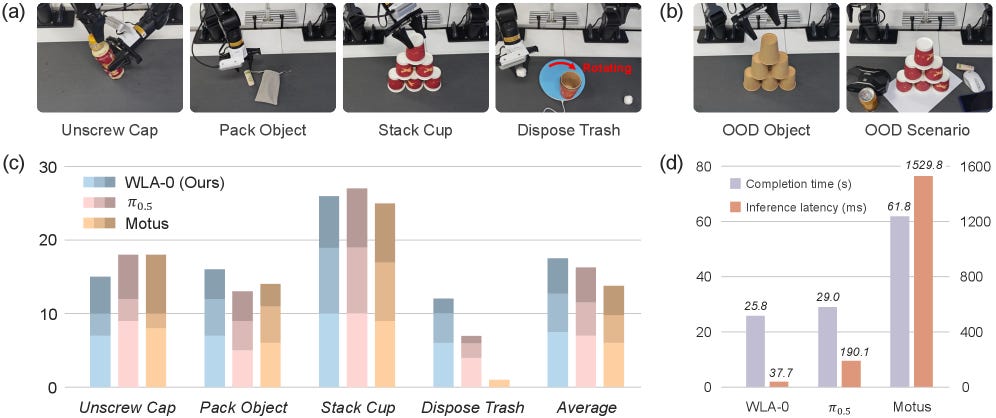
WLA is a single autoregressive Transformer with separate World and Action experts predicting subtasks, subgoal images, and actions together. The 2B prototype reports 92.9% on RoboTwin2.0 Clean and 56.5% on RMBench at 40 ms latency on consumer hardware. No code or weights yet, so read it for the architecture rather than a download.
A position paper from a Stanford/ETH/IIT/TU Darmstadt/UCL group argues the bottleneck is not policy scale but the missing machinery to turn unstructured behavior (human motion, internet video, sim rollouts) into grounded robot supervision. It lays out four interfaces — autolabelling, human-to-robot retargeting, physics-grounded world models, and reward inference from video — as the open agenda. A useful frame to read GRAIL and VLA-JEPA against.
This year’s ICRA Best Paper in robot learning shows that fixed-environment benchmarks let policies exploit background cues correlated with camera pose, masking viewpoint-generalization failures. Conditioning explicitly on camera pose through per-pixel Plücker ray embeddings fixes it, with gains on ACT, Diffusion Policy, and SmolVLA in sim and real. Code is out.
ACE Robotics and CUHK open-sourced Kairos-HomeWorld, a framework that builds simulation-ready, fully furnished homes from a text prompt, plus a dataset of 300K floorplans, 5K furnished homes, and 50K physics-enabled interactive assets. Worth a look if you need interactive household environments for long-horizon tasks; check the license before you build on it.
Aaron Prather’s essay argues that dexterity demos can’t be compared because labs don’t share definitions of grasp or success, test conditions, or data formats, and tactile sensing has no common format at all. No new method, but a clean statement of why the field’s manipulation results don’t stack up, and what the NSF-backed COMPARE effort is doing about it.
One more worth a look: Coarse-to-Control does VLA planning in action-token space — predict a coarse trajectory sketch, then decode executable tokens from the same vocabulary (97.9% LIBERO, with the gains concentrated on long-horizon tasks).
Qianxun Intelligence’s Spirit v1.6 scored 1,924 on RoboArena, ahead of NVIDIA’s Cosmos3-Nano-Policy at 1,881 — the first time a Chinese model leads a benchmark NVIDIA co-built with Stanford and Berkeley, and it happened a day after Cosmos 3’s launch. The reported edge came from the real-world data pipeline rather than more compute, which is the part worth watching as the leaderboard churns.
ICRA 2026 wrapped on June 5. Expect code and project pages from the award papers and Best Manipulation finalists — Dexora (open bimanual dexterity VLA) and GEAR-VLA (geometry-aware cross-embodiment) both have artifacts promised but not yet posted.
CVPR ran through June 7, so more Physical AI dataset and tooling posts are likely to trail in.
See you next week.
Comments
Nothing yet. Say the first thing.
Sign in to join the conversation.