
BitRobot, Unitree, and Hugging Face put HIW-500 on the Hub this week: more than 500 hours of Unitree G1 teleoperation recorded in actual homes across Southeast Asia, over 23,000 episodes with subtask and language annotations. Open humanoid data at this scale, collected outside the lab, has been rare, and LeRobot has added G1 support so it lands within reach of anyone with the robot.
HIW-500, from BitRobot Network with Unitree and Hugging Face, is 500+ hours of human teleoperation on a Unitree G1 collected across real homes in Southeast Asia. The card lists more than 23,000 episodes annotated with 161 subtask labels, 148,000+ subtask annotations, and language instructions, which makes it usable for imitation and VLA training and for long-horizon household tasks rather than single skills. What sets it apart is the setting: most open humanoid data is lab-staged or simulated, and real-home teleoperation at this volume is hard to come by. The LeRobot team has re-encoded the set into LeRobot format, cutting it from roughly 10TB to about 2TB for streaming, and added Unitree G1 support, though the card still lists that format as coming soon, so for now the data comes as raw ROS bag / MCAP and the license isn’t stated. It’s pitched as the largest open humanoid teleop dataset to date; even setting that claim aside, it’s one of the more useful artifacts to land this week.
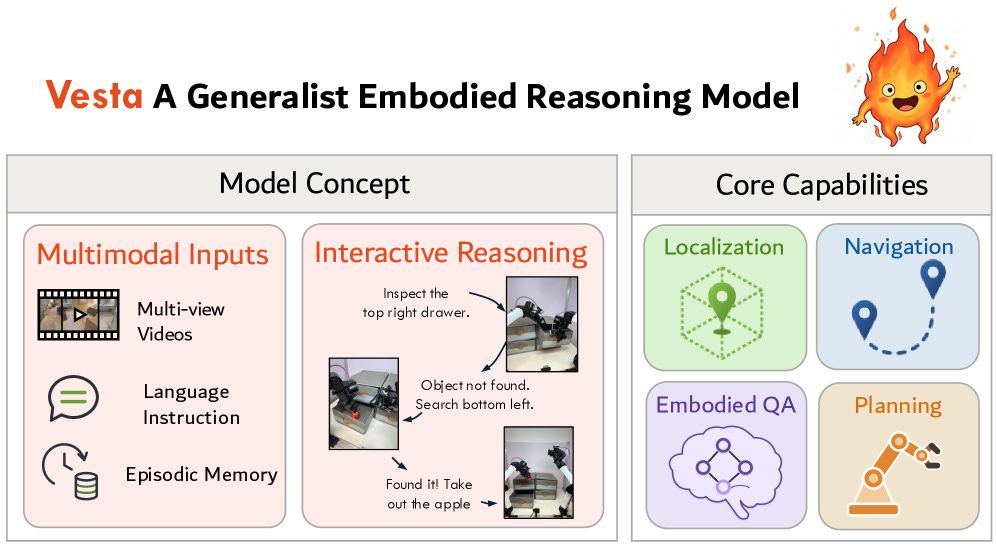
NVIDIA GEAR’s Vesta folds localization, spatial reasoning, navigation, and long-horizon planning into a single model with a multimodal memory harness, instead of the usual multi-model stack where errors cascade between components. It reports beating individual specialist baselines by more than 20% and improving real-world task success by over 35%, though the numbers are single-setup and there’s no code or weights out yet, so read it for the architectural bet.
HumanScale runs a controlled comparison of egocentric human video against teleoperated robot data as a pretraining source, with post-training and validation held fixed. Given the same amount of pretraining data, the human-video models reach 24% lower validation loss on real-robot action prediction and markedly higher real-task success, which supports pretraining on human video and then adapting with a small amount of labeled robot data. It still uses robot data, just much less of it.
CAIP (a Berkeley and NVIDIA group including Fan, Zhu, Malik, and Darrell) goes after the same data scarcity from a different angle. Control policies need vision paired with actions, which robot trajectories provide but cannot supply at pretraining scale, so CAIP treats 3D hand poses extracted from egocentric video as a stand-in for end-effector actions and learns an action-image representation from 32,000 hours of human video plus only 88 hours of robot data, beating encoders like DINOv2 and R3M. Read next to HumanScale, the two reach the same place by different routes: human video as the scalable substrate, with robot data kept small.
Two papers attack hand-data collection from opposite directions. A Berkeley group’s Do as I Do reconstructs hand-object interaction from ordinary monocular RGB human video and retargets it onto multi-fingered robot hands. Wh0 instead generates the data, using video world models to synthesize a 50,000-episode egocentric hand dataset, and reports lifting zero-shot success on 18 unseen real tasks from 8.3% to 38.9%.
AutoDex is a fully automated setup that generates, physically executes, and labels dexterous grasps with no human in the loop, using a 20-camera rig to handle occlusion. It collected 3,593 trials across two hands and 100 objects at about 4.8x teleoperation throughput, and policies trained on it hit 76% real-world success against 34% for sim-only data, since the rig certifies which grasps actually held.
OpenHLM maps language and pixels directly to all of a humanoid’s degrees of freedom rather than splitting upper and lower body into separate controllers, and the value is in the ablations. It finds joint-based teleoperation beats other interfaces, wheeled-platform pretraining transfers to legged humanoids, and the resulting policy reportedly beats GR00T N1.6 and Ψ₀ with under half the demonstration time.
This benchmark introduces Act2Answer, which turns VLM knowledge tests into VLA evaluations by having the policy answer through object placement instead of language, so you measure retained knowledge without confounding it with control quality. Across 7 VLAs and 9 VLM baselines, the models keep simple concepts but lose richer semantics relative to their source VLMs, VQA co-training helps, and the answer signal lives in the middle layers. Benchmark and code are out.
Tactile Genesis (CMU) is a GPU-parallel tactile simulator running 3 to 20x faster than prior work, which lets one team run the same learning experiment across many sensor types instead of treating each new sensor as a new robot. The design findings are the payoff: proprioception alone fails, where you place the sensor matters more than which sensor it is, whole-hand sensing beats fingertips, and roughly 200 taxels is enough.
Fewer Layers Than You Think — finds π0 and GR00T-N1.5 carry redundant layers a training-free pass can prune, cutting model depth up to 50% with no quality loss and 40-50% less training time.
ImageWAM — models only a target-frame transformation through image editing instead of generating full video, cutting FLOPs to about a sixth and latency to a quarter while staying competitive.
A world-action-models survey (SJTU/NUS) — organizes the recent world-action-model work and the design choices that separate the approaches, useful as an orientation to the area.
Scene semantics, not pixels (AWS) — a methods post arguing robot world models should be built from 3D scene structure extracted by off-the-shelf models, not trained end-to-end on raw pixels.
WVM — builds the value model that scores how promising a robot’s state is on a world model rather than a VLM, since judging a state means predicting what happens next, and ships a benchmark of low-quality trajectories to test such models.
General Intuition is reportedly raising around $300M to build a spatial-temporal foundation model trained on roughly 2 billion gameplay videos a year from Medal. The dollar figure is the headline, but the bet worth noting is gameplay footage as a world-model training corpus.
The data-engine papers above (Wh0, AutoDex, Do as I Do) lead with project pages but not full code or datasets yet. Worth checking back if you want to actually pull them.
CoRL 2026 decisions and RSS 2026 (Sydney, July 13–17) project pages should start landing over the next few weeks.
Comments
Nothing yet. Say the first thing.
Sign in to join the conversation.