
I can usually tell in one question whether a student has a real shot at the Ivy League.
Not because I am psychic. Though honestly, at this point, after enough application cycles and supplemental essays, I am close!
My question is not about their GPA, ACT score, AP count, research internship, nonprofit, robotics award, hospital volunteering, or whether they spent three weeks at a “selective” summer program. It is:
Book A Complimentary Strategy Session
Not for AP Lang. Not because you had to write a discussion post by midnight. Not because your mom bought you Atomic Habits after you got a B+ in precalc and everyone started acting like the house was on fire.
A real book. Chosen by you. Finished by you. Read because something in you wanted to know more.
That question tells me almost everything.
Columbia has one of the most revealing supplemental questions in the Ivy League. List all the books, texts, publications, and other resources you’ve read outside of school.
Columbia says the point is to see a student’s intellectual curiosity, habits of mind, love of learning, and sense of self.
Translation: show us what you care about when no adult is forcing you.
It’s basically a lie detector.
If your Columbia reading list is just The Great Gatsby, 1984, Macbeth, and To Kill a Mockingbird, what you are really saying is:
I have not voluntarily opened a book since the Obama administration.
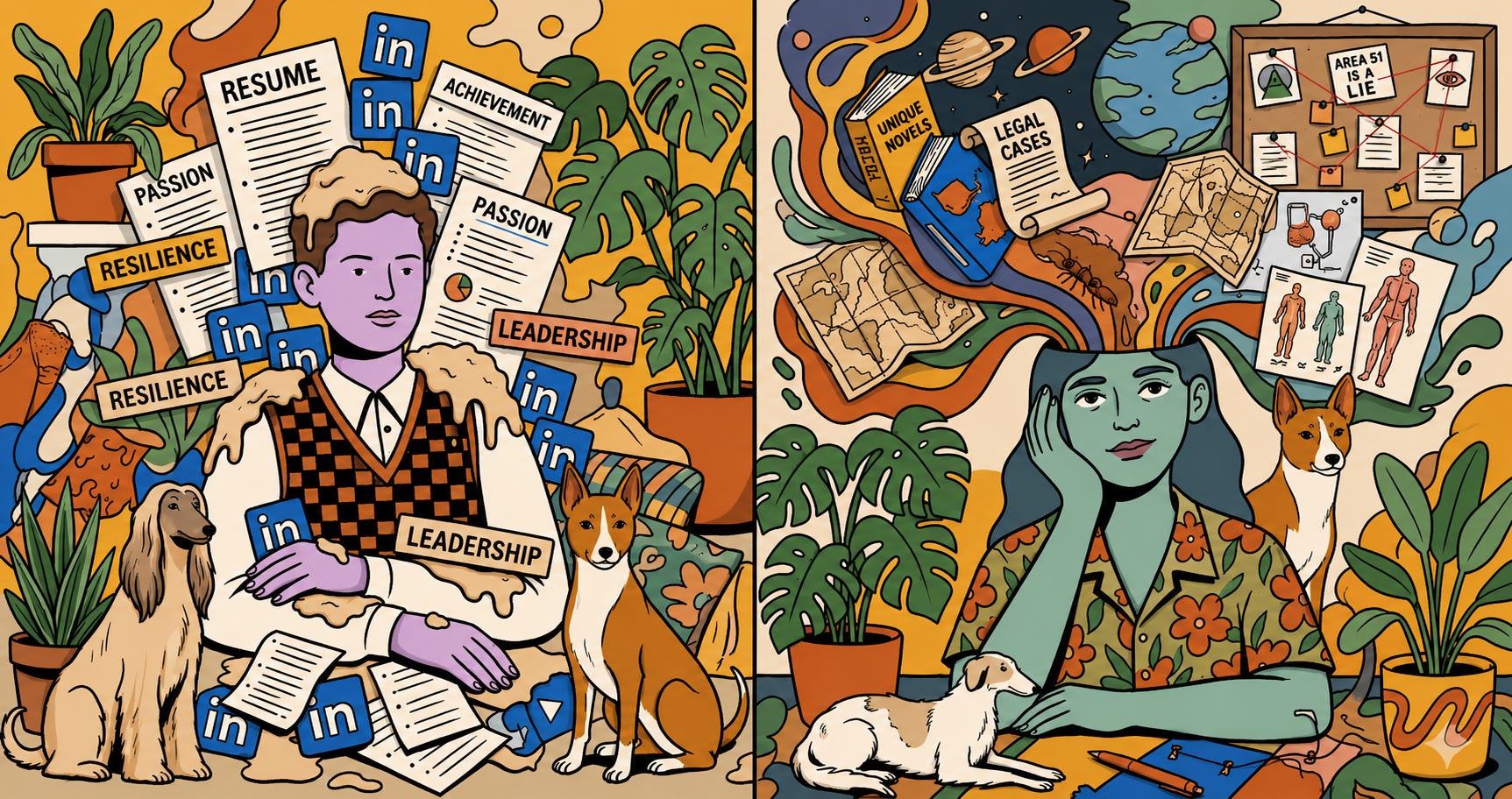
A student can have the grades, scores, APs, robotics trophy, hospital hours, violin, and the whole little admissions charcuterie board. But if they cannot name anything they read because they were curious, the application is hollow.
It’s also a skills test. Professors at selective schools are already saying students are struggling to finish full books
Some UC Berkeley humanities professors have cut reading assignments because students cannot get through the texts. The Atlantic has covered the broader “kids can’t read” crisis.
When everyone else is getting weaker at sustained reading, a student who can digest a dense book stands out.

Take this scenario: The student is bright. The transcript is strong. The parent is convinced we are dealing with a future Supreme Court justice, neurosurgeon, or benevolent tech founder who will definitely use AI ethically.
Then I ask what they read.
Silence.
Maybe they say they “read articles.”
Articles where, babe? The Economist? Scientific American? The Free Press? Vogue? A Substack by a working physicist?
Or do you mean you watched a TikTok slideshow about “dark psychology facts” while eating Takis in bed? (Yum!)
If the answer is the latter, your essays are flatter. Your insights are shallower. Your sentences all move at the same speed. You write things like “this experience taught me the importance of perseverance” because you have no internal library of better language, structure, or thought.
Reading gives a student rhythm and taste in their own writing. And I’ll say it again: writing gets you into a top college, not just a resume.
We assume reading is for future English majors, emotionally complicated girls, and folks who own tote bags from independent bookstores.
But Caltech doesn’t want code monkeys. MIT isn’t looking for a data-entry clerk.
A future engineer who reads about infrastructure, climate, design failure, ethics, materials, aerospace history, city planning, or the politics of technology gets in.
A future doctor who reads memoirs by patients, books on art therapy, essays about disability, histories of vaccines, or narrative medicine gets in.
A future business major who reads about behavioral economics, fraud, labor, luxury, markets, scarcity, branding, and power gets in.
The kids with the most interesting ideas about their intended majors are almost always the ones who have read widely.
Often, the absence of reading comes to a head when you get your SAT score. Although there are great ways to prep for test day (we have an amazing tutor!), consistent reading is the best way to improve your stats effortlessly.
You cannot hack passage four of the SAT or ACT if your brain has never finished more than an excerpt for your last AP World DBQ.
Consistent readers build vocabulary without flashcards. They recognize sentence structure faster. They follow arguments with less panic. Most of all, they do not collapse when a passage uses 19th-century syntax.
The research backs this up: reading for pleasure is linked to academic progress in vocabulary and even math, and longitudinal studies show it compounds over time.

So yes, I will help you build a college list, write the essays, choose a major, and be brave in all the ways that go beyond an application.
But I am also going to ask the most brutal question in admissions:
And if the answer is “I don’t know,” we are fixing that.
Because reading is not just for an English major. Reading = better testing, better essays, better interviews, better thinking, and better results.
If you or your student has gone years without finishing one, do not panic. That is literally what I do.
I help students make up the gap. I get them reading. I get them thinking. I get them writing like actual humans with actual minds. That’s what gets them in.
No posts
Comments
Nothing yet. Say the first thing.
Sign in to join the conversation.