
An essay response to “Why *are* some people turning to paganism?” by Fortissax— summarized below, but we encourage you to check it out!
Enjoy!
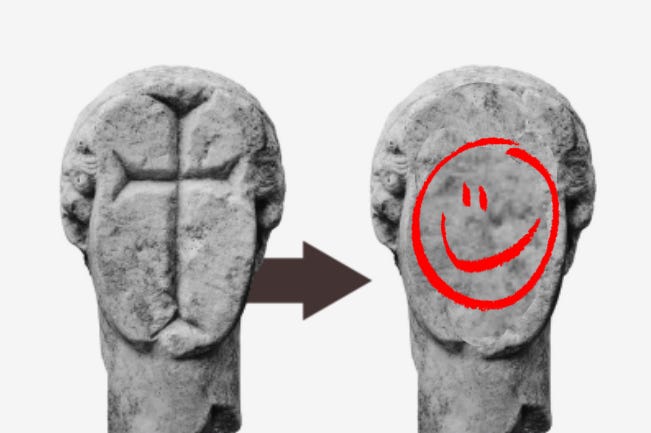
Pagan to Christian dialogue is one of the most enduring and frustrating traditions of right wing internet discourse, a perennial wellspring of engagement baiting and spoiled relationships which has recently burst forth anew. This is why I was pleased to read a recent essay by Fortissax, in which he tried to start a productive dialogue with Christians by putting forward a well intentioned explanation of why individuals (including himself) would choose paganism over Christianity, those core reasons being:
The break in the “living tradition” of Christianity for those raised in secular households, which makes reconnection nigh impossible for some
The alienness of Christianity’s mode of communication to us moderns, in contrast to the pre-Christian epics which we are primed to comprehend via a lifetime’s training on Tolkien, Star Wars, and other pop culture
Mainstream Christian leadership’s incorporation of modern liberal pablum
Alienation from the demographic shift within Christianity, as centuries of missionary work have made much of the non-white world Christian
He goes on to describe the way paganism answers these challenges by “offer[ing] meaning that is immediate, embodied, and accessible” and which can be “experienced rather than argued”, based around sagas, implicit racial bonds, and rituals that are easy for us moderns to grasp.
Fair enough.
My issue with this article, which is perfectly reflective of paganism more broadly, is that it defines itself primarily in opposition to the most fallen forms of Christianity. 82% of the article is a list of the failings of mainstream Christianity without addressing any of the traditional Christian communities which are experiencing a resurgence in recent years, the exact audience most likely to read this content and who could actually engage in a good faith conversation. I enjoyed the excellent Paganism Rising roundtable hosted by Astral as a chaser to this essay, which had a similar tidal pull towards Christian grievances.
I left with a vague understanding that pagans are very into patriarchy, ethnos, and believing there are larval spirits in their pantry — but I’m unclear what they think about abortion, divorce, and charity in a concrete way.
This issue is endemic to paganism as both a reconstructed and decentralized form of spirituality, but it jumped out at me from Fortissax’s essay in two places. First:
“… the internet has played a role in this revival. It has allowed fragmented individuals to access forgotten texts, comparative mythologies, and local folk traditions. People can explore Norse sagas, Druidic rituals, Greco-Roman cosmologies, Baltic animism, and Slavic seasonal rites from their bedrooms. They can join online communities that share reconstructed festivals, devotional poetry, and handmade altars. What begins as curiosity can become practice.”
And elsewhere in the same essay:
“There is no need for a dramatic conversion or a break from the past. There is only the need to remember, to reconnect, and to realign. This makes it especially appealing to those who feel that the sacred has not been rejected, but forgotten.”
These blurry doctrinal edges stand in sharp contrast to the crystal clear cornerstones of the Christian Nicene Creed and the Islamic Shahada, and in the view of the pagan this flexibility is to their benefit, and is a sign of the organic nature of their spirituality; however, it is a foundation of sand, the single point of failure upon which the entire enterprise of paganism collapses for both an obvious and non-obvious reason.
Firstly, the most obvious issue which was very well elucidated by Alex and Phisto at my second shot chaser destination, the Black Ibis Social Club (this spiritual journey is quickly becoming a bit of a bender), is that this flexibility to pick and choose sacred texts and traditions from an anthropological buffet attracts adherents who come seeking the exact religion that most closely fits their preexisting political bias. In the right wing context this is for patriarchy and ethno cults, but using the same source material we see neopagans just as rapidly turning into rootless tree worship and reeking carnie orgies.
And with no *actual* internal hierarchy, the religions of paganism are each a splinter the size of a man’s momentary mood, to the point that many recognized pagans do not actually even believe in Thor as a literal entity that controls thunder, but instead merely as a symbol. Many do insist on the literalness of deities, but the point stands that every pagan is discovering their own faith within a loose framework of archeological guesswork.
Religion as a reconstruction effort requires the “shopping cart” mentality, precisely as I described it in “I Have No Life, and I Must LARP”
“those who seek the most serviceable religion for themselves are actually reducing bloodlines of human experience into just another consumer behavior — a brand choice between Pepsi and Coke, Greek Orthodox or Low-Fat Confucianism…
to define a religion as serviceable is to define religion as a tool, an ends, a mechanism to use or dispose of as serves, which is to view the religion as alien to oneself.”
The attraction is not a unifying truth, but temporary utility. This makes paganism not only decentralized but fragile as a social network.
And without an inescapable creed, barriers to entry, and arbiters punishing heresy, paganism has no core to hold itself against the inherent social entropy of civilization.
Paganism has a sort of horseshoe theory of utility — as a loose set of practices it was historically a powerful and flexible social glue for geographically bounded tribal populations. But in the imperial cities of the world it quickly yielded, time after time, to organized cults and state religions such as Christianity and Islam. Pagans do themselves a disservice to not directly address the ‘why’ of this historical fact.
Yet now in the digital age, nomads of the online world again find value in paganism, bonding over their loosely related practices, held together not by rivers, the speed of a horse, or an exceptionally strong bloodline connection, but instead by how close their spiritual shopping carts match.

The second and less obvious crisis caused by this lack of a coherent central creed is that any legitimate claim on authority over pagan faith can be endlessly disputed — meaning no-one can easily argue for themselves to be the legitimate leader of the faith. In fact, the belief in local gods and spirits encourages an endless drive towards the local and personal.
This actually brings to mind my earlier criticism of constant pagan need to denigrate Christianity, and that it may not even be an intentional move on the part of most pagans, but simply that one of the few things binding them is that they are ‘not Christian’.
As a result of this lack of central leadership, there is no person for outside forces to treat with, power to power, which for the people in these supposedly dissident circles (who often claim to be well read on elite theory), appears to be a pretty major oversight. The president, emperor, pope, or lama will either be left “on read” or need to be content debating politics with someone who has no control over their own political tribe.
This make paganism purely apolitical in a very bizarre way, and in a Schmittian sense means the exception will always be decided by someone outside of their group. This unforced error is in my view the surrendering of a social technology (organized religion).
Which brings me — now that you have indulged me thus far and I stumble home after tying on perhaps one too many arguments during my pagan skepticism binge — to my ultimate conclusion. Hopefully I've laid out why paganism is structurally incapable of fulfilling the role of a religion in a modern civilizational context, but that is an abstract concern and I really do try and always also think through how these conclusions should change our daily lives in an actionable way. If you take a single thing away from me, let it be this:
There can be no productive interfaith dialogue with pagans.
Interfaith dialogue is always a tenuous thing, but as I’ve hopefully explained clearly enough, it is a complete dead-end when dealing with a decentralized and creedless spirituality. There is no-one to align to, no binding text to align against, and no-one of significance to align with, and those seeking your attention by offering discussion (often in with good intentions) lack any ability to offer terms of exchange or exert influence over any significant portion of their coreligionists.
Perhaps someday there will be a common pagan creed and a leader capable of driving it into a new structure, but then it would be a fundamentally different religion. But in the meantime I can only encourage people not to waste their time engaging with pagans — not out of any malice or lack of respect for their intelligence (many are brilliant and sincere people), but simply because in a political sense you may as well be talking to the birds.

Interested in supporting? Tooky’s Mag is now accepting paid subscriptions!
We’ve also released a novella ‘Improvidence’, a Lewis & Clark style adventure across the post-collapse ruins of America following a new spiritual awakening: https://a.co/d/3AGjHU2
No posts
Comments
Nothing yet. Say the first thing.
Sign in to join the conversation.