
Video killed the blogger star and I’m here to seethe about it! This is partly a response to Substack’s recent move to make their videos available on Substack TV, but also a larger view at what made this platform (and many others) so dysfunctional the last 2 years.
Enjoy!

Substack increasingly feels like the world’s shittiest lottery, a temporal sink trap where 75% of links take you to a half page of nearly bullet formatted nontent blog text, interrupted by a popup complaining you haven’t paid yet. Uncoincidentally, as the popularity of this format has risen, the term “slop” has become so ubiquitously (and obnoxiously) applied that it has given spawned a flood of “slop slop”, the repetitive and unproductive complaints about the low standards of independently produced media.
And now the inevitable had evitabled once more. The clock has turned. The turd landed, center-of-mass, into the punchbowl. Substack has spread its tendrils to puppet yet another crude imitation of a more successful website.
Today’s target: YouTube.
The problems are many and best delivered shrilly. But as an earnest and fairly consistent user since 2021, I’ve already seen the unveiling of Substack’s lazy Twitter/X clone, dubbed ‘Notes’, which while not revolutionarily bad, did cause retaliatory link banning on Elon’s site, which cut off one of my (and many other writer’s) primary avenues of growth.
In hindsight, I have to admit that Elon was right! Elon had just spent $44 billion to acquire the world’s premier short-form messaging platform, and within a year some little squirt site that received a huge portion of its audience from his property copy-pasted his code and expected… free advertising? For those not around at the time, it was hitherto a common refrain that “Twitter/X is for short-form, Substack is for longform”, two media platforms synergized in a way that enormously helped longform creators in particular to reach the more generalized "tweet” audience.
Already the Substack brand was diluting — the incentive structure pushing longform writers to compensate for the lack of Twitter/X by posting more frequently (Substack’s own newsletter’s recurring solution to everything is for you to make more content for them).
The second and more egregious turn was the implementation of video and podcast hosting in 2023. Much bemoaned at the time, it did again dilute the brand from ‘written word first’, into a more everything-app flavor — the term “everything app” must have been scrawled on every men’s room in San Francisco, because it’s all those nerds could talk about in in the early 2020s. But unlike Elon’s two-pump chump attempt at everything apping Twitter/X, Substack’s stuck.
It isn’t even the quality of the content — although it’s strictly inferior and lower effort than any equivalent you can find on YouTube). Every Substack first podcasts I follow has totally anemic engagement compared even to my very lo-fi podcast. Substack podcast engagement seems almost entirely reliant on previous success from other websites).
The problem is the app sucks. The audio loses your place and the website itself is constantly closing you out. As a basic piece of software that does the same thing as dozens of other free and proprietary audio/video players, it just doesn’t function.
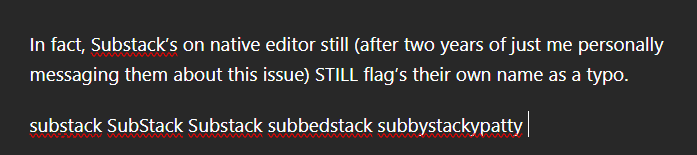
In fact, Substack’s on native editor still (after three years of just me personally messaging the dev team about this issue) STILL flag’s their own name as a typo. It’s an insane indicator of just how little actual care is going into the platform’s utility.
And prowling notes will reveal significant daily bugs and issues being reported over basic functionality. I unintentionally came across this trying to pull up the Substack TV article for reference:
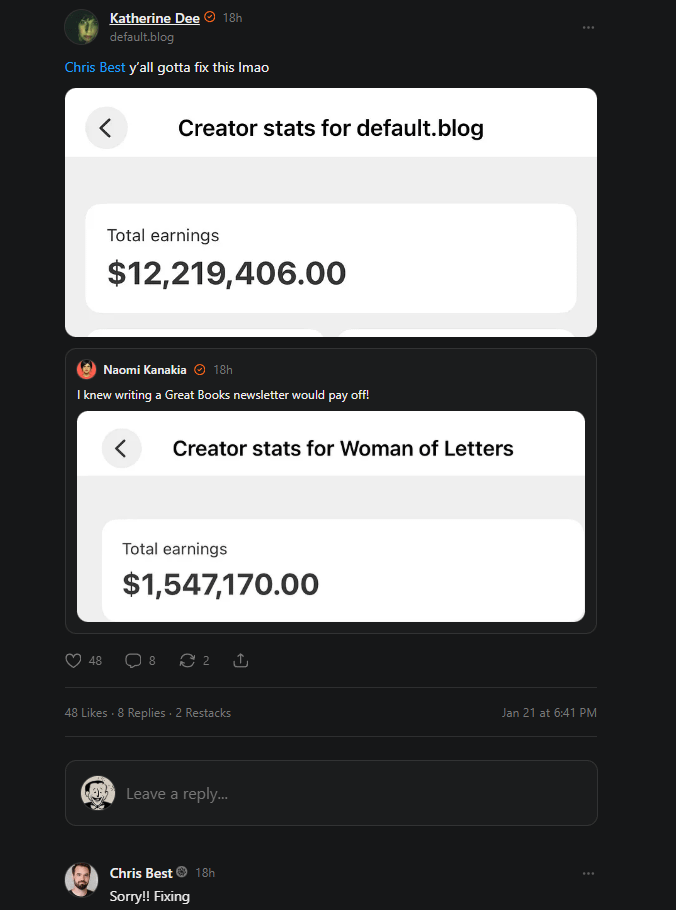
It’s just so squalid and half baked.
But why does the variety in content matter? Why does Substack spiraling into three media formats (post, note, and video/pure audio) across three unrelated sub-platforms (email, notes via phone, and Substack TV)?
Put most simply, they’re entering fields that already have massive network effects. And by interlocking those fields together within their own platform, they radically increased the “noise” relative to signal on any one of those platforms which any creator competes against.
It doesn’t help that Substack itself seems obsessed with growing by getting “fallen” celebrities like Jim Acosta to make the leap to Substack and bring an audience with them.
To be fair, this worked well enough during peak woke and the COVID-era as people with interesting (and much sought out) things to say were constantly getting banned for contributing to the public square; but post vibe-shift in the year 2026, picking up MSM flunkies for exclusive video shows reeks of intentionally forming of a Loser’s League to sap everyone’s existing user base.
And there’s been a quiet brain drain from Substack to the major platforms, most notably Elon’s Twitter/X again, but also YouTube which has severely reduced censorship. For anyone already holding a large audience on other platforms like YouTube or Twitter, there really is no benefit to limiting themselves to Substack. Instead, Substack is increasingly becoming the “why not throw it up there too” app.
And of course this estate sale approach to growth leaves the small contributors in the lurch. We don’t have massive audiences to transfer, and we also don’t necessarily sell the services this scattershot gathered audience is looking to buy. There’s simply no demographic alignment, no intent.
And this minor leaguing and readership demographic death spiral is further poisoned by the lack of organic growth. Due to brand dilution and scattershot talent acquisition, there simply isn’t a singular draw for the proverbial man-on-the-street to join or log in to Substack as there was prior to 2025 .
And so, I sadly foresee that Substack TV will go much the way of Odysee and Rumble (low traffic repositories), only lacking the meager justification of conservative censorship — or really any core principle! It’s just yet another app to hear people struggling to be heard. Worse actually, as Substack lacks Youtube’s robust algorithm to recommend and boost high engagement medium to longform content. An engaging 30-120 minute podcast will legitimately just die within your 80 subscribers.
For my part, I have every intention of continuing to post here for now, as I still have a great deal I want to write, but I certainly don’t have any romantic ideals on the matter or loyalty to the platform besides its low-low price of free.
It’s just sad to see an organization sell out its potential for pennies on the dollar.
It’s my core belief that low quality products (slop) and the constant bitching about it (slop slop) and paywalls are the result of this exact everything appification that Substack TV represents. Given the Substack crown would have loved if the following has happened:
Keep the focus on longform text but DO ADD audio. Then improve, improve, improve the functions of those two things with the app become more of a Spotify/blogging hybrid. People love having articles read to them, lean into that, new music, and podcasts.
Aim to compete with Spotify for the indie music, audiobooks (you already have the authors here), and podcast spheres. These all integrate very well with the reader audience already inclined toward the base product.
Monetize in the Spotify model: upgrading to paid gives a user X free audio (and digital?) books per month, X free paid articles a month or podcasts, X free monthly pledges to their favorite writers, X albums. This would dissolve an enormous collaboration hurdle that currently encourages each content creator to slave away to make superfans whose time they all consume, rather than broad ranges of mutual fandoms
Rough napkin thoughts, but I deeply appreciate your time and own feedback on the situation!

Interested in supporting? Tooky’s Mag is now accepting paid subscriptions!
We’ve also released a novella ‘Improvidence’, a Lewis & Clark style adventure across the post-collapse ruins of America: https://a.co/d/3AGjHU2
No posts
Comments
Nothing yet. Say the first thing.
Sign in to join the conversation.