
“Everyone says marriage should be 50/50. It’s the biggest crap of bullsh*t I’ve ever heard,” celebrity academic Brené Brown told Tim Ferris, bestselling author of The 4-Hour Workweek, in a 2020 clip that has since been shared over four million times on TikTok. “It’s never 50/50. Ever.”
Brown’s viral commentary, which received a second life thanks to a trending 50/50 debate on social media, suggests that reciprocity, not a 50/50 split of daily duties, is a more practical pathway to equitable partnership.
“What we do is we quantify where we are,” said Brown, describing her own marriage. “So if Steve comes home and he’ll be like I got 20 in terms of [...] energy, investment, kindness, patience. I’ll be like, I’ll cover you. Like I’ll pull the 80.”
At first glance, Brown’s suggestion that the partner with more time, energy and resources to give should take on the lion’s share of the relationship responsibilities makes sense.
In reality, it’s the kind of advice that leaves American women with twice as much childcare and household labor as their male peers.
The language of give and take conveniently overlooks how far short of 50/50 nearly all heterosexual relationships still stand, and how consistently men’s contributions are overestimated.
While 81 percent of US men living with their partners are confident that they are already doing their fair share for the household, a 2025 paper by economists Kyle Hancock, Jeanne Lafortune and Corinne Low reveals just how little men’s household contributions shift in heterosexual partnership, even when they have the capacity to step in to ease their partner’s load.
Men’s earnings also appear to have little bearing on how much they contribute to domestic work. Men who earn half as much as their wives, for instance, do about as little housework as men who earn twice as much.
In US households where husbands and wives earn around the same amount of money, a Pew analysis finds that husbands still get around three and half extra hours of leisure each week. While their wives carry an additional four and half hours of combined caregiving and household labor.
Male pundits and manosphere podcast bros like Brian Atlas, who recently argued that it’s reasonable to expect a woman he’s dating to do his laundry the first time she comes over to his place, often make the case that having a job entitles men to more freedom from domestic labor. But the vast majority of Americans, 77% according to a 2023 Pew Research Center survey, report that they favor more egalitarian households.
Like Brown, however, many believe that even if splitting the physical, emotional and financial labor of relationships 50/50 is admirable, it remains impractical.
When one partner makes half as much as the other, or works more hours for less pay, or loses their job, it may seem sensible to redistribute the load at home accordingly. In this context, Brown’s assertion that it’s never 50/50 speaks to the futility of aiming for a completely even distribution of domestic and financial responsibility.
Such advice, however, also obscures how consistently relationship inequality falls along gendered lines. As creator @la_britney put it in a viral TikTok video, “You mean to tell me I still gotta go to work, make money, pay 50% of the bills, then gotta come home, cook dinner, take care of the kids, pick them up, drop them off at school, wash/fold clothes, grocery shop [....] 50/50? B*tch. This is more like 80/20. 90/10.”
This frank observation that too often, women are left giving more than they get, may not be the kind of inspirational insight that gets shared on podcasts like Tim Ferris’, which obsess over self-optimization strategies like biohacking, but it does align more closely with the reality reflected by the data.
Numerous studies have shown that women are still left carrying a higher load at home even when they earn more, have less flexibility at work, or already have less free time. Subjecting women to a state of chronic overwork also undermines their professional ambitions, economic autonomy, personal leisure, relationship satisfaction and wellbeing.
Claims that we all must make sacrifices on behalf of our relationships with the people we love seem inarguable, but it’s clear that this sacrifice is one most often made by women.
By ignoring the scale of this inequality, well-intentioned platitudes like relationships take work and compromise wind up reinforcing rather than liberating us from it.
A woman who hasn’t used the bathroom by herself in three and half years, while her husband spends 45 minutes on the toilet scrolling through his phone is conditioned to be “grateful” that at least he takes out the trash.
In fact, studies show that even couples who favor egalitarian relationship ideals are often making so-called compromises that still overwhelmingly benefit male partners.
“Couples insisted they were successfully practicing mutuality without accurately tracking whose interests were served and whose labor promoted those interests,” wrote sociologists Jaclyn Wong and Allison Daminger in their 2024 paper documenting how heterosexual couples who aspired to have marriages of equals still fell into gender unequal patterns at women’s expense.
“Emphasizing “us” looked more like emphasizing “him’,” they concluded.
Men and women alike have been taught to deny these uneven trade offs by citing each partner’s “natural” abilities (“she’s just more type A”, “he just struggles to multi-task”, “it’s just how we’re wired”) or appealing to gender-neutral ideals like maximizing household efficiency (“she just has more flexibility”, “he just makes more money”, “it’s just what makes sense.”)
And yet, in case after case, Daminger’s research shows how often supposedly gender neutral justifications aren’t gender neutral at all.
Women nearly always do the majority of housework, no matter how demanding their own work commitments, or how much less aptitude they have for the tasks at hand.
Justifications rooted in each partner’s supposedly natural abilities, or even in ideas about what works best for a particular partnership, can distract couples from recognizing that such trade-offs are not one-off or temporary instances of inequity in a relationship. They are part of a persistent pattern, where what men want and the support they need to do it is overwhelmingly prioritized at women’s expense, from household labor to work-life balance to relocation decisions to career optimization.
Even in the rare cases that men remain as committed to egalitarian ideals as their partners, the interpersonal, institutional and cultural environments in which our relationships exist still incentivize men to do less.
Consider employers who offer paid paternity leave, but penalize men for using it.
Or the widespread expectation that women should be responsible for childcare and eldercare obligations that require the flexibility to accommodate last-minute doctor’s appointments, sick days and school pick up and drop offs, and subject them to ‘mom guilt’ when they don’t.
Or governments that refuse to prioritize paid leave, affordable childcare and supportive family policies that, paired with the gender pay gap and motherhood penalty, enable men’s long-term professional success at the expense of women’s.
As the data make clear, egalitarian ideals alone are not sufficient in counteracting the widespread gender discrimination women face in and out of the home.
Recent research out of the UK, however, suggests that when both men and women work together to prioritize and uphold women’s ambitions, it offers a better approximation of equal partnership.
In couples where “arrangements were more egalitarian, it was apparent that both members of these couples valued and understood one another’s work role. In particular [...] her partner appreciated and understood the importance of her work, and this was considered in daily decisions,” they concluded, noting how this appreciation and respect translated into more equitable decision making in the home.
It may be true that aiming for a 50/50 split in relationships is a flawed goal. But if we want something different, we need to aim higher, and we need to put women first.
We could start by asking men to take 80% of the work, and be more honest about the facts: that women are already carrying more than enough.
The ideas I’ve written about here are part of my new book, THE AMBITION PENALTY: How Corporate Culture Tells Women to Step Up—and Then Pushes Them Down which is officially out in the world.
The best way to support me (and this work) is to buy the book, share it and review it if you love it.
And if you’re looking to go deeper on the relationship research specifically, make sure to start with Part IV of the book: “Work Beyond the Workplace: The Punishing Double Standards of Singledom, Marriage, and Motherhood”
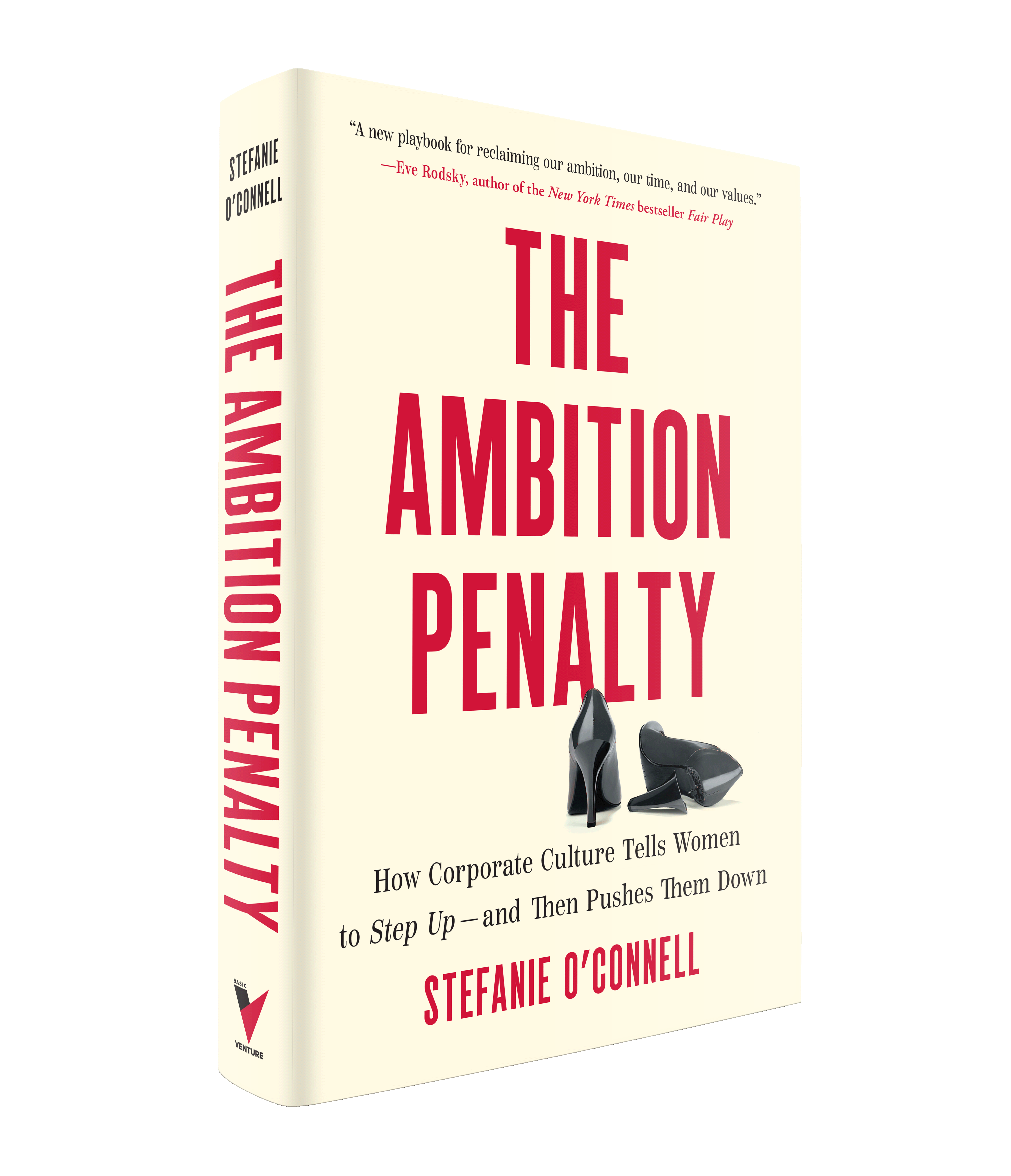
A quick look at what reviewers are saying:
“A seething indictment of the myths we use to prop up gender inequality, not only in the workplace, but in the home as well. Well researched and passionately argued, I am recommending this book to every single one of my friends.”
“Excellent read! I tore through this book in a day. I couldn’t put it down […] This is such a refreshing shift from the girlboss, Lean In, hustle culture feminism that millennial women were raised on.”
“Well researched, brilliantly written. Stefanie makes a compelling case that many of us women probably know anecdotally, yet here she codifies evidence with a call to action. Every man would learn from this book, and every woman should be armed with the data she so expertly elucidates”
If you want to read more, please order the book and consider sharing it with others. And remember to like and share this post too (and subscribe if you haven’t). It’s the best way to support this work and help others find it. Much appreciated!
Comments
Nothing yet. Say the first thing.
Sign in to join the conversation.