
“Rain. Crowd violence. Counterfeit tickets. Overcrowding. People climbing up floodlights. Lasers. Keith Moon’s last gig to a paying audience in England. The final entry in The Guinness Book of Records for loudest concert ever recorded.
This is Charlton 1976, fifty years on.”
A new episode of the Talking About The Who podcast was just published, focusing exclusively on The Who at Charlton on Whit Monday, May 31st 1976, a legendary show for many of the wrong reasons. I am one of several guests recounting their memories of the day (listen to the episode on all good podcast platforms from here); the others are drummer Brett Buddy Ascott, Who designer Richard Evans, and Talking About The Who host Paul Bearman’s own mum and dad, whose attendance that day surely, eventually played its own part in their future son’s own subsequent journey to becoming third or fourth generation Who fan(atic).
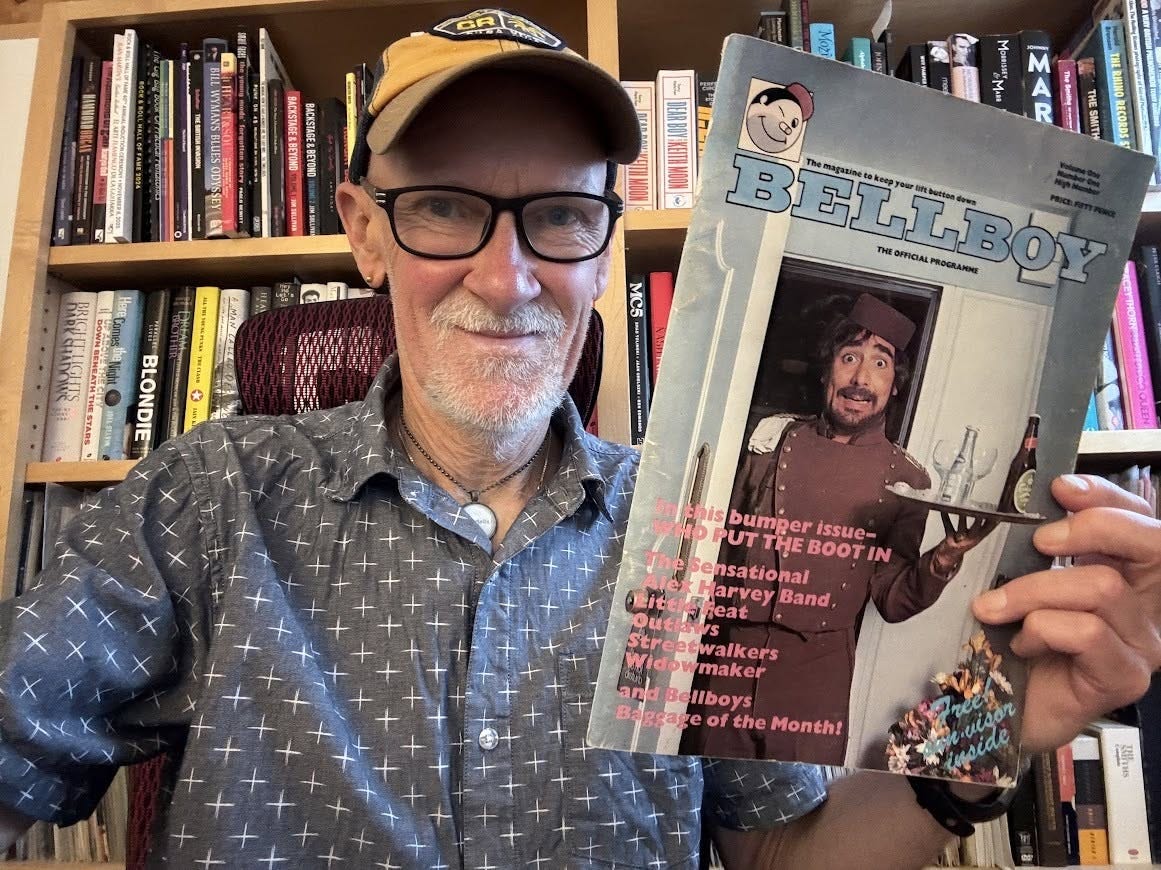
Quite what part that day played in my eventual life path as Keith Moon biographer I can’t tell you, but I can say that I wrote a whole chapter of my first memoir, Boy About Town, about The Who at Charlton. With the Boy About Town sequel POW! When UK Punk Went Pop, 1980-84. A Memoir By Tony Fletcher less than a month away from publication, I thought this would be a good opportunity to share that chapter. Boy About Town is officially no longer in print, but new and used copies do seem to be available via some online stores linked from publisher Penguin Random House webpage here.
I’ve been a guest on Talking About The Who at least a couple of times before, and I will share those links for further Keith Moon podcast-related viewing and listening at the end of this post. In the meantime, enjoy - if that’s the right word for such a horrendously wet and troubled day out - my memories of the days when football grounds were still called football grounds, terraces were still all-standing, and fans, of football teams and rock bands alike, were treated only marginally better than cattle. At least the tour programs back in those days made for proper souvenir reading. And yes, I would do it all over again.
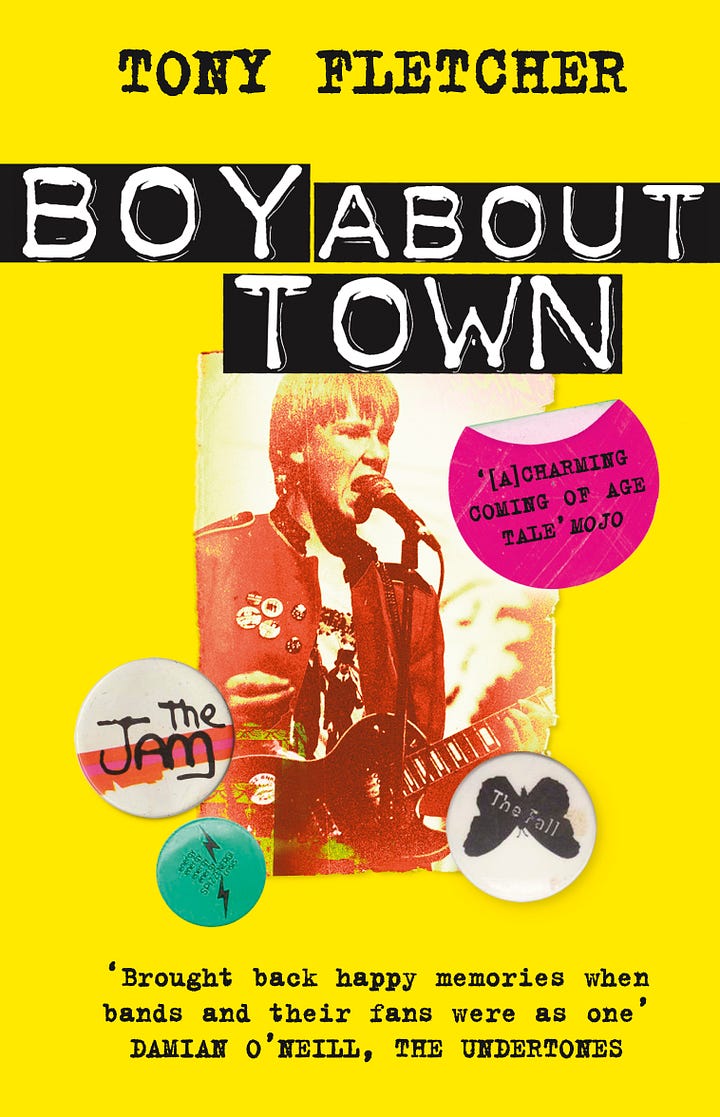
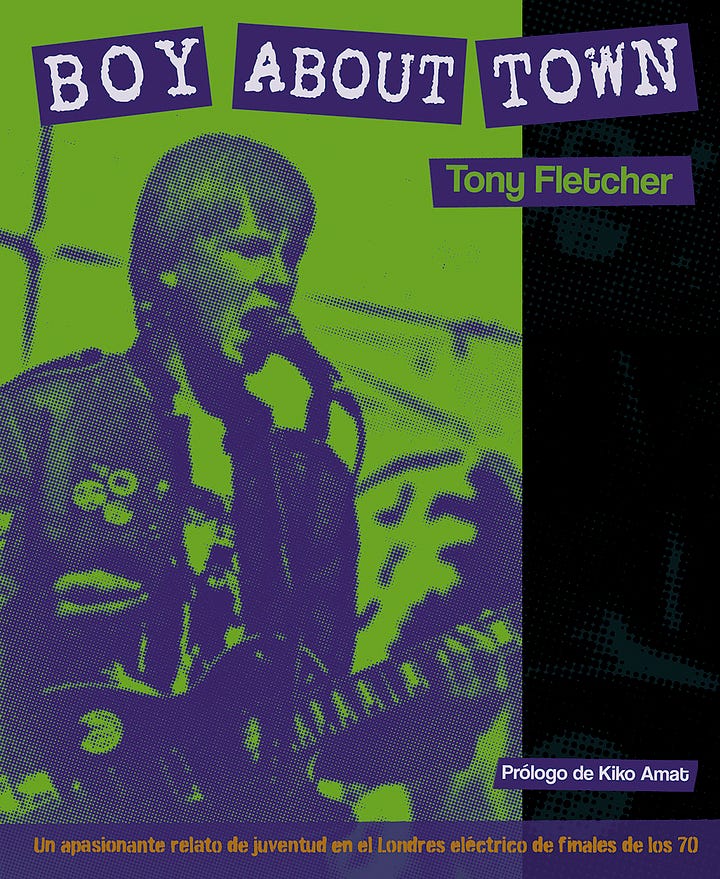
Charlton Athletic were the other South London football team. They weren’t as well supported as Crystal Palace, and those supporters weren’t as menacing as Millwall - who we’d faced on the terraces three times in one frightening week before Christmas, learning the pecking order of football crews in no uncertain terms - but they had the biggest terrace in the country, and that was a good enough reason for The Who to play there. I’d already stood on that East Terrace, with Jeffries, to watch Palace lose (of course). And the Who had already played Charlton, in 1974, before I’d started going to concerts. Now they had announced a return visit, for Whit Monday, this year of 1976, and the thought of seeing them in concert, at a football ground, was more excitement than I could bear. There was no way I going to miss out. I just had to make sure I bought tickets while they were still on sale.
I got my chance when my dad came back to the UK for a visit, and offered to take me into town just before my 12th birthday, in April. We hadn’t seen each other since the previous summer’s repeat journey to Canada. It had been a disaster. Dad had been recovering from a bout of typhoid he’d caught in Mexico, and mainly left us in the hands of some woman – not his girlfriend - who I flatly refused to take orders from on the basis that she wasn’t my mum. My brother promptly seized on the absence of authority figures to bully me relentlessly. We went back up to Cape Breton and visited the same family as before and went camping with them, and I spent a whole night in my tent sobbing that I wanted to go home. There were no shared evenings about Playboy.
As always, dad didn’t know what to do with me when we met at the Oval tube station, just down the road from school. I did, though. I knew exactly what he could do with me. He could help me get a ticket to see The Who. We took the Northern Line to Leicester Square and then we set off down Shaftesbury Avenue, where all the big ticket agencies were located. (And all the instrument stores, too.) The first of them was sold out of Who tickets. So was the second. And the third, the fourth and the fifth. My dad kept telling me I should give up, that I’d have to accept that I couldn’t have everything I wanted. But he didn’t understand. I was used to getting everything I wanted.
Finally, we walked down Great Newport Street, near Leicester Square and found one more tiny little agency. It had tickets! They were £4.00, plus 50p “agent’s fee,” and my dad thought that was astronomical for a rock concert. I assured him otherwise. There were six groups. It would go on for eight or ten hours. And it was The Who! Besides, I had £2.50 on me already. I wasn’t asking for the whole ticket. He eventually contributed the other £2 as my birthday present. Then he took me to a Wimpy Bar at Victoria station for dinner. We had to eat quickly because he was going to a concert himself that night, a classical one. He hadn’t invited me; we both knew I wasn’t interested. Instead, he dropped me at the bus stop, and I made my own way home while he went on to the Festival Hall. My mum was furious that he hadn’t driven me back through South London, but it was fine by me. I’d got what I wanted from the encounter.
Tony Fletcher, Wordsmith posts twice a week, minimum, usually on Thursdays and Sundays. To receive all posts in your Inbox, please subscribe. To keep the page going, please consider a paid subscription at just $6 a month, $60 for the year (less than £5/£50 at current exchange rates.) You get access to all the archives all the time, exclusive interview transcripts, and the monthly Crossed Channels podcast I host with Dan Epstein . And if you are a Who fan, there is a true treasure trove of archived interviews from Dear Boy, my two interviews with Pete Townshend, and other, contemporary Who-related content.
…And just in time. Like Third Division Palace on their epic FA Cup run that had just ended at Stamford Bridge, a Semi-Final short of a Wembley appearance, everyone was now talking about The Who playing Charlton. Even The Rolling Stones. They’d finally come back with a new album, called Black and Blue, and they were playing a full week of shows at Earl’s Court Arena to promote it – during the very week leading up to Charlton. Mick Jagger claimed that the Stones had received a million applications for these concerts. The Rolling Stones, he insisted, were the greatest rock and roll band in the world. I knew otherwise. So did all my fellow Who fans. The Who weren’t poncing about with shows in arenas. They were playing football grounds. Three of them. One in England. One in Wales. One in Scotland. The Who Put The Boot In, it was called, like they were proper hooligans. The week before the concert, a music paper called Sounds came out with a picture of Keith Moon on the front cover, lying on a settee, naked (apart from long socks and high-heeled platform boots). He had a football placed strategically between his legs. I was beginning to fall in love with the man.
Just like at the Great British Music Festival, I went up to Charlton in plenty of time to see all six groups, and just like at Olympia, I found a great big queue waiting for me, so long that it tailed back to a street full of semi-detached houses. So I did what came naturally to me: I joined it. Unlike at Olympia though, this queue didn’t move. At all. An hour after I joined it, we were all still standing there, in exactly the same spot. Word came down that there were thousands of forged tickets around, that’s why it was taking so long. I looked at mine again. I’d bought it from a ticket agency, so I knew it was good. Then we heard Widowmaker, the opening band, start up - so loud it was as if we were inside the Hammersmith Odeon – and people started getting restless. Two young men, long-haired and in jeans like most everyone around, walked up to the one house on the street that was boarded up - and broke in. For the next ten minutes, above the noise of the band on stage, we heard them destroying anything they could lay their hands on, like they were Keith Moon and Pete Townshend setting about their instruments at the end of a Who show. Glass, furniture, chairs… none of us really knew because none of us followed them in. We just looked at the house in amazement. Then they came back out, to a round of applause, took a bow – and carried on walking down the street.
A few minutes later, like a giant flock of birds acting in unison, everyone suddenly changed direction. And again, without instructions or comment, everyone started walking, then jogging, and then some of us running, and the next I knew, I was actually at the ground – and there were turnstiles, and they were open, and if we just queued a little more, we could get through them and into the concert. We must have been queuing in the wrong place all along (not that anyone found that unusual). I got to the turnstile, handed over my ticket. The man behind the grate looked at it, held it up to a light he had beside him, examined it closely, and then turned to look at me again. He let out a long sigh.
-Where’d you get your ticket, son?
-A ticket agency, I stammered.
-Where?
-Leicester Square. A little road off the side. I paid the agency fee and everything.
I was never good at lying. It was, oddly, the one thing that kept me out of trouble. The man behind the turnstile must have figured as much. He shook his head, let out another sigh… and clicked the turnstile.
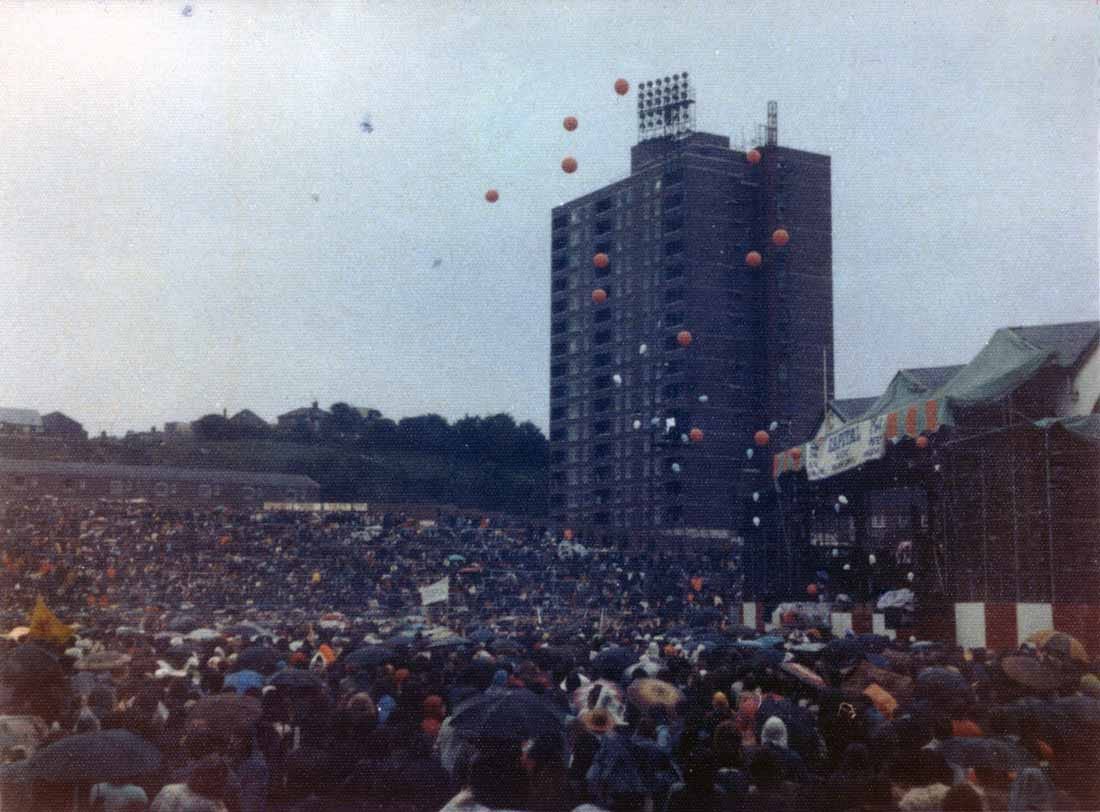
I was in. I didn’t care that I was on my own. (Jeffries was coming later in the day, after going to the pub for lunch, and it wasn’t that he hadn’t invited me along as that I didn’t want to miss anything.) I didn’t care that it would be several hours till The Who were on. It didn’t even bother me that it started to rain, and carried on raining, and that only one stand at Charlton – other than the one that contained the vast stage – had any kind of cover, and it wasn’t the vast East Terrace. I was willing to get wet for The Who. So were tens of thousands of others. Fifty thousand? Sixty thousand? Seventy? Nobody seemed to know. It was obvious, though, that there were too many people for comfort – and that that the crowd was living up to the location. It was a football crowd. I suspected that many of them were drunk. (My mum had introduced me to Pomagne while Palace had been on their Cup run, so I knew what it felt like. It felt good.) I knew they were drunk when they started hurling bottles at each other. I saw people getting carried out to first aid tents and it was obvious that it was getting out of hand. A football match, at least, was over in ninety minutes. This crowd was going to be here all day.
The afternoon wore on with the appearance of two long-haired American bands, the Outlaws and Little Feat, neither of whom did anything for me. The Sensational Alex Harvey Band, who were from Scotland, made up for it. Harvey spent a song parading around the stage as Hitler. Afterwards he told us, “In case you get the wrong impression, Adolph Hitler was a bastard, and don’t let any fascist cunt tell you otherwise.” It didn’t really occur to me that there were any “fascist cunts” around these days; surely my granddad had fought in two World Wars to prevent that ever happening again?
The rain kept coming down and I worried that my poster and my programme were getting wet. The programme was called Bellboy - after the song on Quadrophenia, the one that Keith Moon sang as his “theme” - and it was based on Playboy. Moon was on the cover, in bellboy uniform, shown entering a hotel room, carrying a tray of drinks, a look of surprise on his face as if, perhaps, there was a naked woman on the bed waiting for him. Sure enough, Moon filled the centre spread, too, spread out on a sofa as “Baggage of the Month.” In this picture he was entirely naked, though his legs were carefully crossed to avoid any rude content. It was genius.
When The Who finally came on stage, Roger Daltrey slid his way across it, announcing “The ‘Oo On Ice.” Pete Townshend followed behind - and immediately slipped on his arse. They hadn’t even played a note yet, and already they had proven what I’d always suspected: that they were real.
But once they started playing, I realized that I couldn’t see anything from the East Terrace. And I knew I couldn’t possibly make it down to the front, not when I saw how many people were being lifted out from the crash barriers, several of them unconscious. So I found some space just in front of the terrace, on the grass, the width of a football pitch from the stage. I stood there, jumping up and down, delighted but frustrated. I wanted to be able to see the whites of Townshend’s eyes, to watch what chords he was playing. I wanted to be able to count the number of Keith Moon’s tom toms.
I settled for the music. The Who played some of their early hits, and they played much of Tommy – including, of course, the “See Me Feel Me/Listening To You” finale. They skipped most of Quadrophenia, which was a shame, played only a few songs from The Who By Numbers - which was weird given that it was their new LP - and played the extended version of “My Generation,” including part of an old single “Join Together” that I’d grown to love after hearing Jeffries’s copy but couldn’t find in any shop anywhere. (And it wasn’t on any album, either. It was almost like it no longer existed. Music could be funny like that.)
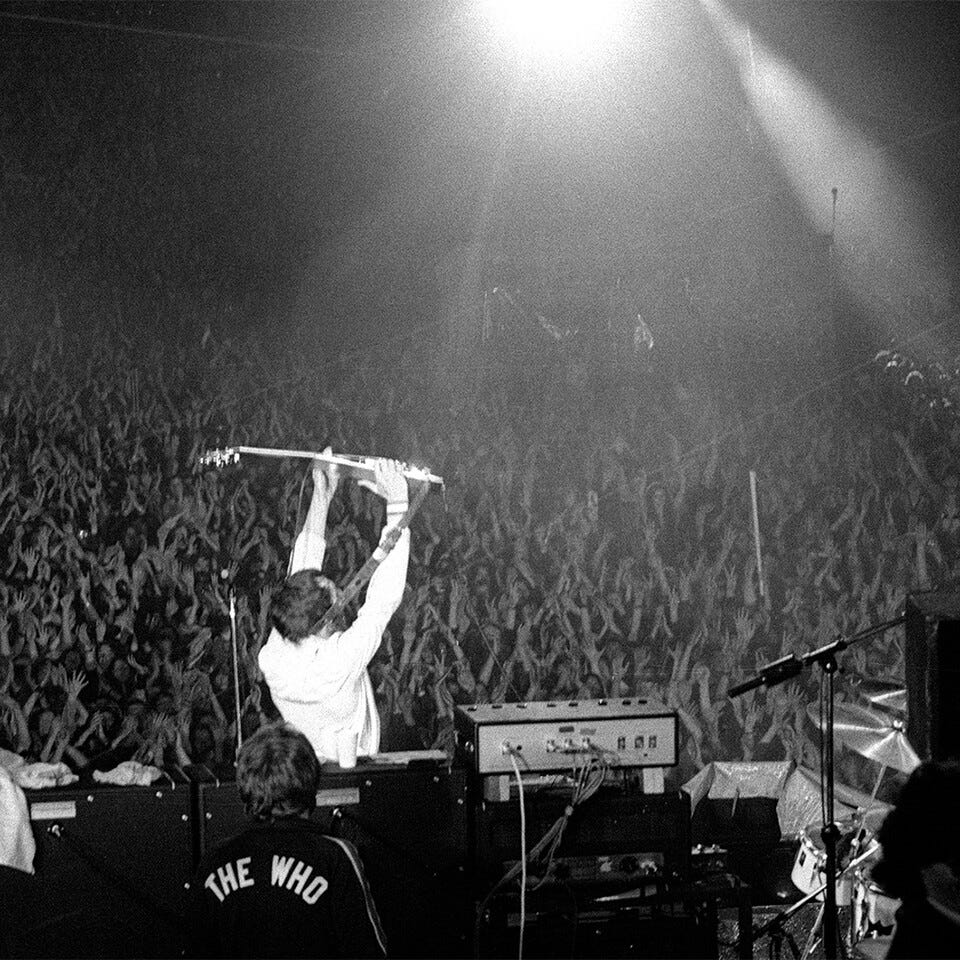
The night ended with their other major anthem, “Won’t Get Fooled Again.” As with the finale to Tommy, earlier, green lasers went off above our heads, bouncing from the stage to the floodlights and then off around all four corners of the ground. It was cosmic, to use David Bowie’s choice of word from “Starman.” But there was no smashing up of the instruments. Apparently they’d grown out of all that.
I made it home on my own, a train back in to Charing Cross and the last number three from Trafalgar Square. The next morning, me and mum got up early to go to our caravan for the rest of the Whitsun Week. The caravan site was set above a little village on the South Devon coast, near where my dad’s dad and his sister had lived, in a remote field, where cows grazed in the grass until the farmers took them in for milking. It was the perfect destination, allowing mum to escape London and the tension of her schools for short bursts of time without spending unnecessary (or unavailable) money on hotels, boats, planes or leaky tents. She looked forward to it more than anything, and wasn’t thrilled that we were delaying three days of this holiday just so I could see The Who at Charlton. It was bad enough that Easter and summer holidays and various half-terms were all arranged around Crystal Palace games.
I read my copy of Bellboy on the drive, much of it out loud. There were individual articles on each member of The Who. Pete Townshend proclaimed, “When I was a kid, a guitar was all I had,” and I imagined that was me. John Entwistle observed, “I’ve got four cars but I don’t drive,” and I hoped that would be me. Roger Daltrey said of his band-mates, “They’ve always hated my guts, mate” and I hoped that would not be me, even though I loved the idea that a band like The Who hated each other’s guts.
The profile on Keith Moon capped them all, though. It read like a greatest hits of his destructive episodes, involving various amounts of nudity, cherry bombs, piranha fish, Lincoln convertibles sinking into hotel swimming pools and the remarkable ability to carve through an entire hotel wall with a paper knife. It ended with a quote from Keith himself: “I don’t give a damn about a Holiday Inn room,” he said. “There’s ten million of them exactly the same. I book it and it’s my home for the time I stay there. If I smash it to smithereens, I’ll pay for it. When people ask me if I act like it at home, the answer is yes.”
How I wished that was me. But I knew it never would be. I didn’t have the guts.
Tony Fletcher, Wordsmith posts twice a week, minimum, usually on Thursdays and Sundays. To receive all posts in your Inbox, please subscribe. To keep the page going, please consider a paid subscription at just $6 a month, $60 for the year (less than £5/£50 at current exchange rates.) You get access to all the archives all the time, exclusive interview transcripts, and the monthly Crossed Channels podcast I host with . I promise not to spend your own hard-earned money on knickers to throw at Tom Jones.
While the new episode of the Talking About The Who podcast is audio only, you can listen along on YouTube.
Paul Bearman and I previously participated in this commemorative debut Wordsmith livestream, in which I talked more exclusively about my Keith Moon biography Dear Boy.
I was also among the debut guests from Season 1, which you can access from here.
Talking About The Who’s Paul Bearman and I will finally meet in person when Paul hosts an In Conversation with me about POW! When UK Punk Went Pop, 1980-84. A Memoir By Tony Fletcher at Brown Books Community Bookshop in Luton on September 9, one of 14 events I will be doing in the UK that month to promote my new memoir. Full list is here.
Thanks for reading. Feel free to comment below.
Thanks for reading Tony Fletcher, Wordsmith! This post is public so feel free to share it.
Comments
Nothing yet. Say the first thing.
Sign in to join the conversation.