
I bought a copy of The Atlantic magazine just over a week ago, specifically so I could read the cover story on how “The Age of Reading Is Over.” If you sense some contradiction or irony in a magazine, reliant on readers, publishing a cover story about the death of reading, which I duly purchased to read, then your senses are attuned. The Atlantic, serious weighty alternative to the New Yorker though it may be, is not beyond an alluring cover headline, and I’m not beyond being allured by one.
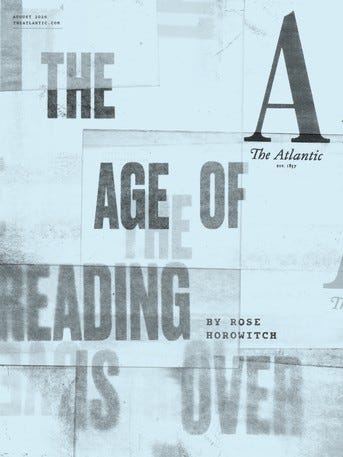
The crux of the article, however, as you also may surmise, is deadly serious. It suggests that those of us who still believe in the power of the written word, as constructed in real sentences, paragraphs, magazine and book form, are increasingly in the minority. “The Age of Reading Is Over” has almost as many depressing stats as Damian Hall’s new book on physical ageing that I reviewed last week. “Fewer than half of all American adults reported reading a book of any kind in 2022; only 38% read a novel or short story.” (Is not a novel also a “book of any kind”? Nevermind.) “In 1975, about half of 20-somethings said they read the newspaper every day. Today, less than 10% do.” “From 1984 to 2025, the percentage of 13-year-olds who said they rarely or never read for fun rose from 8 to 29 per cent.”
I can testify to the latter. When I moved off the mountain in 2019, I donated half my vast library of music-related books to the nearby Rock Academy building where I had started directing shows. I donated the book cases with it, and we set up a library inside the rehearsal room. This library contained all manner of content, from 1970s sheet music, through cut-and-paste biographies, on to visual-heavy treatises, and deep historic works and memoirs. Other parents added more, and I was even gifted at least two decades’ worth of Q and Mojo magazines for those who preferred that particular printed medium. There was something for everyone and anyone. However, almost never, in the hundreds of hours I spent in that rehearsal room, did I see a single student of any age peruse the shelf for something to take off it while between their songs, let alone sitting down and reading it. Scrolling their phones, on the other hand? Bingo.1
“From 1984 to 2025, the percentage of 13-year-olds who said they rarely or never read for fun rose from 8 to 29 per cent.”
The effects of this shift away from the longer form written word towards the rapid-fire posts of social media, or the visual news and opinion provided on YouTube, is more than just cultural or economic. It has intellectual implications for human progress. “Reading shaped the modern mind,” Horowitz writes. “Its disappearance will reshape it.”
Already, she notes, we are seeing “average IQ scores… declining by about three points a decade,” as evidenced by examples of how “the number of American adults who cannot paraphrase or make inferences from a multipage text has risen over 50% in less than a decade.” This is the natural outcome of an American public education system that shifted from assigning whole books to read in favour of short excerpts, it being deemed more important that students pass upcoming tests rather than improve their long-term literacy. [The reportage in the Atlantic article is mostly centered on the USA, but the general stats and overall conclusions will be similar in many a “first world” nation where literacy is no longer considered a path out of poverty. Brits will get more than their share of content below.] The arrival of the digital age only accelerated this process, with even pre-kindergarteners being provided some form of tablet in many Districts nowadays.
However, if “the Age of Reading Is Over,” you, my reader, are clearly among the exception. Ultimately, there are still enough of us who innately understand the benefits of long-form reading, even if we haven’t all read the evidence in Horowitz’s article.
The reason to buy a magazine, as opposed to reading a single “alluring” article online, is that it takes you somewhere.
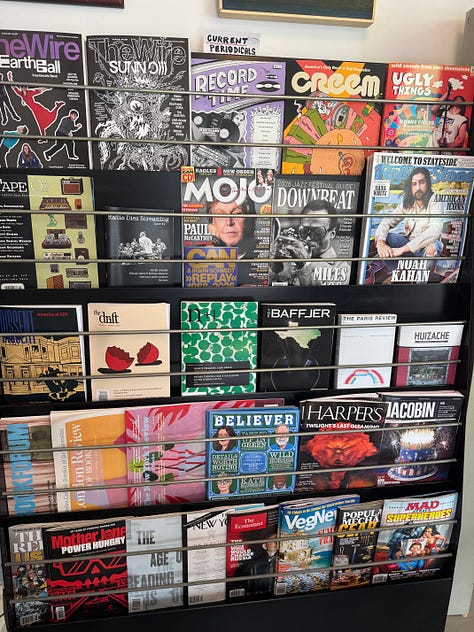
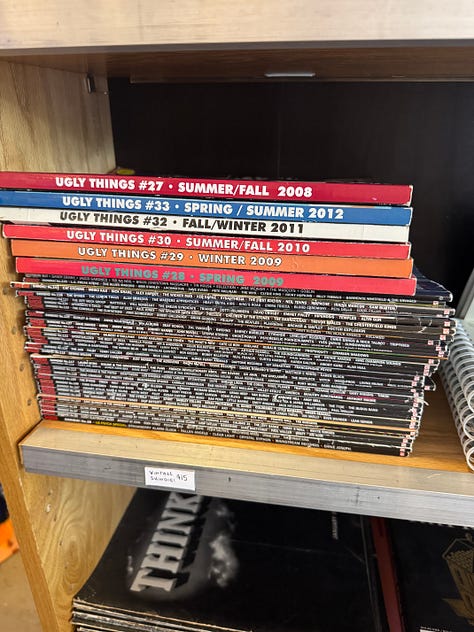
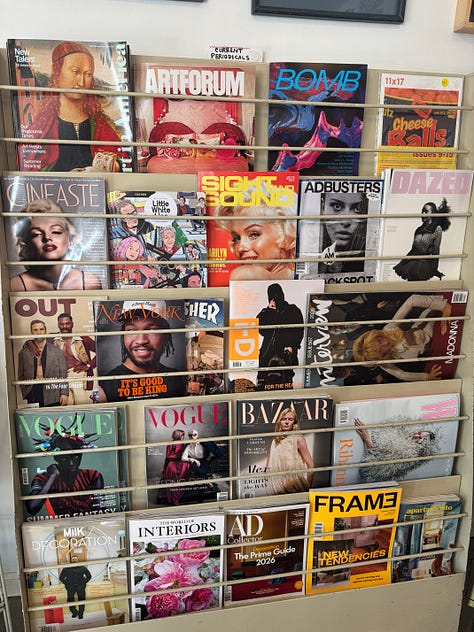
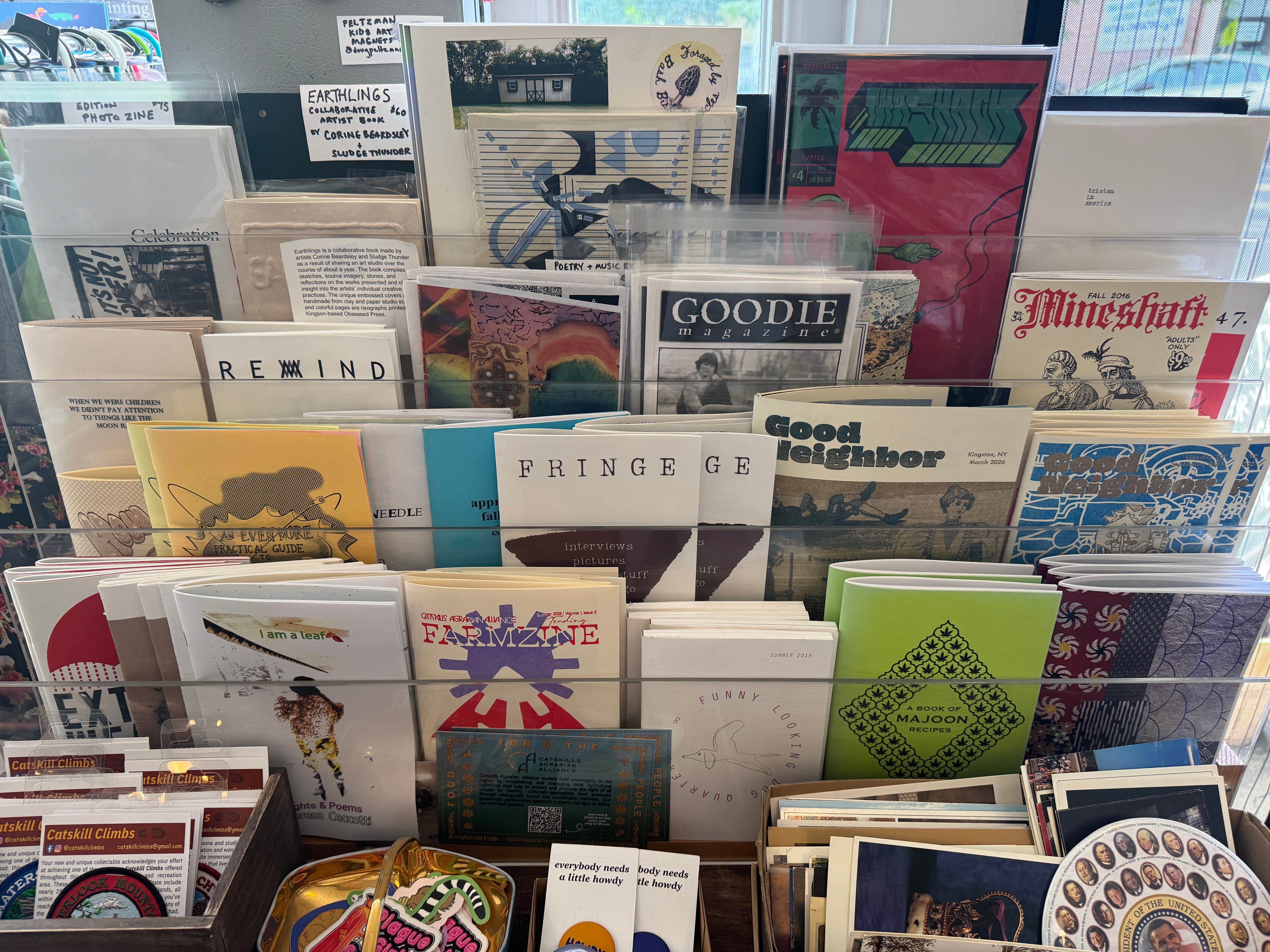
As it happens, I purchased the Atlantic at a shop just around the corner from our new home, albeit on a city “block” not well traveled. The shop is called Curious and while it sells other items, at least 50% of its inventory is in magazine form. This includes music zines going back decades, such as the UK’s Shindig! and Sight and Sound, as well as the latest issues of Creem, Ugly Things, Tape Op, and other music mags I rarely see anywhere in print form. There are also fancy imported British publications like Believer and Huizache, plus - and I love this and it’s more relevant to a younger market - dozens of self-produced “perzines” – some more pictorial than wordy, but all of them confirming an undying love of the printed form.
Curious is not a runaway success; though it’s survived two years, the owner tells me that business is slow. That may be down to location and thrift store-style layout. Business is a hell of a lot brisker at Good News, a famous “newsagent” on London’s Berwick Street whose series of floor-to-ceiling shelving looks like it is seeking to stock every high-end magazine known to exist.2 Many of these mags are expensive to purchase, but then they are also expensive to print, especially when circulation – circulating back around to the Atlantic’s cover story premise – has narrowed enormously in an increasingly digital marketplace.
Nonetheless, such magazines don’t just persist. They thrive. They continue to start up at what would be a frightening rate but for stating the obvious: even as most fulfil a specific (and potentially marginal) niche, they also fulfil a more general need. The reason to buy a magazine, as opposed to reading a single “alluring” article online, is that it takes you somewhere.
Case in point: as a result of purchasing the Atlantic and reading how “The Age of Reading Is Over,” I found myself reading on about “The Rosenberg Boys,” the two now-ageing sons of Julius and Ethel Rosenberg, who were denied the opportunity to age gracefully themselves when executed in the electric chair for espionage in June 1953. Like many, I’ve seen the pictures of Michael and Robby, as little boys, petitioning the US Government to spare their parents’ lives; I’ve never known their own actual life stories, nor read such a relatively brisk summary of the facts about Ethel and Julius as now known, and which their sons have had to come to terms with knowing as well. A fifteen-hundred-word essay in the Culture Critics section of the magazine asking, “What is punctuation even for?” seems like my next essential article.
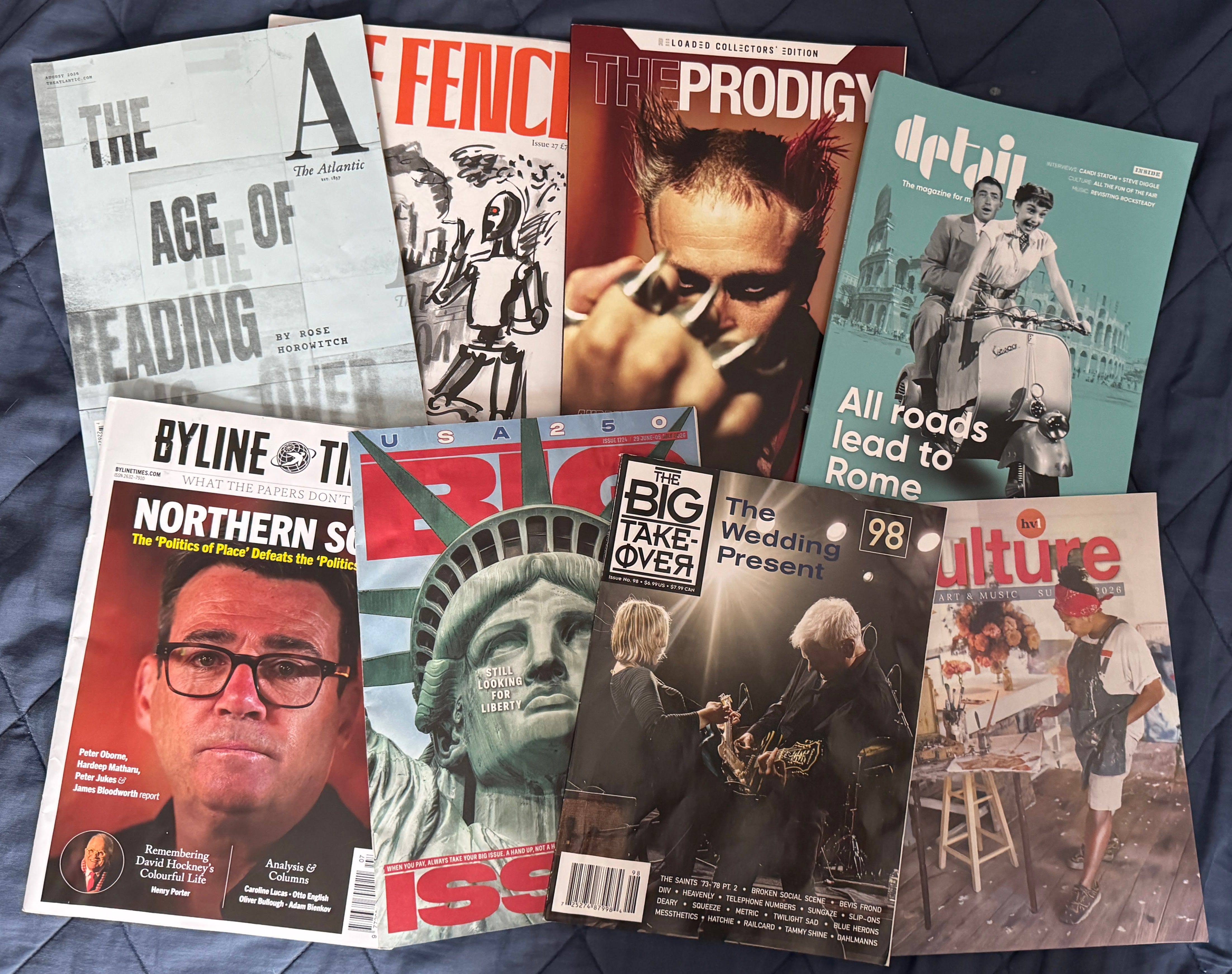
The Atlantic’s cover story jumped to the front of the queue - admittedly, to provide the introduction of this post that I already wanted to write - of a reading backlog that has swelled of late. As well as the books I wrote about last week, I came back from the UK armed to the gills with printed journal. Back in New York, evidently I have acquired yet more. Here then, is a summary of the best of what I’ve digested in my current cultural binge. I hope it might inspire you, if not necessarily to follow a link and order one of these magazines online, then to take (more) time out the next you see a magazine or perzine rack – and to take your wallet out in the process. We’d miss them if they were gone
Tony Fletcher, Wordsmith posts at least twice a week. To receive all posts in your Inbox, please subscribe. To support the page’s continuation, please consider a paid subscription at just $6 a month, $60 for the year (less than £5/£50 at current exchange rates.) You get access to all the archives all the time, exclusive interview transcripts, and the monthly Crossed Channels podcast I host with Dan Epstein. You also keep the lights on and the engine running. With gratitude.
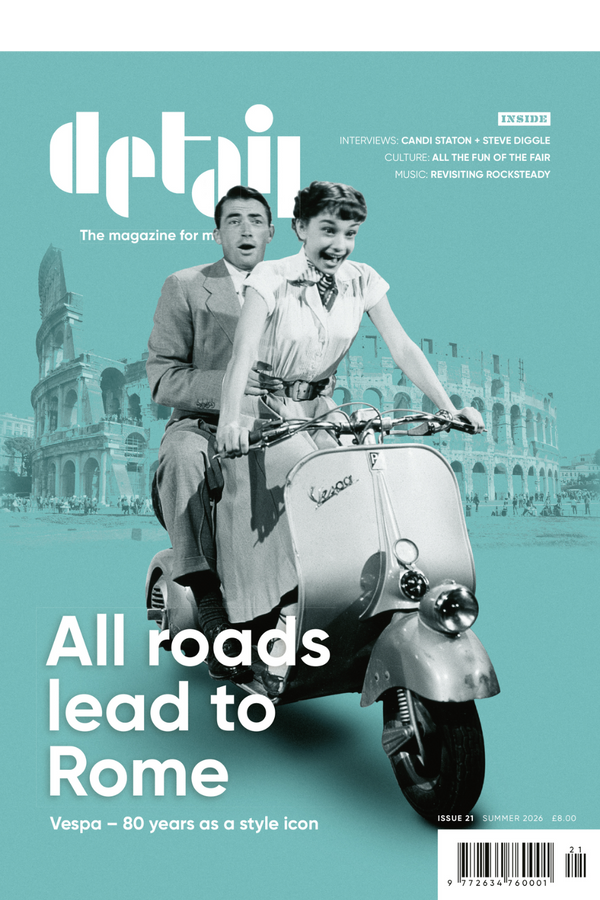
Not to be confused with Details, the early 1990s New York young men and, briefly international lifestyle Bible, the singular Detail is a comparatively new magazine designed – and it is designed impeccably - for the discerning modernist. While this descriptive term for an entire lifestyle has been open to debate ever since its late 70s oxymoronic “Revival,” Detail does not sully itself with that awkward question of definition but rather, celebrates the lifestyle itself. In detail, but of course.
The Summer 26 issue duly comes with a cover story honouring Vespa’s “80 Years as a style icon” and includes additional features on the fairground as a cultural attraction from the 1950s onwards, rocksteady as a source of musical inspiration from the 60s ditto, and Johan Cruyf as the essence of early 70s style and flair on the football pitch. Interviews with Candi Staton and Steve Diggle provide musical meat, while a feature on Art Gallery Clothing celebrates that particular brand’s “Three decades of style.”
Detail’s list of contributors should be familiar to anyone who has stayed “in” with the mod in crowd over the years – Ed Piller, Lois Wilson, Rick Blackman and Mark Webster to name a few – but if those names do not ring a bell, you may be familiar with the guest editor of Issue 20, a certain Paul Weller. Meantime, thanks to a personal introduction to editor Claire Mahoney by James Brown, a noted former magazine editor himself, there is every likelihood that the next issue of Detail will feature some words of my own. As someone who has had one foot firmly in that modernist scene and the other resolutely outside, I am delighted to finally make its acquaintance.
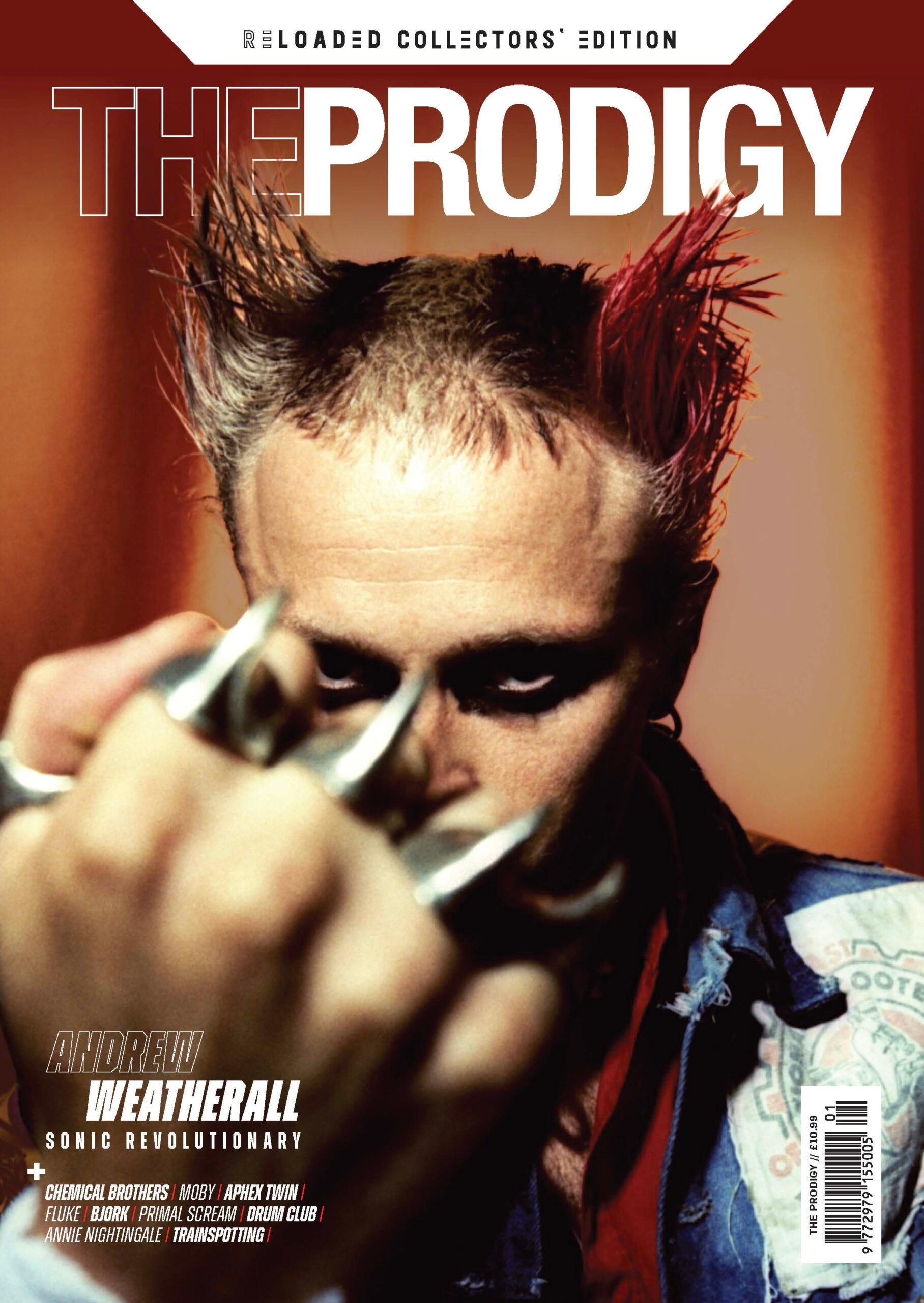
Not to be confused with Loaded, the mid- and late-1990s British lads’ lifestyle Bible – though have there truly been so many magazines in history that the best titles need to be so similarly reused? - the brand new Reloaded nonetheless joins the racks and ranks of nostalgic music mags, this one with a focus on that specific “decade that didn’t sleep.” And though the promised-thrice-yearly “bookzine” suggests that it will cover a wider array of the 1990s music scene, its debut issue, handed to me personally by a core contributor, Kris Needs, focuses exclusively on what editor Martin James cites, in as many re-arranged words, as “the tangled threads of the early 90s dance explosion.”
To this end, a picture of the late Keith Flint of The Prodigy dominates the cover – the group’s name taking prominence over that of the magazine title - while that of the late Andrew Weatherall (“Sonic Revolutionary”) has secondary billing. Additional front page citations of Chemical Brothers, Moby, Aphex Twin, Fluke, Bjork, Primal Scream, Drum Club, Annie Nightingale and Trainspotting suggest that this a veritable trip down memory lane taken right out of the Barbican’s 1996 exhibition I wrote about here.
Reloaded is not, however, a series of archived cuttings, per the typical Mojo or Select “Collector’s Edition”; all the pieces here appear especially commissioned. Nor are the features on The Prodigy and Andrew Weatherall isolated one-offs but, rather, deep dives whereby a series of articles attempt to build a more holistic picture. In the case of that “Sonic Revolutionary” Weatherall, that attempt comes in three parts. Karen Mills writes all about the birth of Boy’s Own (the club, zine and production team, of which Weatherall was a member, that married 1980s Indie sensibilities with Balearic music); Kris Needs presents a six-page personal profile of the man he was fortunate enough to call a friend; and the same writer then provides a four-page profile of the woman that was Weatherall’s “psychic shorthand” musical partner and attempts to explain why so many of Weatherall’s final recordings have remained officially unreleased. (Needs and Walsh are themselves now actual partners.)
Flicking through Reloaded, I was surprised by how much fondness I maintain for the artists, album, concerts and characters featured within, many via contemporary interviews and/or retrospective reviews in the present moment. Reloaded therefore deserves credit for making nostalgia seem remarkably contemporary, something the 1996 exhibit did not.
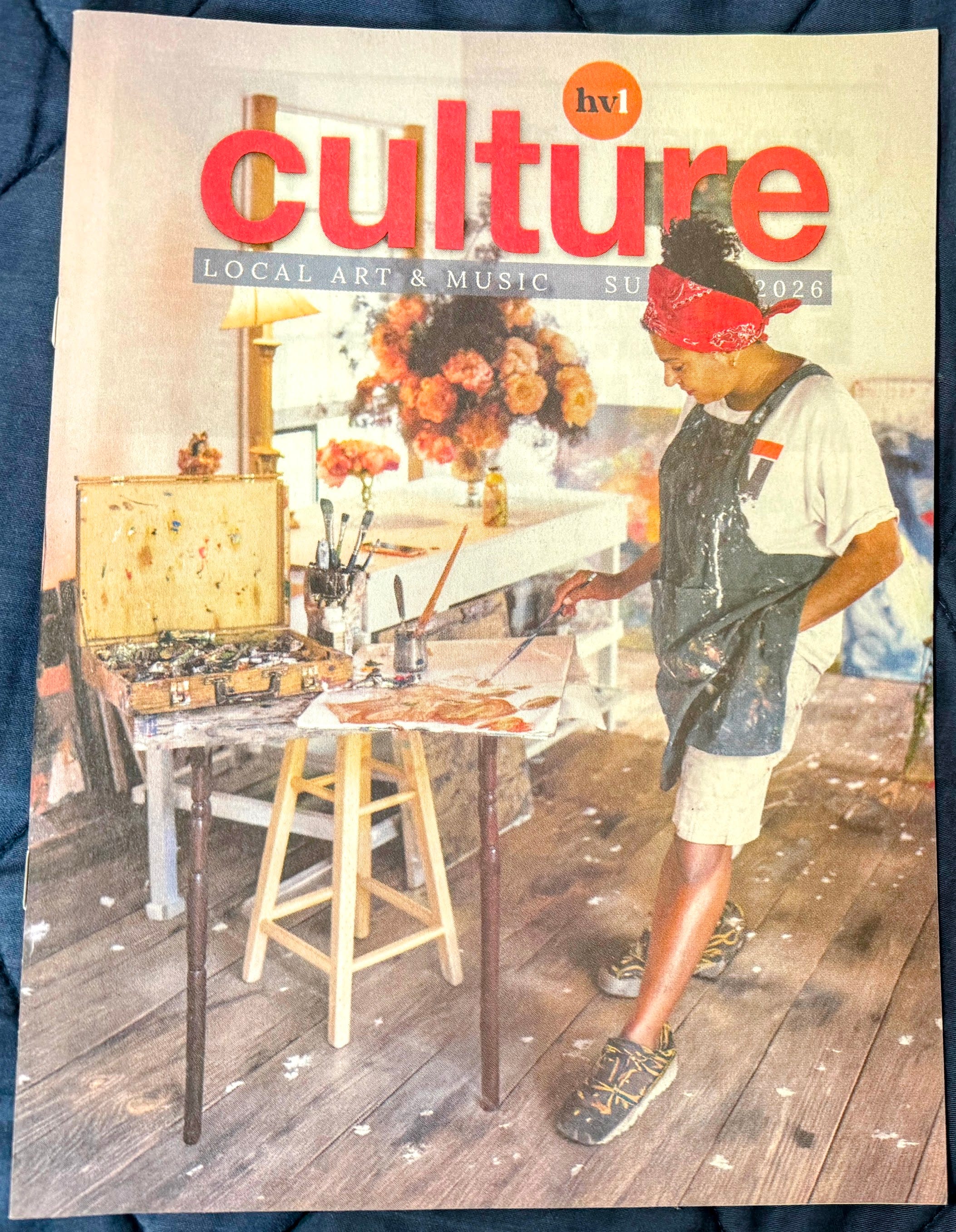
My home area is full of advertorial magazines, many of them so glossy and sensual that the casual reader may not realize the majority of profiled entities are also paying advertisers. The seasonal A4 newsprint Culture mag that can be found inside local weeklies and additionally distributed in coffee shops, cafés and anywhere else that will take it, takes a slightly different tack: three or four non-aligned articles commissioned to fill the space between relentless local ads.
Why should I write about it? Because this current issue features as its cover star and inside essayist the local mainstay I’ve long known as the musician Simi Stone, writing here under her original name SImantha MollyLou Surnaka, about her return to her original art form: painting.
It’s not an unfamiliar transition in either direction, but in her case it was precipitated by a career-changing rejection as depicted in the opening words of her article: “When I got off the phone with David Byrne, I was crying. He had said he had to replace me on the American Utopia tour, and it hurt.”
After years of solo toil with considerable local acclaim but little commercial fame, that American Utopia tour was meant to be Simi Stone’s promotion to the big time, and those of us who knew her from the neighborhood were all thrilled for her. But a foot injury meant that, despite playing chops, she could not successfully participate in Byrne’s movement extravaganza, and so she was let go. As she goes on to write, the dismissal was a final nail in her musical ambition’s coffin. “The music business had wrecked me mentally. It had been like a bad boyfriend to me, the kind whom you kept going back to in the desperate hope that maybe this time he’d choose you if you acted right and looked pretty enough…”
From this dark start, Simi writes about being embraced by local artists and teachers whose generous spirits have always flowed, and her essay becomes a love letter to a Woodstock spirit, the permeation of which can only be confirmed by those who have experienced it. The article concludes with a powerful paragraph about the artist life and how “My constant comparison throughout it all has been self-expression.” So much more than the usual filler one finds in this kind of freebie mag, Simi’s essay indicates that The Age of Writing most definitely is not over.
(You can read/download this issue of Culture from here.)
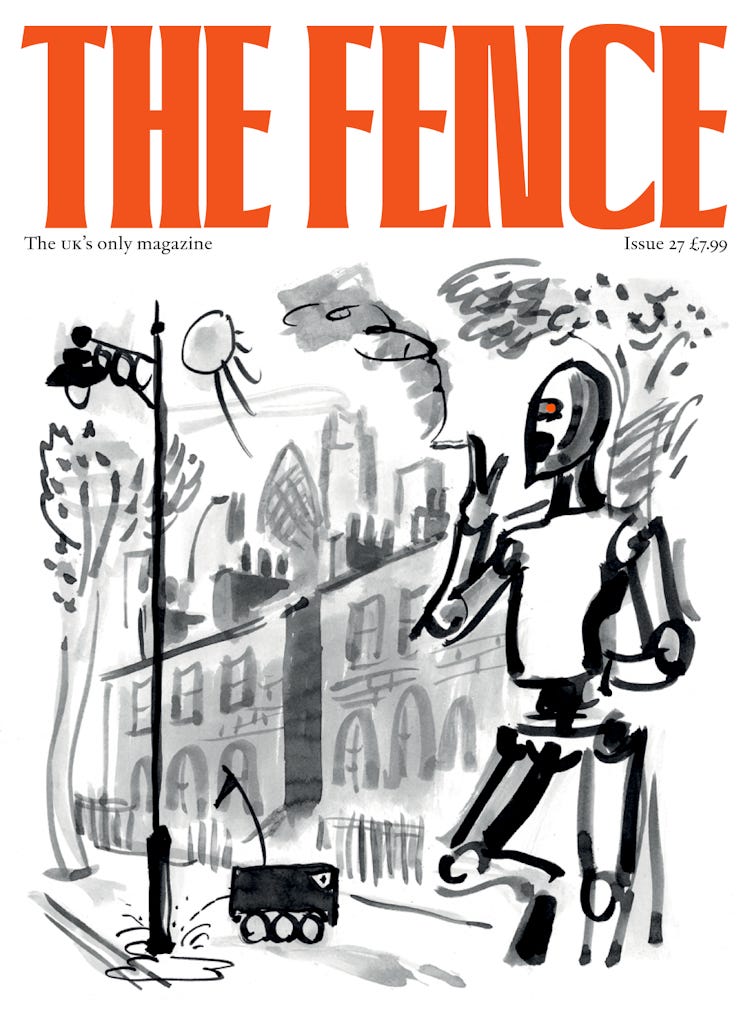
The Fence, a name presumably chosen for its multiple meanings and allusions, has found a successful niche, wherein it manages to be intellectual and hip without ever being overtly condescending or patronizing. In other words – and there are LOTS of words in a copy of The Fence, accompanied occasionally by drawings but the complete absence of photographs – it can run a first-person account about the prohibitive cost of going on tour as a modern-day musician, alongside a deep dive into the ongoing death of the Groucho Club. It can also run an article on the recently deceased fashion designer Pam Hogg alongside a profile of the “unlikely icon of Glasgow’s underground music scene,” the 73-year old Tony Morris, who has become an Instagram sensation with his “surreal depictions of suburban life compressed into minute-long audiovisual sketches.”
The Fence can also, in its current issue, then detour into some lengthy fiction, as well as a fascinating look at the resilient macho drinking culture of the London insurance industry (as penned, not unsympathetically, by a female). There’s a definite degree of insider hipsterism about it, and the latter pages’ attempts at light relief feel a little too Private Eye, but speaking as an outsider to the names of the contributors, and the people and places they are discussing, I don’t feel alienated as much as I’m intrigued. I’ve learned much from reading The Fence, and I’ve especially appreciated the quality of its writing, something on which the editorial team does not skimp. This is not always the case, and sometimes it’s out of necessity…

As with The Fence, Sidetracked is a publication I’ve purchased previously (both times at Good News), and as with The Fence, I must have been sufficiently impressed given that I ponied up an almost book-sized cover price for the latest issue. Yet however expensive that £12 might look on this page here, it could be considered a steal given that Sidetracked has the feel of a coffee table book, its 145 A4 pages – matt, not glossy, which also distinguishes it, and for the better - filled with full-colour photographic travel essays.
These are not Conde Nast or Sunday Times-style guided tours of famous cities and idyllic beaches, nor even the everyday slumming adventures of the youthful backpacker. Rather, they are tales of singular adventures that push beyond the edge of what most of us might contemplate…. A one-man-and-his-dog cross-country Norwegian sojourn “under their own power,” be that packrafts, skiing or hiking, for example. A 1500km solo crossing of New Zealand’s South Island , “alternating between paddling and walking.” A canoe journey from Lemmenjoki River to the Arctic Circle. A climbing trip in Greenland. And so many more.
The adventurers who tell their stories in Sidetracked are, evidently, hardcore, and their photographs of their journeys are as artistic as the voyages themselves appear masochistic. The adventures can be overwhelming, and the stories can be confusing: they all tend to open with a paragraph that drops us into the middle of the action, and some of them never back up for the full picture. (The host country of the Lemmenjoki River goes unnamed, at least early on.) Additionally, the writing is of varied quality: not every adventurer-photographer can be a wordsmith as well, as Sophie Dingwall confesses in noting that “Even the most skilled writer would fall short of describing the wonder that defines Greenland.”
But when the skills all come together, they exhibit a perfectly triangulated creative-athletic-artistic synergy. The aptly-named Jenny Tough writes exclusively about just two days of one journey, the first of them which starts with her halfway up a perilously steep 4200m high scree mountain, which - naturally - she eventually summits, before running down the other side, battling AMS, fear, wonderment, common sense, and her own limits of endurance and agility throughout.
We learn almost nothing else about her. We don’t know the journey she is on, its beginning or intended end, nor the reason for it. Even the country in which she is traveling goes unnamed, except for reference to the southern, “Uzbek” border. We only glean that she is an experienced fastpacker and keen mountain runner, that she dresses conservatively when in countries that expect as much of a female, but that when, on the blisteringly hot second day, she finds herself encountering a glacier-fed lake with no humanity in sight, she strips off her clothes for an ice-cold swim. And though her literary pacing and prose has served her well thus far, she too succumbs to the elemental: “I don’t have language for the beauty of this place. It’s simply seared into my memory as a perfect mountain memory that I’ll carry for the rest of my life.”
I could live with that, and besides, and but of course, she brought her camera.
I like to stay informed about British politics – and not just British politics, but the British political take on world affairs. Managing this intention can be hit or miss, and I’ve struggled to find a publication that reflects my ideology as a committed leftist/liberal/progressive, but one who does not like to tow party lines, indeed one who often instinctively plays Devil’s Advocate to the prevailing opinion and as such, and not that Kevin Rowland necessarily meant it in this capacity, is “open to suggestion.”
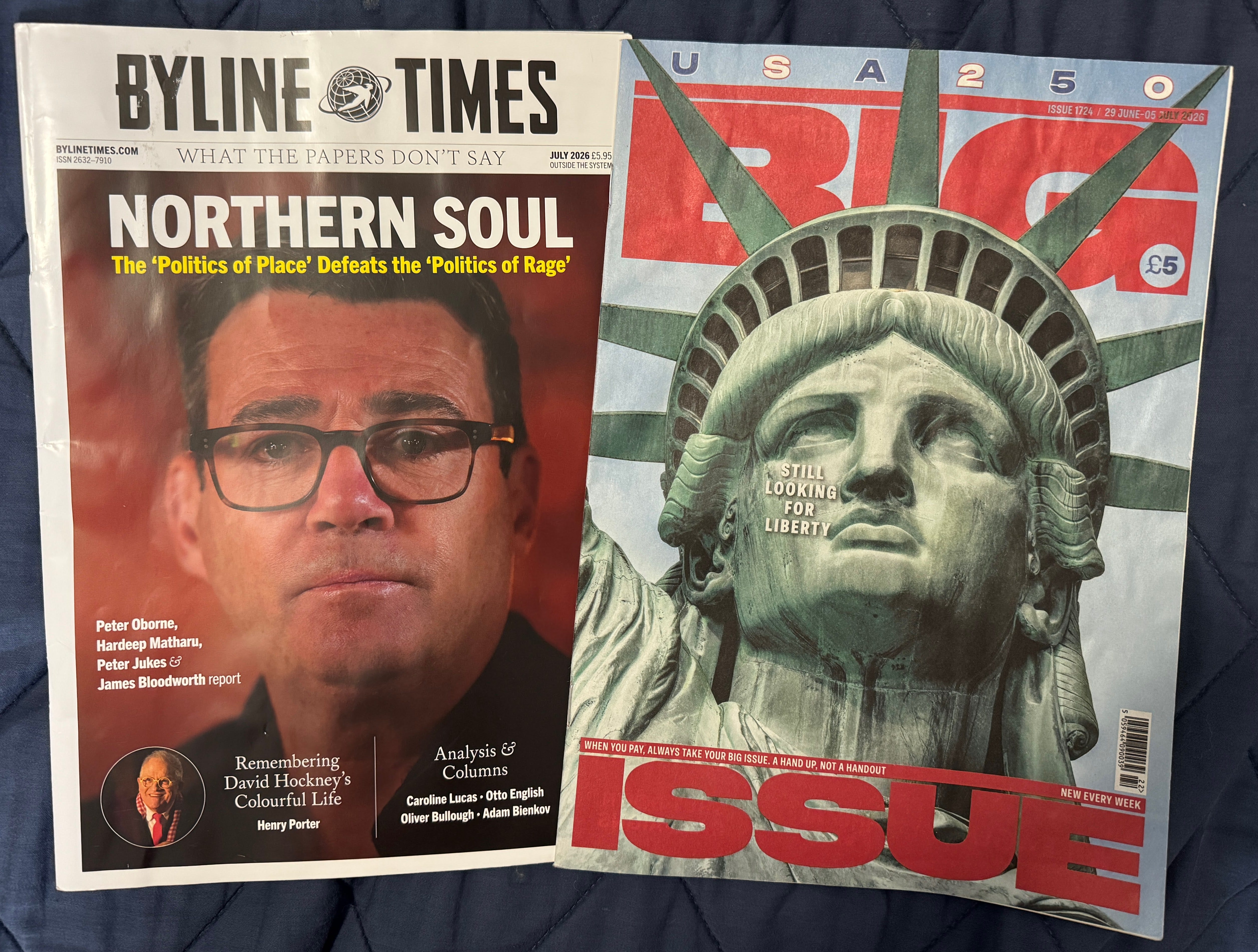
Byline Times is about as close as I’ve come to finding my mag. The man who was, at the July issue’s publication deadline, only vying to become Prime Miniser, Andy Burnham, dominated the cover and core interior coverage of the issue I purchased, but the mag saw duty not to get carried away by any suggestion that his “Northern Soul” would make him a National Saviour. So while one side of that coverage proclaimed that “Burnham is a Giant Step Backwards to a Better Sort of British Politics,” the opposite page saw Labour MP Clive Lewis insist that “The Answer Cannot Be Managerial Politics with a Different Accent.3
Elsewhere, Byline Times tackles “Antisemitism in the Shadow of Israel’s Wars” – not a topic many hard-leftists wish to concern themselves with – as well as the pre-release “backlash” to The Odyssey movie’s casting decisions, helping correct the record about which of Homer’s characters actually were Black or Trans while duly noting that not a single cast member was Greek.
There’s plenty here about US politics, the environment, and the ongoing scourge of Reform – indeed, an article looking at the Brexit vote ten years on connects the dots from the UK’s resultant financial downturn, to possible political and culture ruin should Farage gain the seat of power he’s even more desperate for than Burnham. And if there’s not a lot of humour within its pages – actually, I don’t think there’s any – at least an essay on the late David Hockney notes that his art “was as much an intellectual exercise as it was an expression of the joy he took for being alive.”
With regard to the Big Issue, I’ve written several times here at Wordsmith how continually impressed by I am the consistent quality of its content. Still dismissed by so many as quid-pro-quo publication, a mag to be purchased outside a busy M&S or Tesco’s (per my preferred sellers in Beverley and at the Angel Islington) in a moment of guilt and thrown away quickly thereafter, it is much much more than that. For me, it comes close to my ideal social, political and culture magazine – plus, its money goes to help combat homelessness, and the remainder to a publisher that is far from a capitalist corporate concern.
Perhaps predictably, the cover story in the build-up to the USA’s 250th birthday – an occasion I was glad to miss, the July 4 weekend falling bang in-between my two weekend reasons for being in the UK – zoomed in on the Statue of Liberty, and as per so many of the newspapers I purchased that weekend, the mag sought clarity on the USA’s current state of (foul?) play via a series of short interviews or articles from those who have lived it. But high-profile exceptions like Anthony Scaramucci and John Bolton aside, the Big Issue garnered opinions from everyday people, like the man who runs a small tour guide business in Oklahoma, a 22-year-old graphic designer in Kentucky, and a vendor for a Big Issue equivalent in Washington D.C. As Baroness Beeban Kidron writes elsewhere in a piece on the USA tech companies’ data grabs of British (and other countries’) subjects, “the US is a tremendous, terrifying and extraordinary place.”
The Big Issue covers multiple issues. I can learn what’s going on at street level from the pages up front, and after the major articles in the middle, I can turn to the pink-paged Culture section at the back to read up on the new opera about Greta Thunberg, about the man who coined the term Art Deco (his name is Bevis Hillier, he’s still alive and well in his late 80s, and he just wrote a book on the subject ) and not just why Music Is Medicine – many of us know as much – but how Canadian Health professionals in Quebec are seeking to prescribe specific concert attendances as cure.

Finally, if the age of reading is truly over, then someone needs to tell Jack Rabid and his merry crew of collaborators, because The Big Takeover is still knocking out its twice-yearly magazine packed with more words than a month full of Sunday Times. Indeed, 45 years since starting out as a one-page broadsheet, this most eternal of American zines is now closing in on Issue 100, with its #98 running a phenomenal 162 pages deep. while somehow still retailing for just $6.99, less than anything else reviewed here but the freebie.
For this low cover price, we can perhaps thank the legions of loyal advertisers, almost all of them indie labels (whose very presence also confirms that the age of physical music is not over, either). Their proud parade of new (and rereleased) music, when combined with the staff’s indefatigable determination to write about everything under the sun (Jack reviews, in depth, his Top 40 Albums for each issue and then uses another four pages to write about dozens more) makes the Big Takeover a daunting proposition. How many of us, for example, are truly willing to invest the time in an unedited two-part interview with the under-sung members of The Saints 1973-78?
But on the Flipside (to reference another important American zine through the ages), where else could Yours Truly read a several-thousand-word interview with Nick Saloman, a.k.a. The Bevis Frond, a career cult musician for whom I have a particularly soft spot given that he played drums (perfectly well at that, despite protestations that “I’m not a drummer”) on the first two Dear Boys singles? Similarly, how could I not appreciate a short piece on Railcard, who will be playing alongside the Dear Boys at the Sound Lounge in Sutton in support of my new book, on September 10th.
These acts aside, and even though it’s The Wedding Present who take the cover, it’s not all Anglophilia at TBT. Features on Broken Social Scene, Telephone Numbers and the “Dreamy and Meaningful Midwestern Emo” of Sungaze vie for attention alongside those dozens of pages of reviews.
Thankfully, TBT is more than just obsessive musical completism. Jack Rabid opens proceedings with a four-page/circa 4,000 word editorial on “The Worst American Exceptionalism (Part 2),” writely citing the USA’s (lack of a) health care system, (lack of) gun control, and (lack of) concern for climate change as the three major issues that puts the nation out of step with the rest of the world, and which, I might add, causes many who live within its borders to lose sleep at night.
Towards the end of his detailed perspective on these societal failures, Jack turns to the ballot box with enthusiasm, encouraging readers to turn the tide around in November’s 2026 Midterms. I admire his undying optimism and his faith in humanity – if not just in the prospect of fair elections, and then in elected politicians to do the right thing, then in the ability of people to still read, in depth, with the desire to do so, too. Long may the magazine reign.
Thanks for reading Tony Fletcher, Wordsmith! This post is public so feel free to share it.
By the time I stopped at the Rock Academy, in early 2025, the library had been moved to a toilet. An unused toilet at that.
Much of that business is in lottery tickets and tobacco, but equally, anyone really think Barnes & Noble does not make its profits in coffee?
I have met Andy Burnham just once, when we both attended a semi-private book presentation by Liverpudlian Kevin Sampson entitled Hillsborough Voices. The book was published in 2017, the same year Burnham became Mayor of Manchester, and I suspect it was in the run-up to that election, else his presence in London for a book event might have been questioned. Nonetheless, his passion for the game and his support for the survivors and families of the Hillsborough disaster was evident.
Comments
Nothing yet. Say the first thing.
Sign in to join the conversation.