

The Last Judgement - Michelangelo
My ‘tour of duty’ into government, working on delivering parts of the AI Action Plan, has come to an end. I will be writing more about my time in government shortly, as it has had profound effects on my worldview, what I think needs to get done, and the next steps of my career. But for now, the semi-spicy takes will return.
I have spent the last couple of weeks engrossed in all things Dan Wang. The technology analyst has published a new book, ‘Breakneck: China’s Quest to Engineer the Future’. It is a fantastic read, and is one of those articulations you may not quite have realised: but once you see it, you see it everywhere.
Breakneck’s central claim is that China is an “engineering state” building infrastructure at breakneck speed, whereas the United States is a “lawyerly society” that obstructs projects at every turn. He notes that Chinese elites are dominated by engineers (Xi Jinping is a chemical engineer, Hu Jintao a hydropower engineer, etc.), while about half of U.S. Congress members hold law degrees. This background shapes each country’s approach. China’s technocratic leadership drives rapid construction, whereas America’s legalistic culture and litigious processes slow things down.
The book itself offers more nuance than this binary may suggest. Wang outlines many of the common features of both nations, including a combination of a “surprisingly libertarian” (in China’s case) and “you can just do things” attitude. The engineering state of China, Wang argues, has a fetish for optimisation, with this muscle leading to extremely traumatizing outcomes for the public, such as the One Child Policy and Zero Covid. Meanwhile, the lawyerly society has provided much needed voice for the public, advancing the rights of the dispossessed.
There are also some limitations with the book. I think the argument doesn’t explore enough whether the overall capability of Chinese politicians is just better than the US, with top talent more likely to go into the Politburo than congress. I also would have liked to have seen more of a focus on pre-Deng Xiaoping elite culture. The focus on engineering vs wider STEM could also be restrictive. But this post isn’t an attempt to evaluate if Wang is correct or not.

In fact, I think the engineering state vs lawyerly society distinction is a pretty helpful rubric through which to understand modern states. I am also, for the purpose of this piece, leaning heavily into the premise that lawyers have a tendency to block building things. This does not mean that I think lawyers = bad.
As a result, I wanted to try to situate the UK within this framework. Several years ago, Conservative ministers launched a broadside at ‘lefty lawyers’ being the source of many of the UK’s ills. This argument has begun to rear its head again, albeit in a slightly different form. Judicial Review has been identified as a major constraint that is holding up housing and infrastructure projects, while the ECHR is being used as a means of blocking a panoply of state actions.
It would be easy to look at these features of the British state and conclude that we, too, are a lawyerly society. But at risk of sounding like an institutionalised civil servant, it might be a bit more complicated than that. After all, there are other competing conceptions for the high-status professions that shape the nation’s overall political economy.
Much ink has been spilled, for example, on the role of ‘PPE bollocks’ in redefining Britain’s current dysfunction (disclaimer: I have a degree in this). Indeed, Wang, in an interview with Aaron Bastani, jokes that the comparative advantage of the UK is saying clever one-liners, which makes them perfect for TV (see how the media indexes very highly on how capable a minister is based on how effective a media communicator they are), finance, and consulting.
So, to what extent is the UK a lawyerly society? Is this the reason that it struggles to build? Or is something else at play? In this piece I look at the data and reflect on my own government experience to conclude that:
The UK is much closer to the lawyerly society than the engineering state
But there are several key reasons why describing the UK as the ‘lawyerly society’, by Wang’s framing, is not quite accurate
The UK is closer to resembling a broader ‘managerial paralysis’: a surplus of managers, lawyers, HR staff and generalist consultants can tie internal bureaucracies in knots, rather than through courtroom litigation
One dimension to consider where the UK sits on the lawyerly society vs engineer state spectrum is the background of MPs.
The House of Commons Library is a great resource for the career and social backgrounds of MPs. It mapped the career makeup of parliamentarians up to around 2015, although hasn’t kept as much data over the last few years.
The presence of lawyers in parliament has held somewhat steady over the last half century. It dropped from a peak of 16.5% in 1983 to 10.2% in 1997. The New Labour revolution brought about a revival in lawyerly representation, with 14.2% of MPs having a legal background in 2015.
Engineers, however, have always been much harder to find in Westminster. Their representation peaked at a measly 4.5% in 1979. What is worse is that this figure has collapsed by a factor of five in the preceding years. In 2015, just 6 MPs were engineers by background, a mere 1% of parliament.
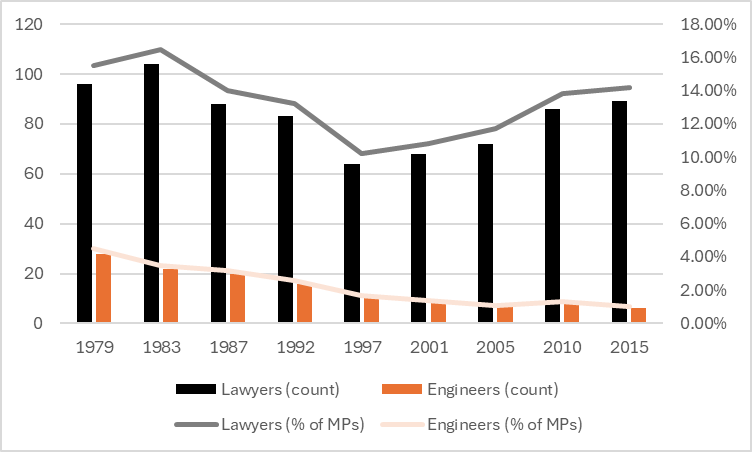
Figures are drawn from House of Commons Library research briefings on MPs’ occupations; “lawyers” include those who practised as barristers or solicitors, and “engineers” include those who worked in professional engineering roles before entering Parliament.
A weakness of this data may be that a backbench MP is not the one approving big infrastructure projects. After all, ministers are the ones who usually sign off. Although I think this isn’t the most compelling point (MPs may not sign off projects, but they certainly can help block them), it is worth zooming in on additional data points. Here, the makeup of previous Cabinets would offer another perspective.
Lawyers have always found a seat at the Cabinet table. Around 2-4 members of the Cabinet at any time have generally been lawyers.
Engineers, on the other hand, barely get a hearing. Since 1976, there have been just two engineers who have made it to the highest status meeting in government. One of those was Kemi Badenoch, who has a software engineering background (this may not be the warmest evidence in favour of the benefits of more engineers in government).
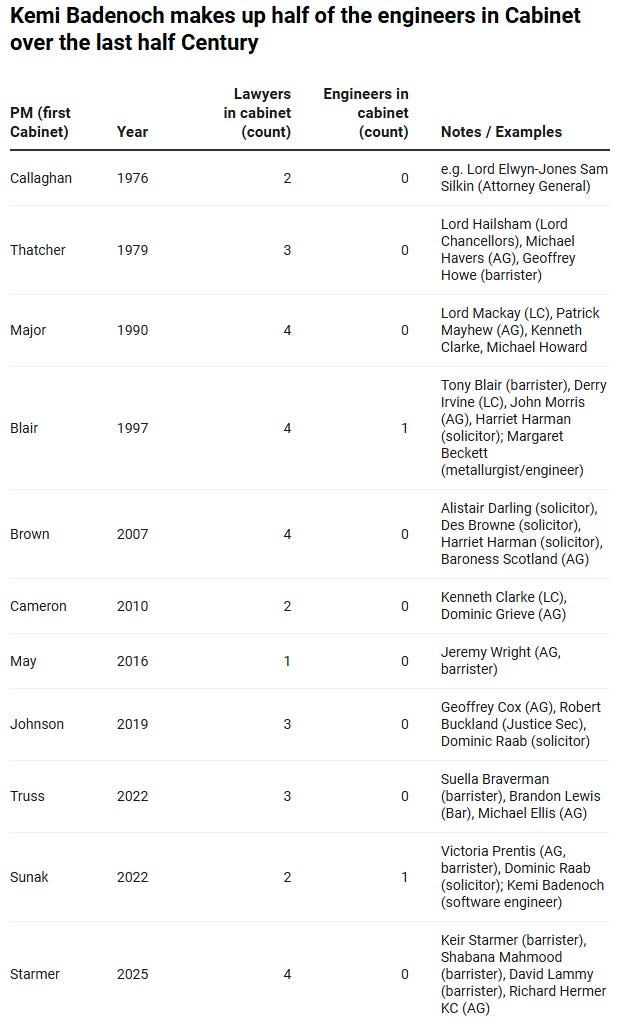
Cabinet posts are taken from official Cabinet Office lists and biographies (Parliament website, Who’s Who, Wikipedia); individuals are classified as “lawyer” if they held a legal office or practised law, and as “engineer” if they worked in a substantive engineering role prior to politics
All of this evidence so far suggests that the UK has a much stronger legalistic muscle and has skipped engineering leg day.
But how does this compare on the international stage?
The picture here matches the overall trend, but in a less straightforward manner. Finding comparative data was close to impossible here.
Most countries lack a major engineering presence in parliament. But many other countries, such as the Netherlands (8.7%) Sweden (5.7%), Germany (5.5%) have much higher rates than the UK. Other nations, such as Italy (1.5%) and the USA (1.7%) are closer to the UK makeup.
On the legal front, the UK is actually relatively middle of the pack. The US is way out in front, with 32% of the House of Representatives (and 50% of Senators) as having been to law school. In Italy and the Netherlands, that figure is 18 and 15.7% respectively. France, who I couldn’t find data on for their engineering representation, has only around 6% of National Assembly members as lawyers by trade.
If you are, like many Whitehall watchers, Cummings-pilled - you may think that actually what the ministers think isn’t so relevant. What actually matters might be what the senior civils servants do and think.
Finding data on senior officials is generally tricky, but the backgrounds of Permanent Secretaries (the most senior official in a department) are generally available.
What you find here might look like a similar pattern. But there are other factors that need to be considered.
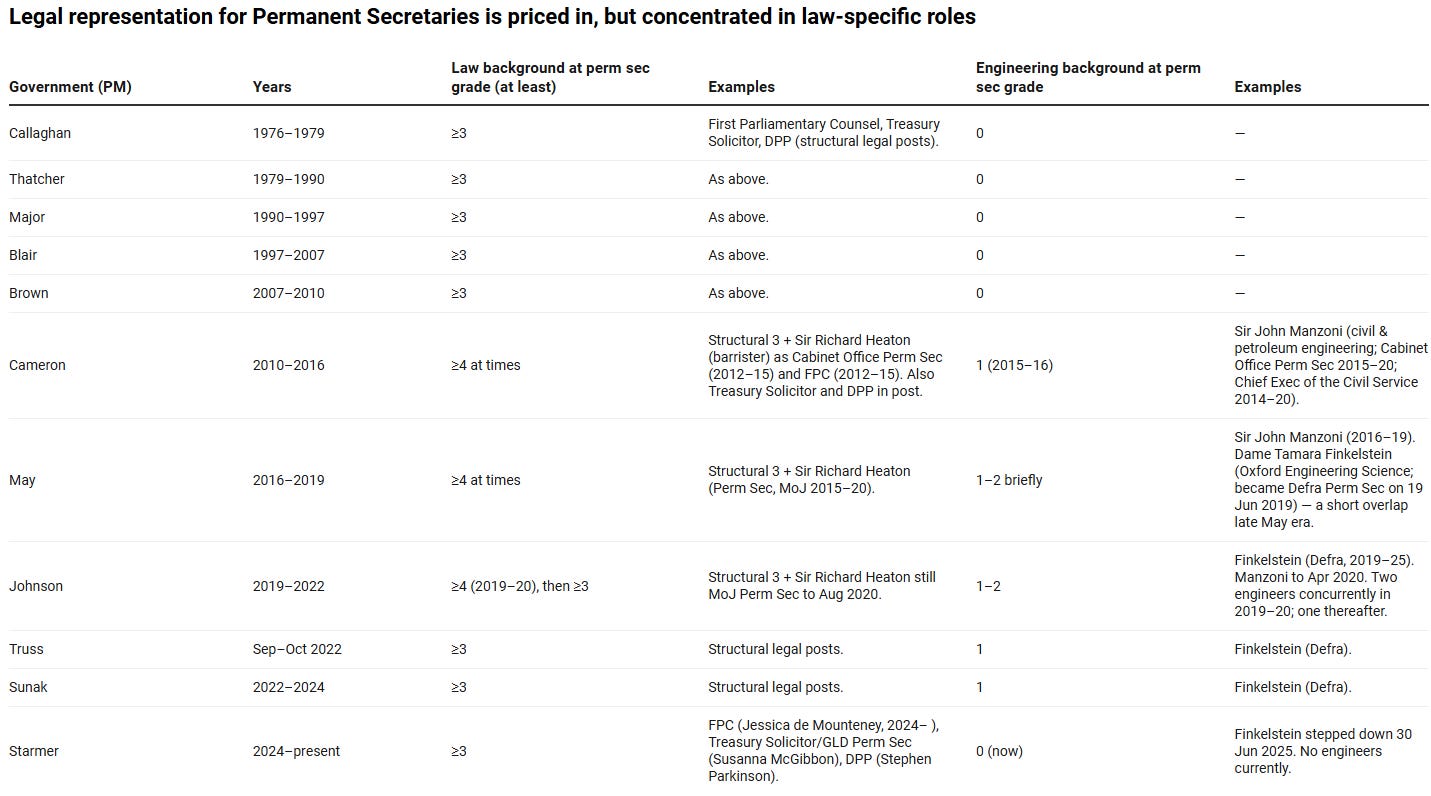
Backgrounds are taken from departmental biographies; individuals are counted as “lawyer” if they had a professional legal career and as “engineer” if they held a recognised engineering or applied science role before joining the civil service..
What we find is that Law is structurally embedded at the very top of Whitehall. Since 1976, there have effectively been three Permanent-Secretary-grade legal leaders at all times (First Parliamentary Counsel, GLD/Treasury Solicitor, Director of Public Prosecutions).
As the story goes in parliament, Engineering backgrounds among Permanent-Secretary-grade leaders are exceptionally rare. In the last 50 years, I could verify just two: Sir John Manzoni (2015–20) and Dame Tamara Finkelstein (2019–25). Today, there are none.
It is difficult to know what conclusions we should draw from this. On the one hand, a lot of the Permanent Secretary roles that boast lawyers are positions that only a lawyer can do. It’s already priced in. As a result, this suggests a less pervasive legalistic tendency than if the Permanent Secretaries of the Department for Transport and Environment were lawyers. On the other hand, the fact that the British State has automatically created Perm Sec level roles for specific legal counsel sends a signal about what it values.
If you have any experience working in the civil service, you see how this plays out. Working in government, every time you try to do something that is remotely high impact, you will eventually be told that your idea may well be illegal. During my secondment, I had to spend a shocking amount of time doing back and forth over whether interventions we were making were violating subsidy control, or why organisations that we wished to support, who were the only credible organisation in the country to deliver certain projects, would get a ‘Direct Award’, rather than going to a ‘fair and open procurement’ process. This delayed money getting out of the door and creates major delivery risks for projects being delayed.
As a result of this, my sense is that the lawyerly blockage aspect of the UK somewhat differs to the US. The UK has more of an administrative proceduralism, whereas the US is generally more mired in a truly judicial proceduralism.
For infrastructure projects, the UK tends to delay start times, sometimes indefinitely. The US more often sees projects start and then stall mid-course. For instance, the UK may spend 15 years debating and planning a rail line (HS2’s phase 2 was under discussion for a decade before cancellation), while the U.S. started building California’s high-speed rail relatively quickly in 2015 but has since progressed slowly amid lawsuits and funding holdups. In both cases, the timeline to completion extends far beyond initial expectations, but the pain points differ: UK projects suffer pre-construction paralysis, U.S. projects suffer mid-process gridlock. This of course isn’t a neat binary: judicial reviews have become a detrimental feature to the UK planning process.
I think the data outlined firmly suggests that on a spectrum from ‘engineering state’ to ‘lawyerly society’, the UK is certainly closer to a lawyerly composition. However, I don’t think this is as complete an analysis as it would be for the US or China. This is for a couple of reasons:
There are other European nations that have a broadly similar elite legal/engineering composition who are much better at building things than the UK.
We have become a lot worse at building things over the last forty years. But this hasn’t coincided with a rise in legal representation in parliament and the senior civil service.
The ‘procedural fetish’ that the lawyerly society is charged with pining for is certainly endemic within the British state. But I believe that there are a broader set of features that hold back the state in a manner that I don’t think is strongly synonymous with lawyers.
Britain is famously a service economy. The Professional Managerial Class roles that this sector bestows have generally been seen as high wage and high status. But it may well be the case that many of these functions are the machine that constrains our ability to build.
The UK’s professional elite has gravitated toward administrative and compliance roles, a phenomenon Pamela Dow calls “HR Britain”. Dow, a former senior civil servant tasked with reforming the way officials are trained, argues that Britain’s governing class is increasingly made up of Human Resources and bureaucracy specialists rather than builders or innovators.
She lists some statistics detailing how Britain now leads the world in HR:
the share of HR directors on corporate boards jumped from 47% to 85% between 2005 and 2017;
over 70% of FTSE 100 firms have a Chief People/HR Officer on the executive team
Astonishingly, HR staff now outnumber NHS doctors by about 3 to 1 in the UK, with the number of HR workers growing 42% from 2011 to 2021
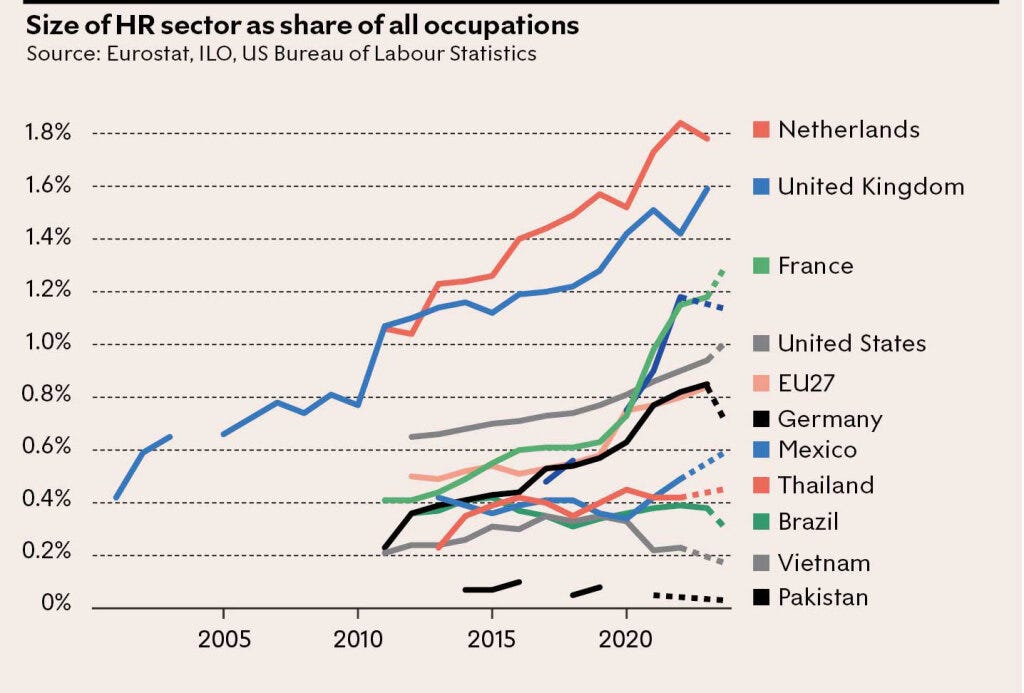
Dow labels this a “shadow HR empire” running Britain. The bureaucratic, compliance-focused culture this reflects is very much in line with the notion of a “lawyerly” society – one preoccupied with process, regulation, and managing risk (and “people”) rather than with engineering.
But this goes beyond just process. HR and the surrounding umbrella of PMC roles often have hyper-fixation on Key Performance Indicators and other targets that constrain creativity and act as a handcuff on overall dynamism. This should not be confused with ‘talent and people’ functions, charged with attracting and retaining talent, who are critical functions which should be further empowered where possible.
In some ways, you could compare this laser focus on KPIs above all else as a gene derived from the engineering state, rather than a lawyerly society. Wang’s harrowing chapters on the horrors of Zero Covid and the One Child policy outline how only engineers could so ruthlessly pursue a particular number at the expense of everything else that it creates historic levels of trauma for the population. Now, the HR empire is of course, not as brutal, but its incentives clearly generate perverse effects for the industries that they govern.
Furthermore, a well-meaning, often defensible tendency to ‘standardise’ hiring, compensation, and promotions, can sometimes go awry when executed poorly.
In government, this has dire consequences for talent recruitment. Civil servants of all stripes decry the hoops you need to jump through to prove you are ready to get a promotion, while top talent you are trying to bring in will not be able to command the wage that they deserve, because a team has failed in their attempts to get a ‘special pay case’ to justify paying close to market wages for top technical expertise and outside of the low, rigid civil service pay bands.
I am not convinced that ‘HR Britain’ is the overall constraint on UK productivity, but I do think this argument is most compelling around constraining civil service talent recruitment, retention, and development. This is certainly a major barrier to better state capacity, but doesn't explain all of the insanity you see in other parts of infrastructure buildout etc.
This is where Dan Davies’ arguments are convincing. He argues that in the Anglosphere, quasi-judicial planning plus a thriving professional services ecosystem (law firms, environmental impact consultants, PR shops) creates pre-emptive risk aversion. Developers over-engineer applications to insure against every conceivable objection. That makes paperwork and timelines balloon, even when no one actually sues.
The now infamous HS2 ‘bat shed’ totted up to around £100m in costs, with lawyers, hydrologists, etc exploring 17 different options, billing at hundreds of thousands per analysis.
In Davies' view, it isn’t chiefly that “lawyers block projects in court.” It’s that planning is organised as a quasi-judicial process, and that professional-services incentives make everyone behave as if litigation is imminent, inflating cost and time even without actual lawsuits. In short: lawyerly culture matters, but the industrial organization of planning and consulting is the engine of delay.
At risk of not picking a side, I see Wang, Dow, and Davies’ arguments reinforcing one another. Britain’s issue might be described as a ‘managerial paralysis’ - a surplus of managers, lawyers, HR staff and generalist consultants that tie internal bureaucracies in knots, rather than through courtroom litigation.
This managerial paralysis has several core components:
The procedural fetish of the lawyerly society,
The commercial incentives to treat litigation as imminent
The fixation on standardisation and KPIs of HR Britain
Critically, these things bleed into each other in all sorts of unhelpful ways.
Take the bat shed example. The procedural fetish sees every species impact studied at length, and calls for judicial review beckon. Litigation incentives emerge where contractors commission extra ecological reports to protect against judicial review. Managers optimise for KPIs where they want to show they have addressed ‘stakeholder concerns’ and complied with process, rather than cost or delivery speed. The result is £100m spent on a single mitigation structure before works have even advanced.
All of these professions bring positive elements to the table. Public input, environmental protection, and workers’ rights are the bedrock of individual liberty and a democratic society.
But it also has culminated in a ‘rentier state’: where the rich can block housing developments so that the rest cannot get on the property ladder, where senior civil servants can remain at the top of the tree, unthreatened by new outside talent that may disrupt their status, and an overall culture chooses indecision for fear of controversy or upsetting special interest groups, at the expense of the public.
I am sure that it wouldn’t hurt if we had more engineers and less lawyers in parliament and swathes of the senior elite of Britain. But for us at least, it is not the case that One Profession Rules Them all.
If Wang is right: if the US is the lawyerly society, if China is the Engineering State, perhaps that makes Britain’s contribution to this scheme clear. Perhaps it is the Powerpoint Machine, where nothing is built until the slide deck is complete.
No posts
Comments
Nothing yet. Say the first thing.
Sign in to join the conversation.