
Last time, I wrote about the Lizardman constant, the idea that for any opinion poll a small proportion of respondents will endorse any proposition, even one as ridiculous as “Do you believe that shape-shifting reptilian people control our world by taking on human form and gaining political power to manipulate our societies, or not?” or “The Canadian Armed Forces have been secretly developing an elite army of genetically engineered, super intelligent, giant raccoons to invade nearby countries”.
Part of the story there is that running good surveys is hard, and one of the risks is people who respond inauthentically — meaning that they either don’t read the questions or respond for their own amusement rather than in order to provide researchers with high-quality data (imagine!).
In the comments, Peter Barrett pointed out another part of the story here: stories based on inauthentic responding are popular: the media like to share polls which suggest a large number of people believe something dumb, and we, the audience, must like hearing this. These results don’t receive the scrutiny they should because they play into the ever-popular “people are stupid” school of psychology.
The “people are stupid” school is a rough label for all the results in psychology which suggest that human reason is a disaster: biased, superstitious, credulous and so on. Even balanced views in the original research become laundered, so that when they are cited by other researchers, or by the media, the aspects showing reasonableness are de-emphasised, and the aspects showing foolishness or bias are emphasised.
A good example is Thinking Fast and Slow, by Nobel laureate Daniel Kahneman. The book is a magnificent synthesis of work in the judgement and decision tradition, a tradition which the author helped found and define. The Fast Thinking of the title is intuitive and based on pattern recognition, the Slow Thinking is deliberate and reasoned. This is a so-called Dual Process model of the mind (which, for what it is worth, I reject).
Nobody knows the work better, and Kahneman is a careful writer, but at times even he slips into intimating that the Fast is biased and the Slow is rational (a distinction which he knows better than to fully accept). This suggests a false image of the mind which is something like this:
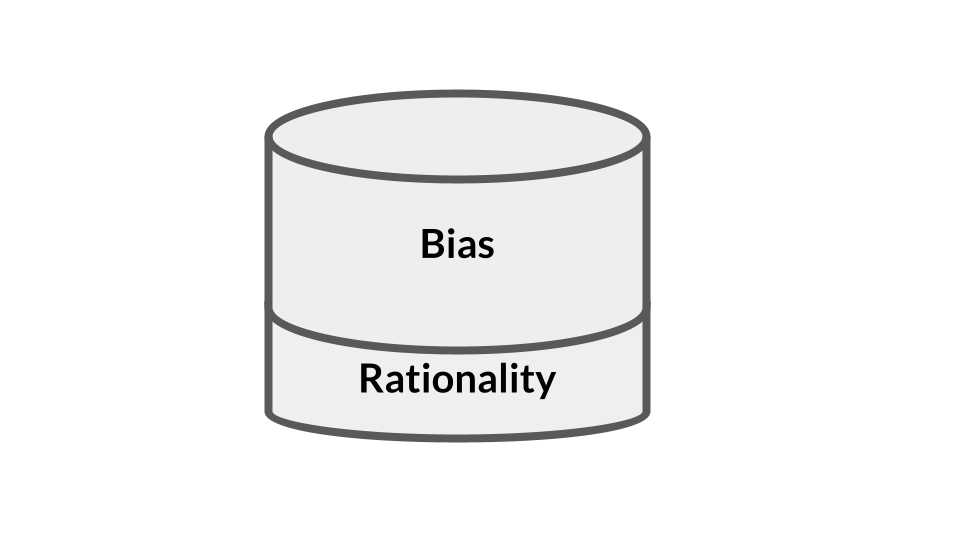
The two styles of processing become associated with Good vs Bad reasoning. There is Bias (bad, the larger part) and Rationality (good, a minority). We’ve known since at least the 80s that research results showing failures of human reason are more likely to be cited than research results showing successes (Christensen-Szalanski & Beach, 1984). Perhaps it is true, failures are more interesting, so it is understandable why more attention is devoted to them, but that doesn’t mean they define the majority of human attempts at reasoning, nor that biased or unsuccessful reasoning is the product of a single type of process (and there is some kind of better reasoning process ‘underneath’ which remains untapped).
When Kahneman’s work is talked about by others there is sometimes another distortion — bias and rationality become properties of individuals, rather than properties of processes which we all possess. Some of us are rational, and some of us (always other people) are biased:
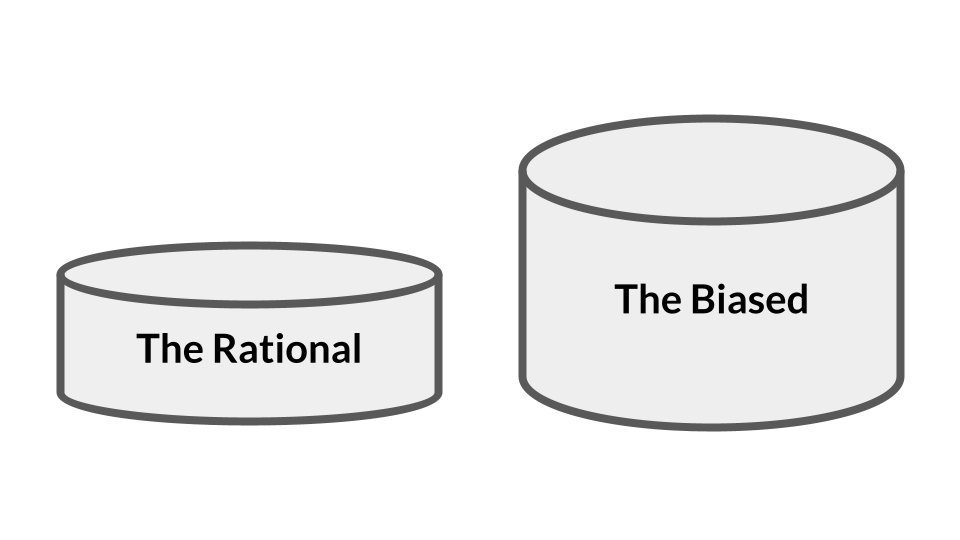
In political science, this was formalised as the “third person effect” (Davison, 1983), a tendency for most people to think that other people are more vulnerable to manipulation, stupidity and irrationality than ourselves.
It was this idea that I was trying to capture formally by developing a new measurement scale, the Faith in Reason scale (which emerged out of this newsletter from May 2022, and led to this paper, which is currently under review). The work here tries to measure the degree to which individuals believe the general public is reasonable.
My results suggest that there is a wide spread of views, with a small tendency to believe the worst rather than the best of the reasoning powers of our fellow citizens.
This is in line with the popularity of stories of absurd beliefs revealed by polling, and the “people are stupid” school of psychology, but why is it so?
Maybe it is no more than attentional bias to bad news — just as stories of crime and disaster invite us to prepare for life-threatening dangers, so stories of foolishness and error invite us to prepare for reason-threatening dangers. Better to overestimate the chances of error than be wrong with a false confidence. This theory, however, doesn’t explain the discrepancy between our beliefs about our own reason and that of other people.
In the comments on last week’s newsletter, Peter went on to suggest that the discrepancy could be a side-effect of a classic phenomenon, the Fundamental Attribution Error. This is the idea that we see other people’s behaviour as arising from their enduring traits, such as their intelligence or personality, while our own behaviours seem more strongly guided by our circumstances and environment. Or, colloquially, I tripped over because someone left something in my way, but you tripped over because you’re clumsy.
Expanding the thought a bit: understanding behaviour, whether our own or other people’s, requires knowing something of the environment (what outcomes are likely), the information available and the relevant motivations (what we want to get or avoid as a consequence of any choice). We know these better for ourselves than for other people, but it is easy to neglect our ignorance of the differences in environment, information and motivation between us and others. When we observe other people’s choices we conclude people are making them for our environment, with the knowledge we have, for the reasons we make decisions. From this perspective, other people’s choices — perfectly sensible for them — can look stupid.
This explains why we might believe other people are less reasonable than they are, but not about why we might enjoy believing it.
An obvious suggestion is that believing other people are foolish panders to our ego. The more foolish other people are, the more special we are just by being non-foolish. I don’t know how you would test this idea, or even calibrate belief in it up or down.
The belief also seems to feed fairly directly into anti-democratic sentiment. If people are fools then they shouldn’t be trusted to make decisions about society, and maybe it is better to let an (intellectual) elite decide instead. Although I think this connection is clear, you still regularly hear various shades of “people only voted this way because they were tricked” from supposedly pro-liberal democracy commentators. And, further, identifying a consequence of this belief doesn’t add up to successfully identifying a cause (unless you buy into the additional conspiracy theory that elites would like us to believe it because it leaves them in charge, so they control the media to encourage the belief).
So, there’s no single story I’m happy with. I’ll continue thinking on it. If you have any suggestions as to why the “people are stupid” school of psychology is so popular, please let me know.
This newsletter is free for everyone to read and always will be. If you can afford it, feel free to chip in to help me keep writing for everyone: upgrade to a paid subscription (more on why here).
See below for references, and other things I’ve noticed.
Christensen-Szalanski, J. J. J., & Beach, L. R. (1984). The citation bias: Fad and fashion in the judgment and decision literature. American Psychologist, 39(1), 75–78. https://doi.org/10.1037/0003-066X.39.1.75
Davison, W. P. (1983). The third-person effect in communication. Public Opinion Quarterly, 47(1), 1-15.
That paper on measuring belief in the reasonableness of others:
Stafford, T., Zhu, J., & Dommett, K. (2024, December 31). Quantifying belief in the rationality of others: the Faith in Reason scale. https://doi.org/10.31234/osf.io/umwxj
Newsletter introducing this: Belief in the reasonableness of others. Reasonable People #57: Developing a measure of our faith in reason, new work from me
origin story: Quantifying our Faith in reason. Reasonable People #30: Measuring the core belief that people do what they do for good reasons.
where it went: The effects of political disappointment. Testing how we feel about each other when democracy doesn’t go our way, a work in progress.
I showed two diagrams which I claimed were distortions of the truth about bias and rationality. This one is a closer reflection of how I think things really work in the mind. Bias and rationality are different sides of the same thing:
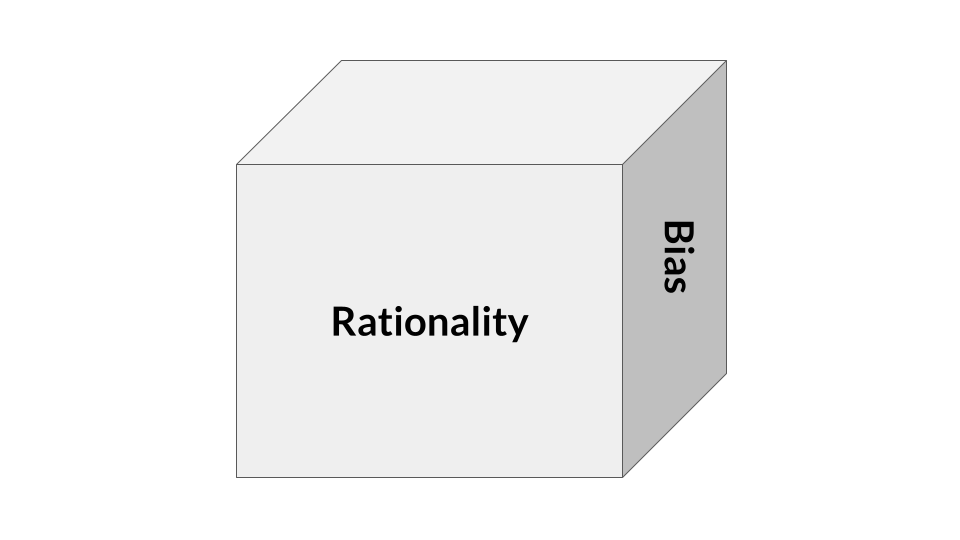
When you give up on the idea of a perfect rationality, you can start to describe how the mind actually works, producing success (mostly) and failures (in some predictable circumstance) as a consequence of the same common core of cognition. More on that another day.
Thanks for reading Reasonable People! This post is public so feel free to share it.
Others things…
Mike argues that factual errors produced by AI fact-checks are less of a problem that many claim. In fact, over-indexing on the mistakes of AI creates a risk you’ll neglect how useful they are as a part of a wider process of argument-building:
"The question is not whether the answers you get are perfect (there are no perfect answers to most things anyway). The question is whether a person who learns to use these tools in this way will have more evidence-informed opinions on things than someone who does not know how to use these tools."
Link: Publishing-brain limits people’s understanding of AI usefulness
Kate dissects how the engagement algorithms of the big social media platforms mesh with a strategy of implication rather than direct statement of provocative views:
If audiences engage with the post because they like its implied anti-immigrant messaging, Walsh wins. If audiences engage with the post to counter his anti-immigrant messaging, he also wins. If audiences engage in order to fight about what he meant or didn’t mean by the post, again, he wins. Our engagement — via reactions and comments and even just lingering longer on his post — feeds his status within Facebook’s algorithms and means that we and more people like us will continue to see his content and more content like his in the future.
Link: Engineering Engagement: Strategic Ambiguity and Controversy-Bait
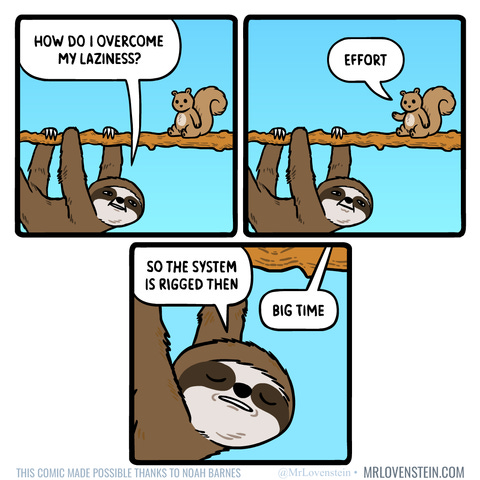
Mr Lovenstein, Laziness:
Comments? Feedback? In two minds about getting in touch? I am tom@idiolect.org.uk and on Mastodon at @tomstafford@mastodon.online
AI declaration: I write all the words and think all the thoughts myself. I asked Gemini to check for spelling and grammar.
No posts
Comments
Nothing yet. Say the first thing.
Sign in to join the conversation.