
Last week, Laura Loomer admitted she was wrong about Ukraine. Loomer is an internet personality, a Trump outrider “with a reputation for incendiary social media commentary” (AP News), a “far-right conspiracy-theorist influencer” (Le Monde). Previously she has amplified Russian talking points on Ukraine, minimising civilian suffering and making accusations such as that Ukraine is a hotbed of Nazism. Since visiting Ukraine she has repudiated her previous views, recognising them as “not very nice” and herself as misled.
Conversion experiences are like lightning flashes over the darkened landscape of belief. For most of us, on most topics, we avoid articulating exactly what we think at every moment. This allows the structure of our beliefs to warp and shift over the years, as we gradually drift in how we feel on particular topics. On topics as big as who we support politically or as small as what we believe about the correct way to cook rice, we can change without having to acknowledge to anyone, ourselves included, a singular point at which we switched. Conversions are the exception, the explicit rupture with prior beliefs. Anyone can experience one, but it isn’t surprising that the ones we know most about are from public figures, preachers, pundits and politicians whose job is to regularly profess what they believe.
With someone like Loomer, it is tempting to ask “why not sooner?” Given the wealth of evidence, did she really need to go to Ukraine, to experience an air raid, to convert from one position to the other? If the evidence is so compelling, why did it not change Loomer’s mind earlier?
Asking this would be to make a common mistake about how beliefs change. Our minds are not passive storage for information. We do not instinctively weigh out the evidence for a position like we weigh out sugar in a cake recipe.
The opposite, but more severe, error is to believe that nobody ever changes their mind because of evidence, and people’s commitments are entirely due to their economic incentives, or social connections or deep psychological desires. Obviously we do all have these motivations. Someone like Loomer is more conflicted than most — she makes her money by being the centre of attention for having controversial beliefs. However, as her case illustrates, beliefs do change, and a world where evidence is irrelevant is as cartoonish as one where everyone adjusts their beliefs in perfect response to the evidence.
How can we make sense, then, of the inconsistent relation between the evidence in front of us and our beliefs? Religious narratives describe conversions as flashes of light. A powerful voice from the heavens reveals the Truth and illusion falls away. The psychological truth of conversion experiences is in the rift between before and after. Prior beliefs seem incomprehensible post-conversion, just as pre-conversion the critical evidence seemed insufficient to justify a change in belief.
Beliefs change like businesses go bankrupt: gradually then all at once. With bankruptcy, the business is solvent while it loses money, but at some point the owners (or more likely the creditors) lose faith that it will ever stop losing money, and decide to cut their losses. The loss of faith creates a tipping point where the conditions which were sustainable previously (a daily loss) become unsustainable.
Our beliefs exist in a network with all our other beliefs, with our habits and commitments, and so form a complex system. Our beliefs about who we trust tug on our willingness to believe what we’re told. Our beliefs about the way the world works pull on our beliefs about what is likely to happen, or what a plausible explanation for events is. Our knowledge of what we said yesterday pushes up against what we believe we should say today. The whole network of pushes and pulls creates a tension which holds existing beliefs in place. No wonder a single new piece of evidence can sometimes seem like it is overlooked.
But beliefs do change. A tipping point is reached in which the network of beliefs shifts into a new configuration. The facts haven’t changed but the cumulative weight has crossed a threshold. It may not even be a large thing, but some perturbation knocks a belief-network that previously seemed stable off balance, and a new configuration snaps into existence. Under the threshold, gradually, the links between different beliefs were changing, and then, all at once, we come to realise we now believe something different from what we did yesterday.
This is why argument looks like it has such a hard time being effective, and it is easy to believe in the horror-story of human irrationality (that people don’t change, or just believe what is convenient, or whatever). Making arguments and providing evidence doesn’t work immediately, or consistently, and it doesn’t work on its own, but it does work.
If my account of beliefs as complex networks is right, then some of the time the most effective arguments are changing beliefs under the surface. Even if the person you are arguing with doesn’t admit it, they may be changed by your arguments, with the change in belief emerging hours, days, or years later.
This complexity is the missing ingredient in understanding bounded rationality (https://en.wikipedia.org/wiki/Bounded_rationality). Bounded rationality is the idea that our minds are adapted to make the best sense of an uncertain world in the limited time and with the limited resources we have. This makes us less than ideal reasoners, but still more than simple machines with predictable responses. We each carry a certain amount of inconsistency, but not so much that we should give up on reasoning altogether.
Beliefs are only useful if they are connected to other things, but these connections make the input-output relationship complex. Just as strong evidence doesn’t move people as much as it should, sometimes small things trigger a cascade. If you want to change minds it takes an enduring faith in reason to keep trying.
Reasonable People is having August off. Thanks for reading!
This newsletter is free for everyone to read and always will be. If you can afford it, feel free to chip in to help me keep writing for everyone: upgrade to a paid subscription (more on why here).
See below for references, and other things I’ve noticed.
Previously, by me, a review of a very relevant book:
Unfollow. Reasonable People #28: Megan Phelps-Roper’s story of losing faith in the Westboro Baptist Church
This is a very good podcast generally, and the discussion across four episodes illustrates many of the complexities I didn’t get into in this newsletter.
Past, Present, Future (“The History of Ideas Podcast
with David Runciman”) on Political Conversions: 1 Going Fascist, 2 Communism – The God That Failed, 3 From Trotskyism to Neoconservatism, 4 Switching Sides in the 21st Century
And of course, David McRaney wrote the book “How Mind’s Change”. This reprise of the story from one chapter is great:
YANSS 342 - The Conspiracy Theorist Who Changed His Mind
Thanks for reading Reasonable People! This post is public so feel free to share it.
How do you feel about the balance between reporting and speculation in this newsletter? Normally I feel better when I am trying to report on some primary empirical finding, or at least support my reasoning with careful citation to the literature in cognitive science. Sometimes I break out of this mode and let myself indulge in trying to articulate how I think about things. Today’s post is an example of this. There are no new facts here, it really just (re)description, and without references to the reasons I have come to think about belief change in this way.
Examples of recent posts which are primarily empirical reporting:
Striking evidence for forced experimentation. A natural experiment shows how we always have something to learn, even about the things we are most familiar with.
Another algorithm is possible. How social media could easily be changed to stop us hating each other so much
AI systems out-persuade expert humans. Panic? Quick review of a compelling new report
Examples of recent posts which are also more speculative:
Social thinking. How other people, even if just imagined, can help puncture the illusion of understanding
Why we like to believe other people are stupid Reason sells, but who’s buying?
Predicting human behaviour. Why it is hard, and why LLMs may not help
Are the speculative posts worth reading? Should I keep them?
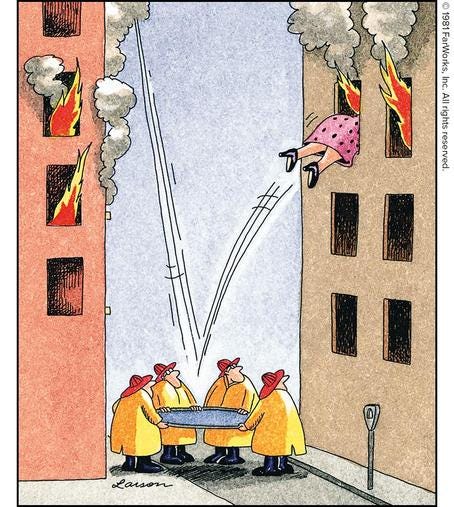
The Far Side Bot has reminded me of Gary Larson’s voluminous output. There’s probably one about belief change in there, but I couldn’t find it, so I share this instead:
END
Comments? Feedback? Change my mind? I am tom@idiolect.org.uk and on Mastodon at @tomstafford@mastodon.online
AI declaration: I write all the words and think all the thoughts myself. I asked Claude to check for spelling and grammar.
No posts
Comments
Nothing yet. Say the first thing.
Sign in to join the conversation.