
In the recent webinar on populism, I made the argument that a technocratic model of investment might have created space for populist attacks, whether from Right or Left. A bit like this, then:
ESG investing raises critical questions about democratic accountability. Through allowing unelected technocrats, rating agencies, and asset managers to define and enforce what counts as “sustainable,” ESG frameworks can mobilise capital in ways that bypass public consent, politicise economic decision-making, and impose contested normative goals. This creates a scenario whereby the ultimate beneficiaries, such as public pension beneficiaries, may unknowingly fund ideological priorities, undermining meritocratic principles, transparency, and trust in both markets and democratic institutions.
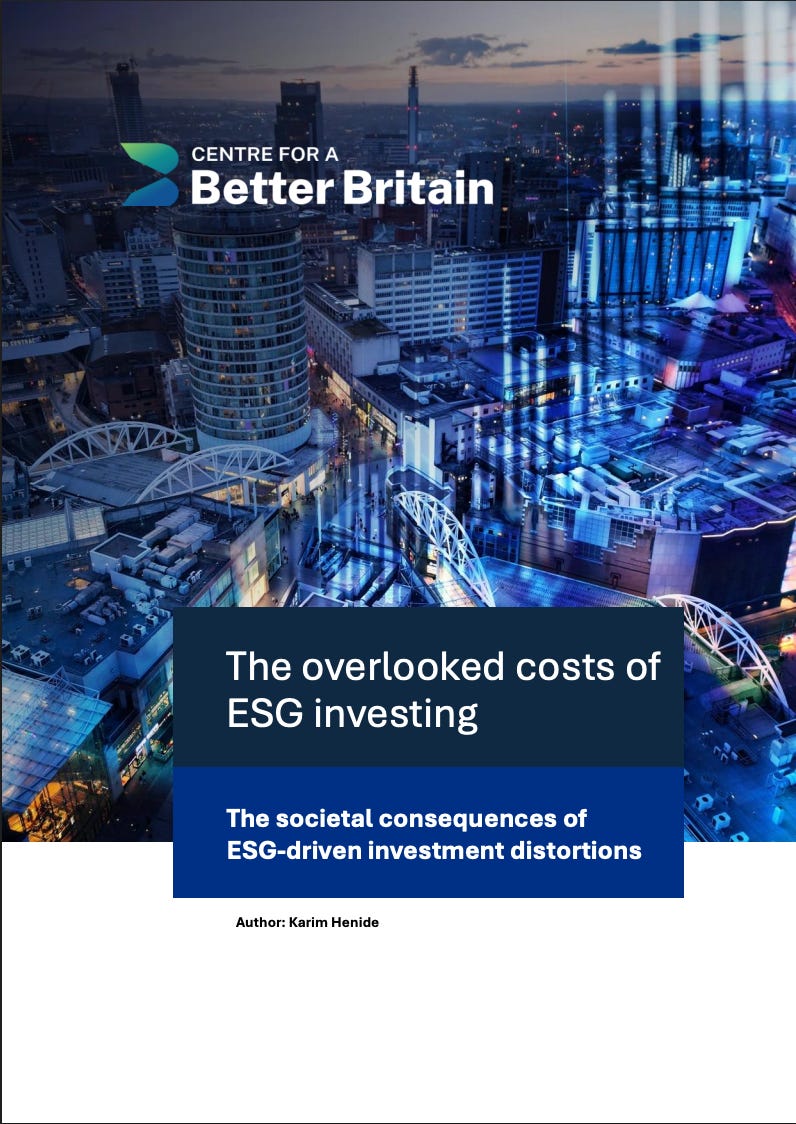
That comes from a new report from the Centre For A Better Britain (CFABB) called The overlooked costs of ESG investing: The societal consequences of ESG-driven investment distortions.
For those of you with better things to do than track the influence of populist politics on investment, the CFABB is closely linked to Reform UK, perhaps even more so than the Prosperity Institute whose output I’ve covered previously.
Reform UK Deputy Leader Richard Tice has already tweeted about it:
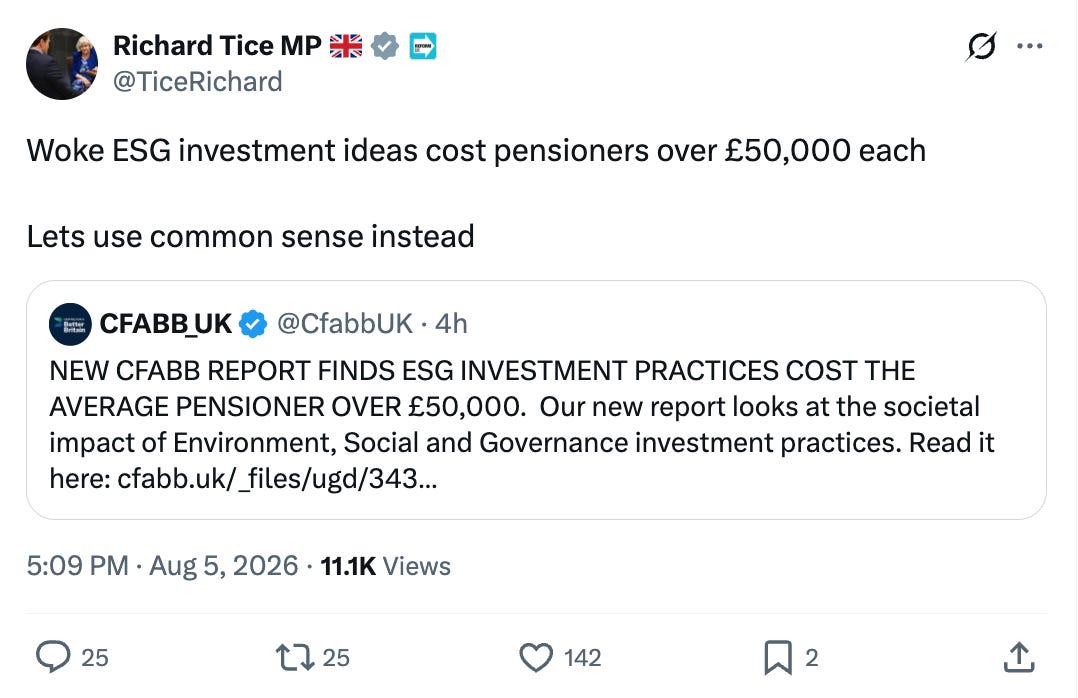
I’ll post up a longer review later but it’s worth clocking that one of its key points is that “ESG imposes societal outcomes without democratic consent” and that technocrats are running the show. As covered in the webinar, the accusation of technocrats making choices without democratic consent fuels the populist argument but it does not follow that populists see the solution as democratisation.
And this comes across in the CFABB report:
investment strategies must be protected from politicisation, including by elected councillors who sit on pensions committees and may be tempted to advance personal political agendas through investment mandates.
We need to address the lack of democratic accountability by reducing the influence of those in the system with democratic accountability….
This, to me, reveals the paradox and opportunity in the populist challenge. Populists seek to represent ‘the people’ as if they were one cohesive bloc with consistent views. Populists think that their views should over-ride the technocrats, not that in areas like this the constituency they claim to represent should deliberate.
Going further into the CFABB report you can see the tension:
Explicit consent for non-financial objectives. Where pension strategies pursue objectives beyond financial risk and return, informed beneficiary consent should be required, not inferred from generic sustainability statements.
My own experience suggests that, if beneficiaries were genuinely given a say, their answers might look very different from those CFABB appears to expect. Would they be willing to accept such an outcome?
What about fiduciary duty?
Statutory clarification of fiduciary duty. Government should provide clearer guidance that the duty of loyalty requires prioritisation of risk-adjusted returns above all other considerations.
Here the objective isn’t really to clarify, it is to define, but again if you do seek to clarify fiduciary duty as it actually exists (as a growing number of people / reports have done now!) this might not land where the report seems to think it will.
And finally, what about this?
Default investment options, the funds most pension savers end up in, should be constructed around unconstrained, market-representative benchmarks, not ESG-tilted or exclusion-based indices
This advocates specific design choices for the funds in which we know most capital will accumulate. So this appears to require the development and adoption of politically ‘neutral’ investment principles that will determine what the public invests in, by technical specialists and without any beneficiary involvement or democratic oversight. I think I read a word for that recently…
Personally I do think the arguments put forward by the likes of the CFABB and the Prosperity Institute deserve to be taken both seriously and at face value. The charge that RI is a technocratic exercise and usually untethered to the views of beneficiaries is not wholly inaccurate. The question is whether to defend the model as it is (“keep the politics out”) or to take the charge seriously and try to engage with it.
Taking that challenge seriously could result in positions that represent beneficiaries’ actual views and interests better than either technocracy or populism. We’re in the foothills of this at the moment in the UK, but it feels like where some of the action may be in future.
PS. The report’s argument also closely resembles something I wrote in early 2025 before Reform even got any influence in the LGPS.
Here’s a prediction: if they choose to do it, it will be easy for far/populist Right parties in Europe to attack ESG/RI as practised by many asset owners in the similar terms as those used in the US.
You can write the UK version of the critique now:
Our pension funds have been taken over by people who have put their own ESG preferences ahead of the interests of British savers. They want to shut down industries that still employ thousands of British workers and they only care about ‘equity’ when it comes to career advancement for middle class professionals and getting well-paid jobs on company boards. They don’t lift a finger for the ordinary Britons that pay their substantial wages. British pension funds should support British workers. We should DOGE the ESG industry feeding off our funds and save some money.
No posts
Comments
Nothing yet. Say the first thing.
Sign in to join the conversation.