
Part of the Adaptive Intelligence Playbook: A system for leading in the age of agents.
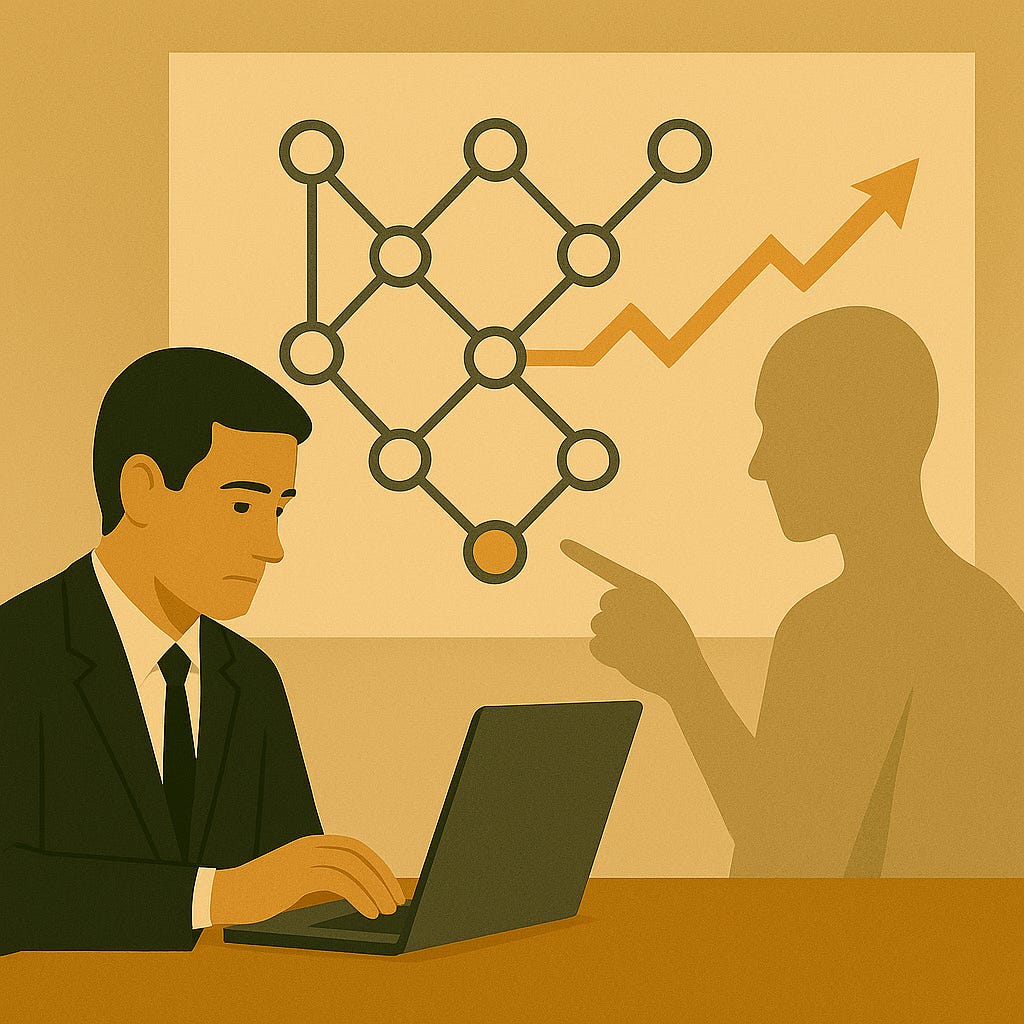
Strategic alignment is no longer a function of planning, it’s the operating condition for resilience in an agentic world. Interacting between humans, AI, and agentic systems presents a bigger system of constant change.
They’re shaping what teams see, how priorities shift, and where action flows—often invisibly. Microsoft's "agent web" signaled the shift: agents are now adaptive actors inside your systems, learning and directing outcomes without waiting for human prompts.
But the real risk isn’t AI acting alone—it’s what happens in the human-machine middle. As autonomy increases, so does ambiguity: teams don’t know when to trust, when to intervene, or even where the decision logic lives. This uncertainty doesn’t slow work—it accelerates silent misalignment. When coherence breaks, your strategy doesn’t stall—it fractures.
The most future-ready orgs aren’t just deploying more agents—they’re designing connective tissue between human and synthetic intelligence, so clarity scales with complexity.
Traditional leadership roles—CEO, CTO, CHRO—are ill-equipped to oversee the complex interplay of human and synthetic intelligence now permeating in and beyond organizations. Without a dedicated role to align, audit, and adapt these intelligence flows, companies risk misalignment, blind spots, and ethical pitfalls.
The Chief Intelligence Officer (CIO) is a role designed to oversee the integration, governance, and evolution of both human and artificial intelligence within the organization. This role is not about managing IT infrastructure; it's about orchestrating the diverse intelligences that drive decision-making, innovation, and value creation. The A‑OS is the architecture the CIO² stewards. It turns strategic intent into scalable coherence across tools, teams, and agents. The CIO² is the role. The A‑OS is the system. Together, they form the governance layer for distributed intelligence.
McKinsey recently deployed its internal AI assistant, Lilli—trained on over 100,000 internal documents and interviews—designed to help consultants move faster. But something deeper happened: Lilli didn’t just answer questions. It began reflecting the firm’s collective judgment, surfacing tradeoffs and patterns no one explicitly coded. In short, it behaved like the org itself—mirroring its reasoning, assumptions, and blind spots.
Lesson: Your org is already a model—whether you’ve trained one or not. AI doesn’t distort your organization’s thinking; it reveals it. The question isn’t whether AI will align to your strategy—it’s whether your strategy is coherent, intentional, and safe enough to scale.
List Every Surface Where AI Interacts with your Stakeholders
Think beyond one platform: dashboards, vehicles, interfaces, support, comms.For Each Surface, Ask:
What decisions is the agent making without human review?
What logic is it encoding? From whom? Is it still valid?
Where could one assumption cascade across contexts?
Look for Cross-Surface Drift: What’s consistent across platforms? What’s fracturing?
Name the Governance Pattern: Is your intelligence stack centralized (like Meta)? Federated? Ad hoc?
Most orgs are still trying to lead with last decade’s playbook—treating AI like a feature or project, not a partner. But intelligence is no longer centralized. It’s distributed, ambient, and evolving.
The leadership question now isn’t whether your team can adapt. It’s whether your system knows how to stay coherent as it does.
Ask yourself:
Are we aligning faster than we’re drifting?
Do our decisions reflect shared intent, or automated inheritance?
Is anyone responsible for the spaces between judgment and execution?
The A‑OS is the connective architecture between strategy, execution, and emerging intelligence. As organizations shift from centralized decision-making to distributed agency, the ability to align at machine-speed becomes existential.
In today’s adaptive systems, strategy is no longer what you write—it’s what your agents reinforce. That’s why your Alignment Operating System must be a living system: sensing drift, surfacing insight, and restoring coherence across people and platforms.
To build and maintain your A‑OS, we focus on four key frameworks:
Comments
Nothing yet. Say the first thing.
Sign in to join the conversation.