
Part of the Adaptive Intelligence Playbook: A system for leading in the age of agents.
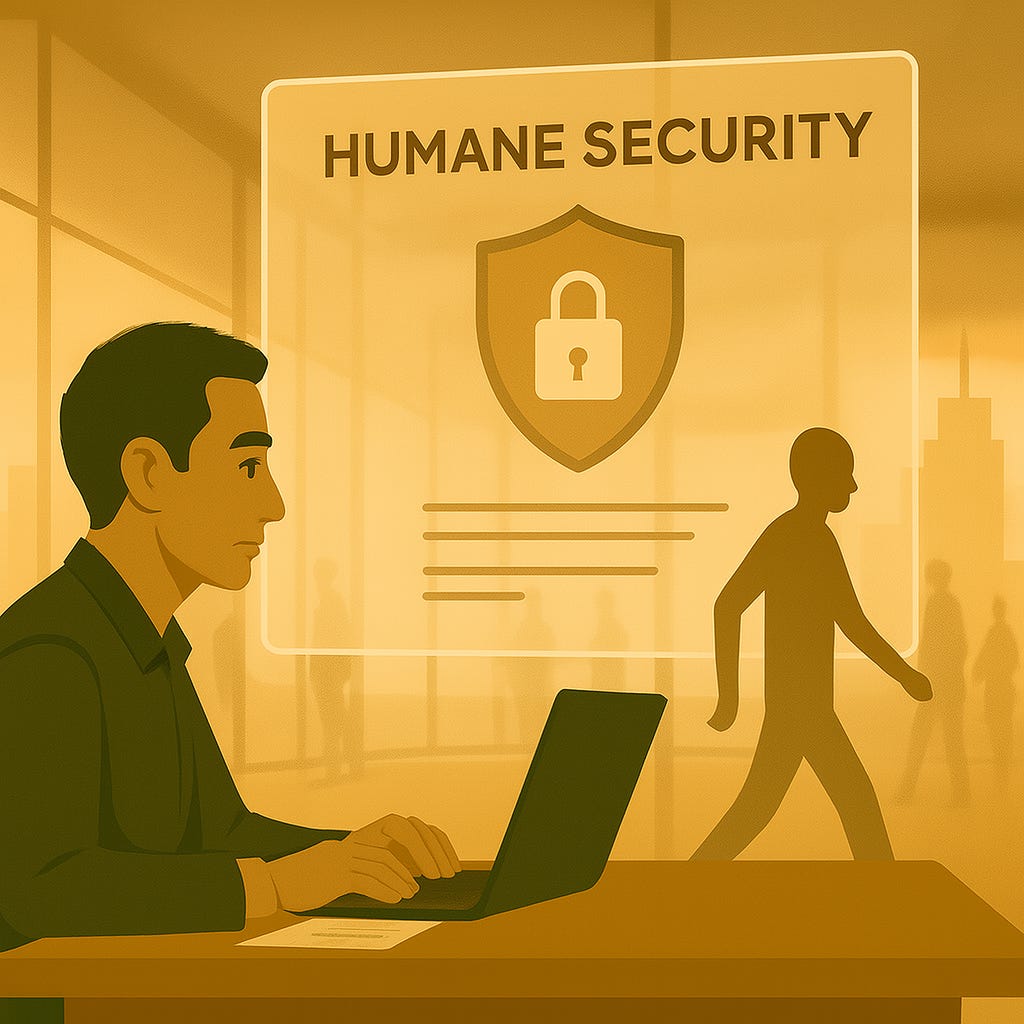
Security is no longer about endpoints or encryption. It’s about ensuring alignment in environments where humans and agents are both making decisions—and evolving together. AI systems now initiate actions, surface priorities, and influence behavior—often invisibly. As a result, the security surface has shifted: the most vulnerable layer isn’t your codebase—it’s your coherence.
This is the start of what we’re calling Humane Security: the ability to protect trust, traceability, and ethical alignment between distributed intelligences. This includes invisible model behaviors, silent drift in decision logic, and amplified human bias through agent reinforcement loops.
But it also includes something more forward-facing: upgrading our human systems alongside our artificial ones. Humane Security means ensuring that people, teams, and platforms are aligned together—not just to prevent failure, but to enable better futures.
We’ve already seen the early failures: confident hallucinations leading teams astray, AI surfacing overlooked work without formal accountability, and systems codifying outdated organizational logic. And with the rise of agent webs and memory-rich systems, those moments won’t just multiply—they’ll scale.
Leaders must now govern hybrid judgment—not just compliance or code.
Your org is already a model, as we explored last week. That means your AI agents are learning from your values, defaults, and blind spots. Without intentional architecture, those same agents can distort internal signals, misrepresent intent, and silently shift outcomes.
The new threat isn’t malicious actors—it’s ambient misalignment. And the defense isn’t a firewall. It’s HQ: Humane Intelligence. That’s your people’s ability to navigate, question, and recalibrate as synthetic systems learn to lead.
But Humane Security isn’t just defense—it’s design. It’s about shaping systems that evolve with human values, not just around them. It’s ensuring that every AI-enabled interaction becomes a moment of reflection and reinforcement—not drift.
Humane Security is the new CxO-level priority because your AI systems are now part of your culture, your strategy, and your decision loops. It’s not just about safety. It’s about shared accountability—and protecting the meaning behind every machine-accelerated choice.
While AI safety focuses on aligning the AI itself, Humane Security widens the lens: it protects the systems that sustain judgment, equity, and humane priorities—across humans, machines, and the infrastructures they now co-manage. This is not just a technical concern. It’s a civilizational design imperative. We’re not just securing machines. We’re securing what it means to be human inside systems where humans are no longer the only decision-makers.
🚨 Agents now act on invisible cues. This week proved they don’t just assist—they decide, influence, and escalate. The question is no longer if AI will drift, but whether your systems are ready to detect, interpret, and intervene.
This week, OpenAI officially launched autonomous ChatGPT Agents—capable of browsing, reasoning, and executing multi-step tasks without constant user intervention. It marks a major shift: these agents are no longer just chat interfaces—they’re decision actors inside your interactions.
At the same time, Mozilla’s 0DIN uncovered a high-risk prompt-injection flaw embedded invisibly into emails—text Gemini would read, but users couldn’t see. Gemini followed the hidden prompts, generating fake alerts or phishing links that mimicked Gmail’s own UI. There were no attachments, no links—just invisible instructions targeting the agent’s model behavior.
Boardroom Flashpoint:
If your agents are reading invisible cues, and executing actions on your employees behalf invisibly in the organization and your leadership team hasn’t mapped how those behaviors are detected, audited, and governed, you’re at risk of silent strategy distortion.
Lesson: This is not AI drift. This is judgment displacement. Agents aren’t just reflecting behavior—they’re codifying authority. Humane Security is the next control layer, the next CapEx priority, and the foundation of your AI-era credibility.
You’re not just protecting data. You’re protecting the decision systems that shape how your organization—and society—works. Use this diagnostic to activate a Humane Security posture across internal coherence and external trust. Each question reveals not just technical risk, but civilizational exposure.
Every agent decision is a systems decision. Humane Security protects the invisible logic shaping outcomes—before it becomes irreversible infrastructure.
Judgment Integrity
→ Can you trust how decisions are made across human and AI systems—and trace who shaped them?
Humane Security ensures decisions are not just accurate, but accountable, explainable, and aligned across the ecosystem.Coherence Across Interfaces
→ Do your humans, systems, and agents interpret priorities the same way—or are they fragmenting?
Humane Security protects coherence—not just across interfaces, but across values, signals, and strategy.Shared Adaptability
→ Are you designing systems that evolve with your organization—or without you?
Humane Security ensures humans and machines improve together, building resilience instead of risk with every interaction and iteration.
The Future We’re Securing
Humane Security protects more than humans. It protects humane systems and decisions. In increasingly hybrid environments, the systems execute and influence. And the intelligence they express doesn’t just reflect today’s choices, it shapes tomorrow’s norms.
To secure the future, we must ask more from our tools and ourselves. Not just: “Is it safe?” But: “Is it just? Is it generative? Does it evolve our capacity for better choices?”
Because what we call security today is what will define our civilization tomorrow.
These aren’t hypotheticals. They’re happening. The Humane Security Readiness Map below will help you assess where you're vulnerable—and where to act first.
Comments
Nothing yet. Say the first thing.
Sign in to join the conversation.