Part of the Adaptive Intelligence Playbook: A system for leading in the age of agents.
Organizational intelligence is no longer just about who leads, but how insight flows. It's about understanding where new value truly emerges.
Breakthroughs rarely come from org charts - they come from deep insights. While founders, innovation labs, and strategic teams often initiate change, the real breakthroughs tend to emerge from intersections—where silos blur, where diverse teams collide, and where AI agents introduce entirely new dynamics. Models are becoming multimodal, ambient, and autonomous. As they plug into workflows, they enable something powerful: the spontaneous recombination of capabilities across the organization.
The real organizational intelligence map is a mesh.
This is a moment of inversion. Core teams no longer dictate direction alone; innovation is increasingly emergent. Adaptive Organizational Intelligence lets you see, sense, and respond to these edge signals in real time.
In practice:
Cross-functional teams become proto-ecosystems.
Agent-enabled workflows and workforces surface novel paths forward.
Decision-making becomes exploratory, not just evaluative.
Organizations that thrive here don’t just integrate AI—they unleash it as connective tissue. They reframe friction as signal. They treat edges not as outliers, but as launchpads.
We often hear this in our work: innovation is still perceived as something owned by certain silos - R&D, innovation, tech teams - or confined to a hackathon. This mindset misses the broader opportunity to upskill the entire workforce in creative and agentic capabilities to enable innovation from anywhere. As a result, organizations may see interesting exploration but fail to convert it into exponential value creation.
When only a subset of the team is empowered to innovate, you limit the surface area of emergence. True innovation surfaces when the organization can see, shape, and contribute. Whether it’s coding agents or generating product imagery through AI, the ability to experiment must be democratized.
In this week’s CxO Council dialogue, we identified that the connective tissue still missing from most organizations was a clear brand and deeply embedded values. These serve as the orientation system that lets distributed innovation feel coherent, making creativity effortless for the organization and intuitive for customers.
The edge is no longer a boundary. It’s a generative zone, if you know how to frame it.
Quick Win: Shift the mindset in the organization in 30 minutes. Align your team on the top 5 mindset shifts for working with AI + agents Access the Session
Uplevel Leadership: Commit to assess and apply HQ (Humane Intelligence) leadership practices over 4 weeks. Everyone should know what today’s intelligence (human and machine) can and can’t do—and how that’s constantly changing. Build awareness, spot gaps, and act with intention. Join our leadership cohort for Developing HQ
Act Fast: Run 1 AI-backed experiment this week. Pick one area where your brand or values can guide a simple, AI-enabled test. Run it. Share what emerged.
Need help getting aligned? Book a session to clarify your innovation infrastructure—before misalignment stalls progress.
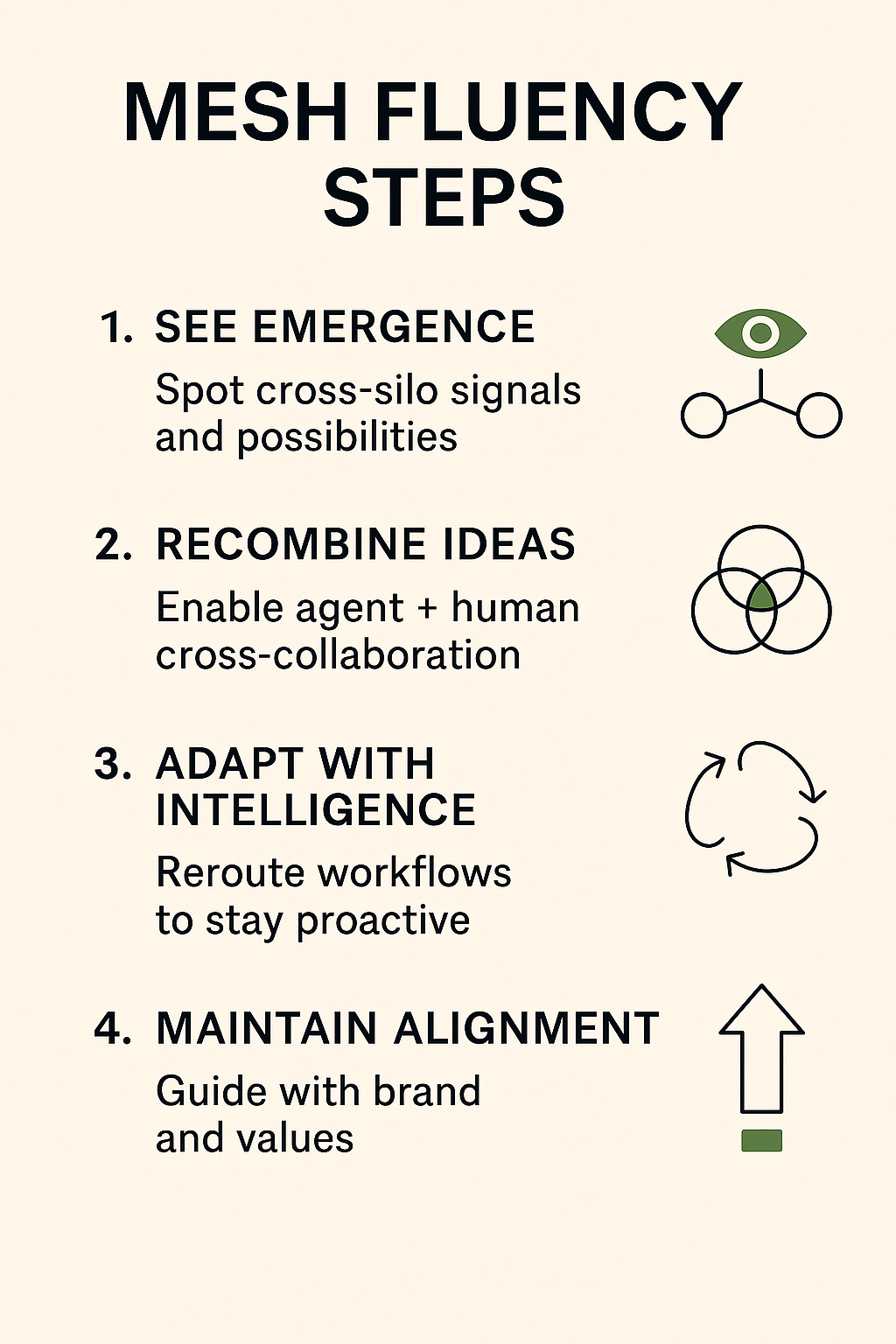
To harness edge innovation, leaders must develop mesh fluency—the ability to spot, enable, and scale insights into action.
💡 What’s the difference between Organizational Intelligence and Mesh Fluency?
Organizational Intelligence is your organization’s cognitive capacity—how well it sees, learns, decides, and adapts.
Mesh Networks are the real-time connections between people, systems, and agents—your dynamic operating structure.
Mesh Fluency is the skill of sensing, enabling, and aligning these interactions intentionally. Mesh fluency doesn’t replace intelligence—it scales it. But only if your foundations are set.
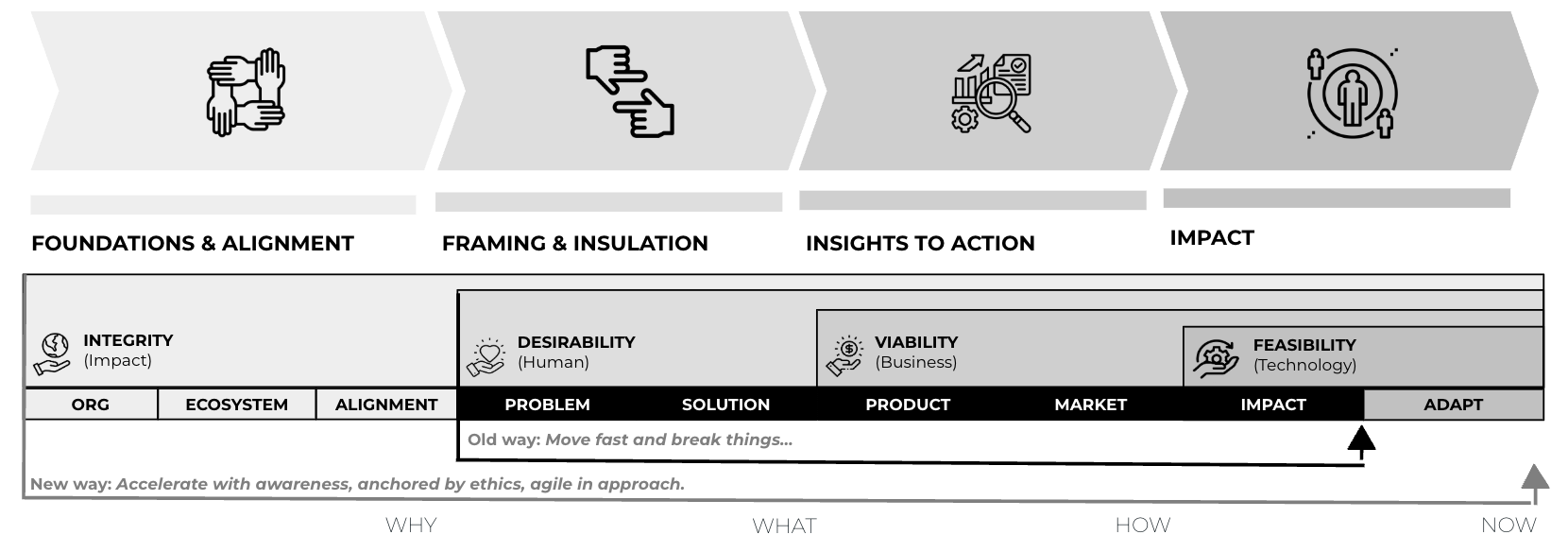
Mesh Fluency builds on solid ground. If your organizational HQ, brand, values, and innovation infrastructure aren’t clearly defined, start with the Innovation Framework at Future | Future. It sets the conditions for responsible, resilient innovation—so your mesh doesn’t fray as you scale.
There are 3 steps necessary to develop mesh fluency:



Comments
Nothing yet. Say the first thing.
Sign in to join the conversation.