
November 7, 2025
I never intended to become a photographer. To begin with, I had almost no sense of what might be called “creative drive.” I started taking photographs simply because, at a drag queen party, I happened to have a camera with me and took some pictures. The event organizer then said, almost casually, “Well, then you can take photos from now on.” In other words, I was promoted from guest to staff, and for me the biggest benefit was being able to attend the event for free. On top of that, the organizer covered the cost of developing the film, so my wallet remained untouched. I never thought of the photographs as “works.” I simply handed over the developed film and prints to the organizer as they were. For me, photography was not a form of self-expression imprinted with my own perspective; it was a way of cutting out moments of the queens’ performances and contributing, in a small way, to their memories. At some point, I began borrowing a camera from one of the event organizers—a wealthy young man—and using that. In short, although I was involved with photography, I was never photographing with the intention of “creating” something myself. The truth is that I was simply carried along by the situation, and that is where I ended up.
It is true that I had been interested in and drawn to artistic things since childhood. Our house contained almost nothing that could properly be called books. What little there was consisted mostly of educational manga that slightly older relatives had outgrown, and an enormous number of exam-prep reference books. I still remember that, for some reason, only two novels—John Steinbeck’s The Grapes of Wrath and Sakyo Komatsu’s Japan Sinks—existed as books deemed worthy of “cultural reading.” I often wondered whether my parents had actually read them. I also recall discovering encyclopedia-like illustrated volumes that relatives had been half-tricked into buying, lying dusty on a bookshelf, and devouring them as if starved. I was sometimes fascinated by the reproductions of artworks lined up in those volumes, but I never went so far as to think that I wanted to create “works” myself. To begin with, as a poor student, I could not afford expensive art materials for my own private enjoyment—and more than anything else, I was bad at drawing.
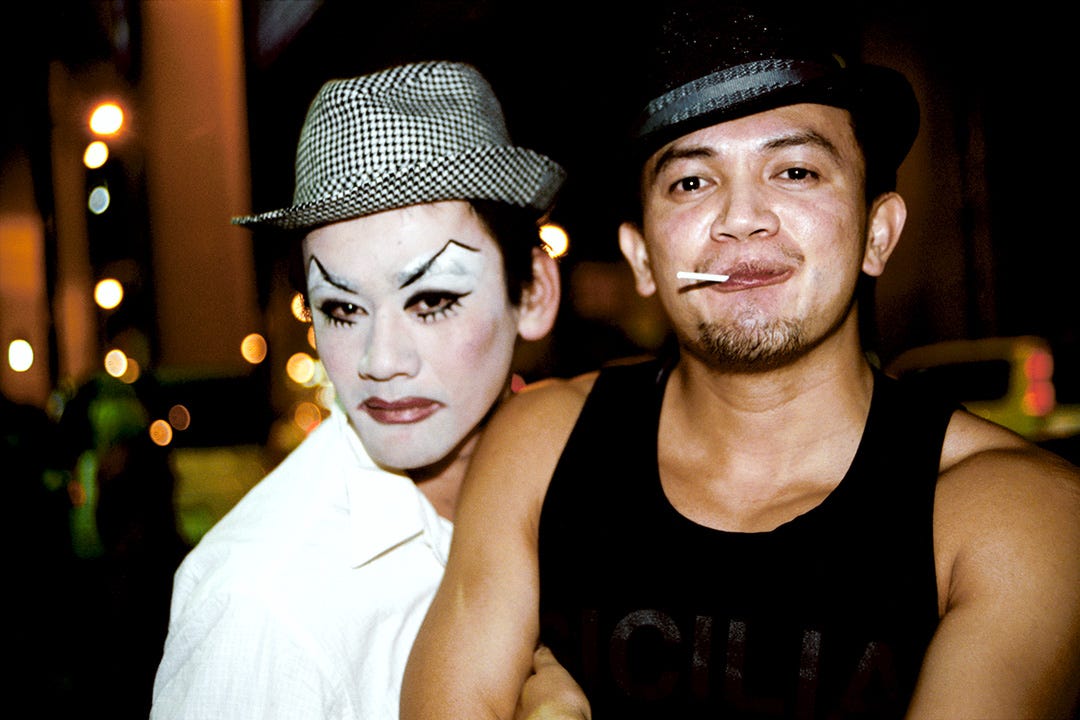
The photographs I took of drag queens were first discovered by a French curator. He was someone who, in his youth, had frequently visited Japan through his connection with the Institut Franco-Japonais in Kyoto, but to me he was just one of those vaguely foreign figures who occasionally appeared in places I frequented. Over time, we somehow became friends—close enough that when he visited Japan, we would even go to public baths together. I had absolutely no idea that he was a specialist in Japanese contemporary art. One day, when he was in Japan, I casually showed him the drag queen photographs I had been taking. To my surprise, he said he wanted to include them in an exhibition he was curating on Japanese contemporary art. I assumed he must be joking, but after he returned to France, I received an email from his assistant, and it became clear that he was quite serious.
Around that time, I had begun—if only slightly—to think of my “photography” as a form of self-expression. A piece in which I pasted together one hundred photographs of boys working at a sex shop where my friend S worked was the first thing in my life that could reasonably be called a “work.” It was displayed for the opening of a gay porn video shop in Dōyama, though the treatment it received was hardly what one would call an exhibition: the shop owner directly blacked out explicit areas on the prints with a marker. Even so, when the French curator saw it, he enthusiastically said he wanted to show it. He returned to France with nude photographs of male escorts stuffed into a white plastic shopping bag. Watching him leave, I genuinely wondered whether this person was really okay.
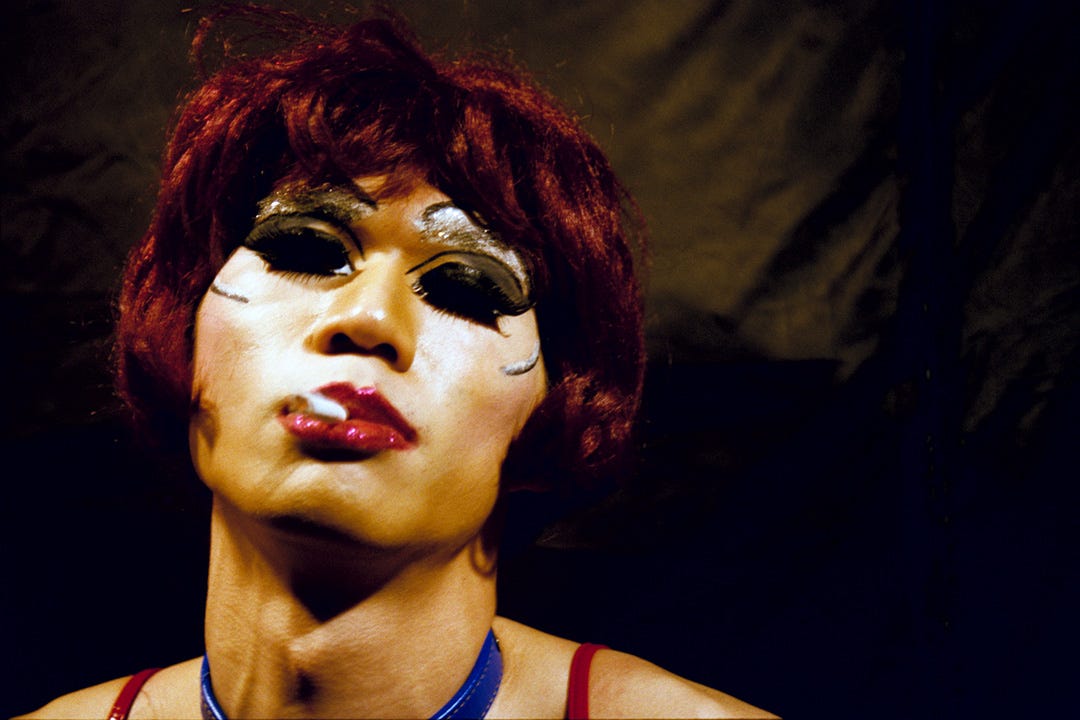
And so, almost by accident, I made my debut in France as a “photographer.” The space I was given was not large, but seeing the drag queen photographs I had casually taken projected as a slideshow alongside the works of such prominent artists of the time—Takashi Murakami, Kenji Yanobe, Yoshitomo Nara, among others—felt deeply strange. Whether you believe it or not, the curator I reunited with in France apparently even intended to screen my photographs alongside slides by Nan Goldin. However, he later told me that Goldin had lost the entire set of slides, and the plan was abandoned. There is no way to verify the truth of that story now, but for me, it remains one of the strangest events of my life.
Through circumstances like these, I somehow became a “photographer.” Even now, when I occasionally meet people who are properly called photographers, I feel deeply uncomfortable. They admired the idea of being a photographer from a young age and possess an intense passion for photography itself. They are like mountaineers who prepare themselves to climb a steep and dangerous mountain, enduring tremendous effort and hardship to finally reach the summit. Meanwhile, I was put into a helicopter without knowing where it was headed, and for some reason, I found myself set down on the very same mountaintop. If that isn’t awkward, I don’t know what is.
Perhaps what we call “luck” is precisely this—things happening that we never intended. But when something utterly unforeseen occurs right before your eyes, it doesn’t even feel like luck to the person involved. It feels simply strange. My life as a photographer began with what could be called a “fortunate” start, but at the same time, it marked the beginning of my peculiar life.
静かな声
2025年11月7日
私は写真家になろうとは思っていなかった。そもそも私には「創作意欲」というものが殆どなかった。私が写真を撮り始めたのは、ドラァグクイーンのパーティーでたまたま持っていたカメラを使って写真を撮ったときに、パーティーの主催者に「じゃあ次から写真撮ってね」と言われたのがそもそものきっかけだった。言ってみればイベントの客からスタッフに昇格したので、イベントに無料で出入りできる、というのが私にとっては最大の利益だった。ついでに撮影したフィルムの現像代は主催者が負担してくれたので、私の財布は傷まなかかった。私はその写真を「作品」だとも思わず、現像から上がってきたフィルムと写真をそのままその主催者に渡していた。私にとって写真は私の視点が刻印された作品などではなく、クイーンのパフォーマンスを切り取って、彼らのちょっとした思い出に貢献するためのものであった。カメラは途中からイベントの主催者の一人である、お金持ちの子息だった某に借りて、それを使っていた。つまり、私は写真というものに関わりながら、自らで何かを「作る」という意思で撮影を行なっていたわけではなかった。ただ、その場の状況に流されていたら、そうなっていた、というのが本当のところだ。
幼い頃から芸術的なものに興味があり、それに憧れていたのは事実だ。私の家には本と呼べるものは殆どなく、あったとしても基本的にはそれは自分より少し年上の親戚の子供たちが成長して読まなくなった学習漫画と、受験勉強用の膨大な参考書しかなかった。今でも覚えているが、なぜかスタインベックの「怒りの葡萄」と、小松左京の「日本沈没」の2冊だけが、教養としての読書に値するものとして存在していたが、私の両親はあの本を読んだのだろうか。親戚が半ば騙されたように買わされた百科全書のような図鑑が埃をかぶったまま本棚に眠っているのを発見して、それを借りて貪るように読んだのを覚えている。しかし、図鑑に並べられた絵画作品を見て、それに興味を持つことはあっても、さすがに「作品」を作りたい、とまでは思わなかった。そもそも貧乏学生の私は、自分の純粋な趣味のために効果な画材を買うほどの余裕はなかったし、そして何よりもー私は絵が下手だった。
私が記録したドラァグクイーンの写真は、まずはフランス人のキュレーターに見出された。彼はもともと若い頃に京都の日仏会館の関係でよく日本に来ていた人だったが、私が時々顔を出す場所に現れる、よくわからない外国人の一人だった。やがてなんだかんだと仲良くなり、日本に来るときには一緒に銭湯に行くくらいの仲になったが、彼が日本の現代美術の専門家であることは全く知らなかった。ある日彼が日本に来たときに、何の気なしに私が撮っていた、ドラァグクイーンの写真を見せたところ、彼はそれを彼が企画している日本の現代美術を紹介する展示で見せたい、と言い出した。まさかご冗談でしょ、と思っていたが、彼がフランスに帰国した後、彼のアシスタントからメールがあり、この話は嘘ではないということが判明した。
その頃の私といえば、自分の「写真」について、以前よりは多少なりとも「自己表現の一種」のように考えるようになっていた。友人のS君が働く風俗店のボーイさんたちにポーズを撮ってもらった写真100枚を1つに貼り合わせたものは、私の人生最初の「作品」と呼べるものだった。堂山のゲイポルノビデオ屋の開店記念でその「作品」は展示されていたが、店主がプリントの上に直接マジックで際どい部分を黒塗りしたり、と、およそ展示と呼べるような扱いではなかったが、そのフランス人のキュレーターはその作品を見ると嬉々としてそれを展示したい、と言った。彼はその売り専のボーイさんのヌード写真を、白いビニールの買い物袋に入れてフランスに戻って行った。それを見ながらこの人は本当に大丈夫だろうか?と訝しがったのは事実だ。
こうして私は「写真家」としてうっかりフランスでデビューしてしまった。私に与えられた空間は、決して大きな場所ではなかったが、その当時の錚々たるアーティスト、例えば村上隆やヤノベケンジ、奈良美智などに混ざって私がなんとなく撮影していたドラァグクイーンの写真がスライドショーで流れていたのは、とても奇妙な感じだった。信じるか信じないかは別にして、フランスで再会した件のキュレーターは、私のこの写真を恐れ多くもナン・ゴールディンのスライドと併せて上映しようとしていたらしい。ただ、ナン・ゴールディン氏がそのスライド一式を紛失してしまったので、その企画は没になった、とのことだった。今となっては真偽の確かめようがない話だが、私にとっては自分の人生で起こった最も奇妙な出来事の一つ、と言って良いだろう。
このようなきっかけがあって、私は「写真家」になってしまった。今でもごく稀に「写真家」と呼ばれる人たちと会うと、私は大変気まずい思いをする。彼らは若い頃から「写真家」という存在に憧れ、そして写真というものに大変な情熱を持っている。彼らは必死で険しい山を登る覚悟をした登山家のようなものだ。そして大変な苦労と労力をかけてその山頂にたどり着く。その一方、私は、どこに行くのかもわからずヘリコプターに乗せられてしまい、なぜか同じ山頂に降り立ってしまった。これを気まずいと言わずに何と言おうか。
恐らく幸運、というのはこのような自分が意図しないことが起こることなのだろうが、想像すらしていなかった物事が目の前で起こると、当の本人にとってはそれは幸運かどうかすら判別不能な、ただただ奇妙な出来事のようにしか感じないものなのだ。私の写真家の人生は「幸運」なスタートを切ったが、それは私の奇妙な人生の始まりでもあったのだ。
No posts
Comments
Nothing yet. Say the first thing.
Sign in to join the conversation.