

One thing I love about reading and writing Flash fiction is that a story can turn or pirouette in one sentence from a standard narrative into something that floats off the page and impacts the reader. These texts only become stories when they’ve been lifted by this sentence, as if given the breath of meaning. The story that I want to use as an example is “The Canyon Where the Coyotes Live” by Bobbie Ann Mason, found in The Best of Small Fictions 2015, published by Queens Ferry Press.
The story starts not with a character name, but with a singular “she” who “lives near a canyon with four cats.” Not the most fraught first line, but serviceable to get an idea of character and a hint at the problem.
She lives near a canyon with four cats. The Post-It notes on the bulletin board keep track of the cats–their special needs, the diets, the vet appointments, little notes about their charming pranks and romps.
Lucky for us, dear reader, this isn’t a normal cat lady; rather, she cares deeply for her cats, as we soon learn they stand in for the children she’s never been able to have.
Four paragraphs later, we get a quick but detailed snapshot of each cat, and we know, through the sheer detail, that this woman cherishes them.
Yesterday she recorded Annie chirping at a snail. Normally Annie chirps at the sparrows who bathe in a bowl outside the large window.
Billy chirped at an invisible fly. He was leaping high into the air, reaching and chattering. Carrie and Davy have other hobbies–spiders and tiny furry fake mice, respectively.
The cats do not go outside because of the canyon where the coyotes live.
So it’s a good start to a normal story, filled with specific details, but what gives it emotional heft is the line that comes immediately after describing each cat.
There is a husband around the house, too.
I’m singling out this sentence because it tells me so much about this woman and her love for her cats and the secondary role that the husband plays and has played for years. I know this couple’s relationship without Mason having to say anything else. In some ways, the reader does a lot of work by creating their own image of the relationship; the story could have stopped there and been a nice 100-word story. But the story hinges here and expands, making this relationship more specific to these characters and giving us a jolt of understanding. We’re now privy to the drama of these characters and this particular story. It’s not just about cats anymore.
Flash, at its best, jolts the reader into understanding, into a new or forgotten feeling about the world. It does this by letting the reader make inferences and play along with the writer. When we over-write these scenes or add too much interiority, we take away this part of the game from the reader.
The woman wants to see her cats play in the canyon, but it’s too dangerous because of the coyotes. A lovely metaphor for children, and also not a metaphor, because it’s important to the drama of the story. The husband gets a few lines of dialogue that show the reader just how secondary he is — he became a means to get her children, but he failed, and he’s paying for it. He seems to know his role too, because his dialogue is constantly at odds with what the woman wants.
Referring callously to the coyotes, he says,
‘Everything’s gotta eat...’ ‘Including me.’
‘Have a Pop-Tart,” she says.
“Pop-Tarts are for kids. Why do we have Pop-Tarts?”
Exactly.
Here we jump back into the woman’s thoughts, and while her husband will never understand, the reader does, creating emotion and energy not only through the dramatic irony, but because we understand this woman’s desire. She’d like to get rid of the metaphorical cats too, but for now that’s all she’s got, and this might be all she’ll ever have.
Well, here comes our husband again, to open his mouth to show just how little he understands his wife. That is why the sentence introducing the husband matters. Without it, we just have a lonely cat woman who wants kids instead. Pretty basic, right? I’d wager Mason felt a little thrill when she found that sentence introducing the husband, knowing she had a story worth writing.
He mentions that he thinks she’s driving herself nuts about the safety of cats. He’s too literal for her, and he thinks if it weren’t for the coyotes she’d find something else to be frightened of. Well, of course, she would, we’d like to tell this husband. Her whole life is one of terror, because she knows she’ll never get what she most desires.
The husband, reeling, tired of being so secondary and living with her fear, commits the final verbal sin by saying, “...we are lucky we don’t have any kids. I see how you would be with them.”
There are so many ways Mason could have had the woman respond, a lot of which would have led to melodrama or a reduction in our empathy for her, but Mason walks the tightrope of stoicism and uses the image or detail to seal the story, to seal the relationship for us, when she writes that “She snatches the Pop-Tart from his hand. ‘I’ll make lunch.’”
This is meaningful because her action tells him he is so secondary that he doesn’t deserve the food she bought for children she’ll never have. He’s no longer good enough to live within the bubble of her one desire. And here I wish the story had ended, because the last paragraph goes into an extended religious metaphor about a ripped-out heart that I understand as a closing, but feel that it actually distracts by trying to take this story to a higher literary plane that it doesn’t need because everything else fits so well. The snatching of the Pop-Tart, of all things, ends this story so well.
This story would not have resonated so well for me without this line: “There is a husband around the house, too.” Without the husband described in such a cold, secondary way, I wouldn’t have cared so much about this woman and her desire to have children. One sentence can make the difference between story and vignette, between a basic narrative and one that leaps off the page.
Prompt: Read through an unfinished or unpublished story, looking for the sentence that leaps out at you, that helps the reader understand something they didn’t know or weren’t quite feeling yet. How can it be manipulated to add even more context, to cause even more of a stirring or an escalation in this story? Should some part of it be repeated? Is it a single unifying image or motif? Should it come much earlier in the story? Are you missing a sentence that defines or redefines relationships or power dynamics? Could that serve as a metaphor or highlight the story's theme? Are you missing a small piece of backfill that would help us see the character in a different light or from a different perspective? different angle right before they do something drastic or something that disrupts their lives? Add a character, add an action, add an image, something that might not seem to belong, and let that dissonance add to your character’s unease!
If you enjoy what I do, consider supporting me on Ko-fi! Every little bit means the world! https://ko-fi.com/tommydeanwriter
New Classes:
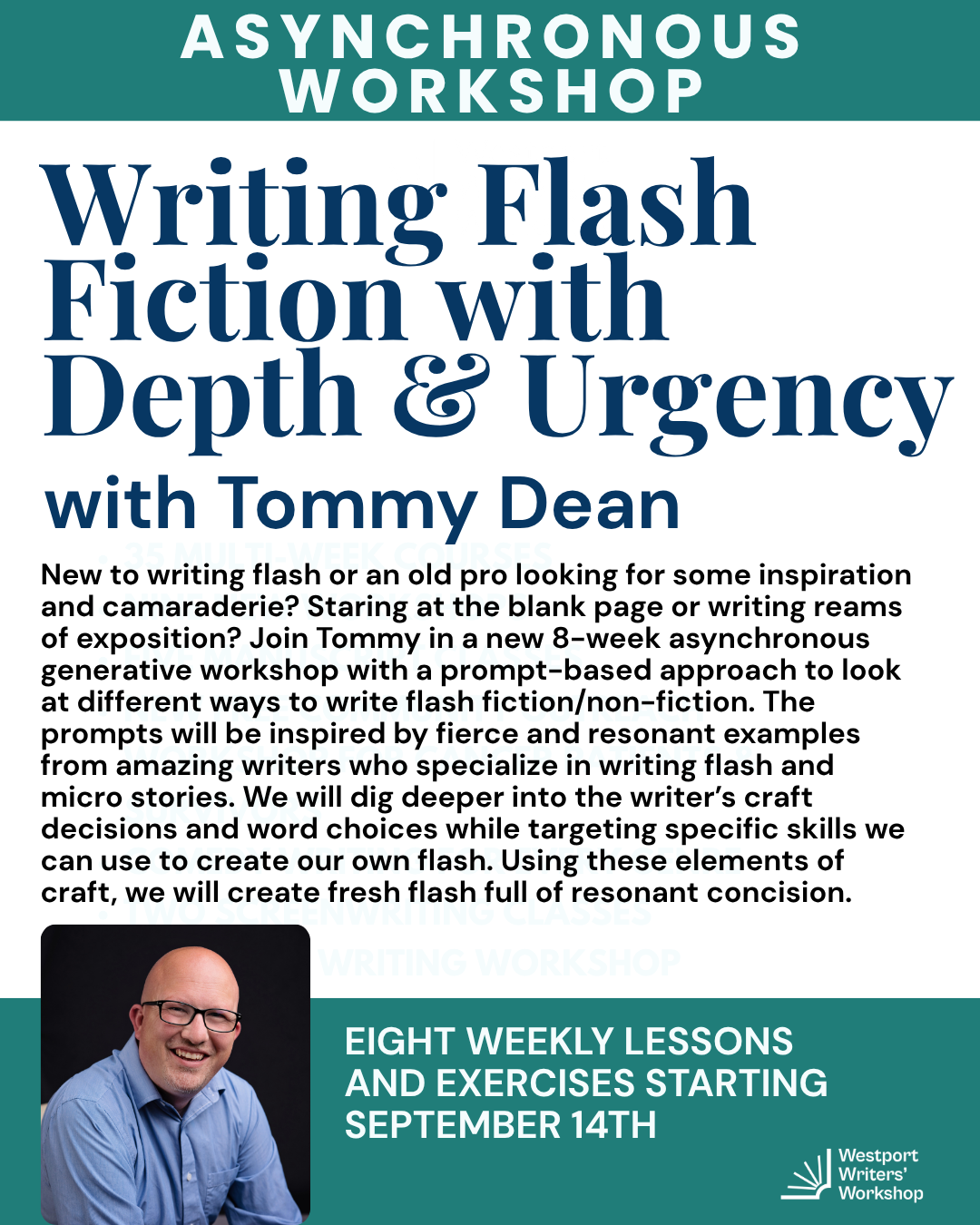
Cost: $120
Where: Online/Asychonous
November 29 through December 13, 2026
12 spots
The class structure is asynchronous, so you can log in as needed throughout the week. I’ll provide 1-2 prompts per day Monday-Wednesday-Friday and repeat this the next week with model texts and my analysis of how to use the model texts. You can write a flash for both or just 1 and post it to the learning environment (Canvas). I will then provide positive, encouraging feedback for each flash piece you write. You will also get a chance to give and receive positive comments from your peers. We’ll use Saturday and Sunday to catch up on writing and commenting!
Have you checked out my editing services? I’ve added some discounts to help writers start with agent-ready queries and novel openings! Check out the price drops!
Comments
Nothing yet. Say the first thing.
Sign in to join the conversation.