
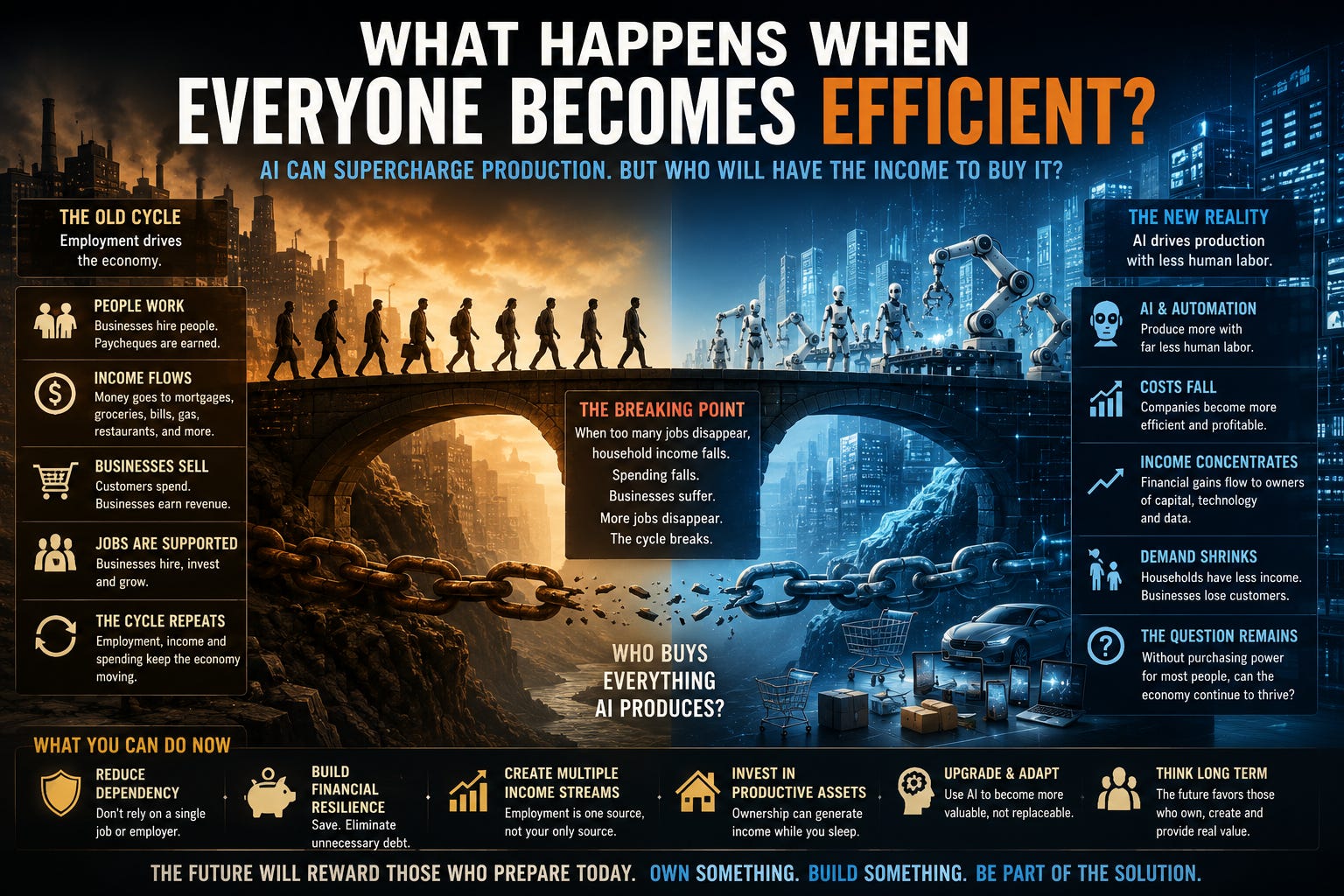
Every business is being told essentially the same thing about artificial intelligence: become more efficient. Automate repetitive work, reduce administrative overhead, increase productivity, lower costs and accomplish with ten people what previously required twenty.
From the perspective of an individual business, the logic is difficult to argue with. Payroll is expensive. Employees require salaries, benefits, office space, equipment, training, management and time. If artificial intelligence allows a company to maintain or increase its output while employing fewer people, the financial incentive to do so will be enormous.
The problem begins when every business reaches the same conclusion.
The employee one company eliminates is the customer another company depends upon.
That connection is easy to overlook because businesses generally examine their own expenses, revenues and productivity in isolation. A software company that reduces its workforce by 20 per cent may immediately improve its operating margins without experiencing any decline in its own sales. From its perspective, the decision may have been entirely successful.
But those former employees were spending their salaries somewhere.
They were making mortgage payments, buying groceries, financing vehicles, eating at restaurants, renovating their homes, paying insurance premiums, taking vacations, buying clothing, supporting charities, hiring tradespeople and paying for countless other products and services.
When their income becomes uncertain or disappears, their spending habits change very quickly. The new vehicle can wait another year. The kitchen renovation gets postponed. The vacation is reconsidered. Restaurants become an occasional luxury rather than a regular habit. Subscriptions that once seemed insignificant suddenly become unnecessary expenses. Families stretch the life of appliances, shop more carefully for groceries and become much more cautious about taking on new debt.
One household behaving this way means almost nothing to the broader economy. Hundreds of thousands or millions of households behaving this way creates something entirely different.
The car dealership sells fewer vehicles. The restaurant serves fewer meals. The contractor receives fewer calls. Retailers see less traffic. Builders sell fewer houses. Businesses that depended upon those customers then begin experiencing their own financial pressure.
And what do businesses do when revenues decline?
They become more efficient.
That is where the economic consequences of artificial intelligence could become considerably more complicated than simply calculating how many jobs a machine can perform.
Businesses understandably treat payroll as an expense. Anyone who has operated a business knows that labour can be one of the largest costs on an income statement, so technology that allows a company to accomplish more with fewer employees will naturally be attractive.
From the perspective of the overall economy, however, payroll performs another function that rarely receives the same attention.
Payroll distributes purchasing power.
A company pays an employee on Friday, but that money does not disappear. Some of it becomes a mortgage payment. Some goes to the grocery store. Some pays an electricity bill, insurance premium or car payment. Some might go to a restaurant on Saturday night.
Those businesses then use portions of that revenue to pay their employees and suppliers, who spend some of their income somewhere else.
There is a circular relationship between employment, income, consumption and business revenue that is easy to overlook when we examine companies individually.
A business does not hire someone because it wants to create a consumer. It hires that person because it requires labour. Nevertheless, the income generated through employment allows that individual to participate in the consumption side of the economy.
For generations, this arrangement has worked remarkably well because technological progress has generally created new opportunities for human labour as old ones disappeared.
Agricultural machinery eliminated enormous amounts of farm labour while industrialization created manufacturing employment. Factory automation displaced some workers while computers and telecommunications created entirely new industries. The internet destroyed some business models while creating others that previous generations could scarcely have imagined.
History therefore gives us good reason to be cautious about predictions of permanent technological unemployment.
Human beings are remarkably good at creating new things to do.
Artificial intelligence may follow the same historical pattern. New industries are already appearing around AI, and entirely new professions will almost certainly emerge. Increased productivity may create economic opportunities that we cannot yet anticipate.
But history does not guarantee that every technological transition will unfold in exactly the same way.
Artificial intelligence is unusual because it is increasingly capable of performing the cognitive work that became the destination for workers displaced by earlier automation.
For decades, the advice was straightforward. Machines were good at repetitive physical work, so people should become more educated and move into knowledge-based occupations requiring reasoning, communication, analysis and creativity.
AI is now moving directly into those occupations.
Programming, accounting, research, administration, marketing, customer service, design, legal work, financial analysis, writing and countless other activities can already be assisted by artificial intelligence. The more capable these systems become, the more they will move from helping people complete individual tasks toward completing entire workflows.
The important question is therefore not whether AI can perform your entire job today.
The more relevant question may be how many people your employer will require when every employee becomes dramatically more productive.
A company does not need AI to replace every accountant before accounting employment changes. If five accountants using AI can eventually perform the work previously completed by ten, the economic consequence is already significant.
Multiply that across thousands of companies and hundreds of occupations and we begin confronting a very different question.
What happens when the amount of human labour required to produce the things we consume begins declining faster than new forms of employment can replace it?
There is enormous excitement surrounding the productivity gains artificial intelligence may create, and much of that excitement is justified.
If businesses can produce more goods and services with less labour, society could become substantially wealthier.
Medical administration could become less expensive. Software could be developed faster. Small companies could suddenly possess capabilities that once required large departments. Education could become more accessible. Manufacturing could become more precise. Scientific research could accelerate. New products could reach markets faster and businesses could operate at levels of efficiency that would have been unimaginable only a generation ago.
Those are real benefits.
But production is only one side of a market economy.
The other side is consumption.
A factory capable of producing one million televisions has little economic value if only ten thousand people can afford to buy them. A restaurant can automate much of its kitchen and prepare meals with extraordinary efficiency, but it still requires customers with enough disposable income to eat there. A construction company can use AI to reduce design and administrative costs, but houses still require buyers with sufficient income to purchase them.
Greater productivity can lower prices, and that should not be dismissed. If AI allows something that once cost $1,000 to be produced for $500, consumers require less income to purchase it.
That could significantly improve living standards.
However, many household expenses cannot simply fall toward zero. People will still require housing, food, transportation, energy, health care, clothing and other necessities. Even in an extraordinarily productive economy, people still require some mechanism through which they obtain a financial claim on what the economy produces.
For most people today, that mechanism is employment.
We sell our labour, receive money in return and use that money to purchase a portion of society’s production.
If the economy requires substantially less human labour, then we eventually have to ask how purchasing power reaches people when employment can no longer distribute enough of it.
AI may therefore create a distribution problem long before it creates a production problem.
We may become extraordinarily good at producing things while simultaneously weakening the mechanism through which most people obtain the money required to buy them.
Imagine an economy twenty years from now in which factories require a fraction of today’s workers. Software companies operate with remarkably small teams. Administrative departments have largely disappeared. Transportation has become increasingly autonomous, and many professional services can be delivered with a small percentage of the human labour previously required.
Measured purely by productive capacity, that economy could be spectacularly successful.
Now imagine that the majority of the financial gains created by those productivity improvements flow toward the people and organizations that own the companies, technologies, artificial intelligence systems, intellectual property, data centres, robots and other productive assets responsible for generating that output.
Nothing has necessarily gone wrong with production.
In fact, production may have become extraordinarily successful.
The difficulty is that income could become increasingly separated from the people expected to consume what is being produced.
That creates what I think of as the efficiency paradox.
The more successful businesses become at removing labour from production, the less effective employment becomes as the mechanism through which purchasing power is distributed throughout society.
From the perspective of an individual company, reducing labour costs can be entirely rational.
From the perspective of an entire economy, everyone simultaneously reducing labour costs creates a much more complicated outcome because labour costs are also somebody else’s income.
If household income weakens sufficiently, consumer demand follows.
That decline then affects businesses whose owners may have believed themselves completely insulated from technological unemployment.
One of the easiest ways to dismiss concerns about AI is to look at your own occupation and conclude that a machine could never completely replace you.
That may even be true.
But you do not have to lose your job for technological disruption to reach your household.
Your employer could lose customers.
Your industry could become more competitive.
Your hours could be reduced.
Wage growth could slow because fewer workers are required.
A business you own could experience declining demand because its customers have less disposable income.
The value of your house could be affected if a major employer in your community dramatically reduces its workforce.
Your children could graduate into a labour market where many traditional entry-level professional jobs have changed or disappeared.
Your investments could be affected as some industries benefit enormously from AI while others struggle to adapt.
A restaurant owner may never be replaced by artificial intelligence, but the restaurant still requires customers.
A contractor may continue building houses, but homeowners need sufficient income to hire one.
A dentist may never be fully automated, but patients still require money or insurance coverage.
A landlord may own the building, but tenants require income to pay the rent.
Even businesses that primarily sell to other businesses eventually connect to household consumption somewhere down the chain. A software company sells to a retailer. The retailer sells to consumers. A manufacturer sells to a distributor, which sells to a contractor, who performs work for a homeowner.
The chain can become complicated, but household purchasing power sits beneath an enormous amount of economic activity.
Economic weakness can therefore travel through the same network that distributes prosperity.
Most of us have built our financial lives around an assumption we rarely stop to examine.
Someone will continue paying us for our labour.
Our mortgage, car payment, retirement plans, children’s education, vacations and everyday standard of living are usually constructed around that assumption.
Even people earning excellent salaries can be remarkably vulnerable if almost every financial obligation they have depends upon their next paycheque arriving on schedule.
Artificial intelligence should at least cause us to examine how secure that assumption will remain over the next ten or twenty years.
You do not have to believe that AI will eliminate your occupation. You only need to consider what happens if it allows your employer to accomplish the same amount of work with 20 per cent fewer employees.
Then consider what happens when thousands of other employers discover the same thing.
There is an enormous difference between earning $150,000 per year while carrying a large mortgage, two vehicle payments, credit-card debt and almost no savings, and earning considerably less while having very little debt, meaningful savings and several sources of income.
The person with the larger salary may appear wealthier while being much more dependent upon uninterrupted employment.
That distinction could become increasingly important.
In an uncertain employment environment, financial resilience may have less to do with earning the highest possible salary and more to do with reducing the number of things that can financially destroy you when that salary stops.
Debt deserves particular attention because debt converts future income into current obligations.
Every payment you commit yourself to today assumes some ability to produce income tomorrow.
A mortgage may be necessary. A business loan may create productive capacity. Some debt can be entirely rational. But a household carrying obligations right to the limit of its current income leaves itself very little room for technological disruption, recession, illness, career changes or any other unexpected event.
The future value of financial independence may therefore rise considerably as the employment market becomes less predictable.
That does not mean people should panic, sell everything they own or prepare for economic collapse.
It means we have been given something valuable: advance warning that the relationship between technology and employment may be changing.
What we do with that warning is up to us.
There is sometimes a tendency to discuss technological disruption as though employees stand on one side while business owners stand safely on the other.
The reality is more complicated.
Business owners benefit enormously from productivity improvements, particularly when they can increase output while reducing costs.
But business owners also require customers.
The owner of a restaurant, retail store, construction company, dental practice, hotel, dealership or rental property may be protected from losing a conventional job while remaining completely exposed to declining consumer demand.
That creates an unusual alignment of interests.
Employees need businesses to provide opportunities for income.
Businesses need households to possess enough income to remain customers.
For the last century, employment has served as one of the primary bridges connecting those interests. Businesses paid people to participate in production, and those people used their earnings to participate in consumption.
Artificial intelligence could weaken that connection.
If it does, the problem will eventually belong to everyone.
There is another way people participate financially in an economy besides employment.
Ownership.
Someone who owns shares in profitable companies can receive dividends and capital appreciation. An author can receive royalties from intellectual property. A business owner participates in profits. An employee with meaningful equity can share in the productivity improvements of the company. A farmer owns productive land. Cooperatives distribute profits among their members. Pension funds own productive assets on behalf of millions of workers.
I think of these arrangements broadly as productive ownership: ownership of assets that participate in producing goods, services or income.
For most households, employment currently provides the overwhelming majority of their income. Their most important economic asset is therefore their ability to sell their labour.
That worked extraordinarily well in an economy in which human labour remained essential to almost every productive activity.
If human labour becomes less essential, ownership may become considerably more important.
Consider two people facing exactly the same technological disruption.
The first person receives all of his income from employment.
The second receives most of her income from employment as well, but also owns investments, receives some business income, has intellectual property producing royalties or possesses another productive asset generating income.
Both may experience disruption.
Their exposure is very different.
This does not mean everyone can simply become wealthy by buying stocks, starting businesses or becoming landlords. Not everyone has sufficient capital, not every business succeeds and every investment carries risk. Telling millions of displaced workers to become entrepreneurs would be no more realistic than telling everyone to become professional athletes.
The broader principle is what deserves attention.
If labour becomes less central to production, ownership may need to become more widely distributed if people are going to continue participating financially in the productive economy.
That ownership could take many forms: personal investments, employee ownership, retirement funds, cooperatives, small businesses, intellectual property, community enterprises, productive land, public investment funds or structures that have not yet been developed.
We should be willing to explore all of them.
The important shift is from asking only, “What job will I have?” toward also asking, “What will I own?”
Universal Basic Income and Guaranteed Basic Income inevitably appear in discussions about technological unemployment, and there is an obvious reason.
If employment eventually becomes unable to distribute enough purchasing power throughout the population, government transfers could perform part of that function instead.
People would receive an income floor and continue spending that money on housing, food, transportation and other necessities. The money would subsequently return to businesses through consumer spending.
There are serious questions surrounding such systems.
How would they be funded? What level of taxation would be required? What would happen to inflation? How would benefits interact with existing social programs? Would political parties continually change the rules? Would a guaranteed income discourage some forms of work? How large would the payment need to become in a society where housing and other essential costs remain high?
There is also a deeper philosophical question.
Should people become increasingly dependent upon government transfers, or should we find ways to give more citizens a direct ownership stake in the productive capacity generating society’s wealth?
Perhaps the answer eventually includes both.
We could see shorter work weeks, continued conventional employment, entrepreneurship, employee ownership, investment income, public income support and entirely new forms of productive ownership existing together.
Nobody knows yet.
What seems increasingly difficult to assume is that conventional full-time employment will indefinitely remain the primary mechanism through which almost every household obtains purchasing power, regardless of how little human labour the economy eventually requires.
Nobody knows how quickly these changes will happen.
That uncertainty is actually an argument for preparation rather than panic.
If artificial intelligence ultimately creates millions of new occupations and employment remains strong, reducing unnecessary debt, building savings, acquiring productive assets and developing additional sources of income will not have harmed you.
If the labour market becomes substantially more unstable, those decisions may become extremely valuable.
The first step is simply to understand your own exposure.
Ask how much of your household income depends upon a single employer. Consider how long you could maintain your current obligations if that income disappeared. Look carefully at debt that assumes years of uninterrupted earnings. Think about whether you own anything capable of generating income independently of the hours you personally work.
Consider which parts of your occupation AI is likely to enhance and which parts it could eventually perform without you. Learn to use the technology rather than pretending it will disappear. A worker who understands how to multiply his productivity with AI will probably remain more valuable for longer than one who refuses to adapt.
But skills alone may not be enough.
For most of our lives, we have been taught to prepare for the future primarily by making ourselves employable.
Get educated. Develop skills. Work hard. Build experience. Earn promotions. Increase your salary.
That advice is still valuable.
It may simply become incomplete.
The next generation may also need to learn how to accumulate ownership.
This is the question I keep returning to.
Artificial intelligence could create an age of extraordinary abundance. Businesses may become capable of producing more goods and services at lower costs than anything we have previously experienced.
That should be something worth celebrating.
But an economy is more than a production machine. It is a network of exchanges between people and organizations, and those exchanges require purchasing power.
Businesses need customers just as much as customers need businesses.
For generations, employment has connected those two sides of the economy. Businesses paid people to help produce goods and services, and those people used their wages to consume what businesses produced.
Artificial intelligence may gradually loosen that relationship.
Perhaps AI will create enough new occupations to preserve the employment cycle. I hope it does. Perhaps productivity improvements will reduce the cost of living enough that people can maintain excellent standards of living while working considerably fewer hours. Perhaps ownership will become much more broadly distributed. Perhaps governments will eventually create new ways of maintaining purchasing power.
Most likely, the future will contain some combination of all of these things.
But hoping everything works itself out is not a personal financial strategy.
If artificial intelligence allows businesses to produce considerably more while employing considerably fewer people, society will eventually have to determine how the financial benefits of that productive capacity reach the people expected to consume what is produced.
Governments, businesses and economists will argue about that question for years.
The rest of us have a more immediate question to consider.
For most people today, the answer to “How do you participate in the economy?” is straightforward: I work.
Perhaps we should begin preparing for a future in which the answer becomes broader.
I work.
I save.
I invest.
I own.
I produce.
I participate in the wealth created by technology rather than relying exclusively upon someone continuing to purchase my labour.
The goal should not be to fear artificial intelligence. AI may become one of the greatest productivity tools humanity has ever created.
The goal is to recognize that the economic rules surrounding us may change as a consequence of that success.
A business can become more efficient by employing fewer people. An entire economy cannot indefinitely reduce the incomes of consumers without eventually confronting the question of how those consumers are supposed to remain customers.
And for each of us personally, there is an even more important question worth asking now, while we still have time to do something about the answer:
If the economy needs less of your labour ten years from now, what will you own that continues producing income for you?
One of the reasons I keep returning to questions like this is that uncertainty becomes much more dangerous when we wait until a crisis is already upon us before deciding what to do.
That is also the thinking behind another book I have been developing, The People’s Emergency Plan. The book adapts the Operational Planning Process I learned through the military and emergency-management world into something ordinary people and families can actually use.
The objective is simple: understand the situation before it becomes an emergency, identify the risks that matter to you, consider realistic courses of action, make decisions in advance and build a plan that can be adjusted when circumstances change.
Artificial intelligence and employment disruption may never develop into the scenario described in this article. I certainly hope they do not. But planning is not about predicting the future perfectly. It is about recognizing plausible risks early enough that you still have choices.
Whether the challenge is an emergency, financial disruption, job loss or some other major change in circumstances, having thought through your options before you are under pressure can make an enormous difference.
That is what The People’s Emergency Plan is intended to help people do.
Comments
Nothing yet. Say the first thing.
Sign in to join the conversation.