
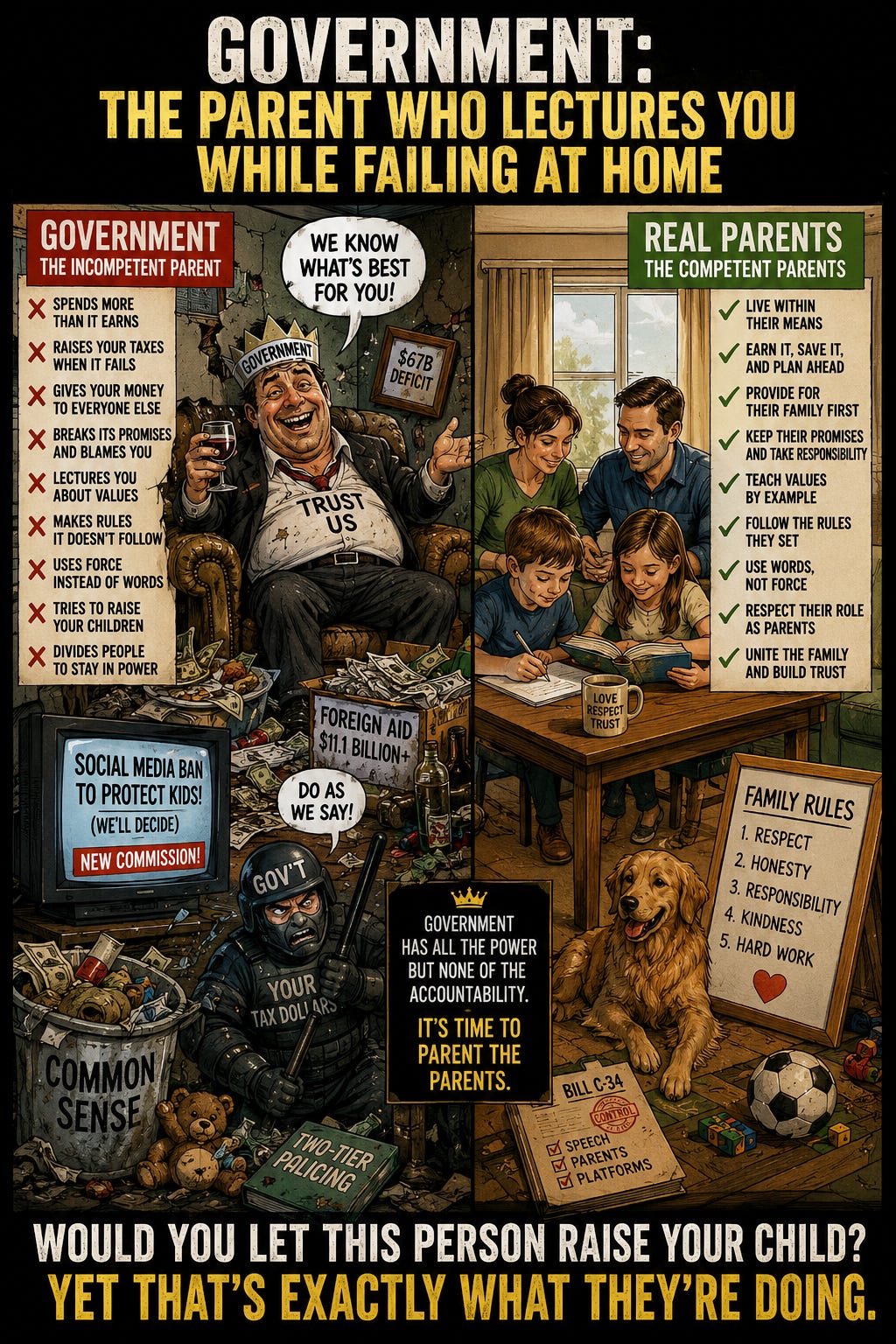
Across the Western world, governments have suddenly discovered that children use social media.
Australia has already imposed an under-sixteen restriction. Canada has introduced its own legislation. The United Kingdom has announced a similar policy, while France and several other European governments are advancing or considering their own versions. The ages, exemptions and enforcement systems are not identical, but the language is remarkably familiar: protect children, restore childhood, make the internet safer and assist parents who apparently require federal supervision to operate their own homes.
Governments that cannot balance a budget, maintain functioning emergency rooms, deliver basic public services reliably or prevent violent repeat offenders from returning to the streets have finally discovered the one area in which they possess unquestionable expertise: raising everybody else’s children.
What an enormous relief.
After years of watching public institutions fail upward, Canadians may now sleep peacefully knowing that the same political class that can lose track of billions of dollars, turn a passport application into a spiritual journey and make road construction last longer than some marriages has volunteered to take a more active role in family life.
I understand the dangers of social media because I am a parent. Online platforms can expose children to pornography, predatory adults, bullying, addictive algorithms, political manipulation and social pressures that previous generations never faced. Parents should take those dangers seriously, and technology companies should face severe consequences when they knowingly design products that exploit children.
My objection begins when politicians take a legitimate concern, wrap it in the language of safety and use it as another excuse to transfer authority away from families and into the hands of officials.
Government is volunteering to perform my responsibilities as a parent while routinely failing to meet the behavioural standards responsible parents establish inside their own homes. Parents are expected to manage money, control their tempers, tell the truth, settle disagreements without violence, establish consistent rules and accept responsibility when their decisions cause harm. Government demands all of those behaviours from the public while treating itself as the gifted child who should not be constrained by ordinary expectations.
The political class apparently believes adulthood is something it regulates rather than something it should demonstrate.
I recognize that I am selecting examples of government hypocrisy to make this argument. I could select dozens more without breaking a sweat.
I could examine education, healthcare, criminal justice, public spending, censorship, privacy, emergency management or virtually any other area in which government institutions lecture citizens about responsibility while refusing to follow the standards they impose. The examples in this article are not a complete inventory. They are a small sample from a warehouse so full that someone should probably order a public inquiry into storage capacity.
The ease with which these examples can be selected is precisely the problem.
Government institutions have accumulated such an impressive record of contradiction, selective enforcement and institutional failure that they should exercise considerably more humility before telling parents how to raise their children.
Humility, unfortunately, remains one of the few things government has not yet established a commission to study.
Imagine operating your household the way the federal government operates Canada.
Every year, you spend considerably more than you earn. You borrow the difference, describe the spending as an investment in the family’s future and assure everyone that the debt remains perfectly manageable because you have produced a colour-coded presentation. When the bills arrive, you blame the previous homeowner, commission a review and inform your children that financial discipline will begin sometime after the next election.
Canada’s 2026 Spring Economic Update projected a federal deficit of approximately $67 billion for 2025–26, followed by another projected deficit of $65 billion in 2026–27.[1] In Ottawa, borrowing $132 billion over two years can still be described as responsible fiscal management, provided the announcement includes enough references to resilience, strategic investment and building Canada strong.
Try that argument with your bank.
Tell your mortgage lender that the family is not overspending but making transformative investments in household capacity. Explain that the maxed-out credit cards represent an ambitious growth agenda. Reassure the bank manager that repayment remains central to your long-term vision, although regrettably no specific date can be provided because the family is still consulting stakeholders.
I am sure the applause will be immediate.
A household eventually reaches the limit of its income and credit. When expenses exceed revenue, ordinary people must reduce spending, sell something, earn more money or accept insolvency. Families cannot establish a household revenue agency, declare their neighbours’ income taxable and send officers if anyone refuses to contribute, but government enjoys precisely that advantage.
Whenever politicians overspend, they can raise taxes, introduce fees, expand the tax base, borrow against future generations or reduce the purchasing power of everyone’s money. The people responsible for the overspending rarely lose their pensions, surrender their salaries or sell their homes. The public absorbs the consequences while politicians hold a press conference about shared sacrifice.
Nothing demonstrates shared sacrifice quite like being told to pay more by people whose own paycheques arrive directly from the taxes they are increasing.
Parents are also expected to plan ahead. We are told to maintain savings, prepare for emergencies, avoid unnecessary debt and make responsible decisions for the future. Government lectures families about financial literacy while routinely spending money it does not have and leaving the bill to children who were not old enough to vote when the debt was accumulated.
Any parent who handled the family finances that way would eventually lose access to the bank account. Government responds by increasing its own credit limit and launching a public-awareness campaign about responsible borrowing.
Presumably, the campaign will include a downloadable pamphlet.
The comparison becomes even more absurd when governments send billions of dollars abroad while borrowing money to finance services at home.
Canada reported providing approximately $11.1 billion in international assistance during the 2023–24 fiscal year. That included development programs, humanitarian assistance, peace and security initiatives, loans and other forms of support.[2]
Some international assistance serves legitimate Canadian interests. Humanitarian disasters occur, alliances carry obligations and instability abroad can create consequences at home. A serious country may determine that certain expenditures are morally justified or strategically necessary.
The difficulty begins when politicians treat public money as though it were a personal charitable fund and public consent as an irritating administrative detail.
Imagine depositing your paycheque, transferring a substantial portion of it to several other households and then informing your own family that there is not enough money to repair the roof, pay the heating bill or take a sick child to a functioning medical clinic. When your spouse objects, you explain that the transfers demonstrate the family’s leadership throughout the neighbourhood. When the mortgage payment comes due, you borrow the money, and when the lender becomes concerned, you knock on your neighbour’s door and demand a larger contribution.
Your family would not praise your compassion. They would question your judgement, cancel your access to online banking and possibly hide the chequebook.
Politicians face no such humiliation.
Compassion financed through debt and compulsory taxation is particularly convenient because the person receiving the praise is rarely the person carrying the cost. Politicians announce the generosity, taxpayers finance it and children inherit the debt. Government then congratulates itself for displaying moral leadership with money it did not earn.
Generosity has never been easier than when someone else is paying.
Before Ottawa sends billions abroad, Canadians are entitled to know why the expenditure is necessary, what national interest it serves, what measurable result it is expected to achieve and whether the country can afford it. Parliament should debate those commitments openly instead of treating Canadians as an inexhaustible source of funds whose permission is neither required nor particularly interesting.
A responsible parent provides for the household before attempting to become the saviour of the entire neighbourhood. Government apparently considers that kind of thinking embarrassingly provincial.
No doubt the leaking roof will feel better once it learns that the family is showing global leadership.
Parents intervene when children fight because children are still learning self-control, negotiation and restraint. We tell them to calm down, listen to one another, explain what happened and use their words rather than their fists.
Governments teach the same principles in schools, where children are instructed to resolve conflict peacefully, respect differences, reject bullying and seek assistance from a responsible adult. International politics then offers a slightly more advanced curriculum.
Political leaders trade threats, impose collective punishment, escalate regional conflicts, finance proxy wars and eventually send young people to kill other young people. The leaders who failed to achieve a diplomatic resolution usually watch the consequences from secure offices surrounded by advisers, security personnel and an inspiring number of flags.
Some wars are unavoidable. A country that is attacked has a right and duty to defend itself, and genuine threats cannot always be defeated through conversation. Even so, military force should represent the final failure of diplomacy rather than a convenient instrument for political ambition, ideological expansion or institutional prestige.
A government that expects ordinary citizens to de-escalate every disagreement should be required to demonstrate that it exhausted peaceful options before spending their money and risking their children’s lives.
Perhaps politicians should be required to sit in a school conflict-resolution circle before authorizing military action. They could pass around the talking stick, identify their feelings and demonstrate that they have used their big-kid voices before reaching for missiles.
The idea sounds ridiculous only because the standards imposed on children bear so little resemblance to the conduct tolerated from governments.
Government’s financial incompetence and appetite for force are serious enough, but its arrogance becomes far more personal when public institutions begin placing themselves between parents and their own children.
Government interference becomes considerably more offensive when public institutions deliberately insert themselves between parents and children.
Schools contact parents about attendance, academic performance, behavioural problems, incomplete assignments, dress-code violations, missed permission forms and conflicts with other students. Parents are expected to attend meetings, provide transportation, supervise homework, enforce consequences and accept responsibility whenever the school decides their child requires intervention.
The parent remains fully responsible whenever the institution needs cooperation, money, discipline, a signature or someone to blame.
When the subject becomes gender identity, however, some Ontario school-board policies explicitly prohibit disclosure to parents without the student’s permission. The Avon Maitland District School Board, for example, states that a school shall not disclose a student’s gender status to parents or caregivers without the student’s explicit prior consent. Toronto District School Board guidance has also contemplated using one name or set of pronouns at school and another in correspondence or meetings with parents.[3]
The bureaucracy calls this confidentiality.
Ordinary people call it deliberate concealment.
When school employees knowingly present one version of a child’s identity inside the classroom and another version to the parents at home, they are not simply remaining silent. They are helping construct and maintain a secret life between a minor and the adults legally responsible for that minor.
Apparently, parents are essential when a permission slip needs signing but dangerously intrusive when they want to know what is happening in their own child’s life.
A child who faces a genuine and identifiable danger at home must be protected. Evidence of abuse should be investigated, and no parent receives immunity simply by becoming a parent. Protecting a child from a specific and credible threat, however, differs fundamentally from creating policies that presume parents may be dangerous before any evidence exists.
Under such policies, the parent does not have to threaten the child, abuse the child or even know that a concern exists. Institutional suspicion comes built into the arrangement. The parent becomes the presumed danger, while the school employee becomes the trusted confidant by virtue of having completed the correct training module and selected the correct pronouns during the morning briefing.
Teachers and administrators do not carry the lifelong responsibility borne by parents. They will not necessarily live with the emotional, medical or social consequences of decisions made during a child’s confusion. They will not remain responsible for the child after graduation, and they will not be present decades later if the child concludes that the adults involved should have slowed the process down rather than affirming every declaration immediately.
Government institutions cannot demand parental involvement whenever a child becomes difficult, disruptive or expensive, then dismiss parental authority whenever the parents’ judgement conflicts with institutional ideology.
Schools may assist parents. They may protect children from bullying, provide a safe environment and respond to credible evidence of abuse. They should never be permitted to recruit children into a confidential relationship against their own families merely because administrators have decided that government employees understand the child better than the people raising them.
Parents are good enough to be called when the child misses class, fails an assignment, breaks a rule or needs someone to pay for a field trip. When the institution decides that the information is ideologically sensitive, however, the same parent suddenly becomes a potential threat who must be carefully managed.
Government wants all of the authority of a parent without accepting any of the permanent responsibility.
A familiar arrangement, really.
The same paternal arrogance now appears in the campaign against social media.
Facebook became publicly available in 2006. YouTube launched in 2005. Smartphones have been common for well over a decade. Children have spent years gaining easy access to pornography, adult conversations, violent material and predatory strangers while governments responded with studies, advisory panels, consultation papers and the occasional solemn speech about online safety.
Nothing protects a child quite like a government consultation.
If government were genuinely serious about protecting children from online harm, minors would have been blocked from Pornhub and OnlyFans years ago, while platforms such as Roblox would have faced aggressive intervention the moment predators began using them to approach, groom and lure children.
Governments had years to address the most obvious dangers. Pornography remained available behind a meaningless button asking users to declare that they were eighteen. Adult subscription platforms remained reachable through weak or easily circumvented controls. Digital playgrounds allowed strangers to hide behind cartoon avatars, build relationships with minors, offer virtual rewards and attempt to move those conversations onto private messaging services.
Those were not subtle risks hidden deep inside complicated technology policy. They were obvious dangers occurring in plain sight.
Roblox is particularly revealing because it presents itself as a colourful gaming environment for children while also functioning as an enormous social platform where users can communicate, form relationships and move between virtual spaces. Predators can pretend to be children, gain trust through repeated interaction, offer Robux or virtual items and then attempt to move the conversation to Discord, Snapchat or another private service.
Government did not discover these risks last week. Parents, investigators, child-safety organizations and journalists have been warning about them for years.
Apparently, the danger required a little more studying.
If protecting children had truly been the priority, Pornhub and OnlyFans would have been effectively prohibited for minors long ago. Roblox and similar platforms would have faced severe restrictions and consequences whenever their systems allowed predators to reach children. Governments would have acted decisively against the places where children were already encountering pornography, grooming and exploitation rather than waiting until broad regulation of ordinary communication became politically convenient.
Instead, politicians watched the dangers grow, issued warnings, funded studies and congratulated themselves for raising awareness. After observing the digital world develop for approximately twenty years, Ottawa has now arrived heroically at the scene and announced that something should be done.
The fire has been burning for two decades, but fortunately the committee has now selected a chair, approved a mandate and scheduled stakeholder consultations.
Bill C-34 proposes a new Digital Safety Commission of Canada, restrictions preventing children under sixteen from holding accounts on regulated social-media services, rules concerning children’s access to pornographic content and additional obligations for platforms and artificial-intelligence chatbots.[4]
Naturally, the answer to government’s failure to address obvious dangers is another federal commission.
When government fails to solve a problem, it rarely lacks confidence. It simply concludes that the original problem was insufficiently staffed.
Several of the bill’s objectives sound reasonable. Children should not have unrestricted access to pornography. Technology companies should not be permitted to design addictive systems for minors without consequences. Platforms should respond effectively to child sexual exploitation, non-consensual intimate content and predatory conduct.
Government’s extraordinarily late arrival nevertheless deserves scrutiny.
For years, children could encounter explicit adult material after clicking a button declaring that they were over eighteen. The digital equivalent of asking a child whether he was old enough and accepting a nod apparently satisfied society’s guardians. Now, with public distrust of government rising and social media allowing citizens to communicate outside traditional institutions, social networking has suddenly become an emergency requiring a new commission, future regulations and government-approved exemptions.
The timing may be entirely innocent, of course. Governments are famous for reacting rapidly to new technology, particularly after it has existed for two decades.
While Ottawa builds its regulatory machinery, the British government is moving closer to the device itself.
In June 2026, British Prime Minister Keir Starmer gave technology companies three months to demonstrate meaningful progress toward making it impossible for children to take, send, receive or view nude images on smartphones and tablets. His government threatened legislation if the industry failed to produce a technical solution.[5]
The proposal is sold as child protection, naturally, because intrusive government powers are rarely introduced under a slogan such as “We Would Like to Inspect Your Private Communications.”
Signal, one of the most trusted encrypted-messaging companies in the world, warned that implementing such a demand could require content to be inspected directly on personal devices before encryption protects it. Signal described the concept as invisible surveillance infrastructure switched on by default.
Encryption protects a message while it travels between devices. Device-level or client-side scanning examines material before it is encrypted or after it is decrypted. A system capable of examining one category of private content can later be instructed to examine another.
Today, the stated target is nude imagery involving children. Tomorrow, another government may decide to search for extremism, misinformation, prohibited political material or another category created after the scanning infrastructure is already embedded in the device.
Government officials will assure citizens that such powers would never be misused.
Governments are particularly trustworthy when operating technical systems that citizens cannot see, inspect or disable.
The British announcement does not yet amount to an order requiring Apple and Google to install universal scanning software on every device used by every British citizen. The direction of travel remains deeply concerning. Government is demanding a technical capability that critics warn could require private content to be inspected at the device level.
Canadians should pay attention because Canada and the United Kingdom have already committed themselves to deeper cooperation on digital infrastructure. In June 2025, Prime Ministers Mark Carney and Keir Starmer announced plans to co-develop policy tools, standards and common components for what they called “nation-building digital public infrastructure.”[6]
Nothing puts the public at ease quite like the phrase “nation-building digital public infrastructure.”
It sounds almost as harmless as “temporary emergency measure.”
The agreement does not prove that Canada has adopted Britain’s proposed scanning model. It establishes that Ottawa is actively aligning portions of its digital-policy architecture with a government now demanding far-reaching technical controls in the name of child protection.
Canadians are entitled to know exactly what is being co-developed, which standards are being shared and what “common components” are intended to become part of both countries’ digital infrastructure.
“Digital public infrastructure” sounds wonderfully harmless. So do “online safety,” “age assurance” and “content moderation.” Bureaucracies have developed an impressive vocabulary for describing systems that would sound considerably less comforting if translated into ordinary English.
The proposed Canadian law also leaves crucial decisions to future regulation. Government may determine which services or classes of services become subject to the under-sixteen restriction. The new commission may grant exemptions when it concludes that a platform provides adequate safeguards, based partly on criteria and guidelines developed within the regulatory system.[4]
Canadians therefore do not yet know precisely which platforms will be covered, what technical methods will be required, how age will be verified, what personal information will be collected or why one company may eventually receive an exemption while another does not.
Parliament is being asked to construct the machine before Canadians are shown all the gears, which is always reassuring when the machine may eventually require citizens to identify themselves before speaking online.
The most important questions concern adults as much as children. Will Canadians eventually have to prove their identity or age before accessing lawful speech? Will verification require government identification, facial estimation, third-party data analysis or app-store controls? Who will retain the information, where will it be stored and what happens after the inevitable security breach? Will a system introduced for children become the infrastructure for broader digital identification and access control?
Government officials assure us that the purpose is safety, and history has repeatedly shown that governments never expand powers introduced for narrow and sympathetic purposes.
They simply discover additional efficiencies.
Parents are apparently competent enough to remain legally responsible for their children’s welfare, education and conduct, but not competent enough to decide when those children may create a social-media account. Ottawa does not plan to raise the child, feed the child, transport the child or remain awake when the child is sick. It merely intends to decide which digital services the child may access and what the entire family may have to surrender to prove compliance.
Government is no longer merely parenting children. It is parenting the parents, which is fortunate because adults had apparently been wandering unsupervised for far too long.
The erosion of parental authority does not always end when a child turns eighteen.
A deeply disturbing Alberta case involved a twenty-seven-year-old autistic woman who was approved for medical assistance in dying. Her father sought an emergency injunction because he believed that she lacked the capacity to make such an irreversible decision, suffered from unresolved mental-health problems and had obtained approval after receiving conflicting assessments.
One assessor rejected her application. Others approved it. Her father asked the courts to intervene before the decision became permanent.
The courts lifted the injunction.
She later died through MAiD.
The legal explanation was that she was an adult, was presumed capable and retained autonomy over her own medical decisions. Her father was not her legal guardian and therefore had no authority to override the approval.
The legal explanation does not make the outcome less disturbing.
A father who knew his autistic daughter, lived with the reality of her vulnerabilities and believed that she did not fully understand the consequences was unable to stop the process long enough to secure the kind of independent review that an irreversible death should demand.
I followed this case closely because my own son is autistic and I hold medical power of attorney for him. I understand the difference between respecting the rights of an autistic adult and pretending that every vulnerable person possesses identical capacity in every circumstance.
Autism does not automatically remove a person’s autonomy, but neither should the word “autonomy” end every serious examination of capacity, coercion, depression, unresolved illness or the possibility that death is being offered where intensive support should have been provided instead.
Government insists that parents may lack the judgement required to decide whether a teenager should use social media, yet when a father raises concerns that his vulnerable adult daughter is about to make an irreversible decision, the same government-backed system suddenly discovers an absolute devotion to personal choice.
Apparently, parental judgement is dangerous when government wants more authority and irrelevant when government has already approved death.
The state will interfere with what name a child uses at school, what platform a teenager may access and what information a family must provide to prove compliance. When a father asks for more scrutiny before his autistic daughter dies, however, government institutions announce that family involvement has reached its legal limit.
Death, unlike a social-media account, does not come with a password reset.
Perhaps an expert panel will eventually study that distinction.
Government’s claim that it must protect children becomes considerably less convincing when public-decency laws are enforced according to the political character of an event.
Section 174 of the Criminal Code addresses public nudity. Fully nude adults nevertheless appear openly at Toronto Pride, including in footage showing bondage displays and simulated sexual conduct in public while children and families are present.
I have watched the footage myself.
This was not an abstract concern about whether someone showed too much skin. Naked men and women were openly displaying sexualized behaviour along a public parade route where minors were present.
Toronto Police laid no public-nudity charges at the 2024 Pride parade and said arrests would not be in the community’s interest.[7]
Apparently, enforcing the law becomes optional when the event has the correct political branding.
The same government institutions that say children must be protected from sexual images on private devices tolerate naked adults and public sexual displays at an event marketed as family friendly. Parents are then told that government requires broader surveillance powers because it alone understands how to protect minors.
Would police show the same discretion if naked adults performed simulated sexual acts near children at a church procession, a political rally or a Canada Day parade?
Nobody seriously believes they would.
The issue is not whether Pride should exist or whether gay Canadians possess the same right to gather, celebrate and speak as everyone else. They do. The issue is whether public nudity and sexualized conduct around children become acceptable only when authorities approve of the politics surrounding them.
A law applied selectively is no longer equal law.
Government cannot credibly argue that a nude image inside a private message requires scanning software, age-verification infrastructure and federal regulation while naked adults performing sexualized acts in front of minors require police restraint and cultural sensitivity.
Apparently, the danger to children depends entirely upon whether the nudity appears on a screen or under a rainbow banner.
The pixels are dangerous. The parade float is culturally significant.
Government has a legitimate role in protecting children from criminal exploitation. It should prosecute predators, require companies to preserve evidence, remove illegal material and impose meaningful consequences on platforms that knowingly allow adults to target minors.
Government can also require clear parental controls, prohibit companies from collecting unnecessary information from children and demand that platforms explain how their algorithms are designed to hold a child’s attention.
None of those measures requires stripping parents of authority.
Parents need practical controls that work across devices. They need clear information about the risks hidden inside games and social platforms. They need law enforcement that responds seriously when a predator contacts a child. They need technology companies to stop hiding behind lengthy terms of service after profiting from environments they know contain danger.
What parents do not need is another federal commission deciding that government officials should stand between them and their own children.
Most parents already understand how supervision works. We set rules, explain risks, check behaviour, impose consequences and adjust privileges as children demonstrate judgement. We do not usually establish a seven-member regulatory body, launch a public consultation and postpone the actual household rule until future regulations are drafted.
Perhaps we have been doing parenting incorrectly.
Maybe every household should appoint a commissioner, two deputy commissioners, an advisory council and an independent review panel before deciding whether a twelve-year-old may use TikTok.
A responsible government would empower parents to make informed decisions rather than treating every household as though it were awaiting administrative supervision. It would target criminals and negligent companies instead of creating a system that may eventually require every Canadian to prove an identity before participating in ordinary online life.
The distinction is simple. Protecting children from predators supports parents. Replacing parental judgement with government permission undermines them.
Government appears deeply interested in the second option.
The recurring problem extends beyond one social-media bill or one school-board policy. Governments increasingly treat competent adults as children while behaving as though political institutions themselves have no parents, no boundaries and no consequences.
Government tells families to manage their money while accumulating deficits that future generations must repay. It gives billions abroad while domestic services deteriorate. It teaches children to resolve conflicts peacefully while political leaders repeatedly reach for coercion and military force. It demands parental responsibility while schools conceal consequential information from parents. It ignored children accessing pornography and encountering predators online for years, then suddenly discovered an urgent need for new commissions, regulations and age-verification systems.
Government tolerates public sexual displays where children are present, yet proposes technological systems capable of inspecting private content in the name of protecting those same children. It dismisses parental judgement when schools wish to maintain secrets, invokes adult autonomy when a father asks for greater scrutiny before his vulnerable daughter dies, and then rediscovers the sacred importance of parental responsibility whenever a child misbehaves, misses school or requires financial support.
Government’s principles are remarkably consistent, provided nobody expects them to remain consistent from one paragraph to the next.
Having failed to protect children from obvious dangers, government now presents its failure as the justification for receiving more power.
The logic is almost elegant.
Government neglected the problem, the problem became worse, and government now requires greater authority to rescue the public from the consequences of government neglect. In any ordinary household, this would be called avoiding responsibility. In politics, it is called leadership.
I have deliberately selected examples to illustrate the hypocrisy. The examples could easily have been different.
Another writer could choose the government’s handling of youth crime, drug policy, education standards, housing, family courts, child-welfare agencies, public-health restrictions or any number of institutional failures. The supply of examples is not scarce.
Government institutions have made hypocrisy one of the country’s most renewable resources.
The fact that I can cherry-pick examples so easily should not reassure anyone. It should embarrass the institutions that produced such a large harvest.
Before government officials tell parents how to supervise their children, what information they may receive, which platforms their families may access or what technology must inspect their private lives, those institutions should demonstrate consistency in their own conduct.
Government cannot demand financial responsibility while living on debt. It cannot preach peaceful conflict resolution while treating force as a routine policy instrument. It cannot claim to defend parental responsibility while authorizing schools to conceal important information from parents. It cannot invoke child safety to justify surveillance while tolerating public sexual displays in front of children. It cannot ignore obvious online harms for years and then use its own failure as the justification for greater power.
Parents should certainly protect their children online. Technology companies should face severe consequences when they expose minors to pornography, enable grooming or design addictive systems for children. None of those goals requires pretending that politicians have become the moral heads of every household in the country.
Government has essential responsibilities. It must enforce the law consistently, protect children from criminals, maintain public services and manage public finances competently. Its demand for additional authority becomes difficult to take seriously while it continues failing at the responsibilities it already possesses.
Government institutions should stop lecturing parents long enough to examine their own record.
Perhaps they could form a task force.
Before politicians assume greater control over our children, our families and our private decisions, they should demonstrate the qualities expected from responsible adults: honesty, restraint, consistency, accountability and respect for boundaries.
Until then, their lectures about responsibility will continue to resemble parenting advice delivered by an adolescent who has stolen the family credit card, wrecked the car, given the grocery money to strangers, installed surveillance software on everyone’s phone and returned home to announce a new bedtime for the adults.
Governments regularly prove that they may be unable—or unwilling—to protect your family when a real emergency occurs. The People’s Emergency Plan gives ordinary people a practical process for identifying threats, assessing their environment and building a workable household emergency plan before one is needed.
I also offer a one-day Emergency Planning Bootcamp that guides groups through the process of developing their own plans using the book as the course text.
Learn more: https://tommarazzoofficial.com/training
[1] Federal finances: Canada’s 2026 Spring Economic Update projected deficits of approximately $67 billion in 2025–26 and $65 billion in 2026–27.
[2] International assistance: Canada reported approximately $11.1 billion in international assistance during the 2023–24 fiscal year.
[3] Ontario schools: Published policies and guidance from Ontario school boards include provisions concerning the confidentiality of a student’s gender identity and the use of different names or pronouns in communications with parents.
[4] Bill C-34: The proposed legislation creates a Digital Safety Commission of Canada, establishes rules concerning under-sixteen social-media accounts and children’s access to pornographic content, and leaves several details to future regulations.
[5] United Kingdom device proposal: On June 8, 2026, the British government announced that technology companies would have three months to make meaningful progress toward preventing children from taking, sharing or viewing nude images on devices, with legislation threatened if companies failed to act.
[6] Canada–United Kingdom cooperation: The June 2025 joint statement between Canada and the United Kingdom included cooperation on policy tools, standards and common components for nation-building digital public infrastructure.
[7] Toronto Pride: Toronto Police confirmed that no public-nudity charges were laid at the 2024 Pride parade and said enforcement action was not considered to be in the community’s interest.
Comments
Nothing yet. Say the first thing.
Sign in to join the conversation.