
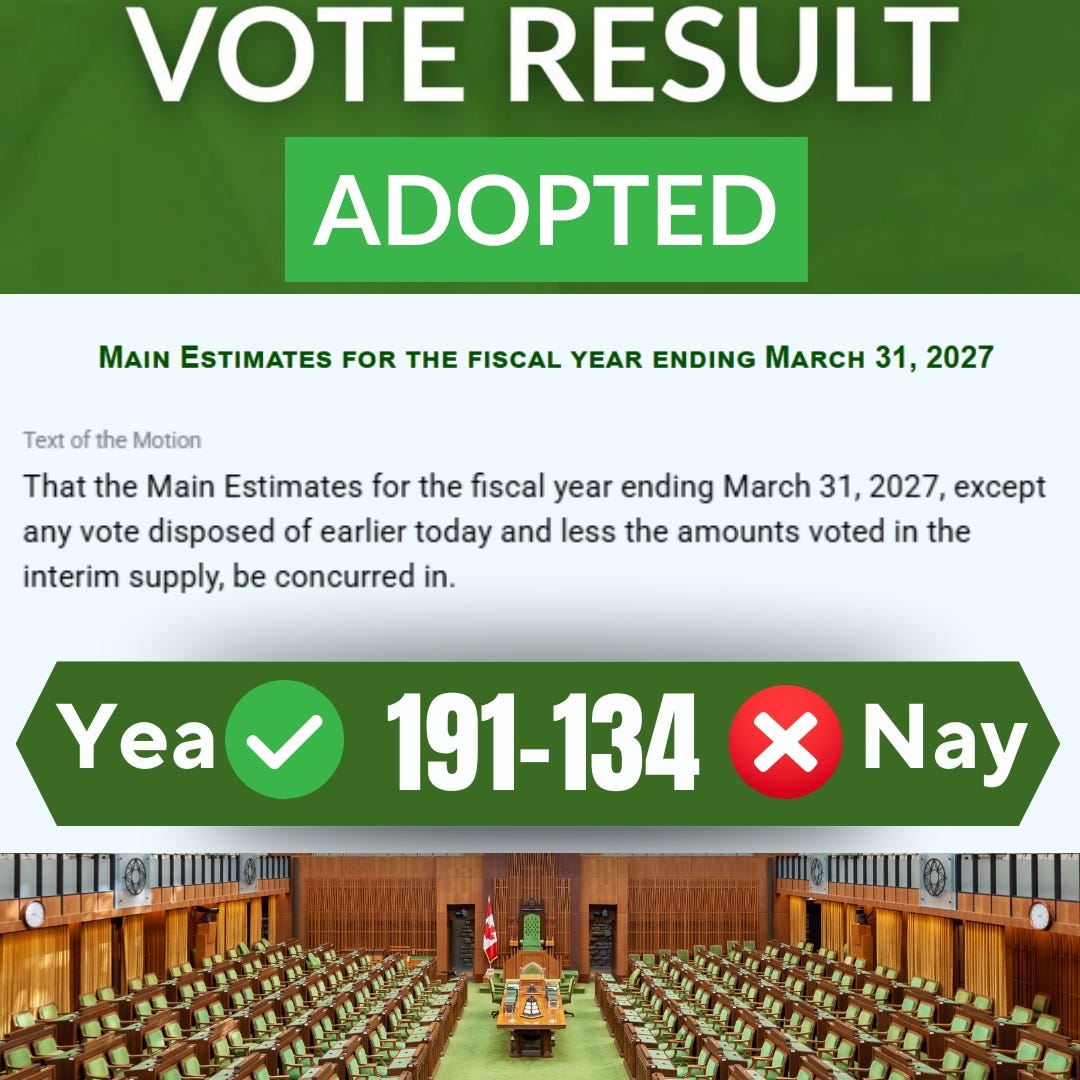
This week Parliament approved the federal government’s spending plan for the year ahead. The main estimates as the spending plan is known lays out in cash terms how much each department is assigned monies and outlines which major programs will be funded and to what level. The 2026–27 Main Estimates set out total budgetary spending of $502.8 billion. To put that in perspective: the same Main Estimates totalled $257.9 billion in 2017–18. Federal spending laid out this way has nearly doubled in less than a decade. It is projected to keep climbing.
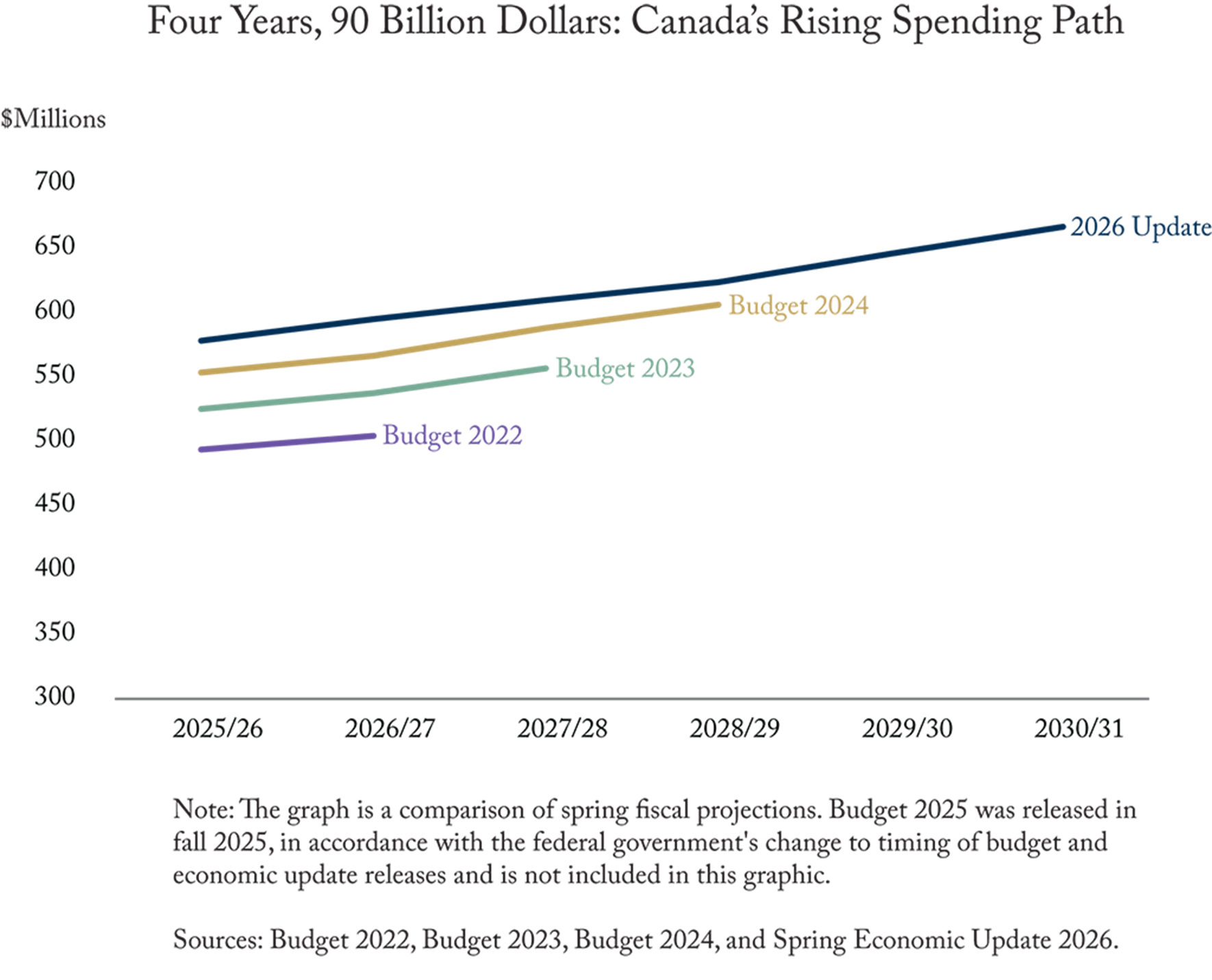
Source: Four Years, 90 Billion Dollars: Canada’s Rising Spending Path – C.D. Howe Institute
The Main Estimates are the government’s formal request to Parliament for the legal authority to spend in the coming fiscal year. They fund everything from federal departments to the transfers sent to provinces and the benefits paid to individuals. Voting on them is the original and the basic job Parliament exists to fulfill -- deciding whether and how much to grant the government the right to spend taxpayer money. This year these spending plans were adopted, with the Liberal MPs, the NDP, and the Bloc Québécois voting in favour and the Conservative official opposition voting against. Had the federal government lost this vote; a federal election could have been triggered.
A single number worth noting is the cost of the national debt. Of that $502.8 billion, $53.7 billion, roughly one in every ten dollars, does not pay for a program, a service, or a benefit. It pays interest on money already borrowed. That figure is up $4.7 billion, or 9.7 per cent, over last year as interest costs climb. For a sense of scale, it’s almost five times what it costs to run Health Canada itself, which costs about $11 billion.
Conservative MP Greg McLean put that into terms Calgary residents would recognize. He told Parliament that servicing the debt works out to about $3,400 per household a year and with a two-bedroom in Calgary renting for around $1,700 a month, that is the equivalent of two months’ rent every family effectively pays toward interest before a single dollar reaches a service they use.
Conservative MP Carol Anstey, citing the Parliamentary Budget Officer, noted that by 2030–31 an estimated 13.1 cents of every dollar of federal revenue is projected to go to debt interest. The PBO, which is non-partisan, also pegs this year’s deficit at $71.8 billion, higher than the $65.3 billion the federal government projected in its spring update.
The federal government has stood by its projections, and the Main Estimates fund real commitments. The Canada Health Transfer, the largest single transfer to the provinces, rises to $57.4 billion this year and is set to keep growing alongside benefits for seniors and defence spending.
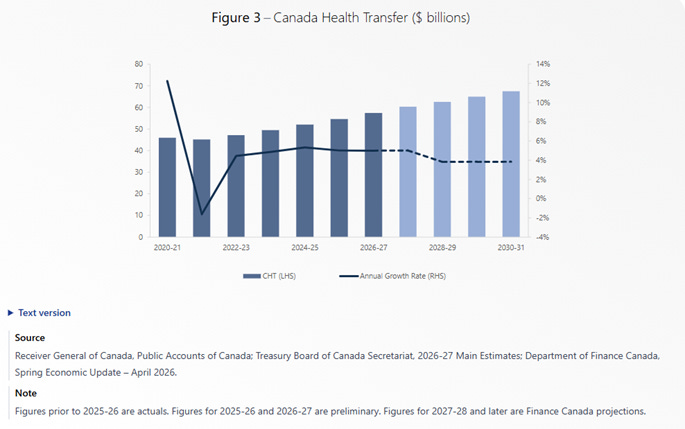
Source: The Government’s Expenditure Plan and the Main Estimates for 2026-27
Its supporters call these necessary investments; the opposition argues the pace of spending and borrowing is unsustainable while driving up inflation. With the Main Estimates now adopted, the federal government has its spending authority for the year. The larger argument over how big the federal government should be, and how much of it is borrowed, is not going anywhere.
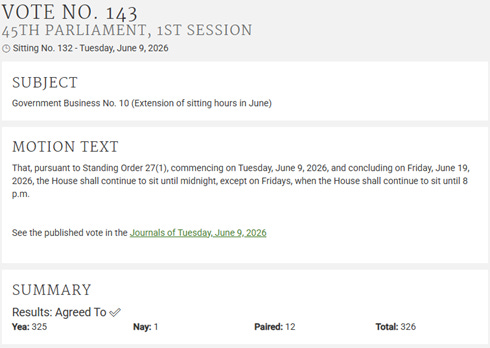
Before Parliament breaks for the summer MPs agreed to extend the working day until midnight for legislation to be reviewed. On Tuesday, June 9, Parliament voted to extend its sitting hours through to June 19, sitting until midnight on most days.
Each spring, in the final stretch before the summer adjournment, the federal government can move to lengthen the parliamentary working day so Parliament can work through as much of its legislative agenda as possible before MPs head back to their ridings. The motion this year covered the ten days from June 9 to June 19.
The motion passed with the unanimous support with MPs from across all parties backing it. That cross-party agreement is worth noting. The extension isn’t tied to any single bill. It’s a practical decision to clear as much of the unfinished legislative agenda as possible before the summer break where MPs return to their ridinfa full time to join community events, host roundtables, meet voters, doorknock, and other tasks in the riding.
In practice, it means long days. With debates and votes running late into the night, MPs are in and around the Parliament buildings for stretches that can approach fourteen hours. Next week, I will provide the usual review of the legislative calendar, what passed and what did not, as well as assess other federal government performed in passing its agenda, what, if any, amendments they accepted to their legislation and make note of major votes.
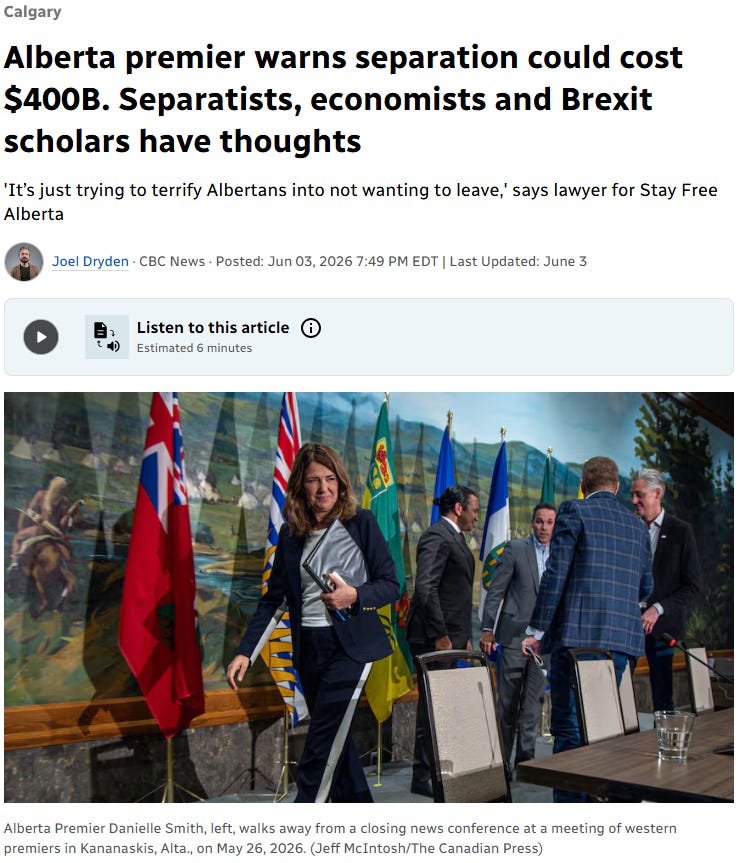
Ahead of the October 19 referendums, the Alberta Premier has put an early number on what leaving Canada could cost Albertans. Her estimate is close to $400 billion in transitional, start-up costs, plus somewhere between $25 billion and $50 billion in annual costs to run an independent country. Spread across the population, that works out to roughly $80,000 per Albertan up front and up to about $10,000 each year.
The figure reflects the cost of rebuilding, from scratch, the federal functions Albertans currently rely on. The Premier pointed to Alberta inheriting its share of the national debt, which she pegged at about $170 billion, with roughly $10 billion a year in interest; standing up a national defence, estimated at $25 billion in start-up costs; and replacing federal programs such as old age security and the child tax benefit. The list also includes taking over Alberta’s portion of the Canada Pension Plan, employment insurance, border control, a postal service, and the regulation of banks, railways and telecommunications.
Trade is a large part of the picture. The Premier noted that an independent Alberta’s trade agreements would all have to be renegotiated, with no guarantee of being grandfathered in, raising the prospect of tariffs on traded goods almost immediately. The first joint review of the Canada-United States-Mexico Agreement, scheduled for July 1, was cited as a near-term pressure point. Lennie Kaplan, a former Alberta finance official who has pushed for these numbers to be made public, reached a similar conclusion in his own analysis: he estimates separation could raise Alberta’s trade costs by about 12 per cent by 2028, and would require renegotiating pipeline access and supply-chain arrangements.
It is worth being clear that this is one calculation, and a preliminary one. The Premier described it as an early estimate, and a full costing document is still being prepared by the finance minister, with the aim of releasing it before the vote. Separation proponents dispute the figure as far too high. Kaplan, for his part, has recommended that the work be handed to an independent expert panel operating outside government, supported by staff who can run the analysis and supply the data. The numbers will firm up as that fuller analysis is done.
As I have said publicly, I will be campaigning on the Stay side of this debate. I wrote about my views on separation in a previous substack and you can check it below.
My Newsletter: October 19th Referendum
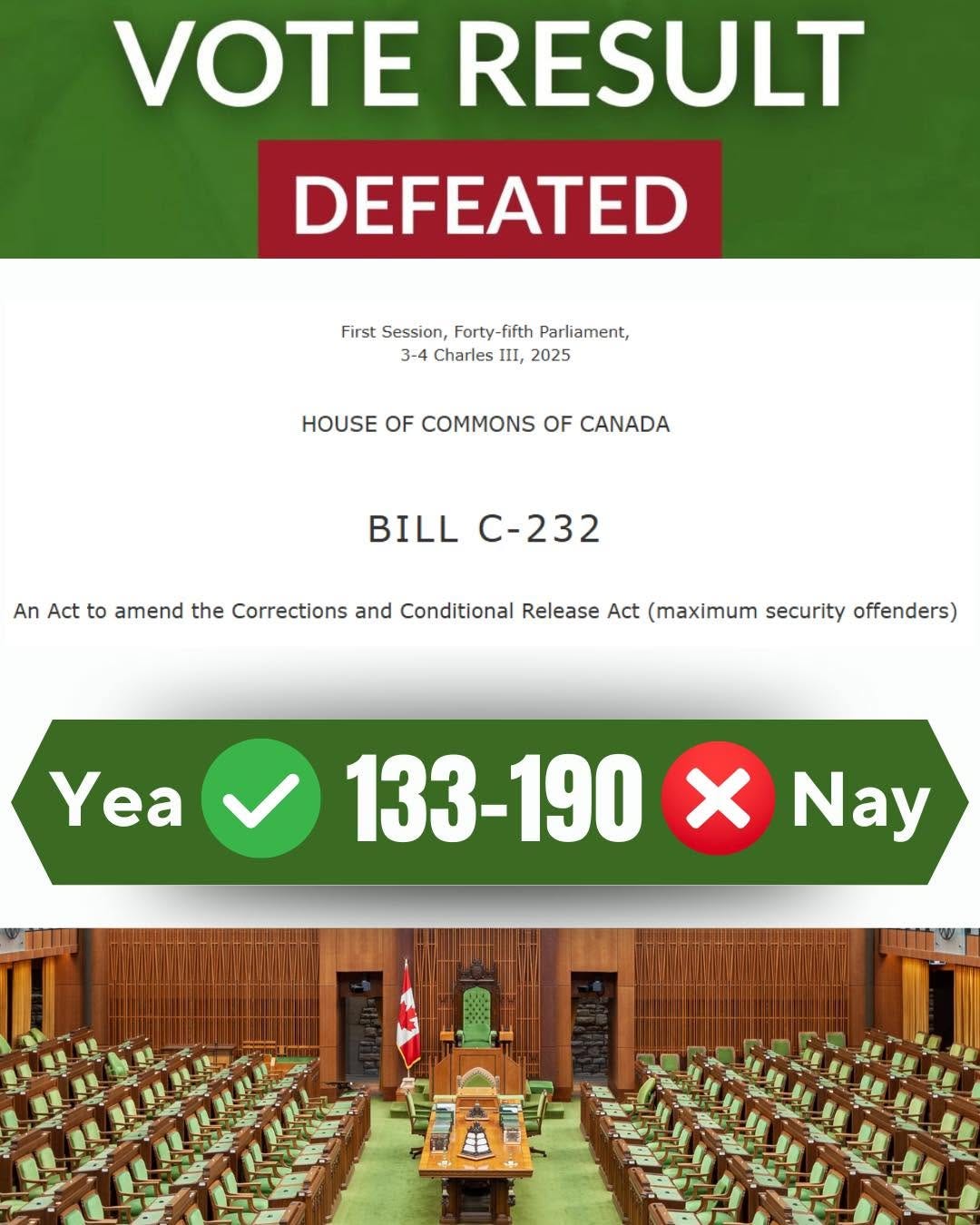
This week Parliament voted down a bill that would have changed where Canada’s most dangerous offenders serve their sentences. Conservative MP Tony Baldinelli’s Private Member’s Bill, Bill C-232, was defeated at second reading by a vote of 190 to 133, with Conservative MPs voting in favour while the Liberal, Bloc , and NDP MPs voting against. Second reading is the stage where MPs decide whether a bill is worth sending on for detailed committee study; when a bill loses here, it stops, and C-232 will not move forward.
What the bill set out to do was straightforward. It would have required that anyone designated a dangerous offender, or convicted of more than one first-degree murder, be permanently classified as maximum-security and held in a maximum-security facilit. This would remove the option to move those offenders to lower-security prisons. MP Baldinelli proposed this legislative idea after Correctional Service Canada moved Paul Bernardo, on May 29, 2023, from the maximum-security Millhaven Institution in Ontario to a medium-security prison at La Macaza, Quebec, a decision that drew national outrage. Bernardo is serving a life sentence, designated a dangerous offender, for the abduction, sexual assault, and murder of two teenage girls, Leslie Mahaffy and Kristen French; convicted in 1995, he has been denied parole at every hearing since. MP Baldinelli placed others in the same category, including Dellen Millard, Mark Smich, and Luka Magnotta.
MP Baldinelli's Speech in Parliament
MP Baldinelli argued that allowing offenders like Bernardo to move to easier conditions is an injustice to victims and their families. It also erodes public confidence in the corrections system. He pointed out that even the CSC commissioner who approved the transfer, Anne Kelly, acknowledged that Bernardo remains a psychopath who committed horrific crimes. The bill would also have repealed the “least restrictive environment” standard the federal government adopted in 2018 and restored the narrower “only the necessary restrictions” language from earlier legislation. The aim, MP Baldinelli told Parliament, was to rebalance the system toward victims and keep the most dangerous offenders where they rightly belong.
The bill was defeated, and the current rules remain in place. MP Baldinelli has said he intends to keep pressing for the change, and bills along these lines have come before Parliament before, so residents are likely to see the question return.
No posts
Comments
Nothing yet. Say the first thing.
Sign in to join the conversation.