
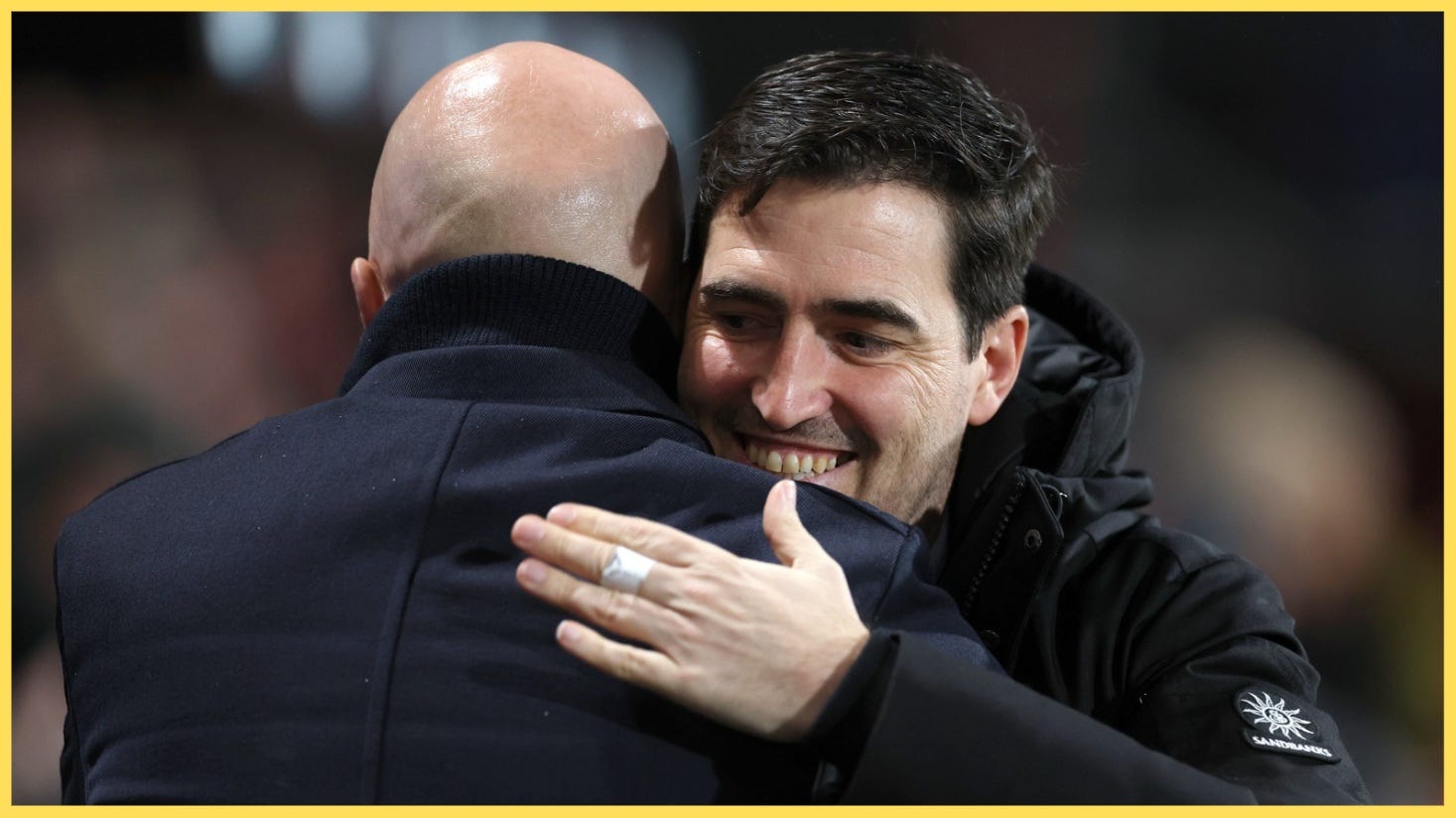
I fully expected the players to be positive about the new manager, Andoni Iraola; I certainly am, and the media seem to be too, so far.
This part is good.
A new manager brings a new optimism, as does a new season, and some exciting new signings, who can offer new dimensions. And while some are still out for some time, the injury crisis of last season will hopefully ease.
But one of the things I’ve disliked about this summer – aside from the recent hysteria over a bunch of kids conceding some goals – is all the shitting on Arne Slot and the supposedly slow football, as well as all his other faults; after a season when so much misfortune collided. I’ve moved on from Slot, but not in the sense that I think he can be treated poorly, as if he didn’t make the team champions.
Before the Leeds friendly, the BBC published this user comment, with user comments all part of the descent into a kind of hell:
“‘I think Liverpool will be very close to the title this year. They were overwhelming favourites last year until they fell apart under Slot.’ John (Leeds fan)”
Liverpool fell apart ‘under Slot’, as if he didn’t also win the league, and he’s why the Reds fell apart.
And never mind that Jürgen Klopp had two similar seasons in 2020-21 and 2022-23, only to organically improve in the seasons that followed, I said both during those crises and after; once the injuries eased, and there was a fresh start after the summer, to reset.
Slot has gone, so Liverpool will now be great because Slot has gone. Except Liverpool, to my eyes, were always likely to be much better this coming season, no matter what happened. For about half a dozen reasons. (Whilst the newness of the manager and his tweaks is the one thing that can work against instant success.)
I want Liverpool to be intense and fast; but I don’t think the Reds were actively trying to be anything that different last season, with slower players (as the faster ones were injured), all recovering from grief, with no proper preseason, and then, for Slot, a first-ever injury crisis in his career. Then, the negative cycle, and fan antagonism hurting the Anfield vibe (which made me worry that Slot would never get the fans back onside, no matter what he did.)
A strength of his had been keeping players fit, but now he had no preseason base after the summer was ruined by death and delayed deals, and some older players were losing their legs, as some fans lost their heads. This doesn’t need constant rehashing, but I want history to be written fairly.
And for expectations to be realistic. To be fair to Slot, but also to Iraola.
I’m a bit concerned that fans and the media are forgetting all the dull games under Jürgen Klopp, banging up against a low-block; as I noted several times last season, winning only 62% of his games against shitball teams (a below par win-rate based on expectations), whilst winning 62% of his games against elite/footballing teams (way above par). And shitball has gone full 1980s’ style since the start of last season. It’s grim.
I don’t expect Iraola to copy Klopp, as he has his own ideas (and doesn’t have the same cachet and clout, as no one does). But it’s hard to play fast football against a low block. As Klopp’s teams often found, in an era before synchronised time-wasting.
There is no space into which you can inject much pace, even if you maybe take extra risks with more shots and attempts at killer passes, but then you might get broken on (albeit that would at least open up the game for 20 seconds). As I keep saying, keepers waste more time when a shot goes wide these days, and any stoppage is used to kill the flow.
It’s also hard if you keep conceding goals to the lottery of long-throws, the taking of which also slows the game down; then it’s a series of who wins the aerial duel in the melée, and where the ball bounces.
Teams can spend hours each day practice using them as an attacking threat, as all they have to do is get the ball into the final third and hope to win corners or long-throws; but if you spent all your time practicing defending them, you’re practicing against random bounces, and you won’t be as good as a football team if all you do is defend long throws in training. You won’t have time to practice your passing, your pressing, your finishing.
It can derail you in a game, and deflate you, and change the mood of a match; but it’s hard to stop unless all your players are 6’6” and wily old pros who know how to use their bodies. You can improve to some degree at defending them, but so many of the outcomes are down to randomness.
It may not matter how fast Iraola wants Liverpool to play if the opposition play long-ball, long-throw football and then feign injury to win free-kicks all over the park, to break the flow and make it a slow, dull stalemate; it’ll be ugly, attritional and par for the course.
And as I found with 26 years of Premier League data, which I shared last season, and how the trends changed when Klopp arrived, refs statistically punish Liverpool far more than opponents; and do so even more when Liverpool press harder, unlike other hard-pressing teams. Liverpool spent years massively losing the Foul Balance.
I repeat:
Refs statistically punish Liverpool far more than opponents; and do so even more when Liverpool press harder, unlike other hard-pressing teams. Liverpool spent years massively losing the Foul Balance.
And the harder Liverpool press, the more opponents will flop down to negate the press and win a cheap but inevitable free-kick; they can just fall over, if they don’t get to the ball first and hoof it over the press – as refs are scared to give a big club (and vitally, a hated club) like Liverpool the benefit of the doubt in case it leads to an uproar; only Manchester United are penalised similarly weirdly over the course of many seasons on this metric, as the other big, hated club due to prior domination. Both clubs also won far fewer free-kicks than expected, despite different styles of play.
When teams like Spurs, Man City and Newcastle pressed hard, they still massively won the Foul Balance. Not Liverpool. Again, this is looking at trends of the Foul Balance of every game since the year 2000 – so well over 10,000 Premier League games. This serves to slow Liverpool down, as well as killing attacks and ruining the flow; plus allows more long-ball free-kick opportunities to the opposition.
And the Reds won a ridiculously low two penalties last season, conceding four. That’s just not normal, in addition to the crazy offsides, lack of red-card DOGSOs to opponents and deflected goals. (It was a bad-luck season, which can obviously happen at any time, but won’t happen every year.)
These are some of the things that may not go away with the change of a manager (albeit the lack of free-kicks to Mo Salah will no longer be a problem). Iraola had his own set-piece issues last season, picking smaller, faster, energetic players to try and press and pass, and not shitball their way to success.
But of course, you can get positive energy and positive ideas; a fresh start.
You can be rid of the sense of a manager the fans didn’t like, and whom they misunderstood far more than he failed to grasp what it meant to be Liverpool manager. (As if any manager could fail to notice what it means when their team wins the league with the Reds; nor when tragedy strikes the club in a way it hadn’t since 1989.)
But let’s stick to reality, not perceptions and misconceptions.
Which is what I’ll do for Iraola, and explain the reasons why as this article unfolds.
Such is the shallow world of analysis that it’s all soundbites and buzzwords these days. It’s all optics, and hot-takes, and surface-level word-vomit. People know a little about a lot of things, but to my eyes most football generalists, who could be interesting talking about football in general, are wrong about Liverpool, most of the time.
Daniel Kahneman famously noted that our minds prioritise coherence over truth; something easy to make sense of, that doesn’t take into account complexities and luck, and focuses instead on outcome or survivorship bias.
**The final two-thirds of this article is for paying TTT Main Hub subscribers only.**
Comments
Nothing yet. Say the first thing.
Sign in to join the conversation.