
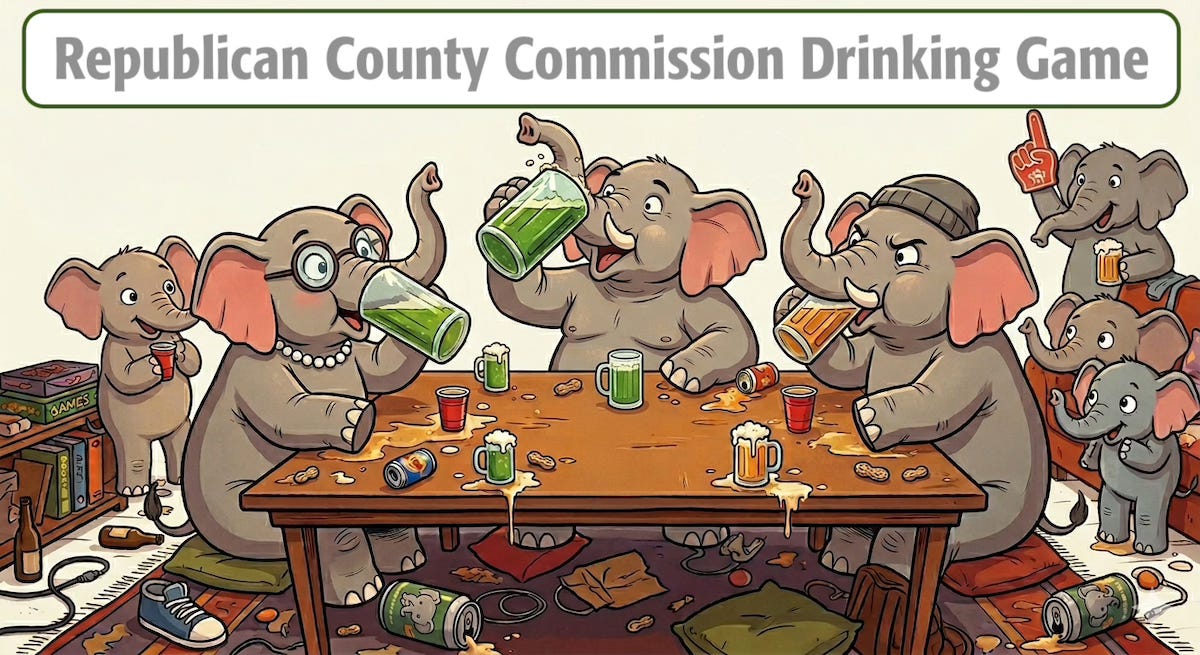
It’s a pivotal election year, with two of three Valley County commission seats contested. Yet the candidate repartee for the Republican races is so blah, the voter can only liven it up by playing a drinking game. If the rules are to take a shot every time a player hears or reads a nebulous campaign platitude, everybody from McCall to Smith’s Ferry will be face down on their rugs on Election Day.
We can suggest another drinking game in which everybody could stay stone-cold sober. That would be looking for differences between the Republican candidates for McCall’s commission opening. Megan Lawler and Michael Weaver are unanimously in support of responsible growth, fiscal responsibility and planning, as if they are looking to distinguish themselves from somebody who isn’t for those things. Or are they implying that current and past county commissioners stand for irresponsibility in all those areas? Who knows? They sure aren’t saying. So the only thing the voter can be logically assured of is that Lawler/Weaver don’t support murder. Good to know, but hardly a reason to pay attention or go to the trouble to cast a ballot.
To be fair, this is basic, political neophyte behavior. Inexperienced aspirants to public office reek with...er...inexperience. It isn’t just name recognition that makes incumbents hard to defeat. They are usually the only ones in the race who have a credible idea of what the job description actually is and what the boundaries of political goals are. The difference in tenor between the wanna be candidates and Katlin Caldwell (the only incumbent in the two races) makes this point better than we can.
Author’s Note: Follow the links to the Star-News and Valley Lookout Q&As in the Links section to evaluate our observation. Is it clear to any of our readers what these candidates will actually DO in office, as opposed to their esoteric view of life in general? Please email any discoveries or clues to tomigrote@substack.com.
One of the ways that a newbie candidate can sound and feel like an incumbent is to talk specifics. The appeal of “a fresh approach” is overrated. People overwhelmingly don’t choose surgeons or financial advisors on that sales pitch. Every day, expansion of online tools makes at least sounding authoritative easier and easier to do. Past commissioner meeting videos are all archived. Both The Star-News and Valley Lookout have excellent searchable online databases that we rely on heavily for research for these posts. Candidates who do not show any grasp of where the bones are buried are destined for some rude surprises at the public’s expense. To slightly improve on an old saying: “the road to hell is paved with pillowy generalities.”
The claim, “I bring private business experience” begs the voter to yawn: “Nobody yet has figured out how to run government like a business. Good luck with that.” Instead, how about: “County roads suck and this is what I propose to do about it.” Instead of, “I will listen to the people,” how about: “I will use tools like advisory votes to give citizens more power and feel closer to policy making. I will oppose any secret deliberation that is a plain excuse to hide decision-making from the public.” It would be so welcome to see somebody insist on establishing legitimate legal interest before slamming the meeting door closed in the people’s face, especially with the politically charged items currently on the county’s agenda.
Candidates love to wrap themselves in the transparency flag. But ambiguities like “I make no promises” or “people want to feel like their voices matter,” are opaque smokescreens that betray the absence of any concrete strategy to which a voter can pin any confidence. Below are some of the real problems on county voters’ minds. We offer our preferred solutions in case those running for office are interested. Agree with our points, disagree, or dismiss. But above all, dear commission candidates, take an honest-to-gawd position on SOMETHING:
From time to time, commissioners brag that the county’s property tax rate is the lowest of any taxing district in the county. There is a good reason for that. The county is woefully behind in spending on road construction and maintenance. For decades, the county relied on an annual payment from the federal government to counties with large tracts of national forest lands. Those funds slowly shrank and became spotty. The county did not make the case that roads are one of the fundamental functions of government, which is a legitimate argument for funding them with property taxes.
The county did put road funding on the ballot in 2019. It tanked because there was no list of priorities for the funds, just an assurance that the money would be spent wisely. Also, the ballot measure was for a permanent levy and not for a two-year, renewable levy. If it had been a two-year levy on a pre-defined project schedule, it would have passed. It would have kept passing (by now, it would have had a fourth round of funding).
Solution: A two-year levy should be proposed so that voters can review regularly if the county has spent the money according to a published list of funding priorities. Want to “listen to the public” in a way that counts? Use a public process to prioritize the projects and not the preferences of staff (like the last time).
The marketplace has always decided where development should go and what kinds of development are appropriate for the current times. The county’s current system of land-use planning accommodates that flexibility. The idea that people will live where government tells them to is a silly fallacy that has not been successful anywhere (see Afterthoughts). The county land use system does not give developers the right to build something blatantly incompatible with surrounding uses. But neither is there a right for people living in an area of a proposed development to set their own definition of “compatibility” to prevent the legal use of land they don’t own.
Solution: County land use policy shouldn’t be locked into “that’s the way we’ve always done it.” But it doesn’t need a total overhaul either. Strategic overlays (a planning tool far less rigid than zones) have prudently been proposed as general guidelines for development because they ease the fears of “hog farms next to homes.” The county’s definitions of “compatible use” should be reviewed to be sure they are up to date and provide a legible decision matrix of how a project blends with the neighborhood (the county’s archaic rating system needs to be dumped). However, the county should also show some spine by approving higher-density projects that make efficient use of the land and reduce sprawl—resisting the NIMBY squawking they are going to get. Finally, preserving open space and agricultural land should not be the purview of the county. The government should not interfere with market forces where farmers and ranchers are allowed to develop their land.
The county could ease public perception by doubling down on public access and public process. 1. Hold public hearings on important policy discussions, whether or not they are required by law. 2. Make all meetings accessible by investing in remote testimony capability. 3. Publish materials the board sees with each meeting agenda. 4. Move public comment from the end of each meeting to the beginning. 5. Appoint a staffer/commissioner to become schooled on the Idaho Open Meeting Law and to monitor so that unintended violations do not occur. 6. Recognize in a formal policy that executive sessions are permitted but not mandated by law. As a routine requirement, discussion should be held before each executive session so commissioners can consider a basic public interest question: “What real damage happens if this is discussed in public?” If closing the door mainly fosters “frank discussion that saves us from publicly exposing our biases,” that fails the test.
In the Nerdist Colony section below, we take some specific statements by candidates that show how their failure to deeply articulate their thinking leads them to seemingly contradict themselves.
Know somebody who likes a good drinking game? We play them all the time around here.
The McCall Public Works administrator must have been admiring the spectacular success of the local sewer district last year when his department announced a 60% increase in the cost of a water system upgrade project. Last May, a measly 22% of sewer district voters all but unanimously approved $7M in revenue bonds the district said were essential to replace a leaky sewer pond liner. We reported two weeks before that election that the district was in line to qualify for enough state assistance to do the job and urged voters to turn down the bond for a few months.
Well, guess what? The sewer district recently announced the state grant/financing package that will replace the liner. And again, we ask the obvious question: “then why was the revenue bond necessary?” It’s a bait-and-switch game we know all too well. The sewer district will say that the bond money will be put to other necessary purposes that they, not the voter, will determine. Will anybody care if agencies no longer feel compelled to be truthful about their financial resources or fear accountability for their cost estimates?
In the May election, McCall voters will again have the opportunity to raise an eyebrow over being told that, “this is going to cost X” and are now being told “this is going to cost 60% more than we thought.” Come to think of it, does anybody headed to the polls know why it is going to take $26.5M for McCity to correct what problem? It was initially reported to stem from morning shower/irrigation use during the six peak summertime weeks of the year. Is it really necessary to build a system that will operate at less than half capacity the other 46 weeks?
Furthermore, were there alternatives to floating another revenue bond explored? There was no answer to that question in local reporting nor on the city’s website. McCity did answer one other noteworthy query: what will happen when if the bond doesn’t pass (emphasis ours)?
If voters do not approve the bond, the City Council will reevaluate project timing and financing options. Without additional financing, project costs would need to be paid sooner through water rates or other adjustments, which could result in larger increases in some years.
That reads like the barn door of possibilities is wide open. Would anybody besides us like to see what these alternatives might be? If the measure passes, fuggeddaboudit. It’s worth noting that last week’s pipe failure that shut down the city’s water treatment plant was not related to the expansion project, reported Valley Lookout. So McCity can’t use that as a scare tactic.
It is a recurring theme in our posts that sloppy, inadequate detail justifying taxation or rate increases is an insult to the electorate. We have repeatedly called out incongruities between what the electorate is first told and what it is later told that contradicts what it was first told. The voter holds only one card to force honest accounting and greater attention to alternatives from local government: the “no” box on the ballot. There isn’t a project timeline that is so dire it can’t wait the few months between elections for more public accounting and more options—especially before the voter commits to long-term debt.
McCity is so confident that their customers will do whatever they tell them to do that the explanation of the cost overrun is buried deep in their website, when it should be on the home page. The voter is told that the financing is essential to “complete the plan” and offers a list of the upgrades but no specifics on how the priorities were arrived at and the projections on which they were based.
The most glaring omission is any attempt to account for a 60% cost overrun. The voter is supposed to swallow that professional engineers can’t get within a moon landing of an accurate cost. Increases in “construction and materials costs,” is supposed to suffice as a logical explanation. “Construction” in this case almost always means labor. If any local business had experienced a 60% increase in overhead in a two year period, there would be a permanent closed sign on its door.
Before throwing more money at a problem the voter can’t define with any specificity, it is completely rational to vote “no.” As the McCity quote above verifies, instead of accepting a single “vote yes or else” threat, a failed measure will trigger a full accounting of costs and alternatives. And that accounting should come in the form of a user-friendly but not condescending document posted on the city’s website, not some dry engineering report. If this Substack had been around in May, 2024, we would have leveled the same skepticism at the original proposal.
Voting “no” in this case is not obstruction. It is a request: show us a complete picture we can understand, give us a chance to evaluate it and then ask us again.
There’s plenty of time for that. Just. Sayin’.
Author’s Note: McCity did conduct a couple of information sessions a month ago when nobody was thinking or talking about the election. Open houses are useful for some and have a place in the communication toolbox. But they would be even more productive if attendees had a background document available ahead of time instead of walking in cold. Live Q&As are always designed with the objective of “getting the CYA over with” as the chief priority.
Would you like to a)tell us how wonderful we are b)tell us to crawl back where we came from c)tell us about your favorite beer? (no pictures please, we endure enough swill around here in the interrogatory sense). Write us a private email! Send your bribe observations to: tomigrote@substack.com. We promise we won't out your trash talk to your church congregation.
• The idea that people will live where government tells them to is a silly fallacy that has not been successful anywhere. This is a reference to a previous post we’ve included in the Links section reviewing the difference between McCall’s strict zoning laws and the county’s more flexible system. The term “zoning” is a catch-all term that catches up a lot of imprecision with it. Aspirants to the open county commissioner seats would do well to bone up. The planning profession jury is in on what strict zoning is really good at. It inflates housing costs by protecting low density with heavy restrictions on higher density development. Especially in dynamic resort economies, it freezes uses for all time that will not stand the test of time. That kills the innovation that promises to provide an anecdote to public funding of housing. —‘nuff said, read the post linked below for more.
Here is what we meant by newbie candidates getting tangled up in their own rhetoric:
“Growth affects everything, including housing, infrastructure, and quality of life. If growth outpaces infrastructure, it puts strain on roads and services. At the same time, we need to ensure our local workforce has opportunities to live and work in this community. The solution is thoughtful and balanced planning. That means guiding growth in appropriate areas, supporting infrastructure improvements, and making decisions that reflect community input while considering long-term impacts.” —Megan Lawler
Our response: “Appropriate” usually means “zoning.” Is that what you are trying to say? “Supporting infrastructure improvements” usually means extractions and impact fees. Is that what you are trying to say? So, how do you support workforce housing if you make it harder to develop housing with zoning and fees?
“My background is in operations—building systems, managing resources, and making decisions that hold up over time. My only special interest is the people of this county. I want to help protect what makes Valley County special.” Weaver said that he was motivated to run for the position because growth is happening, but it has not always been aligned with infrastructure or applied consistently. “That creates pressure on roads, services, and rural areas, and uncertainty for property owners,” Weaver said. “Residents should be able to rely on predictable decision-making that follows a clear plan and respects property rights.” —Michael Weaver
Our response: If “special” means wide open spaces, you have no control over that. If it means a friendly place to do business, then does that also mean the construction business? Is the county still special if the roads are crap? Not sure what “infrastructure” means. Developers are required to have safe water and sewer systems, etc. So we are only talking about roads, a county investment dearth which individual developers cannot be extorted to resolve. Idaho law prevents “extractions” from developers that exceed their project’s footprint. “Predictable decision-making that follows a clear plan” is code for imposing strict zoning which for many voters is in direct conflict with “respects property rights.”
• Incumbents can talk policy gibberish too. Here is Katlin Caldwell on tax-supported housing: “I said I think it’s important for rural hospitals to possibly have some healthier taxing districts, but that is decided upon by voters. I don’t think all taxing districts should be involved with attainable housing, but certainly some of them can be, and it’s helpful to these small rural communities that rely on it.”
Our response: Caldwell is clearly grasping at straws on the different types of taxing districts operating in Valley County, which as an incumbent, she should have a better understanding of. All of them, with the exception of McCall Memorial Hospital District, control the operations of their agencies. Cascade Medical Center District controls and operates its service. The EMS district employs EMTs and operates/controls its service. Ditto with fire districts, school districts, etc. McCall’s hospital district is a hybrid that does not control/operate anything. Since its merger with St. Luke’s Heath Systems, its sole purpose has been to funnel public funds to a profitable, private hospital. It drafts off the standard perception of a hospital district without really having anything in common with the hospital district concept. In this case, Megan Lawler came closer than the incumbent in articulating this distinction and the recognizing its relationship to housing.
• We messed up a piece of the legislative budget process in our last post. We said that the responsibility for crafting the budget had moved from the executive branch (governor) to the legislature and that constituted a shift in control. Wrong. The state budget still originates with the governor’s staff as it always has. And the non-partisan Legislative Services Office still reviews it and makes recommendations as it always has. The resulting downward trend in agency spending makes an arguable case that the legislature’s priority for austerity is winning at the expense of the traditionally accommodated requests from the governor.
• Valley Lookout Q&A on McCall’s commissioner race
• Valley Lookout Q&A on Cascade’s commissioner race
• Star News Q&A on McCall’s commissioner race
• Star News Q&A on Cascade’s commissioner race
• Our post on strict vs flexible zoning
About us: Tom and Tomi Grote owned/published The Star-News for 40 years (1983-2022). We sold the paper and are now retired on an acreage near Lake Fork with two horses and a Basset Hound named Gidget.
No posts
Comments
Nothing yet. Say the first thing.
Sign in to join the conversation.