
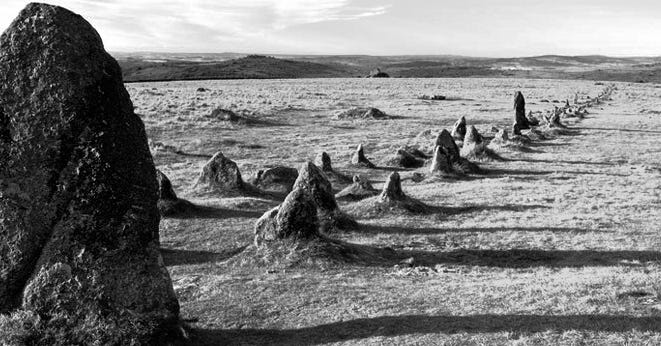
I don’t go a bundle on Christian mythology, as you may have gathered if you follow my work, but I do like Easter. When I lived in Greece, it was my favourite mad festival, and these days, the feast of it still feels powerful and rightly-located in the year, for all that I relish neither overpriced chocolate eggs or regurgitation of Christian stories that are largely shorne of their pre-Christian lifeforce. You’ll find plenty elsewhere about the origins of the Easter story and even the name of Easter, but this piece from Falconer’s Joy (now sadly out of print*) is my addition to the canon of work around surrender, death and resurrection.
Is there a piece of mine I love as much as this one? Hard to say. Sometimes a Wild God, of course, occupies its own space. This was proper graft over a number of years and is good true-speaking, as well as a love-letter to a place on the moor that holds my imagination in mysterious ways down the years now.
*I’d love to reissue Falconer’s Joy - it has some fine pieces in, so if you’ve a few spare thousand quid, do let me know…
Text within this block will maintain its original spacing when published
MERRIVALE
A remembering, in seven parts
I.
In the granite bed where I sleep,
There lies a bear whose breath is the rise
And fall of stars between these
Rough rows of stone.
The bear’s mouth is the October sky,
As hungry as a cave in the mountains,
As black as the water in a dream
In which you fell and died, then lived
To tell the tale, remade from your remains.
I place the only copy of my dog-eared life
Into the broken kist of the Great Bear’s mouth
And it leans out of the heaving night to
Eat the boy and man I’ve been,
Sleeps again with my dreams churning,
Hollow and restless in its ever-pregnant,
Ever-aching belly of the night.
Hail, Merrivale, my bed of stone and stars.
Here, I’ll rest my memories and no other
Story will have a fast hold of me now.
II.
Speak to me in the language of Moss and Stone:
The brook and fox-den know well my
Mother-tongue. Let us be clear:
This Moor-language sings sweeter in my ear
Than all the songs I ever heard from angels,
Clear and beautiful as they were.
I tell you no lie, not here. I could not,
For all my skill in falsity.
This peat-brown water,
These rain-stacked stones;
Oaks both mighty and small.
That stream-crouched May
Beneath which I sleep so deeply
And forget and remember my most
Noble and ignoble truths.
Here are granite avenues; here is the sky above Earth;
The stone-wrought lines in which the ages live,
Not forgotten, by me, tonight at least. Not quite.
This Bear has been stalking my life.
Sweet as a knife, warm as night,
Kind as a wounding and deadly as the hour
In which I dream my last great dream.
I bare my neck to the blades of
Remembering and forgetting.
III.
Once or twice, when my spine was made of birch,
When the fire in my head was a fire in my belly,
I fell up into the sky of trees and there
Among the green leaves of oak and ash,
I found the runes and learned true speech.
Because of this good fortune, I know my rightful name,
Though the fortune was not easily won and the road
Towards my name is a path of hunger and sorrow.
But see, now, am I a bird or a song
Or a stone-bound dreamer?
Truly, I am a swallow in flight;
I am a dour man of England;
I am the river-stalker,
And I am both the blacksmith
And his chains.
I cannot read the Galaxy,
But I know the language of tree,
Leaf and the cross-branched sky.
I know the speech of secrets;
I know the stone-lined path and
I have taken the long way home.
My brow-star is only just beginning to rise.
Attend to the voice in which I spoke truly:
Show me who you are when
The Great Bear has eaten
All your words.
IV.
This, then, is the calling I ignored,
The enemy with whom I would not engage.
This is the place I remembered,
But to which I would not return.
Prodigal and penitent, I pray truly:
Hold me tight and close enough
That memory returns and stays
Right in my remembering.
My seven sisters wait, wiser
Than my brothers in star-Lore,
But not that of stream or tree
Or of the grey stones, now as
Fixed in my geography as a coast
Or a birthplace or a grave.
I was at the battle where the great shout was made;
I advised the army in that significant moment:
Help me recollect precisely
The weapons we employed then and
The banners to which we rallied.
How did we find hope enough
To take to the field
Though our enemies were myriad
And impervious to all our arms?
How did we face the dark
And our certain death and yet,
Somehow, prevail?
Hail, Merrivale, where I fought and
Fell that day and lived again.
Time, tide nor all the flooding sea
Will keep me from you now.
V.
Young as I was in those giddy days,
I believed the fable of unending flight,
Fleet-footed, bright-winged,
Agile as a sprite or a swift,
Weightlessly becoming God.
I wrought havoc in the shadow
Of my hawk-shaped flight,
Became not light, but a bearer
Of insubstantial promises and the folly
Of those who lose the Earth
And forget the shape of their own
Feet in the darkness.
In lesser days than the great hours,
I writhed in the ties of this life,
As stubborn as a fly or a bolt stuck fast,
As graceless as a faltering foot.
When gravity claimed me,
I made a slower, sadder story:
An agent of the light-flecked,
Dark-cracked jackdaw.
A dappled servant of complexity,
One foot in the bright-shining heaven,
One foot in the King’s stone of Dùn Ad,
No longer golden, but dark as
Silver in the ashes of the forge.
The Bear made a feast of all those I wronged,
All those I loved and all who stood by.
Each one in their time has trodden
That pathway of stone and stars.
Was I closer to God and love through
My mistakes or through my triumphs?
Who’s to say? Not I, and the Bear
Is silent and no one else can know.
A hawk cries out in the dark hour,
Hungry and homeless as a saint.
The water in the thin leat sings
Its song of endless, hopeless hope.
The Bear splays its crooked claws and
Reaches out into the dense-tongued darkness
To deliver all our victories against deception.
VI.
It was a dark day, that Easter
And our child, unborn, our first.
We sat in your shadow,
Adrift in our distress.
We climbed King’s Tor,
Knew the world was good,
Though we could not feel it.
Aged with grief,
Cut out of innocence,
We were bereft.
I don’t know another place
That could have held us.
Hail, Merrivale.
This time, I will not forget.
VII.
Three horses,
A skewbald foal as fresh as dawn.
A score or so of sheep
Bleating in the hill-dew.
A wagtail on a finger of rock.
An immense Bear, asleep,
Stretching its arms in the stars.
The high moor is calling;
They have uncovered the queen
With the knotted hair,
And the king is sleeping
In the black-bird’s eye.
Now is not the time for silence.
The chill wind cuts.
The hard ground bites;
The mist becomes rain and I,
A mortal man with
Aching legs and heavy arms,
Awaken to the thin daybreak light.
I will learn to speak with the bear’s tongue;
I will tell my story from the stone-mouth of the kistvaen;
I will learn again to walk the long way home.
I rise and step towards my life,
Daring in this damp dawn to trust
That not all things worth loving are lost.
Another star is rising on the pale horizon
And the moon has yet to sing.
Hail, Merrivale;
I remember;
I believe;
I begin.
Comments
Nothing yet. Say the first thing.
Sign in to join the conversation.