
I was sitting at at the airport, watching people move between gates, queues forming and dissolving, workers repeating the same tasks they’ve likely done hundreds of times before. Everything functions smoothly, and almost automatically.
And that’s the point. It’s hard not to see or wonder how much of what I’m seeing still requires us. For decades, countries like Sweden, Denmark, and Norway built something remarkable: welfare states designed around stability, equality, and long-term employment. The model was simple in principle — work consistently, contribute to society, and in return receive security through education, healthcare, and social safety nets. A great system. A model which provides what you constantly reinforce and finance. It worked. It created some of the most stable and prosperous societies in modern history.
But it was built for a different kind of economy.
That system assumed a world where most people worked in clearly defined roles — a post–World War II economy, often physical, often repetitive, often tied to a single workplace for decades. A world where productivity depended on human labor in a direct, visible way. That world is disappearing.
I look out toward the airstrip. Parts of it are under construction. Workers stand in yellow vests — one smoking, another speaking into a device, another driving across the asphalt. Manual labor is still a very reliable and necessary work. Things need to be built, moved, maintained. From large-scale infrastructure to detailed crafts, physical work remains grounded in reality in a way many other forms of work no longer are. But even here, something feels transitional. The roles remain, but the system around them is changing. Some work remains necessary, but even that exists within a changing system.
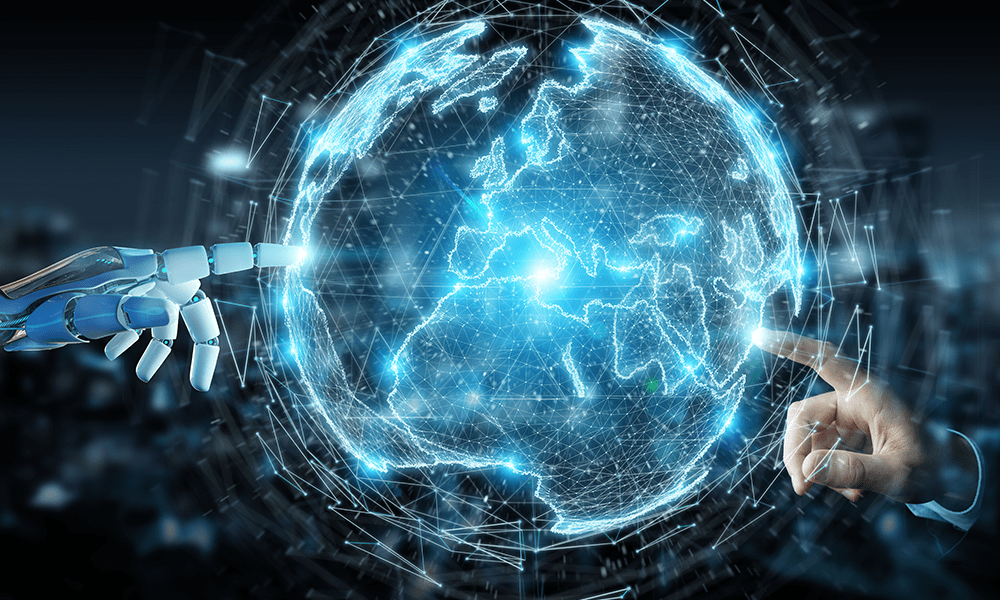
Automation is not a distant concept anymore; it’s embedded in everyday life. Self-service checkouts, digital banking, automated logistics, AI-assisted workflows — these are not future scenarios, they’re already here. And as they improve, they quietly reshape what work actually means. At first, we resist these changes. Then we adapt. Eventually, we prefer them. The same way a new phone once felt unfamiliar, and now feels intuitive. The same way self-checkout once felt inconvenient, and now feels faster. Then what happens, are we liberated, or meaningless?
There’s a growing mismatch between how society is structured and how reality is evolving. We adjust faster than we think. And because we do, the transition feels less like disruption and more like a gradual shift we barely question. But beneath that smooth transition, something more structural is happening. The link between work and security is weakening. For instance, think about the traditional path of education, career, stability, how it no longer guarantees what it once did. Housing costs rise faster than wages. Stable, long-term roles are replaced by flexible, temporary, or automated ones. Entire categories of work become less essential, not overnight, but steadily.
It’s not that people have stopped contributing. Not that people are not ready to put down the work or anything along these lines. It’s that the system requires fewer contributions in the form it once did. And yet, the expectations remain the same. We still measure value through employment. We still organize society around the assumption that most people will work full-time for most of their lives. We still build identity around professions that may not exist in the same way a decade from now. And most people don’t think once about these structural grand changes. Perhaps because staying afloat leaves little time to step back and question it.
There’s a growing mismatch between how society is structured and how reality is evolving. Part of this is technological, another is economic, and yet another part of it is about how power operates. In a globalized, capitalist system, capital tends to concentrate. Much of what we do is now tracked, measured, and optimized.
Our attention has become a resource. Our behavior, a pattern to be analyzed. Even our interactions begin to carry a kind of invisible transaction—where value is constantly assessed, compared, and shaped by systems we don’t fully see. And much of that system is not local. It is built and controlled elsewhere, often far from the societies it quietly reshapes. It is directed and engineered to feel appealing and voluntary, yet spreads globally with little scrutiny of its long-term impact.
The effects are real. People begin to feel replaceable. Because the truth is, we are. Work begins to feel disconnected from purpose. And outside of economics, this uncertainty starts to show up in other ways — social tension, identity struggles, polarization, a search for meaning in places where structure used to provide it. Not because society is collapsing, but because it’s changing faster than our frameworks for understanding it, and how to perceive the actual value of meaning inside of it.
None of this means the foundations of the welfare state were wrong. If anything, they were one of the most successful social models ever created. Institutions like the European Union reflect a broader commitment to cooperation, stability, and shared values that still matter. But systems don’t remain effective just because they once were. They need to evolve alongside the conditions they were built for.
Sitting here at the airport, everything still works. People are employed and all the different systems are running. The ones visible, as the ones running behind which we cannot see. Society, on the surface, is stable. Everyone looks busy, but it feels like we are in between two versions of reality — one that we understand, and one that hasn’t fully taken shape yet. One that is structurally evolving and entering our physical domain for every second that goes by. The question is no longer whether change is happening.
It’s whether we are willing to rethink what work, value, and contribution actually mean in a world that may not need us in the same way it once did.
And if that’s true, what replaces it?
Take care,
Tom
No posts
Comments
Nothing yet. Say the first thing.
Sign in to join the conversation.