
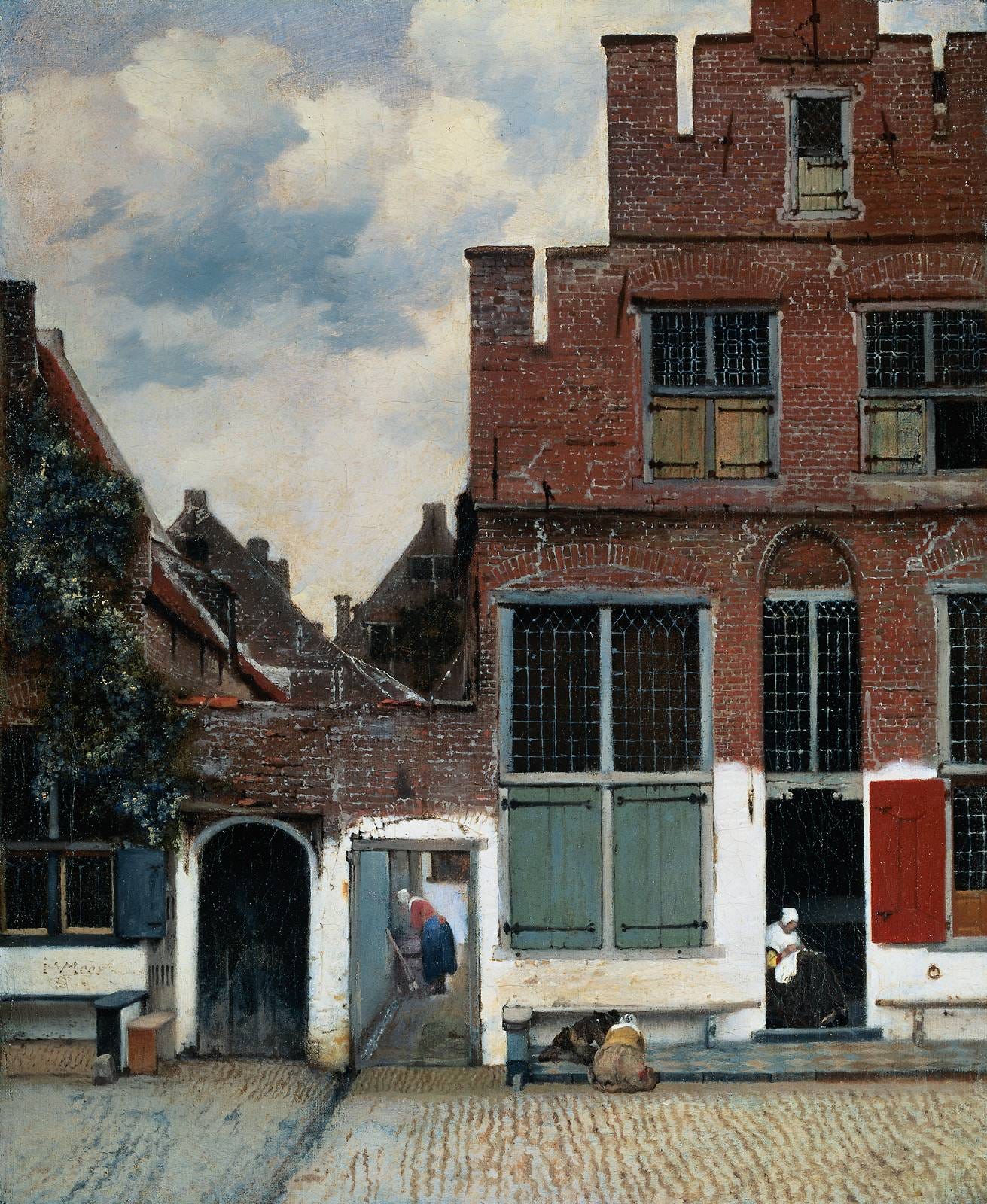
In The Little Street, Vermeer captures the joy and dignity of a simple life in Delft. But just as in View of Delft, Vermeer has taken some artistic liberties with the accuracy of what he shows us. What he gave us is a view of what a good neighborhood should have looked like to him in his town—safe, industrious, harmonious, and simple.
The Buildings
It would be satisfying to identify the specific buildings in the painting. In fact, many have made a sport of trying to do just that. But the street scene shown here is a fabrication. I have recently strolled the streets of Delft. There are scores of buildings in Delft with stepped gabled facades, and any number of arched passageways and small alleyways, both then and now. But the structures shown in his painting were created by copying and pasting ideas from several buildings near Vermeer’s home.
There are several architectural “challenges” indicating that the buildings are inaccurate. The greenish-gray shutters between the doorway and the alleyway cannot be accurate—opening them more than halfway would obstruct the door to the home or block off the alleyway. The left side of that window is too close to the edge of the house to be practical. The bench where the children play looks fragile compared to the rest of the building and seems to hang in the air, supported only on the left side.
The buildings, as depicted, are not pristine; they appear to have undergone extensive repair: Shutters have been replaced, patches are evident, and some repainting has begun but is not yet complete. All of this is consistent with this painting having been done just a few years after De Donderslag (The Thunderclap), an explosion of a gunpowder magazine that destroyed much of Delft in 1654. The explosion would certainly have damaged these dwellings.
The Composition
The composition of the painting is unusual. The top of the building is cropped off, and the whole scene is off-center. If the purpose of the painting were to accurately show a particular building, it would have been framed better. It is intentionally unbalanced to show that this is not an architectural document. It is not about the buildings, but simple everyday life in Delft. It is about the feel of women and children going about their daily activities under a billowy sky, next to a building on a quiet, pristine yet anonymous little street.
There are no church spires or signposts to identify the neighborhood. De Hooch and many other Dutch painters of the time would have included such landmarks to provide a sense of place. By leaving out such landmarks, Vermeer keeps the location anonymous.
The Characters
The woman in the entry of the main building is the only elderly person in any of Vermeer’s paintings. She is involved in the everyday task of mending clothing. Like the woman in the alleyway, she is not involved in anything majestic or grand but is quietly pursuing an everyday but ever-so-important task for the well-being of the household.
The maid in the alleyway—perhaps the same woman working in the kitchen in The Milkmaid—is washing laundry over a wooden barrel, the overflow trickling towards the street. Her broom has already been put to good use: The alleyway and the street are as clean as a Dutch interior. The broom stands at the ready to whisk the wash water towards the drain in the street. The sense of pride in one’s surroundings is evident, even after the damage from the explosion. Vermeer is pleased with his town and wants to share it with us.
The most charming characters in the painting are the two children playing under the bench in the foreground. Surprisingly, although Vermeer was part of a busy household teeming with children, they are rare in his paintings. Children would have been particularly precious at the time this painting was executed, as so many of them had been killed in The Thunderclap. And because these two characters are closer to the viewer, the children appear larger on the canvas than either adult. That is, of course, deliberate: Children, if not the most important people in a household, are certainly the most demanding.
These two are hiding their play from us adults. As with many children’s games, we adults can’t grasp what they are doing. They are participating in a simple everyday childhood game like children everywhere, enjoying an innocent childhood joy. Their innocence reminds us of the fleeting nature of life.
The Joy of Everyday Life
After living through the Thunderclap and witnessing so much death and destruction in Delft, I can imagine the young painter having an acute awareness of the fragility of life. The focus of his paintings immediately shifted from Bible stories and mythological scenes to pictures of everyday life in Delft. Perhaps no painting of his honors the value of a simple life more than this one. The children are safe, the women are occupied, the brickwork is weathered but sturdy. The real “story” of The Little Street is that ordinary life itself is precious.
Thanks for reading Vermeer Stories! This post is public so feel free to share it.
Other Articles of Interest
No posts
Comments
Nothing yet. Say the first thing.
Sign in to join the conversation.