
Many people hurry through museums as if they were on a mission to get as many checkmarks on their tally sheet in as little time as possible. We see them taking an occasional picture of the paintings or standing with their backs to the masterpieces to take a selfie. Even at the Mauritshuis in The Hague, home to perhaps the best collection of Dutch paintings in the world, people scurry past masterpieces by Hals, Vermeer, and Rembrandt with hardly a glance.
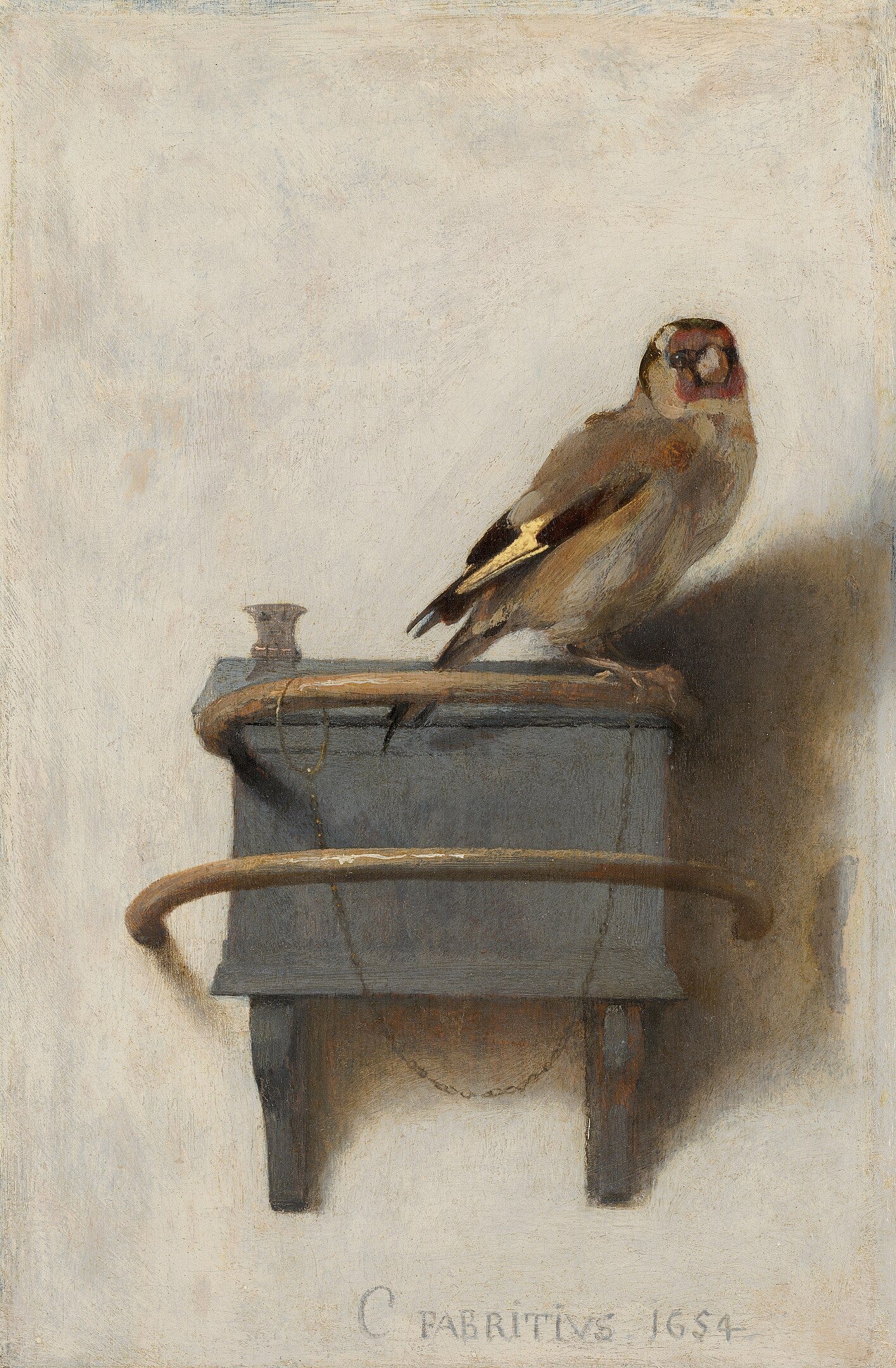
But everyone stops to spend time with The Goldfinch.
What is it about that little bird that is so captivating?
Carel Fabritius
Any biography of Carel Fabritius (1622-1654) is necessarily short. Not much is known about him. And he did not live very long.
He was born in Middembeemster, a small village about 20 miles north of Amsterdam. His father was the village schoolmaster and a weekend painter, inspiring Carel and his two younger brothers, Barent and Johannes, to become painters.
In September of 1641, at age 19, Carel married the girl-next-door. The newlyweds immediately set up house in Amsterdam, where Carel was beginning an apprenticeship in Rembrandt’s studio. He is regarded by many to be Rembrandt’s most gifted student. But his family life during his time in Amsterdam was beset with tragedy. Within two years, his young wife was dead, as were a set of twins and a third child. Carel had just turned 21. He moved back to his parents’ home in Beemster to grieve. He continued to paint during that time, but very few paintings from that period survive. In 1650 he married a widow and moved with her to her hometown of Delft. There, at age 28, his career began to flourish.
For Fabritius, 1654 was a year of extraordinary artistic achievement: During that year he produced what would be considered his four greatest works: The Sentry, a revealing Self Portrait, A View of Delft (not to be confused with Vermeer’s painting of the same name), and The Goldfinch.
But in October of that year, while working at his easel in his studio, an arsenal containing 80,000 pounds of gunpowder exploded just across the street, destroying a quarter of Delft and killing hundreds, including Fabritius himself and three other people in the studio at the time. The explosion, known as De Donderslag (“The Thunderclap”), presumably destroyed many of his paintings; only about a dozen are known to survive.
An analysis of The Goldfinch conducted in 2003 revealed several small indentations on the surface of the work, which could have been caused by debris thrown by the explosion. The paint was apparently still wet and still in his studio at the time of The Thunderclap. Somehow this one was spared. What good fortune that is for us, that this masterpiece survived that catastrophe.
Carduelis carduelis
The painting depicts a popular songbird, the goldfinch.
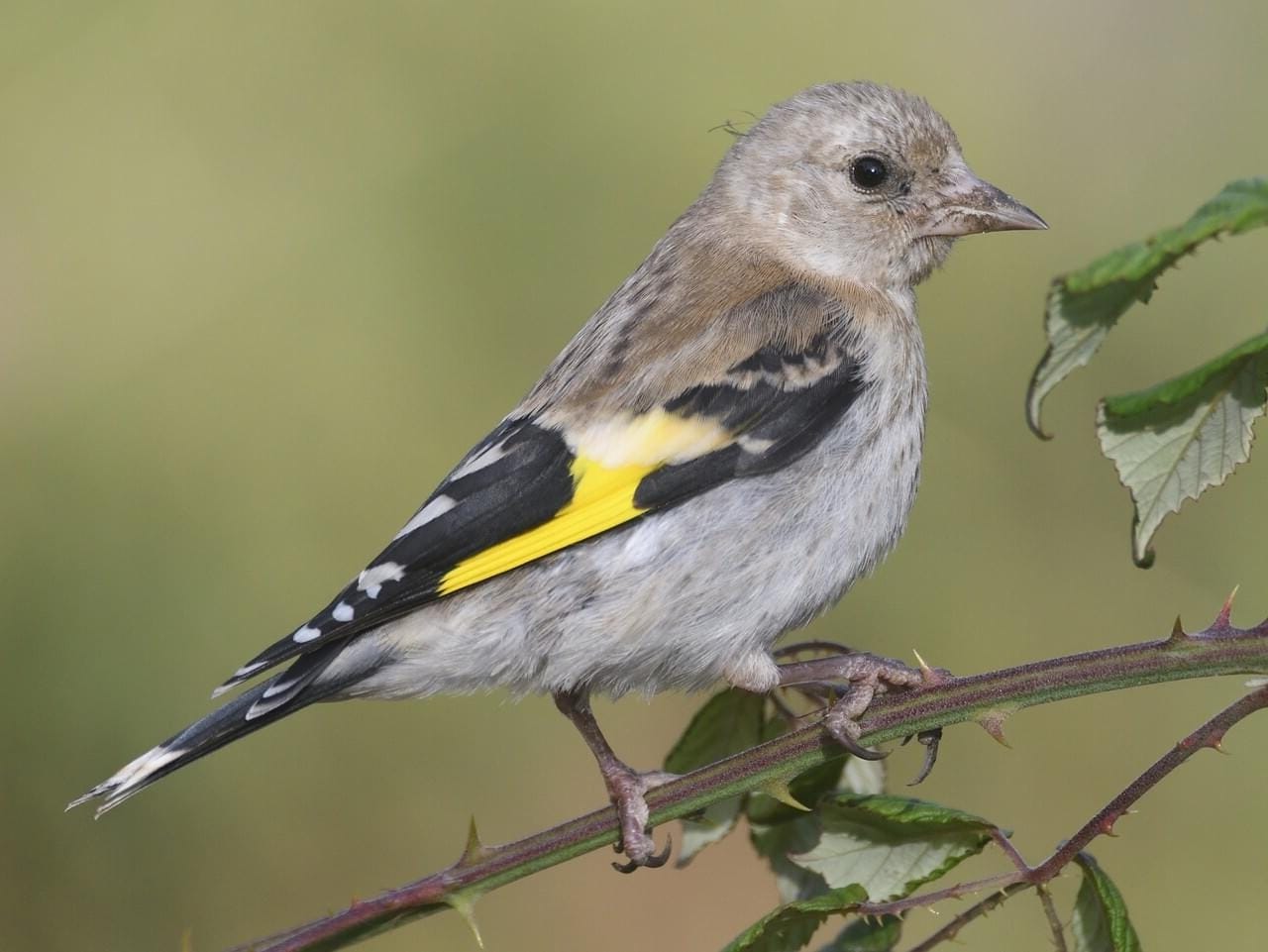
Carel Fabritius was not the only artist to portray the goldfinch in a painting. In fact, Herbert Friedmann produced a monograph in 1946 in which he listed some 486 paintings that included a goldfinch, including works by Rafael, Leonardo da Vinci, Hieronymus Bosch, and others. The goldfinch was popular for its colorful plumage, pleasant song, and the belief that it brought good health and fortune. In paintings, it has been linked to fertility and redemption.
Fabritius’ Version
In the Fabritius painting, the bird is sitting atop the upper of two perches around a blue-gray lidded feeder box affixed to a wall. The bird is life-sized and realistic. The panel may have been intended to be affixed to a window jamb, above the viewer’s eye, to trick the viewer into thinking that there was a real bird there. Such paintings—a style known as trompe-l’œil (literally “tricks the eye”)—are designed to create an image to look convincingly real. Fabritius had experimented with such approaches with the nail in the wall of the Portrait of Abraham de Potter, and with perspective in his A View of Delft, so a painting like this one would not be out of character.
On first glance, this painting would seem to be about being “as free as a bird.” We associate birds with freedom and flight. But then we see the gossamer chain around its ankle holding it to the lower perch. This is a painting not about freedom, but about bondage. Why is such a sweet, innocent bird chained to its feeder?
And again, what is it about this little painting that makes it so engaging?
The Wide-Ranging Influence of The Goldfinch in the Modern World
It turns out that The Goldfinch has had an impact on many. It played an important role in Donna Tartt’s novel of the same name. The book won the 2014 Pulitzer Prize for Fiction, and was made into a 2019 film starring Ansel Elgort and Nicole Kidman.
Even before that, Morri Creech’s poem “Goldfinch” (2010) addressed the bird directly: ”You stare from a modest trompe l’oeil heaven we don’t share.”
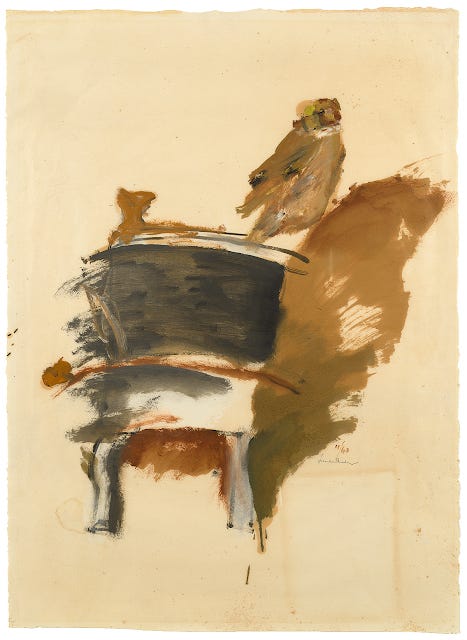
Helen Frankenthaler used the painting as inspiration for her 1960 painting of Fabritius Bird.
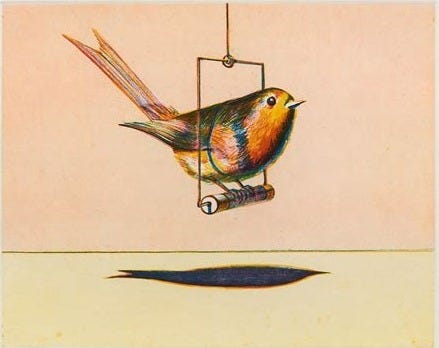
And Wayne Thiebaud said it was an inspiration for his painting, Bird on a Swing.
So again, what is it about The Goldfinch that makes it so engaging?
Perhaps it is the painting’s intimate realism. The trompe-l’œil technique makes the bird appear three-dimensional and lifelike, inviting the viewer to look more closely upon encountering it at the Mauritshuis. Perhaps it is its small size. It is only 13 inches tall, perhaps making it more approachable, or at least less overwhelming than larger paintings nearby. Perhaps it is the tiny chain, showing a fragility and confinement that resonates with the human condition. Perhaps the painting is telling us that we are all held in captivity in one way or another, that we are all held back from our full potential. Perhaps it is that we know that this was his last painting—the punctuation mark at the end of his career—the artistic equivalent of “famous last words.” But we are all captured by this meditation on life, bondage, beauty, fragility, and loss.
Maybe we recognize those feelings.
Maybe that is why we stop and stare.
Thank you for reading Vermeer Stories. Subscriptions are free, but if you enjoyed this article and would like to support my writing, you can buy me a cup of coffee. It would mean a great deal to me.
This post is public, so feel free to share it.
References
Friedmann, Herbert. The Symbolic Goldfinch: Its History and Significance in European Devotional Art. New York: Pantheon Books, 1946.
Other Articles of Interest
No posts
Comments
Nothing yet. Say the first thing.
Sign in to join the conversation.