
Growing up, my parents often had visitors over who spoke English - a language I didn’t learn until I was ten. I remember sitting there, frustrated, watching conversations I couldn’t follow. In those moments, I used to wish desperately that I knew sign language. In my child’s mind, it seemed so obvious: signing was just gesturing, and gesturing was something everyone understood. Surely if I could sign, I could reach across any language barrier and talk to anyone in the world.
Credit: Starbucks
Child logic of course does not hold up, and sign language is not universal. Just like spoken languages, they emerged independently in different communities around the world, shaped by geography, history, community, education, and contact with other local languages. American Sign Language and British Sign Language, I recently came to know are mutually unintelligible even though the UK and the US share a spoken language. Japanese Sign Language and French Sign Language are about as different from each other as their spoken counterparts do. Many signs that seem pictorial and self-evident are actually community-specific conventions, chosen differently by different communities - much like how the written word for “water” shares nothing across English, Arabic, and Mandarin. The diversity of sign languages is a reminder that language - in any form - is a human and local invention.
Credit: Starbucks
Spoken Japanese and Japanese Sign Language (JSL) may share the same cultural home, but they are fundamentally distinct languages. In simple sentences, both spoken Japanese and JSL often place the verb at the end. But that resemblance should not be mistaken for shared grammar. That means, both say “I apple eat” rather than “I eat apple” - which differs from American Sign Language, for instance, which follows Subject-Verb-Object order (“I eat [an] apple”) closer to spoken English. But beyond that surface parallel, JSL operates by entirely different rules. Much of its grammar is conveyed not through hand shapes alone but through what linguists call non-manual signals - eyebrow movements, gaze direction, mouth shape, and body posture all carry grammatical meaning. JSL also has its own fingerspelling system based on the Japanese syllabary rather than an alphabet, and a unique vocabulary that sometimes draws on written Japanese, including elements associated with kanji, tracing their shapes in the air. JSL (日本手話) should also not be confused with Signed Japanese (対応手話), a system that represents spoken Japanese more directly through signs. JSL is a natural language with its own grammar; Signed Japanese is structured around spoken Japanese. In short, sharing a country and a word order is about where the resemblance ends.
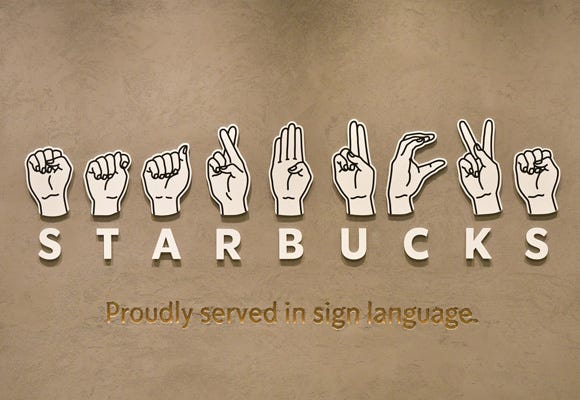
And - there is a Signing Starbucks in Kunitachi. Its official name is Starbucks Coffee nonowa Kunitachi. It opened in 2020 as the first Starbucks Signing Store in Japan. The store is run mainly by Deaf and hard-of-hearing staff, together with hearing staff who use Japanese Sign Language. So the common language of the store is not the usual café language of “iced latte, medium, Hanna with one h only please.” It is Japanese Sign Language.
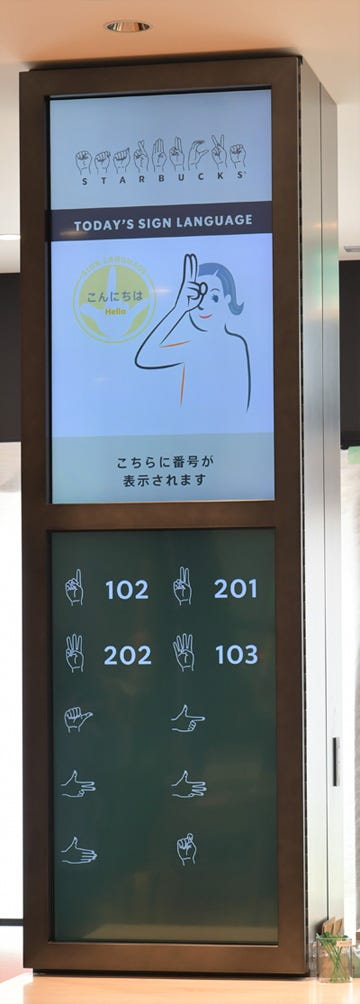
This does not mean that you need to know JSL to order coffee there. Starbucks has thought of this. There are menus you can point at. There are tablets for writing. There are speech-to-text tools. Your drink is called by number on a screen, not by someone shouting your name into the void and hoping you identify spiritually with “Sally.”
The store also has visual design elements connected to sign language. There is artwork. There are signs. Even the uniforms include fingerspelling. The idea is not hidden in the small print. But then again, neither is Starbucks. This is a company that once convinced half the world that “tall” means small, so we must all choose our battles.
Do note, this not a tourist attraction, not a living demonstration of inclusion. It is a normal workplace, a café, a place where people are doing their jobs, probably while someone is taking too long to decide between matcha and caramel. But if sign language is your native language, or one of your languages, it may be a meaningful place to visit. To order coffee in a language that is still too often excluded from ordinary public life. To be in a space where hands moving through the air are not an exception, or a special accommodation, or a small panic at the counter. They are simply how the place works.
I do not know whether the staff use International Sign. So if you use Japanese Sign Language, this store may be especially interesting. If you use another sign language, you can like anybody else communicate via the touch panels.
Other signing cafes in Tokyo are here:
4-15-14 Hongo, Bunkyo-ku
Rendeaf Coffee(a wordplay on Rendezvous)
4-31-11 Hongo, Bunkyo-ku
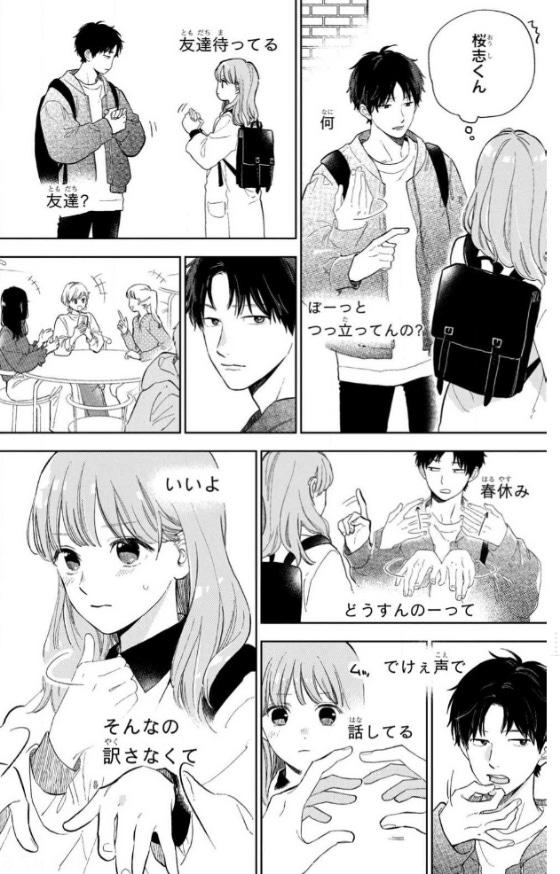
Finally, you might want to have a look at “A Sign of Affection” , a manga that was later adapted into an anime. It follows Yuki, a university student who has been deaf since birth. She communicates through sign language, text, and lip-reading, depending on the situation and on how cooperative the world feels like being that day.
Credit: Kodansha
The story begins when a foreign traveller asks her for directions in what she assumes is English. Before the encounter can collapse entirely, a young man steps in to help. He catches Yuki’s attention, and from there the series follows her relationships, her university life, and the people entering her world. I should add that I have neither read the manga nor watched the anime - the manga is on my tsundoku pile of books - but the reviews are good. Judge for yourself!
No posts
Comments
Nothing yet. Say the first thing.
Sign in to join the conversation.