
I really don’t want to open a can of worms,1 but English is a difficult language. But alas, it’s the only language Daddy and Momma speak so it’s my burden to bear. So here’s what prompted all of this:
Daddy bought tampons at the Lowe’s Home Improvement Store.
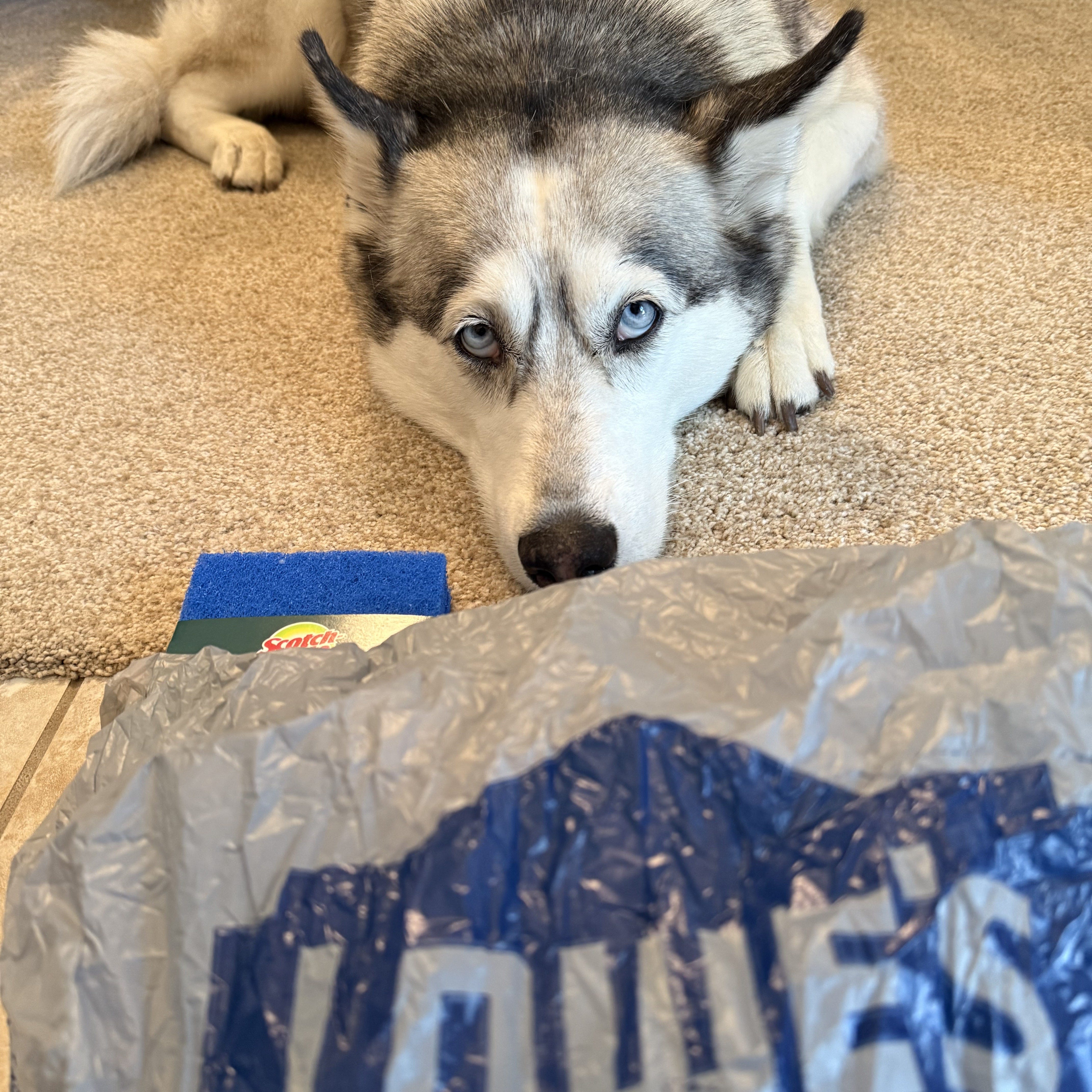
I wouldn’t have believed it. But as I was sniffing through the bag of stuff that Daddy brought home, I saw it with my own eyes.
TAMPONS À RÉCURER
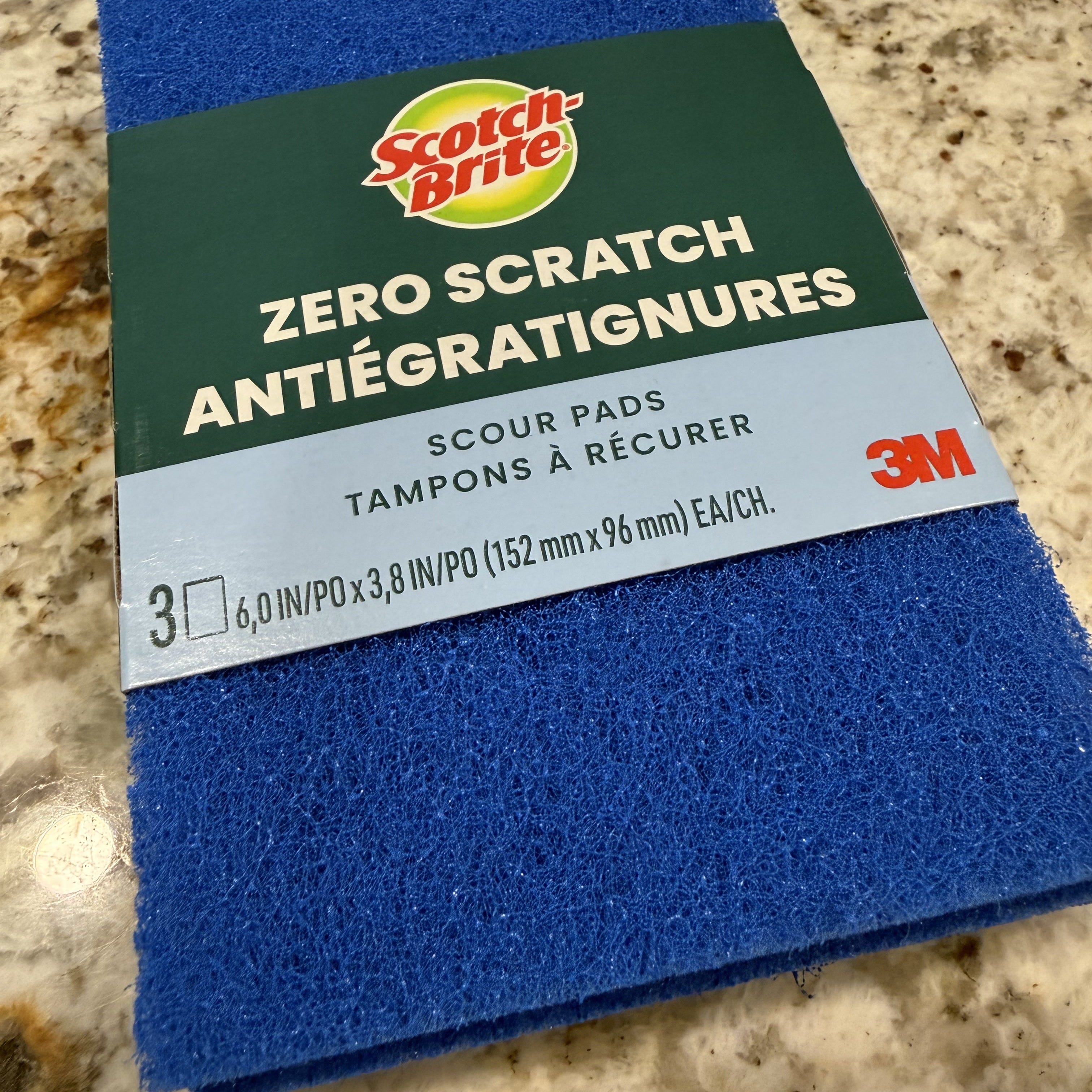
I’ve lived at Casa de Togo long enough to know that Daddy generally avoids buying anything that has a description beginning with “feminine” and I’ve seen enough television commercials to know that tampons belong in that category.
Wanting to be discreet,2 I pulled Daddy aside to point out his obvious shopping error. I knew that he would probably be embarrassed. That’s when he explained that the package simply had bilingual text — in this case, French.3 He assured me that it was just a way to say “SCOUR PADS” in another language. And that the feminine product, tampons, were indeed pads. He also was quick to interject that they were just pads and that any scouring would certainly be unintended. Daddy’s face was pretty red by this point in our conversation and I’m not sure that Daddy was qualified to speak to such details.
Knowing of my deep desire to learn the language of my adopted home, Daddy explained that there are a lot of English words that come from French. So I went to the interwebs to check it out.
It turns out that as many as one third of English words come from the French. In fact, there are some geographic areas where it’s estimated that two thirds of the words come from the French. Daddy tells me that he once worked with a Louisiana lawyer on a case and that he used all kinds of French-laced words. Daddy was pretty sure that the meanings of some of them were just as embarrassing as buying feminine products, but he never asked the guy to elaborate.4
Hundreds and hundreds of English words came from the French. Not even I, a Siberian husky, can be described in purely English — or even Russian — words. The very word “blue" — which is the only way to depict my enchanting eyes — came from the French “bleu.” (Apparently, English speakers feel free to transpose letters at will.)5

I asked Daddy if French words ever showed up in some of the legal terms he had to study. After watching a number of Superman movies and assuming that Superman, even though he was an extra-terrestrial, was fully a citizen of the United States of America, I was taken aback that “justice” was French in origin. Certainly broadens my view of Superman’s pursuit of “truth, justice, and the American way.” Although, the whole “truth” thing has been diminished substantially by politicians in recent days. (By the way, Daddy types my stories for me and following his legal training, he likes to use footnotes. If you’re not reading those, you should reconsider.)
I think the funniest thing is that, even when we adopt words into our language, we insist on mispronouncing them. Again, looking at legal terms, the words that define the jury selection process is French — “voir dire.” Daddy thinks that in French it’s pronounced “VWAH DEER.” In West Texas, we say “VORE DIRE.” Daddy believes that some local judges might even sanction a lawyer for pronouncing it like the French do.6
I’m just saying that you English speakers out there owe a huge debt to the French. I’m not sure they intended to provide so much input to the English language. I am happy to note that some of the French words we borrowed have been anglicized and now the French have adopted the English version. My favorite example is the English word “pedigree” which the French use with wild abandon.7 And I’m proud that my pedigree is somewhat mixed. Daddy says that we should all be glad that languages and people and even animals have mixed pedigrees. It makes for better everything.
Even so, it does make English hard to learn. I’m glad that dogs still speak in the ancient language of “dog.” No derivations necessary no matter what our heritage or our nationality. And very few misunderstandings.
“Open a can of worms” is a good example of why language is perplexing. Momma says that the phrase is an idiom. That means that it has a literal meaning, but that meaning is not what it means. Daddy says that idioms exist in every language on earth, so it’s not just English. For now, let me just say that “open a can of worms” does not mean “open a can of worms.” Instead it means introducing a difficult, perplexing problem into a situation. This footnote would not have been necessary had I simply said what I meant. Therein lies part of the problem, because English speakers love idioms.
“Discreet” is another example of English problem words and I don’t even know why. “Discreet” means to be careful. But there’s another “discrete” which means something separate or away from something else. I guess since I “pulled Daddy aside” I could have used either or both words. Dog communication is much more efficient.
What Daddy could not explain is why a company was printing labels in French here in West Texas where the second most dominant language is Spanish. I can understand if Abilene was just down the road from Quebec or New Brunswick, Canada. And perhaps if we lived in East Texas just across the border from Louisiana.
Just for context, Daddy never learned that lawyer’s given name. He insisted on being called “Boozie.” Daddy was pretty sure that it wasn’t a shortened form of “bourgeoisie” — yet another French word borrowed into the English language.
In Russian, I think that they say “blue” when it’s not spelled like that at all. In fact, Russians use an alphabet where some of the letters are backwards. Daddy says it is psychedelic but I think he meant Cyrillic.
They would also be upset if they knew that the word “judge,” like “justice,” came from the French. Of course, most of them are upset with any association with “Judge Judy,” too, which is why Daddy always addressed them as “Your Honor.” (Just to make it worse, “Honor” was a Latin word adopted by the French who polished it up before we started using it in English. Daddy says to keep that on the hush-hush for now.)
Just in case your keeping score, “wild abandon” is another idiom. Please don’t assume that French people are out of control or totally void of responsibility.
Comments
Nothing yet. Say the first thing.
Sign in to join the conversation.