
If you find today’s topic helpful, consider sharing it with a friend. And if you are said friend reading, then welcome! We’d love to have you stay.
I love novelty.
Like, properly love it. New cities, new routines, repainting rooms, trying new restaurants. Spontaneous “we’re at the pub, come down” texts on a Saturday night? Yes please. Last-minute work pivots, surprise visitors, plans falling through, and turning into something better… Bring. It. On.
I have a low tolerance for things going stale, and an almost constant urge to shake things up. And if life shakes things up for me, I’m usually game.
My husband, on the other hand, would happily eat the same breakfast for the next 30 years. Same coffee shop, same Saturday routine, same restaurants we’ve been going to since we met. A last-minute plan change can throw the rest of his day, and it takes him a while to settle again. Where I see a stale routine, he sees a comforting one.
We’ve been together for almost 20 years, so we’ve mostly figured out how to navigate it. What feels exciting to me feels destabilizing to him. What feels safe to him feels like stagnation to me.
Working this out has taught me a lot. Mostly, it’s taught me that my “embrace change!” cheerleader energy isn’t actually that helpful for someone who finds change genuinely difficult. It’s a bit like telling someone afraid of flying that planes are statistically very safe. Cool. Not the point.
So this month, I wanted to write something for the people who don’t naturally thrive on novelty and change. Whether you zoom out (AI reshaping whole industries, gestures widely to the general state of the world) or zoom in (a new job, a house move, a relationship ending), change is happening whether we like it or not. Figuring out our appetite for it and getting more comfortable with the process will probably stand us all in good stead. 🤝
A few things I’ve learned (some from my husband, some from a lot of reading on the subject):
Most resistance to change is actually a response to loss
When a change is imminent, your brain very quickly inventories what you’re about to lose. The routine, the certainty, the role, the people, the version of yourself that belonged to the old situation. Even when the change is objectively good, the loss is still there. Naming what you’re losing (out loud, on paper, to a friend) and finding a way to make peace with that often spells the difference between unknowingly resisting for months and walking into it clear-eyed and chest forward.
Focus on what you can actually control
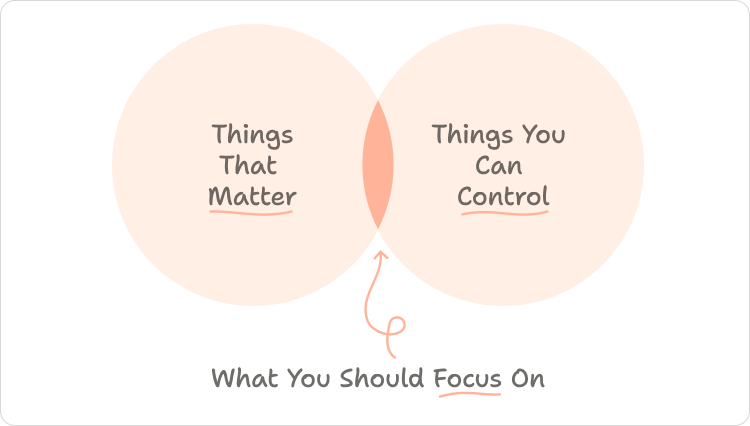
There’s an old Stoic idea that Epictetus called the dichotomy of control. The simple premise is: some things are within your control, and most things aren’t. The key to a calmer life is putting your energy in the first bucket and (as much as you can) letting go of the second.
Easier said than done, obviously. When life takes a left turn, the instinct is to try to wrestle the whole situation into submission. If you’re anything like me, you’ll replay the conversations, refresh the news, and mentally rehearse every possible outcome. None of it changes anything, but it feels like doing something.
This is the question I will often pose to myself:
What’s the next actionable step I can take to improve the situation?
Not “what’s the ideal outcome” or “how do I make this not happen.” Instead, what’s the small, real thing in front of me that’s mine to act on? Can you send an email, book an appointment, have the honest conversation, or go for a walk? Get those tasks into your Todoist, take a breather, and then experience the reassuring satisfaction of ticking them off.
Letting go of the things you can’t control is the hard part, and I won’t pretend otherwise. You need to find a way to handle unanswered questions, worst-case scenarios, and people behaving in ways you can’t influence. None of that disappears just because you’ve decided to focus elsewhere. But every time you put your attention back on the thing that’s yours to move, you resist the spiral. Over time, it does get easier. But it takes practice.
Anchor what stays the same
In the middle of instability, the worst thing you can do is also overhaul your habits. When everything feels new, anchor down hard on the small rituals that don’t have to change. Same coffee. Same walk. Same Sunday phone call to your mum. The sameness is what gives you the stability to handle the actual change.
This is something my husband taught me without realizing it. He’s much better than I am at protecting the small rituals. And even though I often enjoy switching things up, I can still feel all-at-sea if I change too much at once.
You don’t have to like it
This one is for me to learn. My instinct is to find the silver lining in every change. Immediately. And one of the things my husband has taught me is that this isn’t always helpful. Sometimes change is just hard, and the most respectful thing you can do – for yourself, your partner, your friend – is not to rush through it. You’re allowed to find it uncomfortable. You’re allowed to miss what’s gone. You don’t have to be cheerful about it to do it and do it well.
Get curious instead of certain
All that said, if you’ll allow me to make a positive spin for just a second (see, can’t help myself). When change is upon us, the brain wants certainty. What’s going to happen? How will it end? Will I be okay? But certainty isn’t often on offer, and reaching for it just keeps you off balance.
Curiosity is a very helpful mindset. Instead of “what’s going to happen to me?” try “what might I learn about myself in this?” Instead of “I need to know how this ends,” try “I wonder what the next chapter looks like.” It’s a small reframe, but it shifts you from bracing against the change to turning towards it. An altogether more empowering feeling.
One thing I know to be true: change is inevitable. So we might as well get comfortable navigating it.
“When you cannot evade or change a relentless situation, what often saves you is the ability to enter it deeply, to be at home with the bewilderment.”
John O’Donohue, Irish poet and philosopher

When your world gets rocked, tasks tend to end up on other surfaces before they hit Todoist (think whiteboards, sticky notes, WhatsApp messages, etc.). Task capture helps you corral those scattered, half-baked thoughts into an actionable list of tasks.
It’s a new beta feature that lets you point Todoist at a mess of text, a photo, or a document, and get back a list of actual tasks. Dates, priorities, the lot. You can review what it finds before anything is added, so nothing lands on your list without your say-so.
💡 This is genius for adding full meeting notes to, and it will pull out any actionable items.
Open Quick Add and have a play. It’s free for everyone while we’re still in beta, on web, desktop, and mobile.
A filter that’s saved me more than once is: no date.
It surfaces every task in your account without a due date – the stuff you captured in a hurry and never came back to.
Run it during your weekly review, and you’ll find a mix of things that need scheduling, things that are no longer relevant (delete those), and things you’d genuinely forgotten you wanted to do (oh, hi). Especially useful during busy or chaotic periods, when capture-now-think-later is the only option.
To set it up: in Filters & Labels, click Add filter, name it whatever you like, and type no date as the query. Easy peasy!
Whatever changes you’re navigating this May (whether they’re small ones, seismic ones, ones you choose, or ones that choose you), feel free to share more in the Substack comments so we can cheer you on.
See you in June!
Naomi (real human 🙋♀️) and the Todoist team
No posts
Comments
Nothing yet. Say the first thing.
Sign in to join the conversation.