

Use of cannabis across the globe has grown by 40% over the last decade, with 256m people now reported to have used cannabis over the past year in 2024.
That growth, according to the United Nations Office on Drugs and Crime‘s World Drug Report 2026 (WDR26), follows a ‘continuum of gradual normalisation’ towards cannabis use, which in turn has helped drive a fragmented, but expanding wave of policy liberalisation.
Spread across three volumes, the latest official UNODC report offers new insights into the global dynamics of both the legal and illicit cannabis markets, and perhaps more importantly how they impact each other.
The three sections of the report, which include Highlights, Special Points of Interest and the Impact of Drug Use on Safety and Security, paint a picture of a rapidly shifting patchwork of cannabis regulation, rather than a wave of legalisation.
As of December 2025, Canada, Uruguay and 28 jurisdictions in the United States had enacted legal provisions allowing full commercial cultivation, production and sale of cannabis for non-medical adult use, encompassing the most comprehensive commercial end of the spectrum.
Elsewhere, decriminalisation has taken various forms over the last decade, with many policy changes initially thought to be precursors to wider legalisation. As seen in markets like Germany, however, few remain actively on that path.
The Czech Republic’s reform took effect on January 1, 2026, permitting adults aged 21 and over to possess 25 grammes in public or 100 grammes at home and to cultivate up to three plants.
Germany’s CanG reform, in force since April 2024, allows home cultivation of three plants and possession of 25 grams, alongside non-commercial cultivation associations capped at 500 members.
Luxembourg (since June 2023) and Malta (since 2021) permit home cultivation and limited possession for adults, with Malta’s Cannabis Harm Reduction Associations able to supply members up to 7 grammes a day.
South Africa’s 2024 legislative act permits cultivation, possession and consumption in private dwellings, though the report notes it has not yet been operationalised. In Australia, the Australian Capital Territory remains the only jurisdiction allowing home cultivation.
The Netherlands and Switzerland, meanwhile, are each running their own controlled experiments intended to determine the best route forward for further cannabis reform.
Ten Dutch municipalities are now testing a model in which coffeeshops may sell only regulated cannabis from permitted growers, aimed at establishing whether a decriminalised, regulated supply chain works in practice.
Switzerland’s pilot trials, by May 2024, have enrolled 7,000 people who use cannabis across seven cantons. There are early signs of divergence between for-profit and not-for-profit models on product promotion and youth protection, results that could well decide which template the next wave of European reform follows.

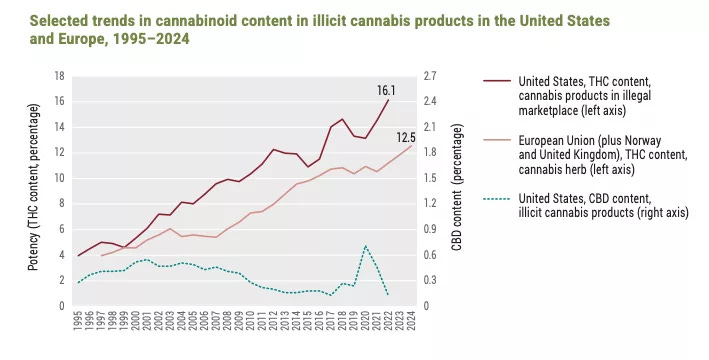
THC content in illicit-market cannabis has climbed steadily on both sides of the Atlantic. In the United States, illicit-market cannabis reached average THC content of 16.1% by 2024, up from just 4% a decade earlier.
In the European Union (Also including Norway and the UK), demand for high THC content has also skyrocketed, with the 2024 average reaching 12.5%, also up from 4% in 1995.
Source: UNODC, World Drug Report 2026, [Highlights, p.41].
The report attributes the rise to genetic selection for high-potency cultivars, the shift to feminised seed and indoor cultivation that allows growers to control light, temperature, humidity and nutrients precisely.
Citing a study of US cannabinoid profiles from 2013 to 2022, the report says that cannabis sold through licensed dispensaries and cannabis seized from the illegal market were of closely related genetic origin, but legal dispensary products tended to carry more THC and less CBD than its illicit counterpart.
Similarly, in the EU the report flags a growing phenomenon of low-THC herbal material being sold on the illicit market increasingly being enhanced with synthetic and semi-synthetic cannabinoids, some highly potent, blurring the line between ‘cannabis’ and adulterated products entirely.
Global seizures of cannabis herb and resin reached historically high aggregate levels in 2023 and 2024, driven chiefly by Africa, which accounted for 61% of the total quantity of cannabis herb and resin seized worldwide in 2024.
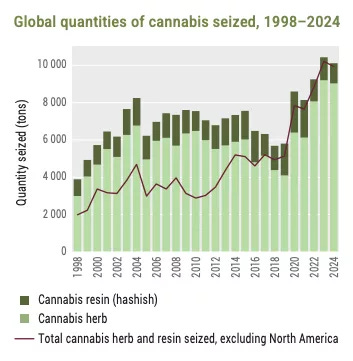
Resin seizures, by contrast, fell to their lowest level since 2011. North America’s own seizures have been declining steadily since 2010, despite a fast-growing legal market, a trend the report links to changing law enforcement priorities under legalisation rather than falling supply.
While this is certainly a case for the benefits of expanded legal access, the report details an emerging trend which largely mitigates this.
In North America, cannabis is increasingly entering commercial supply chains only to be diverted into illicit trafficking elsewhere. Dutch customs seized 65.5 tonnes of cannabis in 2025, a fourfold increase on 2024, sourced mainly from Canada, Thailand and the United States and moved through seaports, air cargo and air passengers.
Ports at Antwerp, Rotterdam and Hamburg, previously associated with other drug flows, are increasingly being used for cannabis. North American countries were named as a source of cannabis shipments by 57 countries and territories outside the region between 2015 and 2024, up from just 11 over the previous decade, a more than fivefold jump the report ties directly to the region’s expanding cultivation capacity.
That is a governance problem as much as an enforcement one. Track-and-trace, seed-to-sale reporting and export licensing are about to matter well beyond the jurisdictions that require them today.
The report’s clearest behavioral signal suggests that the perception of cannabis harm among US 12th graders has been rising since 2021, reversing a long-term decline.
Attitudes, it argues, are hardening even as legal access widens across the country. A similar pattern is emerging among adolescents in parts of Europe.
Cannabis use disorders remain the most common reason people enter drug treatment in Africa and the Americas, and the second most common, behind opioids, in Asia and Europe.
The report is careful to contextualize this, noting that cannabis’s overall disease burden is comparatively low, because the drug ‘may lead less readily to dependence than other drugs’ than the other substances measured in the same dataset.
UNODC’s own framing of where this goes next stays deliberately open. On trafficking, the report observes that cannabis is ‘becoming increasingly interregional and traffickers are reacting to changes in legal and social norms’, a dynamic that will keep pressuring track-and-trace and export licensing.
On the demand side, it notes that the reversal in how adolescents and adults in North America now perceive the drug’s harm ‘is likely to also influence public health outcomes’, a stark reminder that the battle over public perception is far from over.
This is Third-Party content and does not reflect (or not not reflect) the views of Cannabis Confidential or CB1 Capital.
Comments
Nothing yet. Say the first thing.
Sign in to join the conversation.