
API cost is becoming one of the most important design constraints in production GenAI systems. For a long time, many teams defaulted to one premium frontier model for almost every workload. That approach is easy to manage, but it is increasingly expensive and often unnecessary.
The pricing gap between US frontier models and lower-cost Chinese models such as DeepSeek, Kimi, and GLM shows that the real question is no longer “which model is best overall?” but “which model is good enough for this specific task at the lowest reliable cost?”
This article breaks down how much model routing can reduce API spend across different workload types: reasoning, coding, agents, and bulk extraction. Using fixed token assumptions, the savings can range from around 2x on coding tasks to more than 10x or even 40x on high-volume or reasoning-shaped workloads.
But the main point is not to blindly replace frontier models. The real strategy is to measure cost per successful output, use cheaper models where the task is measurable and low-risk, and keep frontier models for the cases where quality, ambiguity, safety, or business risk justify the higher price.
Get All my 9 AI Courses with 60% off
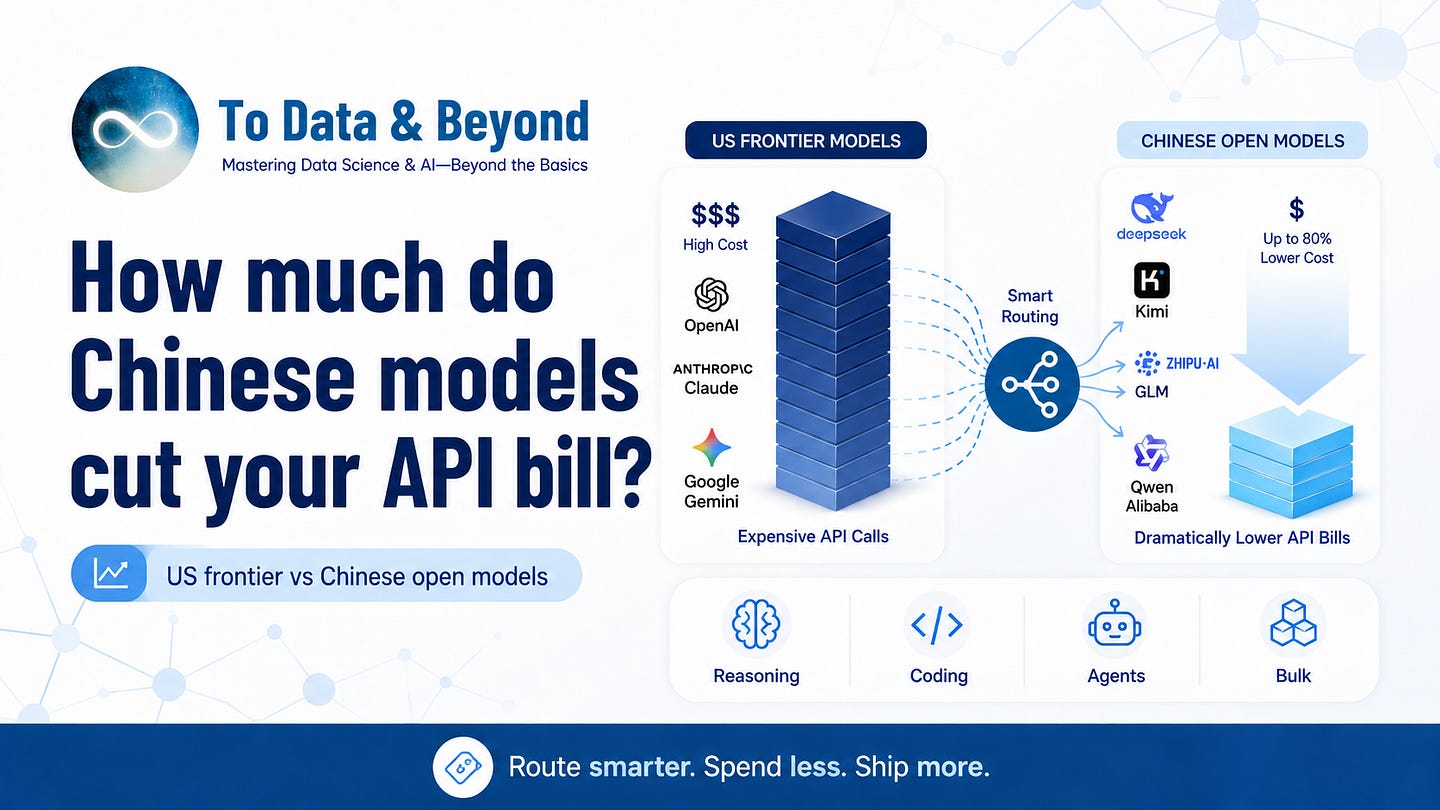
The API bill problem is now a routing problem
Where the price gap actually comes from
What the savings look like in real dollars
How to route tasks without destroying quality
The tradeoff: cheaper models are not free wins
I’m hosting a 3-hour live workshop on Hands-On Loop Engineering with Claude.
We will build Claude loops with persistent state, verification, scheduling, and safer permissions, then apply the pattern to real coding, research, and automation workflows.

For the last three years, choosing a model was mostly a quality decision (sometimes it is just ecosystem or privacy issues). You picked the strongest frontier model you could afford, sent most tasks to it, and only optimized later when the bill became painful.
That approach made sense when the quality gap between top models and cheaper models was large. But the current market is different. Some Chinese models are now priced so far below US frontier models that the model-selection question has changed from “what is the best model?” to “what is the cheapest model that can do this specific task well enough?”
The numbers explain why this matters:
Get All my 9 AI Courses with 60% off
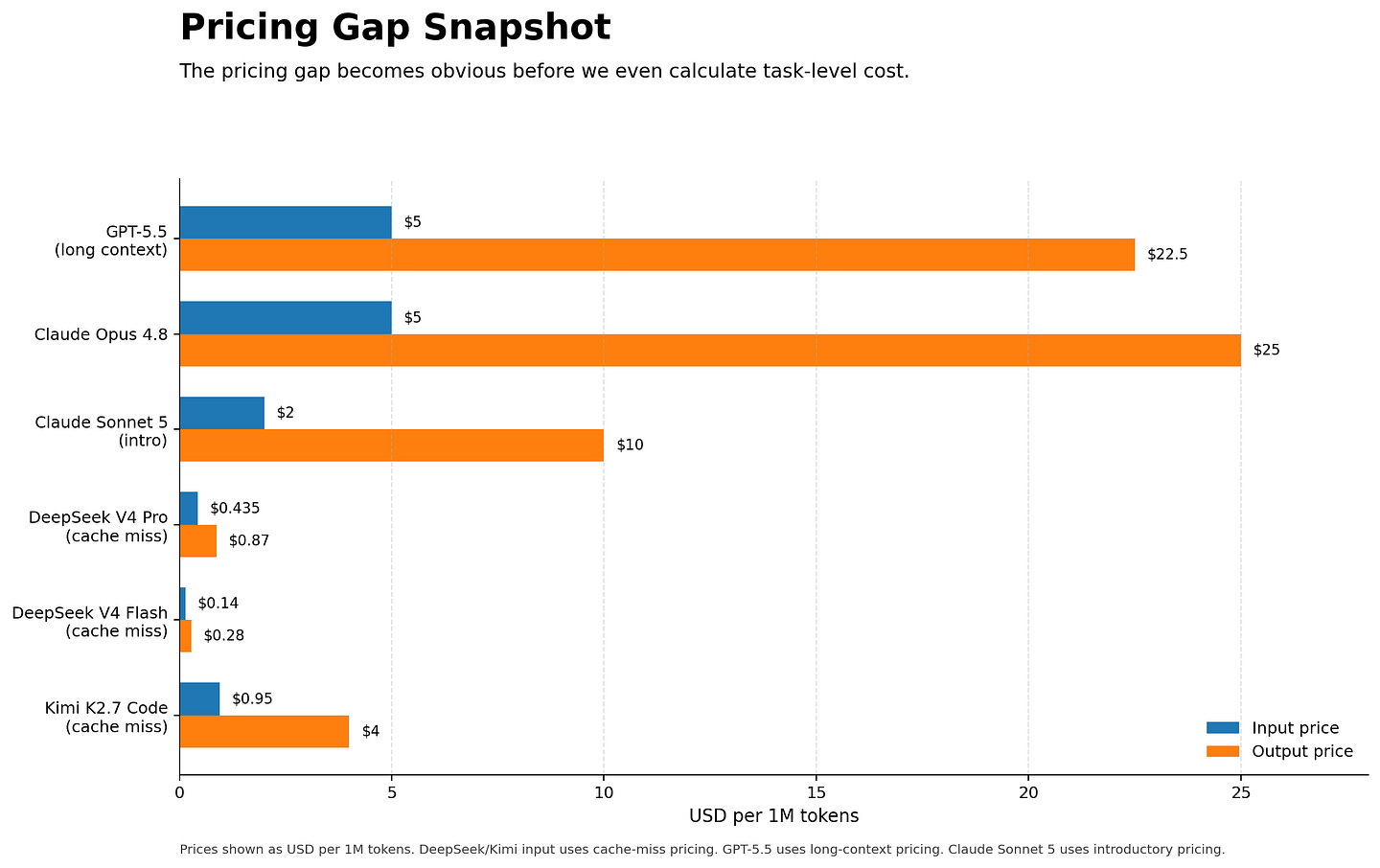
OpenAI lists GPT-5.5 at $2.50–$5.00 per 1M input tokens and $15.00–$22.50 per 1M output tokens, depending on short or long context pricing.
Anthropic lists Claude Opus 4.8 at $10 per 1M input tokens and $50 per 1M output tokens, while Claude Sonnet 5 launched with introductory API pricing of $2 per 1M input tokens and $10 per 1M output tokens through August 31, 2026.
On the other side, DeepSeek’s official pricing page lists DeepSeek V4 Flash at $0.14 per 1M cache-miss input tokens and $0.28 per 1M output tokens, while DeepSeek V4 Pro is still far cheaper than flagship US models at $0.435 per 1M cache-miss input tokens and $0.87 per 1M output tokens.
Kimi K2.7 Code is listed at $0.95 per 1M cache-miss input tokens, $0.19 per 1M cache-hit input tokens, and $4.00 per 1M output tokens.
That does not mean every workload should move to the cheapest model. It means the old habit of sending everything to one premium model is getting harder to justify. If a task is high-volume, predictable, and easy to evaluate, the cost gap can be large enough to change the economics of the whole product.
Get All My 8 Books With 60% Off
A bulk extraction job, classification workflow, rewrite pipeline, or first-pass coding assistant does not always need the most expensive reasoning model on the market. It needs a model that meets the quality threshold at the lowest reliable cost.
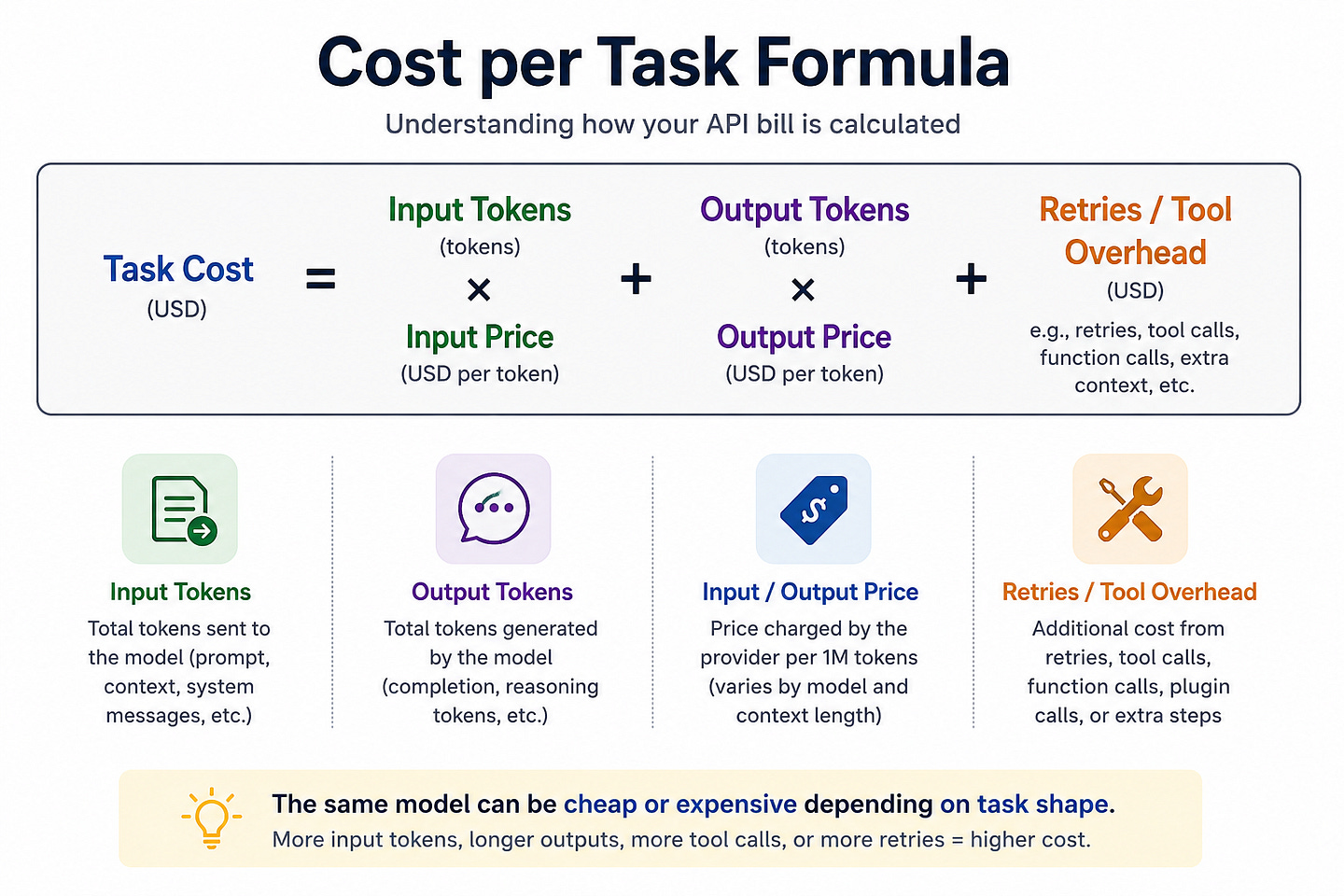
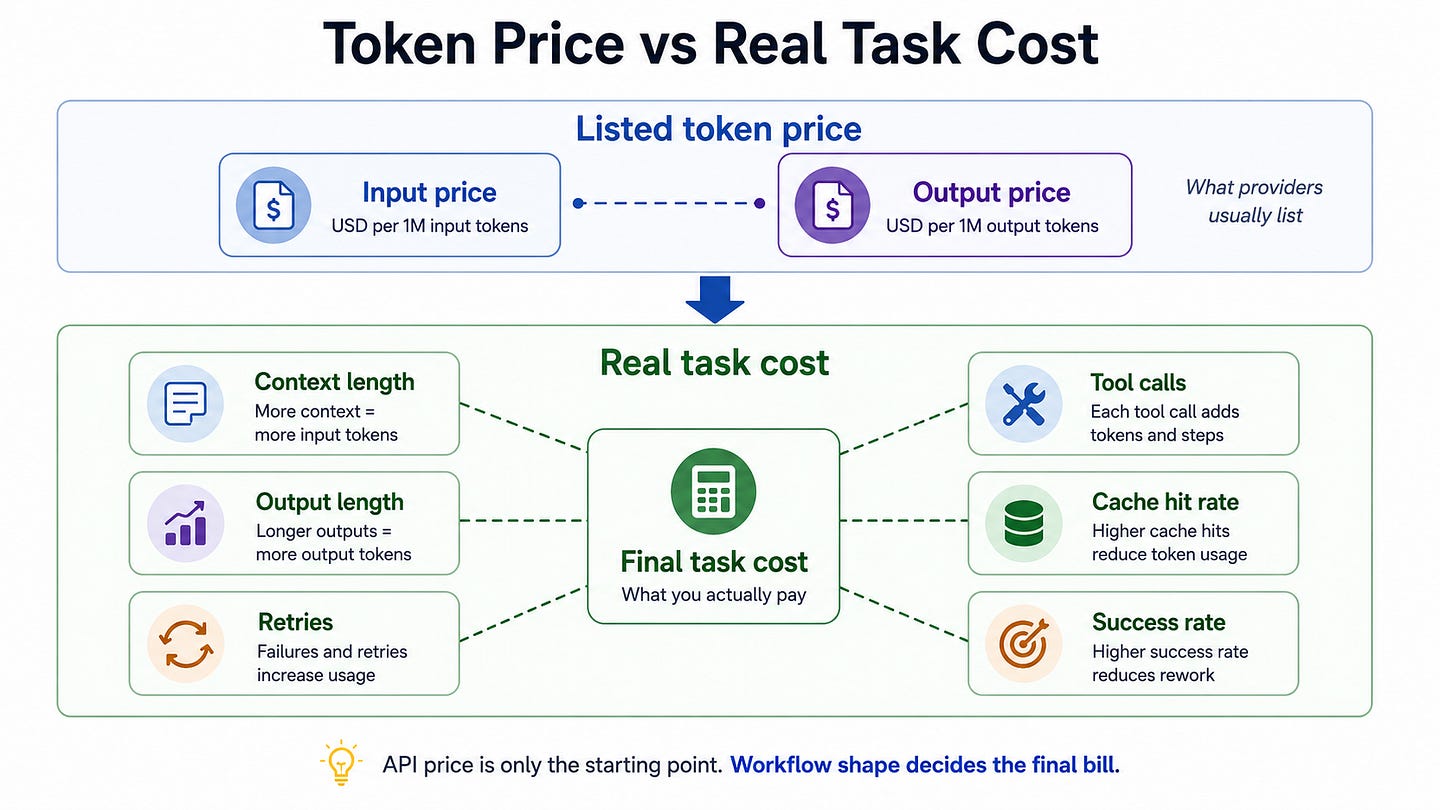
The key is that “cost per task” is not a fixed model property. It depends on the shape of the task: input tokens, output tokens, cached context, thinking tokens, tool calls, retries, and failure rate. This is why listed API prices alone can be misleading.
A recent research paper on reasoning-model pricing found that lower listed prices do not always translate into lower real costs because models can consume very different numbers of hidden or thinking tokens for the same task. In some model-pair comparisons, the lower listed price actually produced a higher total cost. So the point is not to choose the cheapest API blindly. The point is to measure the real cost per successful task.
For this article, I will use concrete example costs because they are easier to reason about than abstract token prices. But each number should be read as a workload estimate, not as a universal truth.
If we assume a fixed task shape, the gap becomes visible very quickly: a reasoning-heavy job that costs around dollars on a frontier model may cost cents on a cheaper reasoning model; a bulk workflow that costs tens of cents on a premium fast model may cost only a few cents on a lower-priced model.
The exact multiplier changes by workload, but the pattern is clear: the best way to cut a GenAI API bill is not necessarily to replace one model with another. It is to route each task to the cheapest model that can reliably complete it.
Get All my 9 AI Courses with 60% off
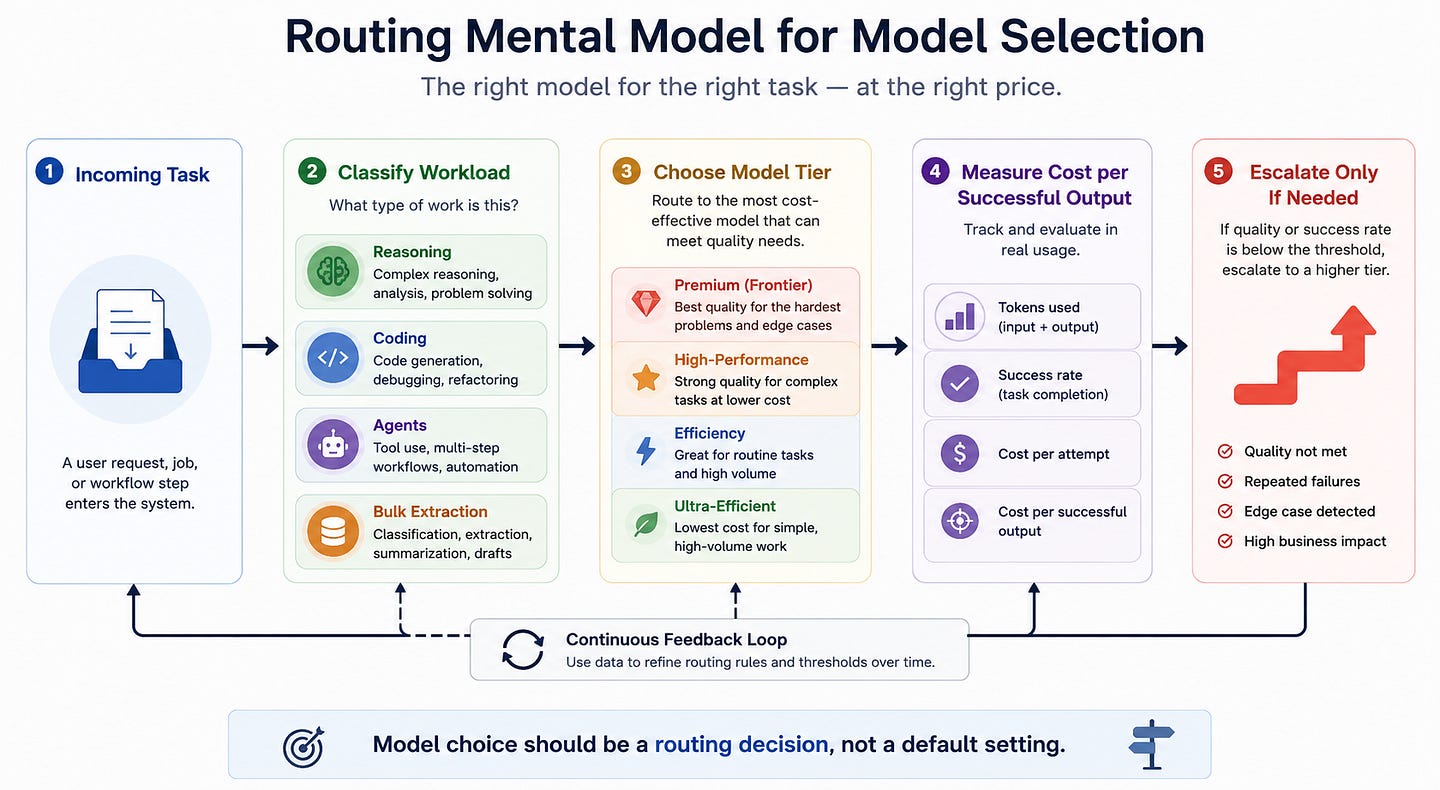
The future of GenAI cost optimization is not one model replacing another. It is workload routing.
The easiest way to misunderstand model pricing is to compare subscription plans or model names instead of token economics. API bills are built from tokens: how many tokens you send in, how many tokens the model generates, whether part of the input is cached, and how many retries or tool calls the workflow needs. Once you look at the numbers at the token level, the gap between US frontier models and lower-priced Chinese models becomes much clearer.
Get All my 9 AI Courses with 60% off
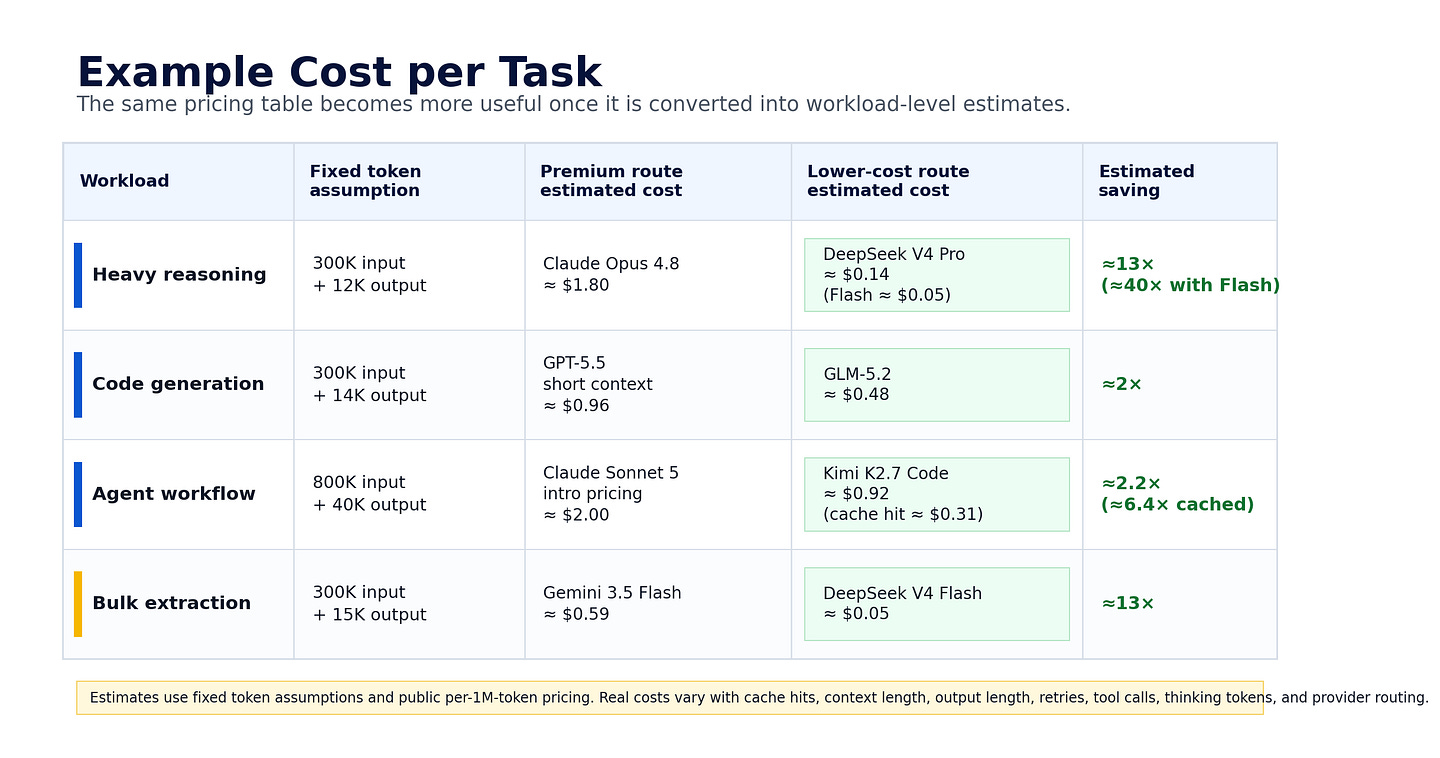
OpenAI currently lists GPT-5.5 at $5.00 per 1M input tokens, $0.50 per 1M cached input tokens, and $30.00 per 1M output tokens.
Anthropic’s higher-end Claude models sit in the same premium category, while DeepSeek’s official API pricing is much lower: DeepSeek V4 Flash is listed at $0.14 per 1M cache-miss input tokens and $0.28 per 1M output tokens, while DeepSeek V4 Pro is listed at $0.435 per 1M cache-miss input tokens and $0.87 per 1M output tokens.
Get All My 8 Books With 60% Off
Z.ai lists GLM-5.2 at $1.40 per 1M input tokens and $4.40 per 1M output tokens, while Kimi’s K2.7 Code pricing page describes token-based API pricing for input, cached input, and output usage.
This is why the savings can look extreme on some workloads. A model that is 10x cheaper on input and 30x cheaper on output does not just reduce the cost of one request. It changes the economics of the entire workflow.
If you run extraction, classification, data cleaning, synthetic data generation, document triage, or first-pass coding at scale, even a few cents saved per task can add up. The savings compound because these tasks repeat thousands or millions of times.
But the important detail is that pricing per token is not the same as cost per successful task. A cheaper model can become less cheap if it needs longer prompts, produces longer outputs, fails more often, or requires more retries.
The same is true for agentic workflows: a single “task” may involve many tool calls, intermediate messages, and repeated model turns. So the real unit of measurement should not be price per token alone. It should be cost per successful output.
The model with the cheapest token price is not always the cheapest model in production. The cheapest model is the one that completes the task reliably at the lowest total cost.
Get All my 9 AI Courses with 60% off
This is where the original “2x to 45x cheaper” framing becomes useful, as long as we treat it as a workload estimate rather than a universal rule. For example, a heavy reasoning task with hundreds of thousands of input tokens and a long output can cost dollars on a premium frontier model and cents on DeepSeek V4 Pro or Flash.
A coding task may show a smaller gap because GLM-5.2 and Kimi are cheaper than GPT-5.5 or Claude, but not always by 40x. Agentic tasks may sit somewhere in the middle because they often include long context, repeated calls, and tool overhead. Bulk extraction and classification are usually where the biggest savings appear, because those tasks often need scale more than frontier-level reasoning.
Get All My 8 Books With 60% Off
That means the right comparison is not “Chinese models versus US models” in general. The better comparison is task type versus model tier. Some tasks need frontier reasoning. Many do not. If a cheaper model is good enough for 70–90% of your workload, the expensive model should become the fallback, not the default.
The pricing gap becomes much easier to understand when we convert token prices into estimated cost per task. A million-token price is useful for comparison, but most teams do not think in “per-token” terms when they budget.
They think in workflows: one reasoning trace, one code-generation task, one agent run, one extraction job, or one batch of drafts. So for this section, I will use fixed workload shapes to show what the savings can look like in US dollars.
Get All my 9 AI Courses with 60% off
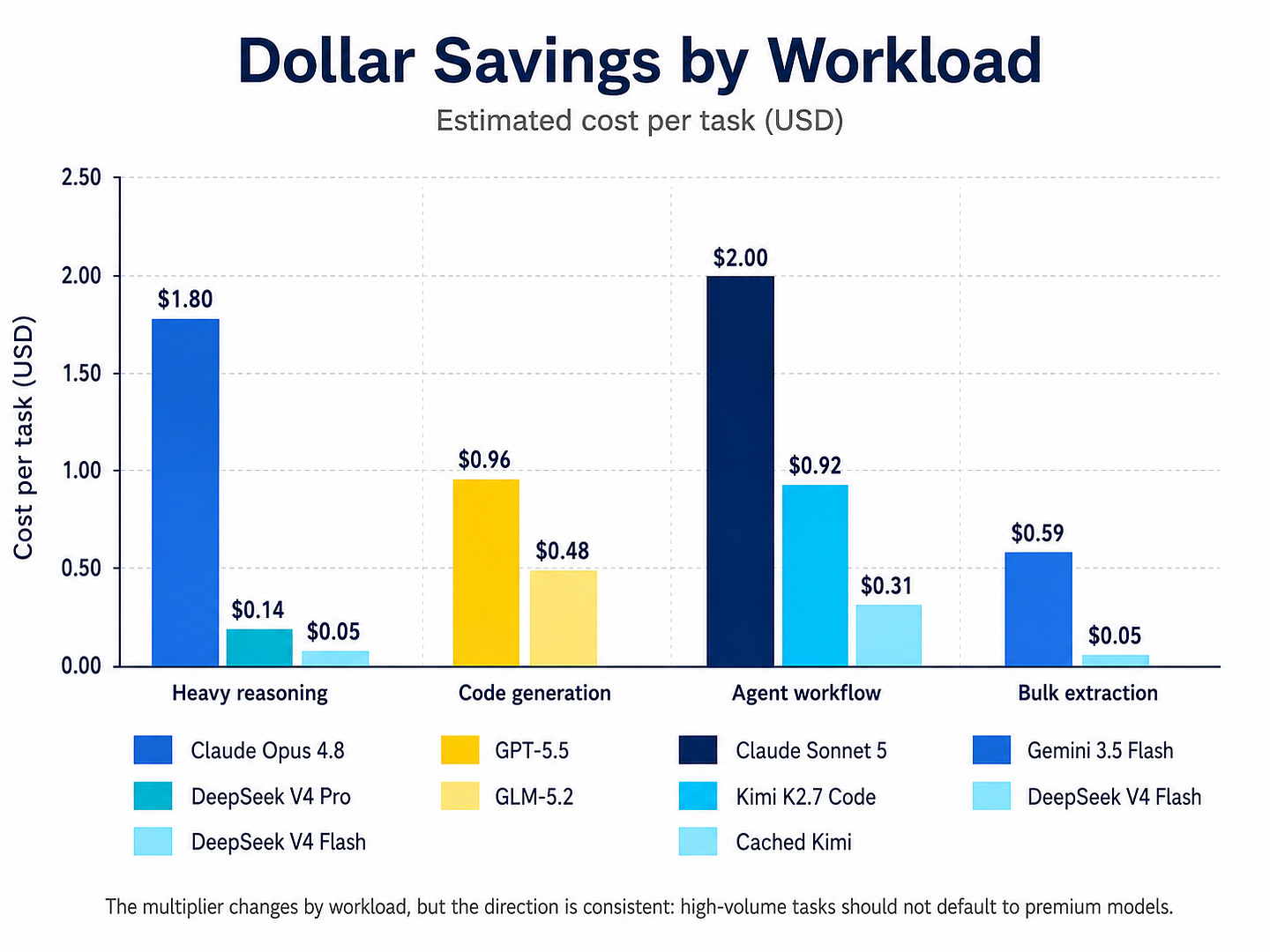
Take a reasoning-heavy task first. If we assume 300K input tokens and 12K output tokens, Claude Opus 4.8 costs roughly $1.80 using Anthropic’s published standard pricing of $5 per 1M input tokens and $25 per 1M output tokens.
The same token shape on DeepSeek V4 Pro costs roughly $0.14, using DeepSeek’s listed cache-miss input price of $0.435 per 1M tokens and output price of $0.87 per 1M tokens. If the task can run on DeepSeek V4 Flash, the estimate drops closer to $0.05. That turns one premium reasoning-style task from dollars into cents.
Get All My 8 Books With 60% Off
For code generation, the gap can be smaller but still meaningful. If we assume 300K input tokens and 14K output tokens, GPT-5.5 at short-context pricing is about $0.96 for the task, while GLM-5.2 is about $0.48 using Z.ai’s listed $1.40 per 1M input tokens and $4.40 per 1M output tokens. That is around a 2x reduction on a workload that many teams run repeatedly: code generation, refactoring, test writing, debugging, and implementation drafts.
Agentic workflows are where caching can change the equation. Suppose an agent run uses 800K input tokens and 40K output tokens across multiple turns. Claude Sonnet 5 at introductory pricing comes out to about $2.00. While Kimi K2.7 Code, using cache-miss input pricing, comes out around $0.92. But Kimi’s pricing page also lists a much lower cache-hit input price of $0.19 per 1M tokens, compared with $0.95 per 1M tokens on a cache miss.
If a large part of the agent context is reused, the same workload can move closer to $0.31. That is why agent pricing should not be evaluated only on the first call. Reused context, repeated tools, and multi-turn memory can make cache behavior a major part of the bill.
Get All My 8 Books With 60% Off
Bulk tasks are usually where the economics are most obvious. A workflow with 300K input tokens and 15K output tokens costs roughly $0.59 on Gemini 3.5 Flash using the pricing assumptions in the earlier table, but around $0.05 on DeepSeek V4 Flash. For extraction, classification, summarization, rewrite drafts, metadata generation, and other high-volume workloads, this is the kind of difference that changes the monthly bill. You do not need the absolute best model in the world for every row in a dataset. You need the cheapest model that clears the quality bar consistently.
Get All my 9 AI Courses with 60% off
The important caveat is that these numbers are estimates under fixed token assumptions. Real production costs can move up or down depending on retries, tool calls, cache hits, hidden reasoning tokens, and failure rates. Recent research on reasoning-model pricing calls this the “price reversal” problem: in some cases, a model with a lower listed price can become more expensive in practice because it consumes more thinking tokens or requires more work to reach the answer. That is why the right metric is not just cost per request. It is cost per successful output.
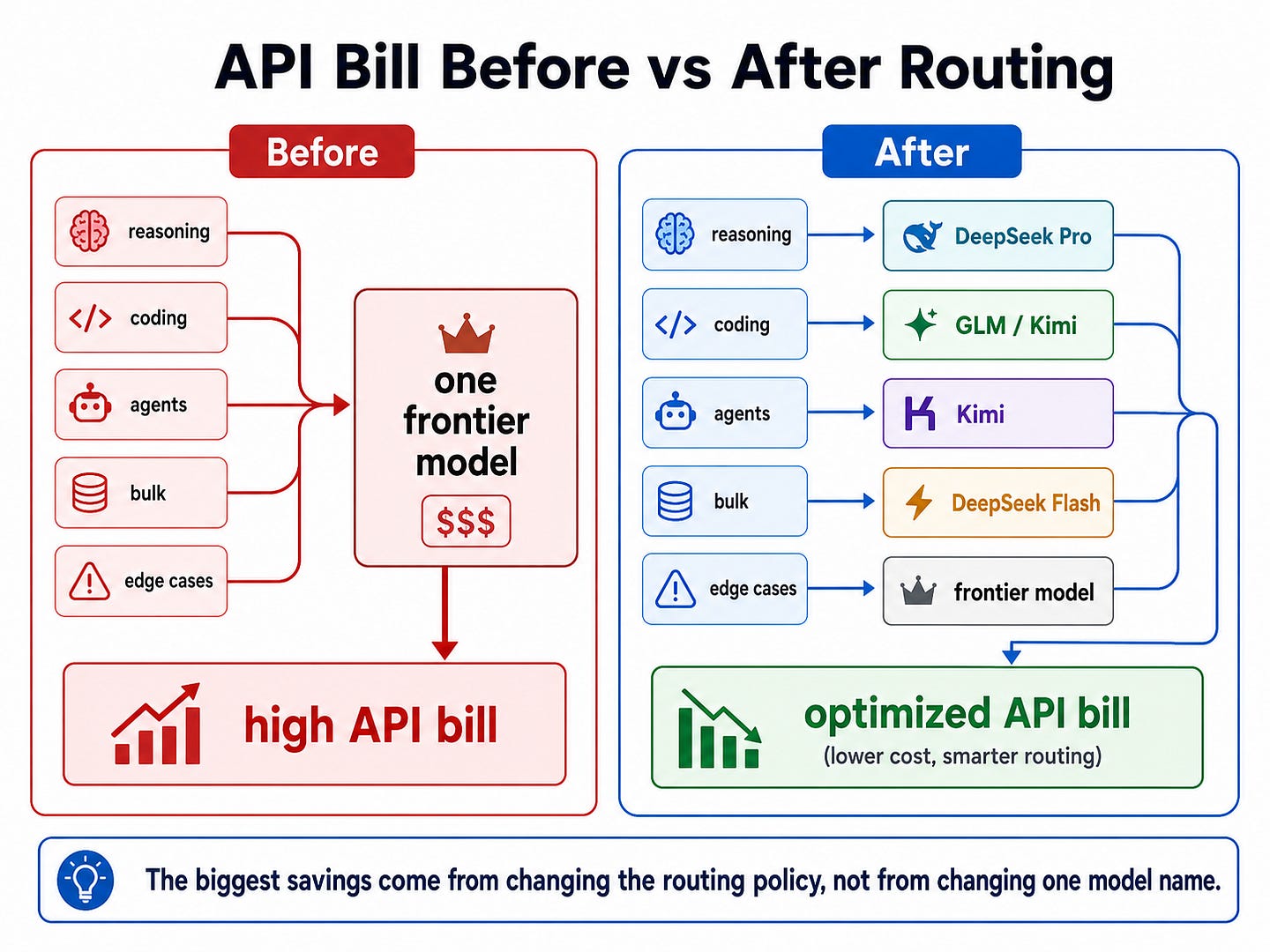
The real saving is not “Chinese model versus US model.” The real saving is routing each workload to the lowest-cost model that can pass your quality threshold.
The mistake is to treat routing as a simple cost switch: expensive model out, cheaper model in. That is not how this should work in production. A better routing system starts with the quality requirement for each workload.
OpenAI’s model selection guidance recommends setting a clear accuracy target and building an evaluation dataset before deciding which model is good enough for a task. That is the right mental model here: you do not replace a frontier model because another model is cheaper; you replace it when the cheaper model passes the quality bar for that workload.
Get All my 9 AI Courses with 60% off
For example, bulk extraction, classification, metadata generation, and first-pass summaries usually have a clear expected format. These are good candidates for cheaper models because you can measure them with exact-match checks, schema validation, human spot checks, or lightweight LLM judges.
Coding tasks need a different evaluation loop: run tests, linters, type checks, and code review. Agent workflows need even more careful measurement because cost depends on the number of turns, tool calls, retries, cache hits, and final success rate. Recent work on prompt caching for long-horizon agentic tasks found that caching can reduce API costs by 45–80% across providers, but only when the cache strategy is designed carefully.
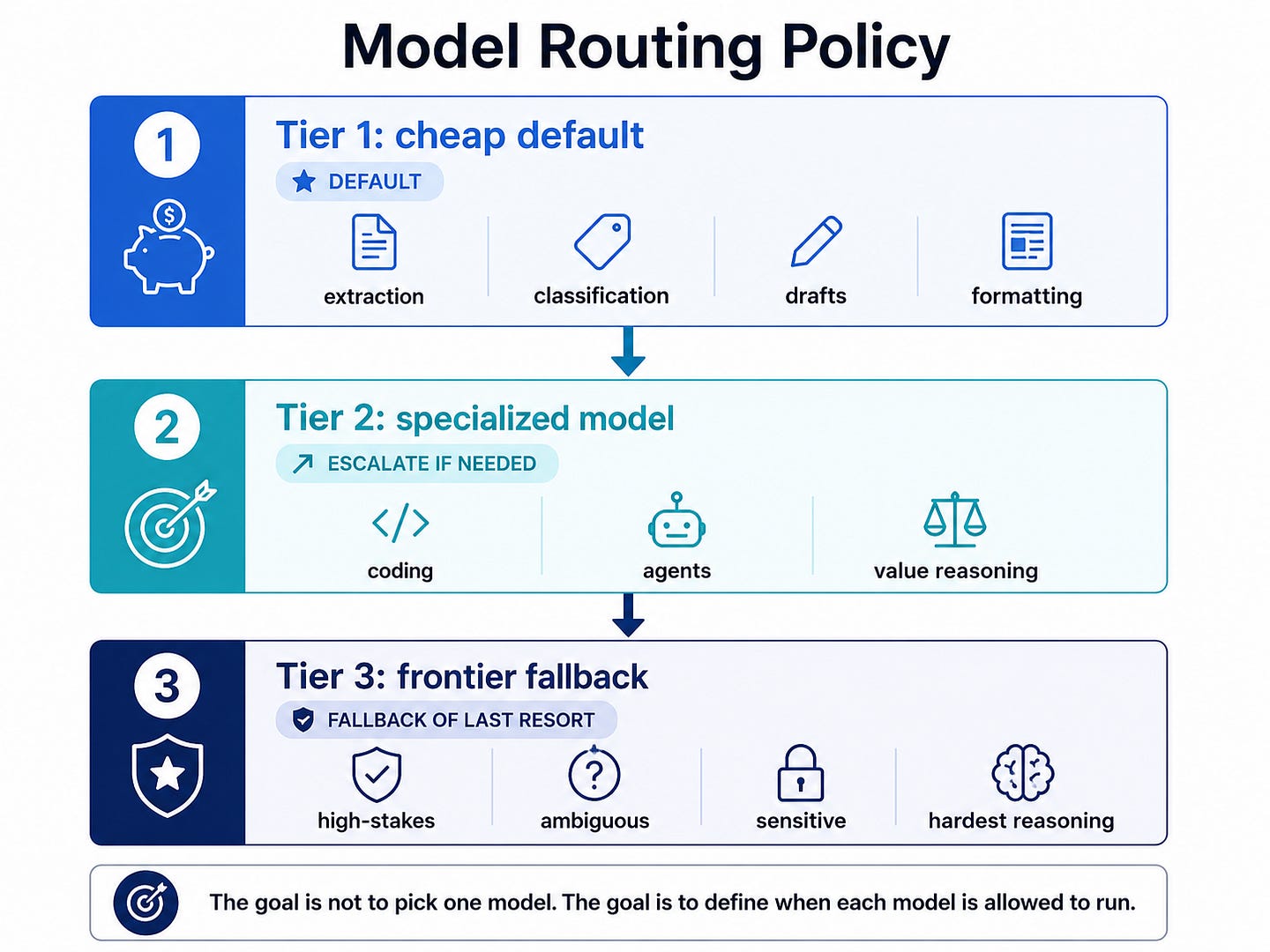
A practical routing setup usually has three tiers. The first tier is the cheap default for high-volume tasks: extraction, formatting, rewriting, classification, and simple drafting.
The second tier is the specialized model for tasks where Chinese models are strong enough to compete directly, such as coding, tool use, and value reasoning. This is where DeepSeek, Kimi, and GLM-style models become interesting.
The third tier is the frontier fallback for the hardest 10–20%: ambiguous reasoning, high-stakes answers, complex world knowledge, sensitive customer-facing outputs, or anything where the cost of failure exceeds the cost of the API call.
A cheaper model should not be the final answer by default. It should be the first attempt when the task is measurable and low-risk.
Get All My 8 Books With 60% Off
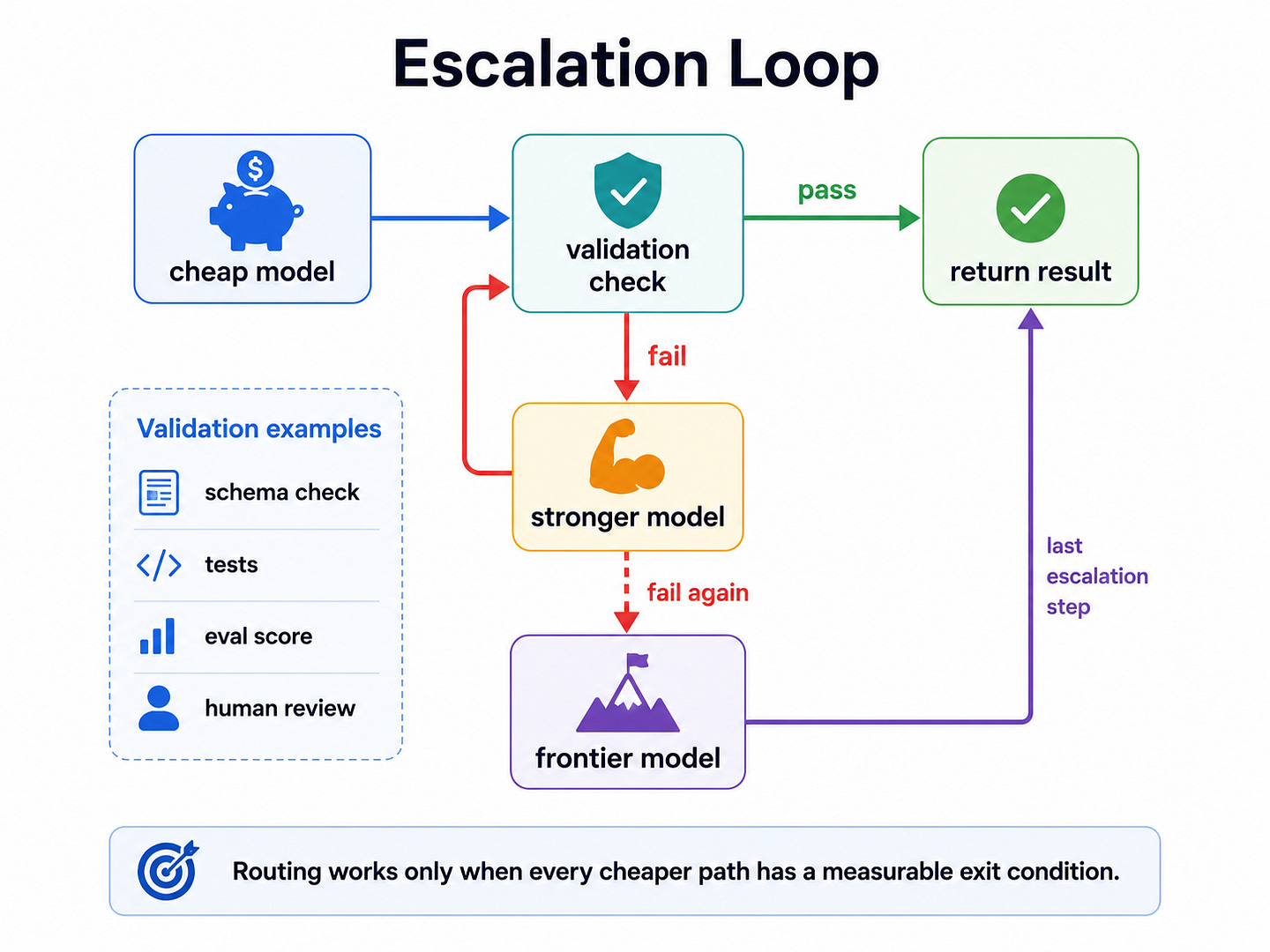
The routing policy should also be dynamic. If the cheap model succeeds, keep the result. If it fails validation, retry once using a stronger, more specialized model.
If it still fails, escalate to a frontier model. This is not just a theoretical idea. Research on intelligent prompt routing frames the problem exactly this way: choose the most cost-effective model while maintaining response quality.
Get All my 9 AI Courses with 60% off
One 2025 routing framework reported 43.9% cost reduction while maintaining quality parity with a stronger Claude-family model in its deployment setting. The exact number will not transfer to every system, but the direction is important: routing can reduce cost without blindly sacrificing quality.
This is also where you need to avoid overfitting to public benchmarks. A model can be strong on SWE-bench, GPQA, or tool-use benchmarks and still fail on your data, your formatting requirements, your latency budget, or your safety constraints.
The only reliable way to decide is to build a small internal eval set for each workload category. For extraction, evaluate schema validity and field accuracy.
For coding, evaluate test pass rate and review burden. For agents, evaluate task completion rate, tool-call count, total cost, and human intervention rate. The routing rule should be based on those measurements, not on a single leaderboard number.
So the best cost-saving strategy is not “use Chinese models everywhere.” It is more precise than that: use cheaper models where the output is measurable, use specialized models where they are strong, and keep frontier models for the tasks where the quality gap still matters. That gives you the benefit of lower-cost inference without turning your production system into a model lottery.
Get All My 8 Books With 60% Off
The main argument of this article is not that Chinese models should replace every US frontier model. That would be the wrong lesson. The better lesson is that the default model should change depending on the workload.
Cheaper models can cut a large part of the API bill, but they only create real savings when they complete the task reliably enough. If quality drops, retries increase, or humans spend more time fixing the output, the cheap route may not be cheap anymore.
Get All my 9 AI Courses with 60% off
This is why routing needs evaluation. OpenAI’s model-selection guidance frames model choice as a balance between accuracy, latency, and cost, and recommends defining the quality target before optimizing for cost.
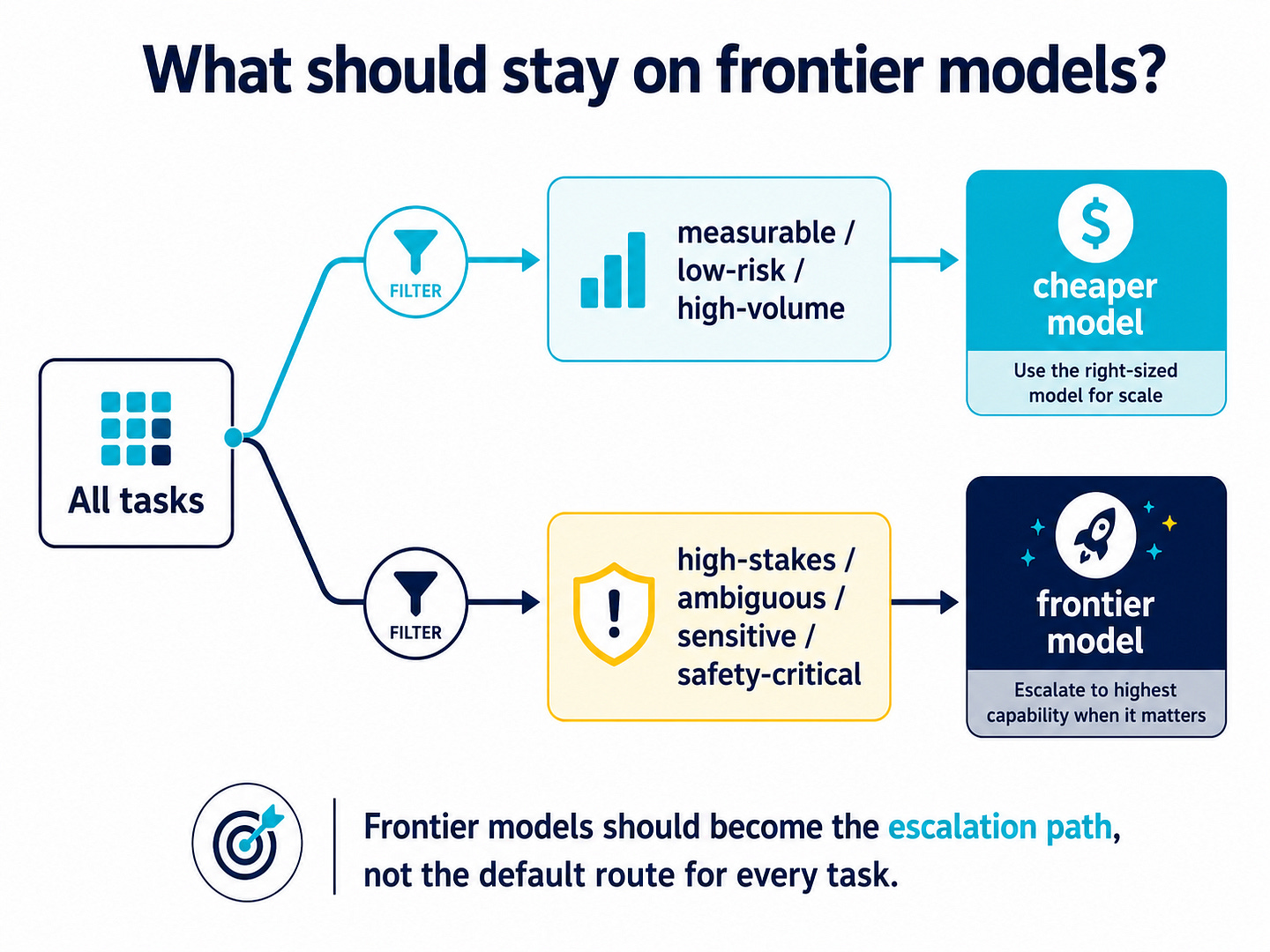
Anthropic makes a similar point for agents: evaluations are useful because they make behavioral changes visible before they reach users, instead of forcing teams to catch problems only in production. For a model-routing setup, this means every cheaper path needs a measurable quality gate.
For bulk extraction, the gate might be schema validity, field accuracy, or exact-match checks. For coding, it might be tests, type checks, linting, and review burden. For agents, it might be task completion rate, tool-call count, number of retries, latency, and cost per successful output.
MLflow’s tracing documentation is relevant here because it treats inputs, outputs, latency, and costs as observability signals for LLM and agent applications. Without that visibility, it is hard to know whether the cheaper model is actually saving money or just hiding the cost in retries and failures.
Get All My 8 Books With 60% Off
There are also categories where frontier models still make sense. High-stakes customer-facing answers, ambiguous reasoning, sensitive workflows, complex world knowledge, legal or financial-adjacent interpretation, and tasks where failure is expensive may still justify premium models. The goal is not to remove GPT, Claude, or Gemini from the stack. The goal is to stop using them as the default for work that a cheaper model can already handle.
Get All my 9 AI Courses with 60% off
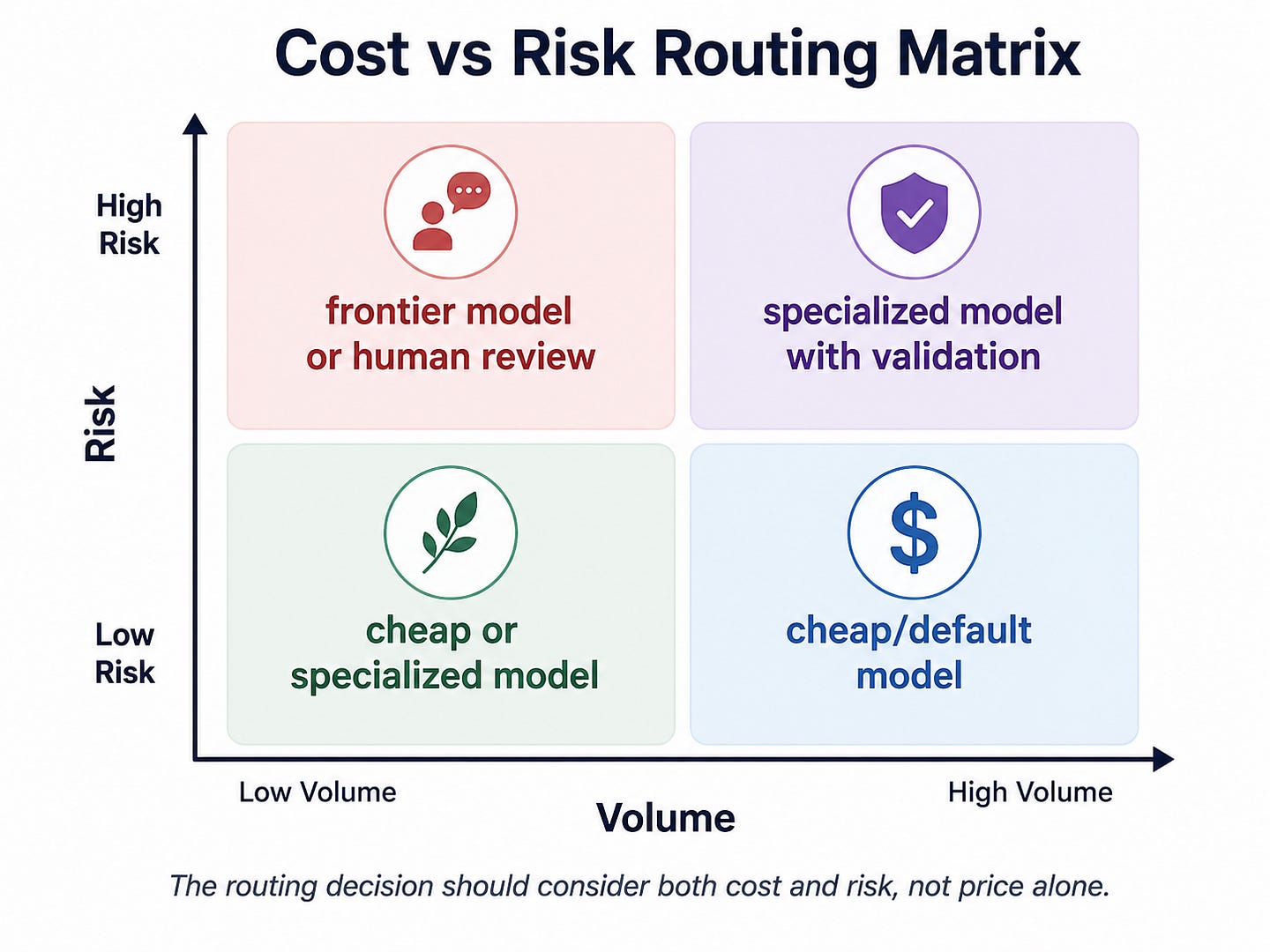
The goal is not to stop using frontier models. The goal is to stop wasting them on tasks that cheaper models can already handle.
There are non-model factors too. API reliability, latency, context length, ecosystem maturity, data governance, compliance requirements, regional availability, rate limits, and tooling quality all matter.
A model can look excellent on price and still be a poor production fit if it is unstable, hard to observe, hard to integrate, or difficult to evaluate on your own workload. Benchmarks are useful signals, but they are not substitutes for internal evals. A leaderboard can tell you where to look. It cannot tell you what will pass your production quality bar.
My view is that the future is not “US frontier models versus Chinese models.” It is model routing as infrastructure. Use low-cost models for measurable, high-volume work.
Use specialized models for coding, agents, and reasoning where they pass your evals. Keep frontier models for the cases where quality, trust, or risk justify the price. That is how you reduce the bill without turning your product into a model lottery.
Get All My 8 Books With 60% Off
The biggest mistake in API cost optimization is treating model choice as a fixed decision. In production, it should be a routing policy. Some workloads should go to cheap default models. Some should go to specialized models that perform well on coding, agents, or value reasoning. Some should still escalate to frontier models because the cost of failure is higher than the cost of inference.
This is why “Chinese models cut your bill by 2x to 45x” is directionally useful, but incomplete on its own. The actual saving depends on input length, output length, cache hit rate, retries, tool calls, and success rate. A cheap model that fails often is not cheap in practice. A premium model used on every simple extraction or classification task is also wasteful. The only useful metric is the total cost of getting a correct, usable result.
My view is that the future of GenAI infrastructure is not model loyalty. It is model routing. Use DeepSeek-style models for value reasoning and bulk tasks when they pass your evals. Use Kimi or GLM-style models for coding and agentic workflows where they meet the quality bar. Keep GPT, Claude, and Gemini-class frontier models for the hardest, riskiest, or most ambiguous work. That is how teams can reduce API bills without turning quality into a gamble.
If you want to move from one-off Claude prompts to repeatable AI workflows, join my Hands-On Loop Engineering with Claude workshop.
It is a 3-hour live session covering the theory, a complete guided build, and a hands-on lab where you start building your own loop.

Comments
Nothing yet. Say the first thing.
Sign in to join the conversation.