
I know, because I did it. I grew up on the North Shore of Kauaʻi in the 1970s, one of only a few hundred haole kids on the island, the redheaded daughter of hippie surfer parents who were chasing waves and running from their high-achieving Mainland families—and not always managing the basics in between. We lived in tents for years, off the land, with no electricity.
And when September came, I walked into a classroom of kids who had new pencils and lunch money and shoes that fit. I did not have those things, and everyone could see it.
You learn to make yourself small when you’re a kid without what others have. You learn to say you forgot, or it’ll be there tomorrow. You live the geography of shame—another name for poverty wearing a child’s face.
I got out of poverty eventually by clinging to education and the dream of a “normal” life. I all the made it all the way to a master’s degree and a career as a counselor in Hawaii’s schools, where I found myself on the other side of a desk I’d once sat across. I experienced a new generation of children doing as I had; kids who “forgot” their supplies. Kids who couldn’t afford the glue stick and the folder and the special calculator on the list; kids who were shamed for the crime of having parents who couldn’t cover their needs, and were being left behind academically and socially because of it.
I had lived it. Now I was paid to witness it; I could not un-see the need.
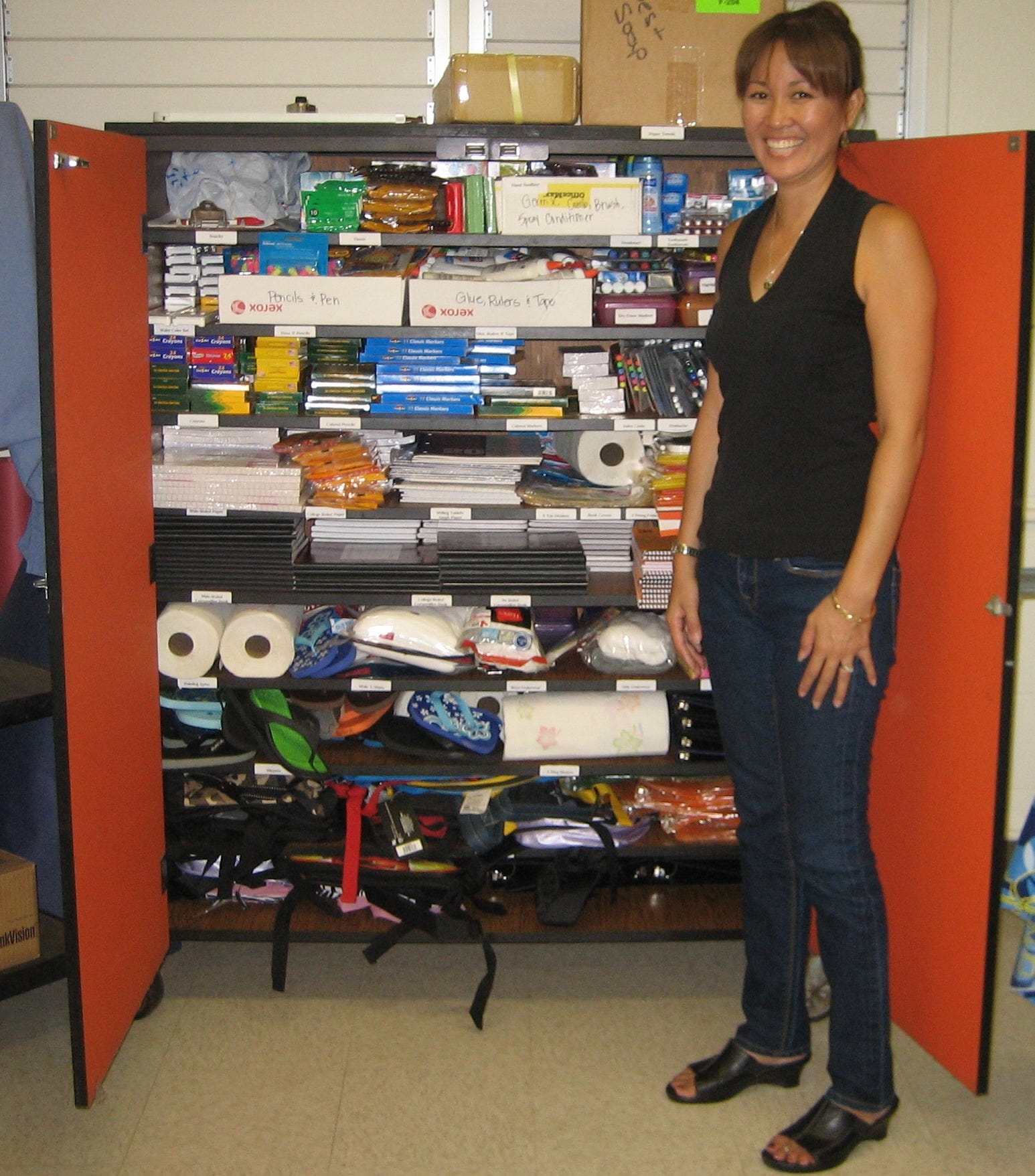
So my sister Bonny and I decided to do something. Well over a decade ago, the two of us founded Keiki Cupboard, a little Maui nonprofit inspired by a simple idea: no child should arrive at school without the supplies they need for learning. Bonny has been our president from day one; I’m the vice president. Our mom, Sue, has been on the board since the beginning—she still loves nothing more than shopping sales for crayons and backpacks, and delivering carloads of supplies to schools all over the island.
Here’s how it works: in each school, there’s a cupboard stocked with at least ten of every item on that school’s supply list. When a teacher, counselor or nurse notices a child in need, they bring that child, privately, into the office where the cupboard lives. The child is handed a new backpack stocked with their own brand-new supplies. In that private moment, questions arise.
First, anxiously: “Do my parents have to pay?”
“No.”
Relief. Then: “Can I take them home?”
“Yes—they’re yours.” More relief.
And then a thoughtful little silence, followed by the comment that undoes me: “Leave some for the other kids.”
From a child who has nothing then received something, the instinct is to make sure there’s enough left for the next child who has nothing.
That’s the ethos of a just and generous world, spoken by a seven-year-old with a brand-new backpack. I have never heard a philosopher say it better.
What does any of this have to do with cozy living?
This series has been about building a warm, beautiful, safe nest and a connected life: a lit candle, found objects, a pie for the neighbor cooling on the counter.
But coziness isn’t meant to line a bunker. Comfort that stops at your front step isn’t meaningful. Hospitality that never goes past your own circle isn’t reaching its potential.
Insularity is the “dark side” of the same social circle that holds and supports us; it can wall others out. The coziest home has a door that opens outward.
You don’t have to serve the whole world to live this way; do a few small things that match your values:
Give where you can watch it land. A food pantry, a supply drive, conservation cleanup at your wildlife refuge, share with a specific family in need. Keiki Cupboard is my version; your mileage will vary—but proximity makes generosity real instead of abstract.
Give what you’re good at. Money helps, but so does your particular skill. My husband Mike, a talented woodworker, volunteers for Christmas in July, a group that does repairs on low income seniors’ houses. A retired teacher tutors math, another sews for foster kids, someone fixes cars, a former nurse rocks babies in a maternity ward. The thing you do well is worth a great deal when donated!
Give quietly. Part of the genius of Keiki Cupboard is privacy—no child (or their parent) is shamed in front of others. When you help, protect people’s dignity. That’s part of the gift.
Give small and regularly. Make your activity sustainable for yourself; no need for sacrificial heroics. A standing habit of leaving something for the others—a monthly give, a recurring commitment, a postcard campaign you participate in. These are plenty to share.
It’s a strangely beautiful thing to grow up as an empty-handed kid and end up as one of the grownups creating and then stocking the supply cupboard. But that’s an arc I find satisfying, and it’s available to all of us in one form or another.
What’s one small thing you could do or give to “the other kids” this week?
Don’t forget to hit the ❤️ and pass on the post or otherwise support if you like this. Meanwhile, Keiki Cupboard is a 501(c)3 nonprofit serving Maui’s schoolchildren. If you’d like to see how it works—or leave some for ‘the others’ yourself—you can find out more at keikicupboard.com
Thanks for reading PASSAGES: Life & stories from a professional writer! This post is public so feel free to share it.
Comments
Nothing yet. Say the first thing.
Sign in to join the conversation.