
The wood has gone silvery in a year.
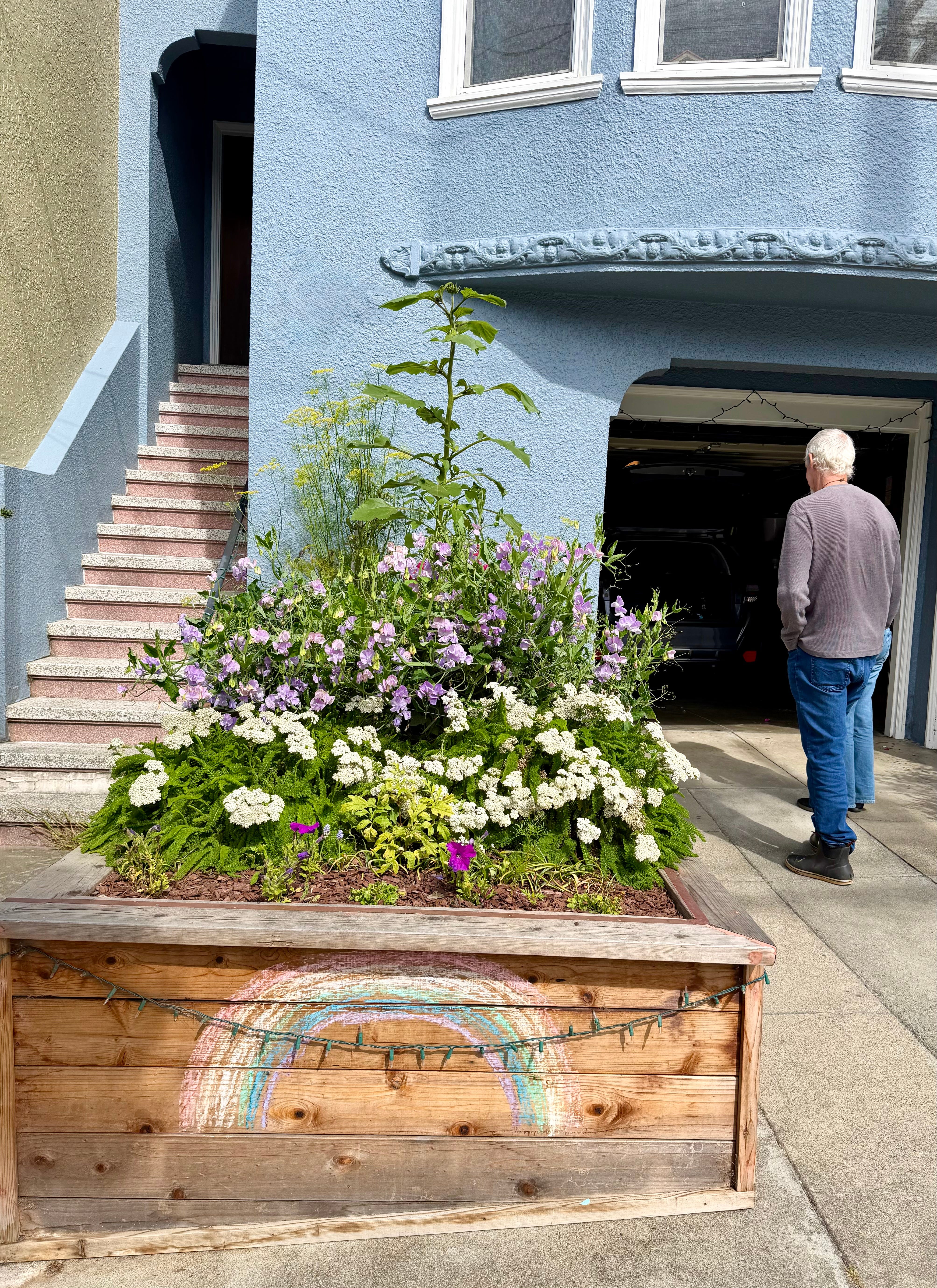
Mike built large cedar planters, raw and square, last August, on the sidewalk outside our daughter’s house in San Francisco—a city where tiny yardlets intrude on the sidewalk but porches or stoops are few. A year of fog and sun have weathered them soft and gray. They’re packed with blooms now. And along the front, in the confident colors of a child, our grandgirls have painted rainbows and draped twinkle lights.
I stood there on the sidewalk and teared up at the sight of bold, jutting sunflowers behind profuse cascades of pink and purple sweetpeas, lacy white yarrow, and ruffled violet petunias. The planters were overflowing with bountiful beauty–and what a way to remember a difficult time they were.
Last August I had radiation cancer treatment at UCSF; some of the best care available anywhere, and I was lucky enough to be accepted as a patient. Our daughter and her family live forty minutes from the hospital and said “come stay with us” before I finished explaining my situation.
So for two months last year, August into October, I lived in my daughter’s house with their family. She drove me to my daily radiation appointments. All of them, over and over, through San Francisco traffic, with her kids in the car and her own life going on around the edges of my treatment schedule. (I wrote about my survival tips here and here if you’re interested.)
People don’t picture this kind of daily commitment grind. They imagine the dramatic moment: the flowers, the hospital waiting room, the hand held at the bad news or the bedside. The actual experience is a prosaic juggle of the needs of a family adjusted to those of an ill person–for many, many days in a row.
Mike was there for me too, bringing me down to San Francisco with my dog and favorite fuzzy blanket, taking me to all the initial terrifying appointments. He came again midway when I was exhausted, sore, and sure I couldn’t complete the marathon, crying often at anything. And he was there at the end, when I rang the bell and he and the staff celebrated my victory with tears.
During that middle section when he was the one driving me to treatments, he decided to build a “thank you” project for our daughter and her family. Every day the garage rang with the sound of hammer and saw and smelled wonderful from the cedar sawdust that eventually would become two enormous planters like king-sized beds flung onto the cement outside their home.
Some gratitude is too big to say, so you build it instead.
When I left in October, the dirt had been put in, so raw that water wouldn’t seep into it. The girls had chosen flowers at the nursery and put the starts in holes they dug with child-sized trowels; they promptly wilted. Things looked bad.
So did I, at that point–a few wisps of hair still clinging to my head, eyebrows and eyelashes gone, muscle tone flaccid, the radiation site swollen, red and oozing.
A year later–those boxes host a paradise. And while I can’t say my body’s blooming that clearly (I still have some side effects and physical complaints) the most important thing has been achieved: I’m cancer free.
Radiation (and immunotherapy, like chemo) is a strange kind of medicine because you accumulate it one day at a time.
You swallow the pills, do the infusions, and go to the treatments. Something happens that you cannot feel (until later, when unpleasant symptoms arise) and for weeks you get worse and more miserable before it’s finally over, and your body (amazing things, bodies) eventually recovers.
There is no morning when you wake up and can point to something that clearly worked; this is a journey of gentle, repetitive, protracted suffering and faith that accumulates healing below where you can see it–until eventually you improve.
I had learned this strange lesson before.
In December of 2021 I caught COVID–and it was the worst kind, developing into what they’ve dubbed “long COVID.” I depend on my brain for writing, for my living–but much of my memory and cognition evaporated along with my energy, and it didn’t come back until the following June.
The diagnosis was one of “rule out everything else and it must be long COVID” so after every exam was done and test run and there was no treatment but “hope it gets better” I wrote my own plan: hot sauna followed by cryotherapy (cold plunges) two times a week. Personally developed affirmation hypnosis recordings daily. Rest that I have never been good at. Healthy eating, lots of water, and five thousand steps a day–all I could manage.
The relief that came from the cold-and-hot treatments was real; for a day or so I felt like myself again. It never lasted. Still, a day of feeling better was better, and my understanding was that COVID affected my vascular system. So did extreme hot-and-cold. Without any better ideas from health professionals I kept doing what I could, for months–and then one day I noticed I was stronger. Could walk further and remember more. The fog was lifting, eventually gone altogether.
Relief that doesn’t last is still relief. Almost nothing that has ever helped me, worked the way we wish medicine took care of things: one dose, it’s fixed, problem solved. Healing accumulated instead, quietly, in small repeated increments I couldn’t prove made a difference.
Cancer treatment at our daughter’s home with her life-affirming children during those many familiar rides in her car, was similar. Only now, a year later, standing in front of those verdant garden boxes, do I realize how much better I really am.
In eighteen years as a licensed clinical social worker, I have watched people struggle with many things before they will accept help or make changes in their lives. I often tell clients that change and improvement won’t come until they’re uncomfortable enough, or want something enough.
That Venn diagram of interlocking pressures defines the window of change.
People accept pain and abuse. They accept debt, exhaustion, a bad year, a worse one. But sometimes, when you want something enough like I wanted to be cancer free, you’ll step out of comfort into misery—or when the pain is bad enough, you’ll walk out the door. It takes what it takes to move us toward change; insight and knowledge about a problem don’t actually change anything.
Letting yourself be cared for is a skill, and you cannot learn it in theory. You learn it in someone’s spare room, on the ninth Tuesday, watching your grown daughter pick up her keys to drive you to the hospital without complaint.
It’s possible the people who love you are not keeping score. You might learn that accepting help, and giving it when you can–is not a withdrawal from an account. It’s a flow, it’s energy. It’s love, and that’s the coziest thing of all.
Now let’s also be honest about what isn’t neat, tidy, and trimmed in flowers.
I’m cancer free, and I’m grateful beyond my ability to express that. But some mornings the ceiling rolls with vertigo when I sit up. I’ve got dental issues from the radiation, and my brows and lashes grew back, but barely. I’m heavier than I was–yay, I’m one of those people that never loses weight, even with cancer treatment! The upshot is…You come out different on the other side of a season like that.
The planters are similar. They aren’t the raw wood Mike built; a year of weather, and dirt, and water got into them. The silver color of the cedar, which looks pretty, means they’re degrading the way things (and bodies) do.
If you’re heading into a hard season, or standing next to someone who is:
Say yes early. Before you’re desperate, while you still have the composure to accept graciously, take help when offered. A person in crisis is harder for everyone than help offered to a person planning ahead.
Let the help be boring or small. Rides. Groceries. A bed to crash in after an appointment. If you’re the one helping, offer to cover the ninth Tuesday, not the grand moment.
Count the day you got. If something helps and then wears off, that is not a failure of the thing and it is not a failure of you. Take the day to rest, wallow a bit–then keep going. This is how most real healing actually works.
Get the medical thing looked at. I say this as a woman who has deferred her own appointments because of money and inconvenience. Cozy personal practices sit alongside real medicine; they don’t replace it.
Leave something behind that stays. When somebody carries you through a season, the thank-you evaporates and the season blurs, but an object that brings joy outlives both. Build a planter box. Plant a tree. Hang a shelf. Install a fountain. Make the gratitude into a thing with corners, and let the children paint on it.
I’m glad to be looking back and finding things to celebrate, though everything isn’t perfect. Change is hard for humans.
What about this piece resonates with you? If something does, pass it on or leave me a comment! Thanks for reading and supporting.
Thanks for reading PASSAGES: Life & stories from a professional writer! This post is public so feel free to share it.
Comments
Nothing yet. Say the first thing.
Sign in to join the conversation.