
About a year ago, in June 2025, I had a long discussion with Anonymous for the Voiceless (AV) founder Paul Bashir, on David Ramms’ YouTube channel. In spite of our different views on animal advocacy, we kept it civil and in the end made each other a promise: Paul would read my book, I would participate in a cube.
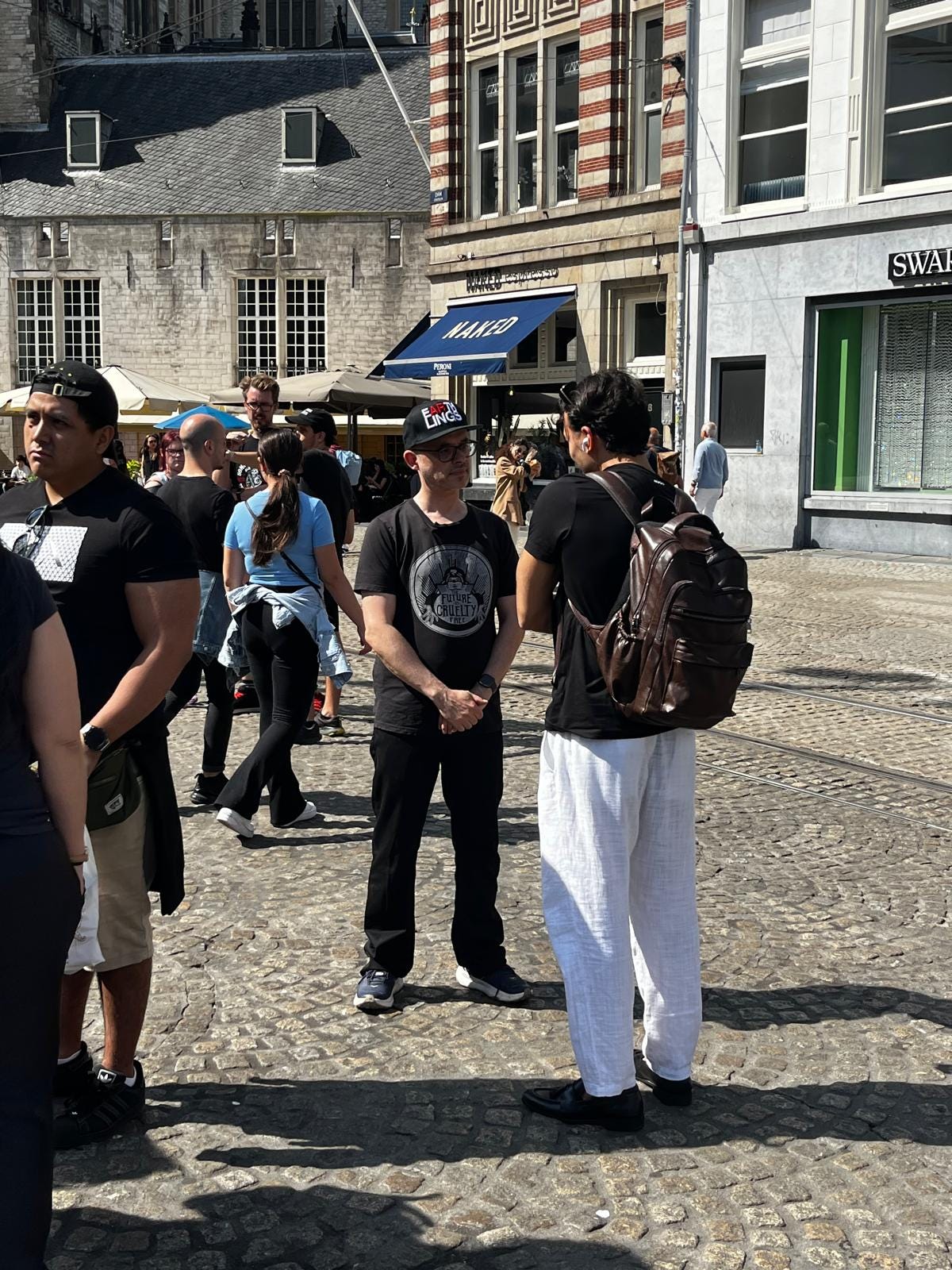
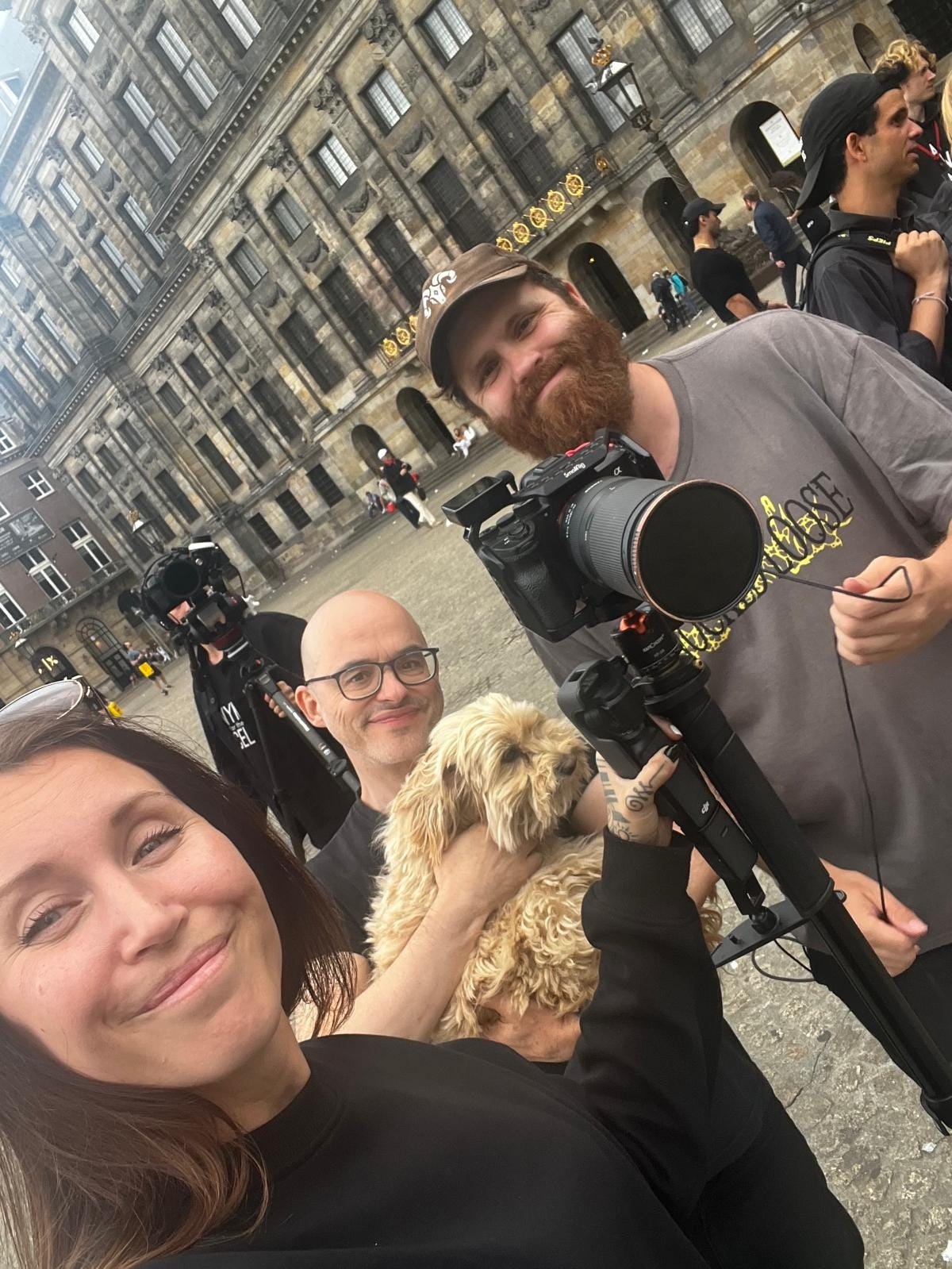
A few weeks ago, I honored my part of the deal. In July 2026, participated in Anonymous activism in Amsterdam, outreaching on two consecutive days, for about six hours in total. David and Anni Ramms filmed the whole thing, and he’ll moderate and record the follow-up discussion at Vegan Campout in August. I’m sharing my preliminary experiences and opinions here.
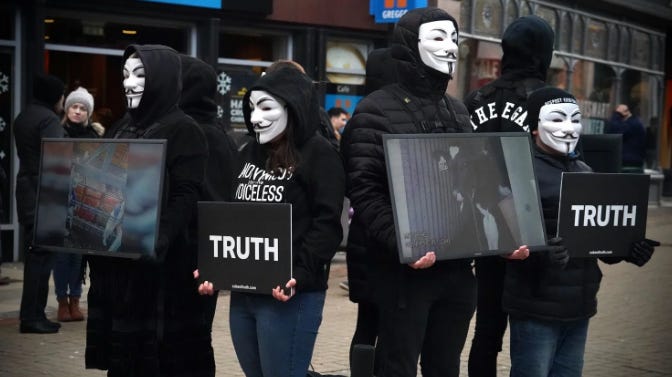
For those not familiar with Anonymous’ approach: a few (masked) people show screens with footage of how humans abuse animals, on some busy square or street. Other activists approach those who seem to engage with the footage. They will try to have a conversation, following a “protocol”: a list of questions that hopefully ends with people committing to stop exploiting animals and going vegan. Or better yet (the ultimate goal): becoming a vegan activist. The questions are entirely focused on the ethical aspect of exploiting animals (I’ll get back to that).
This is a bit of a long posts. There’s a summary at the very end.
I have some critical thoughts, after my experience, but it’s important to note that these are expressed with a lot of respect for what the Anonymous people are doing. I have only admiration for people who commit to helping make things better for animals, in whatever way, shape, or form, and spend a significant amount of time doing it. It was clear to me how seriously all of the activists were taking their job, and how committed they were.
I’m sure most of those who knew me knew that I was to some extent critical of their approach. Nevertheless, I felt very welcome and appreciated. I went in with an open mind, and applied the approach as faithfully as I could (even though I experimented a bit now and then).
I also need to note that obviously my experience was limited. Other people have done this much longer than I have. Also, how this particular group of activists comported themselves is probably not entirely representative of all AV groups. Still, the outreach is pretty streamlined, and as Paul Bashir was there himself, one may assume that this was the most “orthodox” execution of the approach.
In spite of the critical comments below, I find that there’s a lot to like about Anonymous for the Voiceless, and I think it’s great that they’re around. It is a scalable model for individual outreach, and many people can (after a minimal amount of training) participate in it and help advance things for animals.
I do believe a certain (limited) number of people can be reached in this way, and that we can get new activists out of this, who may go on to stay in the movement for a long time and do great things. Chances of success are higher because activists try to focus on the people who seem open, and quickly let go (after three “strikes”) of those who (in activists’ eyes) are not ready.
I’m thankful for this experience and to Paul, my buddy, and the other activists welcoming me. I enjoyed it a lot. I am usually not confrontational when I talk to people, but it felt good to be like that for a bit, and see where it took me. I guess that now and then, “holding people accountable” can be a good strategy. I’m sure I will apply some of the approach in certain circumstances.
I was assigned a buddy, who I first shadowed, after which he shadowed me. We could hear each other’s conversations through a microphone attached to our shirts. My buddy’s comments on my outreach were instructive, and helped me stick to the protocol - which I was there to test. The protocol starts with “Hello, how do you feel about humans exploiting animals?” and then ideally goes on for about eight more questions.
Maybe my very first experience was beginner’s luck (even if I had to speak French, which is not my forte). I bumped into a couple and their young son, who were very open to answering my questions, and very concerned about animals. First the woman and then the son agreed there was nothing keeping them from being vegan, and they promised they would be from now on. The man seemed reluctant, but - improvising a little bit - I told him it would be hard for his wife and son if he didn’t go along, and he agreed as well.
The commitment to go vegan is what the AV activists are after. Once they have that, they get people to confirm that animals deserve to have people speak out for them, and even ask them to stand with a screen for at least a few minutes and be an activist for animals.
Out of maybe 20 conversations, I got to the yes-I’ll-stop-exploiting-animals point only one other time. I heard from other people it was a slow day (sometimes it seemed there were more activists than people stopping to watch the footage).
In my book and work, I make a distinction between pragmatic and idealistic activism. These are not super-defined terms, but one way to make this distinction is to say that pragmatic activism is more outcome-focused (results are most important) while one of the characteristics of idealistic activism is that it focuses heavily on following certain rules.
I’m sure Anonymous activists will think of their activism as very much outcome-focused. However, while - as stated - their commitment to impact is clear, following rules seems also quite important to them. Every time after a chat, my buddy would tell me the terms and expressions I had used but shouldn’t have. It all came down to making sure people understand the problem of animal exploitation as a whole, rather than focus on subparts (e.g. meat) or distractions (e.g. diet).
This focus on exploitation as the problem means that talking about anything other than general animal exploitation seems problematic. It’s not really done to talk about suffering, circumstances, or specific practices. Or if one does, it has to be in a way that connects these aspects - again - to the general problem of animal exploitation. Also: don’t talk about animal products, neither in the abstract, nor concretely about milk, meat, leather… Rather talk about body secretions, body parts, animal skin. Sometimes I felt the “correct” terms were not the ones that were most easily understandable for the audience.
This is part of a wider issue that I see, which is that the outreacher should not adapt the protocol to whoever they have in front of them. There’s no meeting people where they are, there’s only the question of whether they are ready for the protocol or not.
The clearest example I saw of that was when an outreacher talked to a woman who said she was vegan already. After a few questions, it became clear she was plant-based (e.g. not avoiding leather etc.) and the outreacher continued with the protocol, as if she was nowhere near vegan - while I felt she was very close. The woman received zero recognition for where she was already, and the conversation did not feel productive at all to me. I told the outreacher my honest opinion: that this had been worse than nothing.
Here’s an example that I find even more problematic (I didn’t witness it). The person in this video has been an ethical vegan for twenty years. Paul Bashir himself talks to him, but the poor man doesn’t get any pat on the back. On the contrary, because this man is not actively doing outreach and believes people should make their own choices, Paul ends the conversation calling him a disgusting human being. The fact that this video is posted online seems to mean that the AV people are okay with its content? If I had to score to the AV approach, then from whatever number I rate it out of ten, I probably would subtract three or four points for this alone.
The activists seemed not to mind leaving people with a “bad” feeling, for instance by walking out of the conversation, or even being very confrontational (or quite rude) to people. They believe this will make people think. I’m not saying it’s impossible that this happens, but it doesn’t seem very likely (something to test - see below).
A rule I found hard to follow was not to shake a person’s hand after what I thought was a nice interaction. Even if they stuck out their hand, my buddy told me, we refuse it because the victims would not like to see us shake their oppressor’s hand. I can understand the rationale, but it didn’t feel helpful to me to refuse a hand after a person seemed to appreciate the conversation.
In this particular type of outreach, all the attention seems to be directed at getting a person to commit to no longer exploiting animals. I agree that’s a nice goal, but I felt this focus was often at the cost of appreciating and getting the most out of the conversation (the process) itself.
To some extent the activists seem to look at the conversations as black or white: committing to go vegan: good, not getting there: failure. Personally I felt I had some great conversations where I felt I was sowing seeds, but where (understandably) the person was not ready to commit on the spot.
Conversely, I’m not so sure about the people committing. In a meeting, we analyzed interactions on video (many convos are recorded to spread on social media and to learn from). Showing a successful interaction (ending in a handshake), the activist asked what we thought.
I didn’t want to be a downer, but said I gave it at most a 20% chance that the person was now vegan. The others seemed surprised at this. I explained that the conversation was just one moment in a person’s life. While I had no doubt that he was now closer than before, the man would be stepping into the real world, be confronted, perhaps, by a spouse or children who hadn’t been in the conversation, would see meat on every corner of every street, etc. It’s hard to believe one conversation and one “pledge” are strong enough to counter the forces of gravity and inertia. (And if it was enough, it probably means that the person was very close already even before the conversation?)
I guess I’m most critical of how much confidence AV has in the effectiveness of moral suasion, and a particularly strict approach to it to boot. People don’t take the step from a conversation to conviction to permanent behavior change easily.
I like that activists are told to keep control of the conversation (with the help of the protocol). It’s too easy to get sidetracked by all kinds of objections from their interlocutors, which would prevent the activist from making their essential points. However, there seem to be downsides to this. For one thing, activists will focus on getting through their questions. I heard one member of the public say to the activist: “You are working with a script. We are not having a conversation: this is me answering your questions.”
The other downside is that sincerely meant questions and objections are often not taken seriously enough or not responded to. When people express health concerns, these are not addressed. When they say they agree but it’s hard, they get no acknowledgment. When they say they’ve already gone part of the way they don’t get - like I stated before - any recognition. And when people ask: okay, but how? activists are not supposed to give them any pointers, except to say that they can find that out for themselves. Which is true but not necessarily helpful.
AV firmly believes that the WHY comes first. Once you are convinced, you can overcome all obstacles. I believe that the HOW being difficult is in itself an obstacle to understanding the WHY. Once people see that there are tasty, affordable products available, their defensiveness against listening to the WHY can be lowered. Sure, it won’t hurt if they understand the principle of veganism, but understanding it and putting it into practice has huge repercussions.
When people aren’t ready to commit to going vegan, the AV activist is not supposed to present them with another option, nor are they supposed to applaud any other commitment the person makes (like “I’ll look into it; I’ll try it for a week; I’ll think about it…”). I suspect this is because anything less than the commitment to go vegan is unethical, either to do or to suggest. Again, rules.
Personally, I would present people with other options. Even getting them to commit that this month, this week, or even just tomorrow, they wouldn’t use animal products, or that just their next meal would be vegan, would in my eyes be a win. I especially believe that when people DO something, this can have an impact on their commitment and beliefs - which is why I think their grabbing a screen and standing in the cube for a few minutes can be quite meaningful. I think the focus on this is great. But why not also have them do smaller things? Give people, for instance, a discount code from a collaborating restaurant in the area, and measure how many people use it.
Which brings me to impact measurement. How well does the approach work? AV talks about thousands of people going vegan and/or becoming animal activists in the course of a one-month demonstration (e.g. 7,000 people during the action in Cologne, DE). I’m skeptical, but could we come to a trustworthy answer if we do better than just taking people at their word?
Paul Bashir’s answer to people who tell him to measure more is that it’s impossible to be sure, unless we hire private detectives. I think that’s not a satisfactory answer. I can see how a follow-up could be helpful. I asked some of the activists why they don’t routinely ask - after successful interactions - for people’s email address or phone number, and follow up a month and/or three months later, to see how it’s going. There were some logistical objections, but I got no clear answer why this wouldn’t be done. Even if it was consistently done for only a limited amount of time (say two months), this could yield some good data to extrapolate from.
Measuring people’s post-interaction response seems especially important when making big claims that run against our intuitions or against what we know from research. The question of whether letting people walk off with a bad feeling about themselves is productive or not seems to be a good candidate for research. As is the question of whether a committed person really follows through or not.
Paul Bashir claims AV’s method is the most effective outreach method in the movement. I do not underestimate the value of him interacting with thousands of people, but this does not seem to be a claim one can make on the basis of just one’s own (or one’s group’s) experience.
In any case, other people who are more research-experienced than I am could chip in on this.
There’s more to tell, no doubt. I look forward to exploring the pros and cons of the Anonymous approach further with Paul, and I wish AV all the best. I might participate again in the future.
I encourage vegans who are not active to join a group and try out the approach (find your local chapter here). Apart from the real-world impact you may have with it, AV also offers a community. Dog knows how hard it can be to be a vegan in this world. Communities help.
Below is a summary.
What I like:
● the focus on the people presumed to be open/ready
● the guidance activists get (from the protocol and from each other)
● activists constantly learning and being open to feedback
● activists taking control of the conversation (though at some cost)
● the focus on developping activists
● the low threshold for participation
● the community
What would make the approach better still (IMHO)● not just optimizing for handshakes but valuing the process as well
● having something else to ask than go vegan
● being warmer and more connecting (guilt is usually not productive); absolutely avoid rudeness
● being less focused on rules, terms, language and being entirely correct
● improving the installation (more, bigger and sharper screens)
● measuring more
● respecting what people already do, acknowlediging sincerely felt objections
Comments
Nothing yet. Say the first thing.
Sign in to join the conversation.