
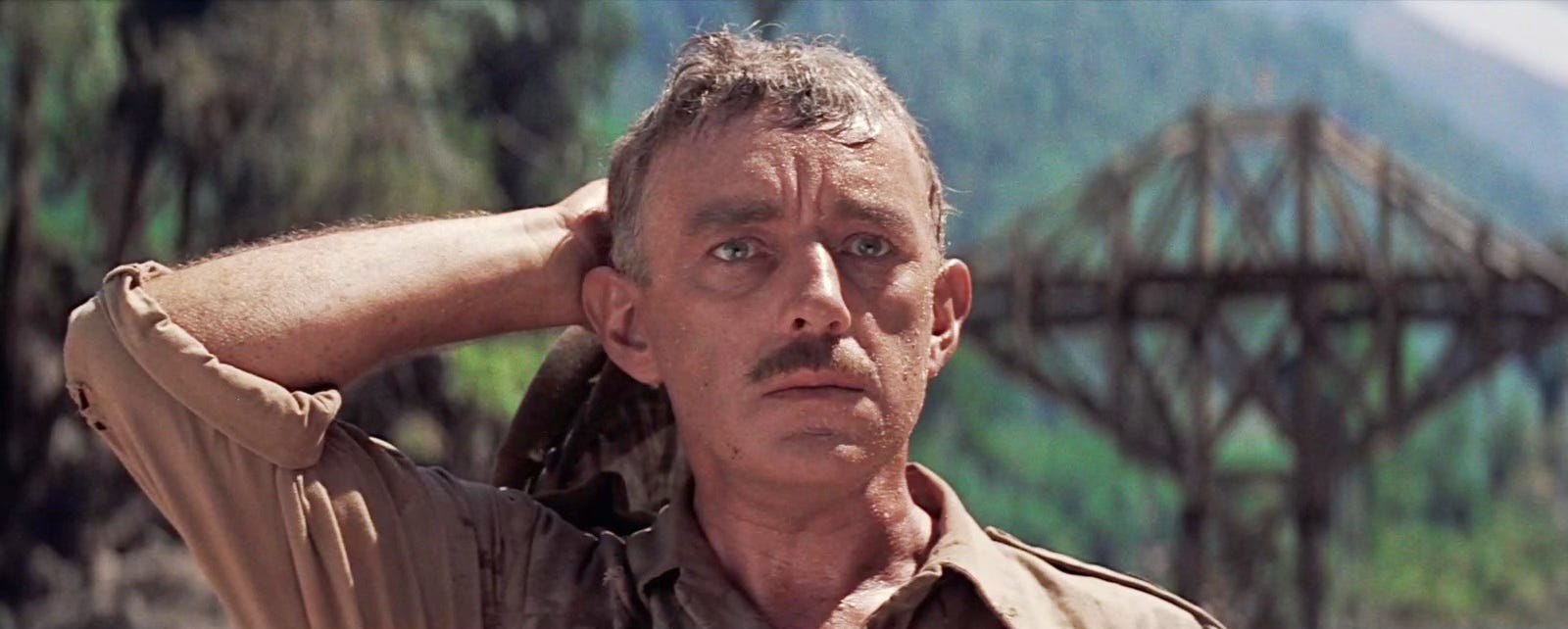
“Madness! Madness!” groans Dr. Clipton (James Donald) as he surveys the scene of devastation that closes David Lean’s great film The Bridge on the River Kwai. It is one of cinema’s iconic “war is hell” laments, prefiguring the concluding pronouncement of Francis Ford Coppola’s Apocalypse Now, another film about men losing themselves in a war-torn jungle, twenty years later: “The horror! The horror!” But Lean’s war movie lacks the fevered hysteria of Coppola’s: it may end with a diagnosis of “madness”, but there are no helicopter charges set to Wagner, no hushed, incoherent ramblings from Marlon Brando. The madness in Bridge on the River Kwai is of a different, subtler sort. It is precisely the sort of madness described by G.K. Chesterton in Orthodoxy: “The madman is not the man who has lost his reason. The madman is the man who has lost everything except his reason.”
According to Chesterton, it is not an excess of imagination that breeds insanity, as is commonly supposed, but a morbid excess of rationality. The maniac is the man who constructs a logical system of perfect internal consistency to account for the universe, yet leaves out vast swaths of common human experience in the process, until, in the end, “his mind moves in a perfect but narrow circle.” This, according to Chesterton, is the “strongest and most unmistakable mark of madness”: a “combination between a logical completeness and a spiritual contraction,” “the combination of an expansive and exhaustive reason with a contracted common sense.” The madmen in The Bridge on the River Kwai are not wild or capricious. They do not spout raving absurdities or froth at the mouth; they are decorous, self-possessed, logical. Indeed, from a certain point of view, they appear quite sane; but when one looks closely, one begins to see the marks of Chestertonian madness – a vision of the world hopelessly narrowed by unbending adherence to a set of codes and rules.
Comments
Nothing yet. Say the first thing.
Sign in to join the conversation.