
(This column first appeared in WBUR’s Cognoscenti: https://www.wbur.org/cognoscenti/2025/09/17/pottery-life-guidebook-empty-nest-t-m-blanchet?)
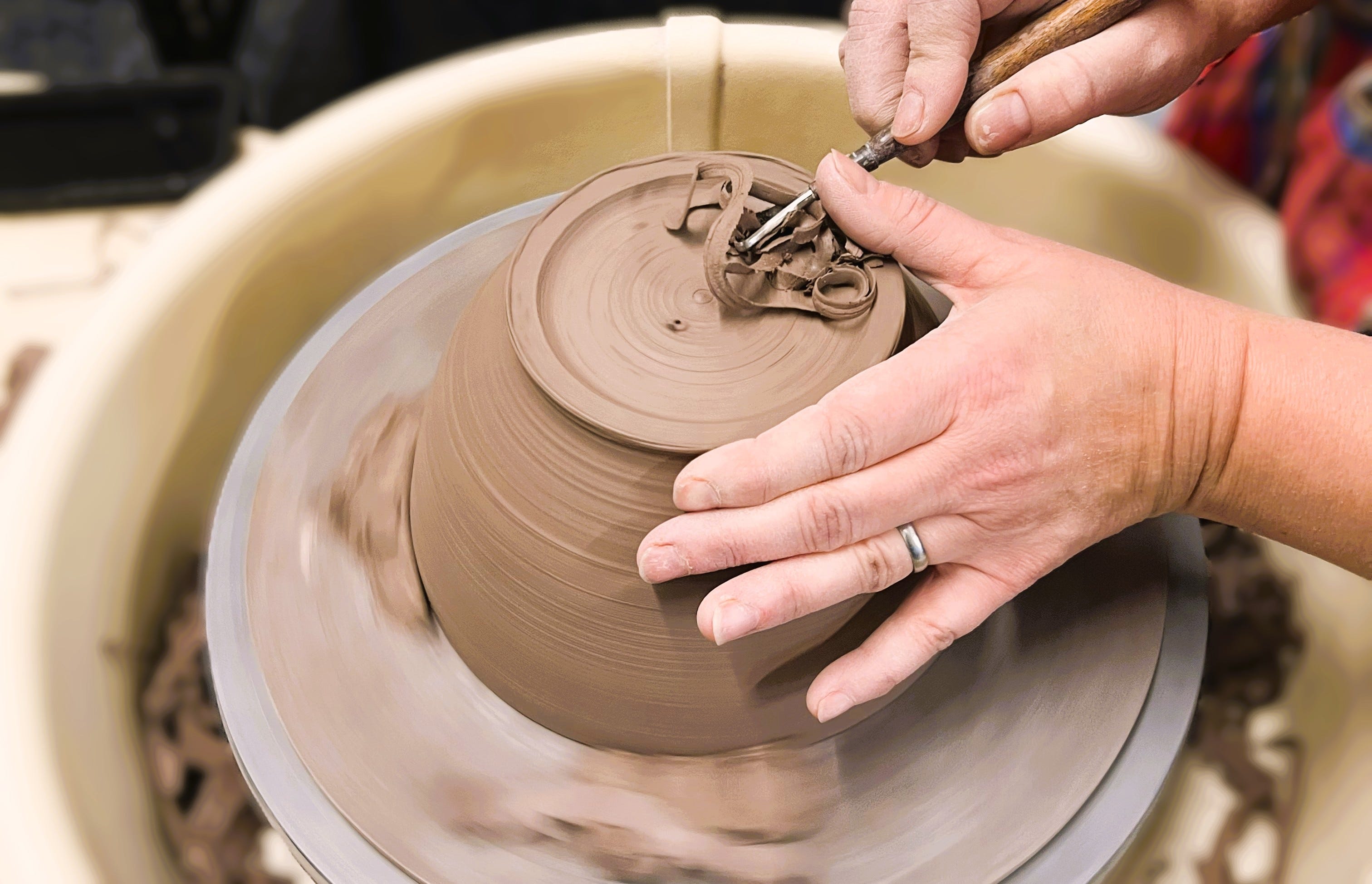
Like most writers, I’m happiest when exploring cliffhangers and conflicts — for my characters. I’m much less deft with my own. So when my youngest left for college and I became an empty nester, this particular plot twist was, honestly, a bit more suspense than I could handle. What’s a suddenly obsolete mom to do? Then I saw an ad for a local pottery class.
Insert your own Ghost joke here, along with a cliché about me being a cliché. I get it. Nevertheless, off I trotted, apron in hand, determined to learn a new skill and maybe create a masterpiece or two. As far as the “masterpiece” part goes, I’ll let you be the judge (see pictures below; try not to laugh). But I definitely did learn a whole lot of things: about pottery, sure, but also about myself. And just like the finished ceramic product, not all of it was pretty.
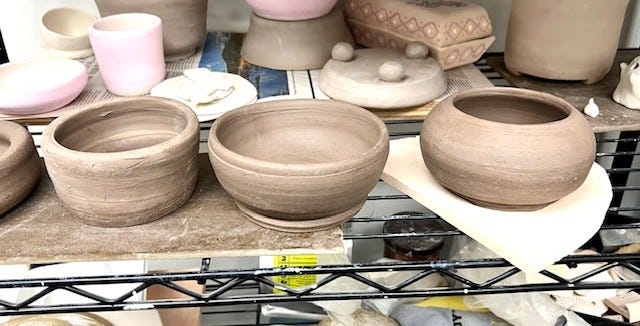
Mess Distressed
I’ve never considered myself a neatnik. But “dishes in the sink” and “socks on the floor” messes cannot compare in any way to “pottery” messes. We’re talking thick, sopping, brown clay, gouged under every fingernail and trapped in every crevice. At first, it was exhilarating, like sticking your hands into a mud puddle and splashing around for a bit. But then—and here’s the rub—you have to clean it all up. Why did this bother me so much? God knows, I’ve done my share of cleaning up after two kids and three dogs through the years. Then I realized: That was exactly why. As the chief cleaner-upper in my house for decades, I’d been conditioned to minimize messes whenever possible. To prevent them before they happened. So purposefully creating a mess felt…wrong, somehow.
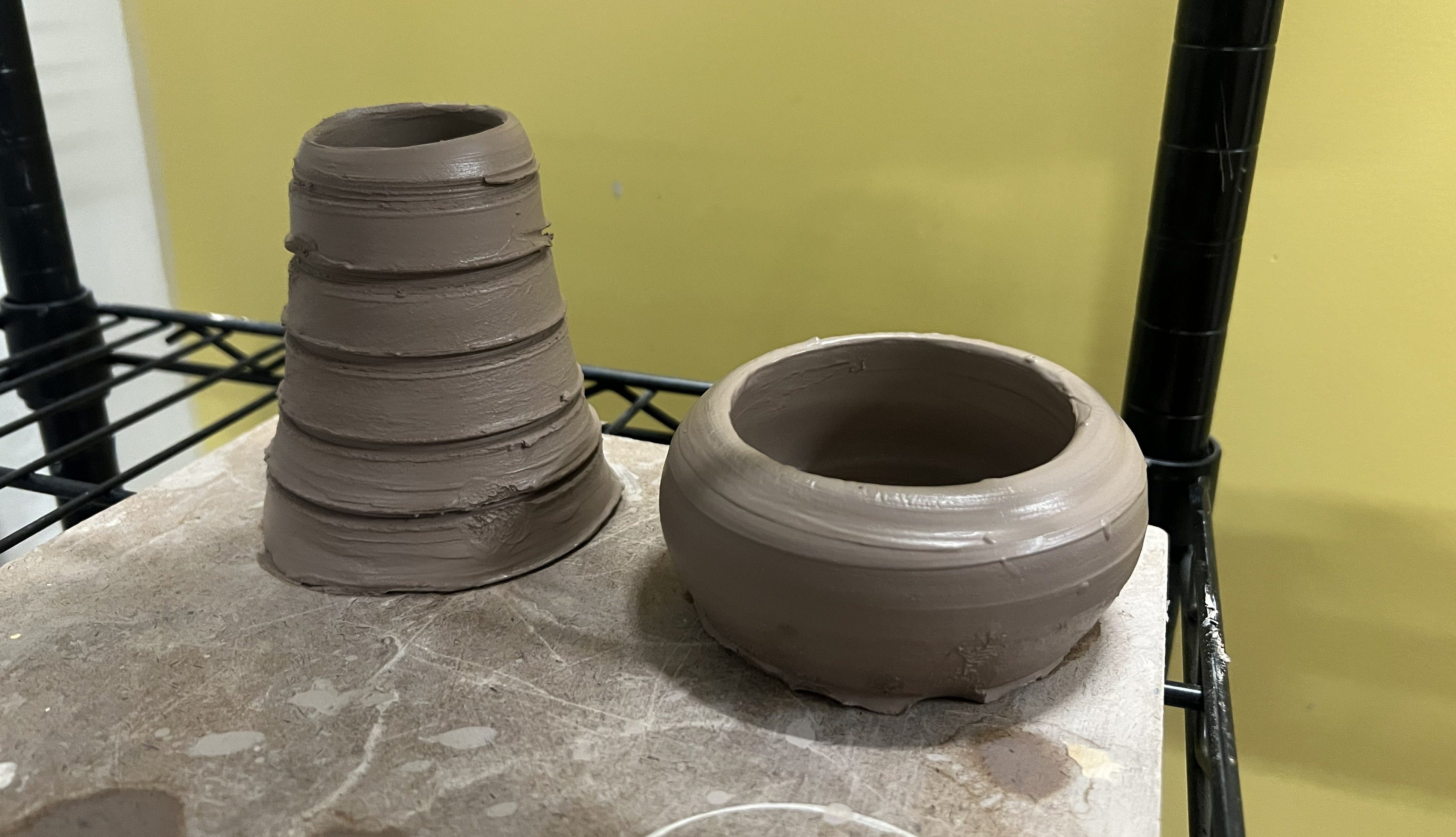
Practice Makes Perfect More Pots
On day one, the instructor warned us with a laugh: “Perfectionists sometimes have a hard time in here.” I laughed back, certain that I could embrace pottery’s freewheeling, anything-goes attitude. But I never did quite manage it. Turns out, the process of taking a lump of clay and trying to morph it into a particular shape on a rapidly spinning wheel is…well, imperfect. And difficult. And unpredictable. No matter which shape I thought I was making, it always turned into something else entirely. Fighting this reality only made it worse: When I worked the clay too long, trying to force it into something it didn’t want to be, the piece would often weaken, wobble, and sometimes even fling itself off the wheel altogether. Flying pots, let me tell you, are quite a sight. And for a while, they also felt like quite a failure.
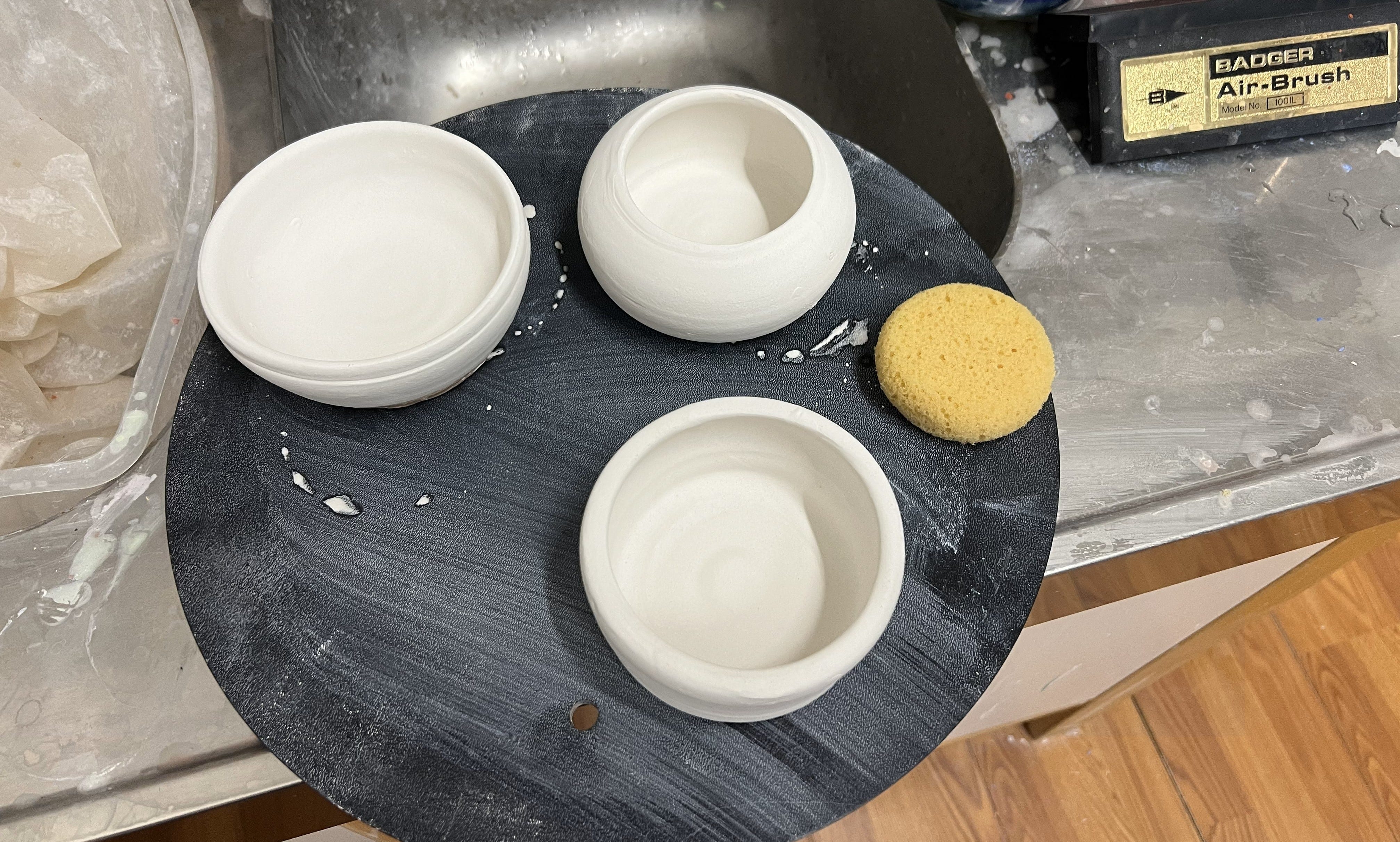
Are We There Yet?
Here’s how I thought it would go: Spin a pot. Bake a pot. Presto, change-o: You have a pot. Instead, I learned that the process is much, much slower than that. First, the shaped clay has to dry. Then dry some more. Once it’s dry enough, you take a session or two to refine the piece with blades and brushes. Maybe you add a handle, or a lid. Then, it gets a glaze. Then, a bake in the kiln. All in all, it took five—sometimes six!—weeks before I held the finished product in my hands. And during that time, there were multiple opportunities to make adjustments and additions along the way. So: no rush, baby. No rush. We’re taking this nice and slooooow.
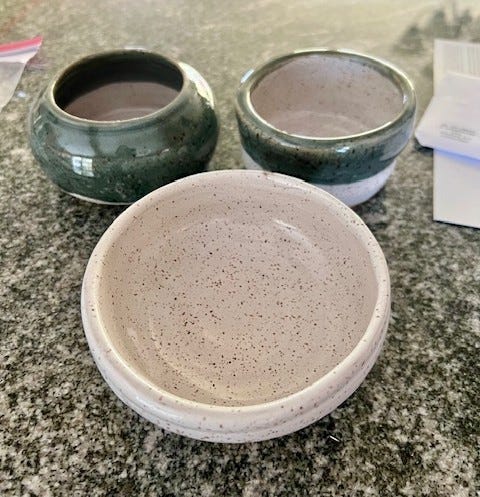
Wait, Let Me Overthink This
“Can you tell me again how to…?” Every time my poor, patient instructor wandered away, I would lure her back with questions. I needed to hear the “rules” again and again. (Even though there are no rules in a pottery studio.) Once, when I was struggling to make a chunk of clay “center” on the wheel, my friend and fellow potter Wendy gave me this piece of unexpected wisdom: “Close your eyes.” What? How could that possibly work? But damn if it didn’t. As Wendy had already learned, pottery is a physical thing, not a mental thing. Spinning, pressing, feeling…throwing your whole body into it. That’s what it takes to find balance.
I expected the pottery part to be hard—learning a new skill always is. I did not, however, expect the introspection part to be even harder. So, from now on, the new-and-improved Me will be trying to follow a new-and-improved modus operandi, honed and shaped by countless mistakes on the wheel. I’m calling it:
THE POTTERY MANUAL FOR LIFE
· Make a mess. Make lots of them, all the time. That’s what sponges and sinks are for. And no treasure—or true love, or life’s work, or bit of fun—has ever been made without one.
· You rarely get the exact result you were aiming for. But that’s all right. Keep spinning. Whatever you end up with is exactly what you were meant to have.
· No, life is not a dress rehearsal. But that doesn’t mean you have to get everything right the first time. You can make a version, let it sit, and then come at it again with sharp tools and a new perspective. It ain’t over ‘till it’s baked.
· There is a lid for every pot, it’s true. But sometimes you have to make the damn thing yourself.
· Even the wobbliest wobbles harden into something astonishing after surviving the heat of the kiln. You’re tougher than you think.
· A good glaze is like a good friend: It emphasizes the best, and glosses over the worst.
· When all else fails, close your eyes and feel your way. The world will keep trying to stretch you too thin, knock you into a teeter, and fling you around. But as long as you’re centered, you’ll stay on the wheel—a masterpiece, always, in the making.
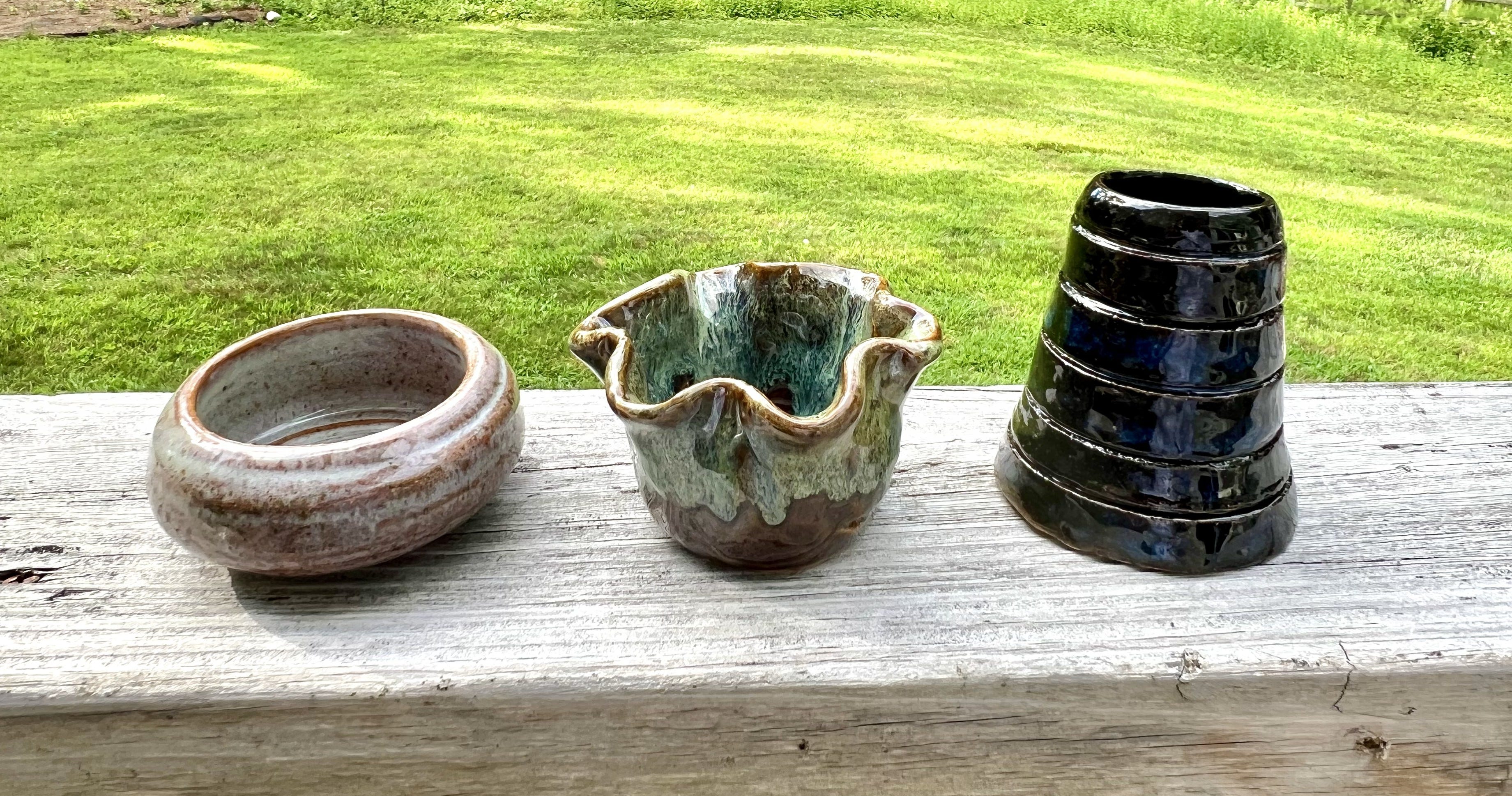
Trisha Blanchet is the author of Murder Like Magic (coming August 25, 2026, from Crooked Lane), The Neath Trilogy (Herrick’s End, Herrick’s Lie, and Herrick’s Key), The Cow Crashed into the Moon, and more. She’s also the producer and host of A Mighty Blaze Podcast, a member of the Tall Poppy Writers, and the founder of Operation Delta Dog: Service Dogs for Veterans (OperationDeltaDog.org).
Murder Like Magic < Preorder here!
The Neath Trilogy (Herrick’s End, Herrick’s Lie, and Herrick’s Key) < Get your copies here!
Operation Delta Dog: Service Dogs for Veterans < Learn more here!
A Mighty Blaze Podcast < Great author interviews here!
Comments
Nothing yet. Say the first thing.
Sign in to join the conversation.