
Investing is pretty easy when the market is going up.
Other than the 2020 COVID dip and a relatively tame bear market in 2022, the last decade has been a remarkably smooth ride.
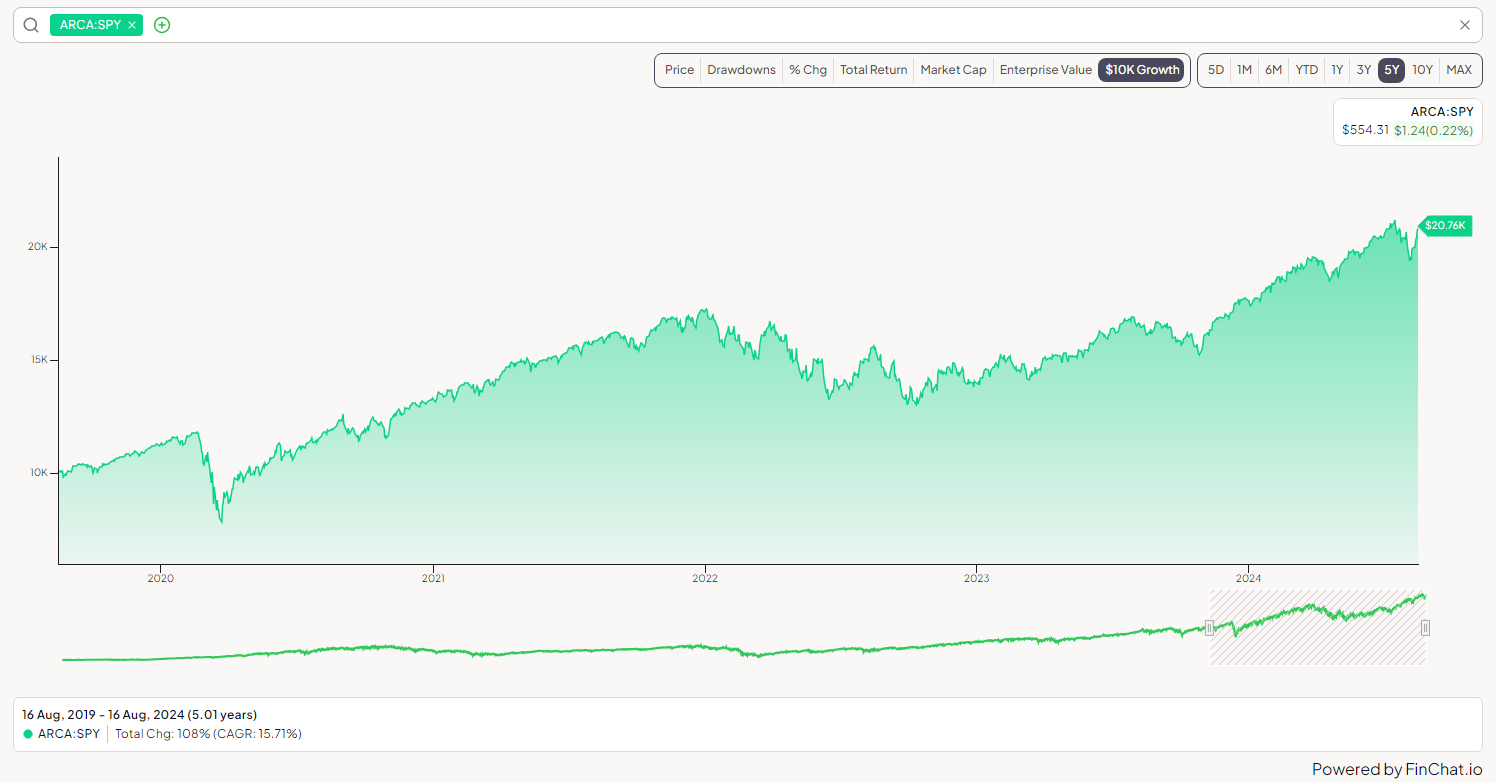
Investors also tend to have short memories, so 2020 and 2022 are likely not top of mind for most market participatins. 2008 is either a distant memory or just a lesson from the history books.
I suspect that’s why we’ve seen such panic and emotion when the market drops lately.
But I’m not going to start with how to handle the market going down. I have a pretty easy time with that. Today I’m going to start with how to handle the market going up.
I own a few companies that are priced above what I think they’re worth.
When the overvaluation gets to a certain point, I get tempted to sell them. It’s much harder for me to hold an overvalued compnay than it is to buy or hold one that’s falling.
Recently I’ve been thinking about why.
I thought I had a really high risk tolerance.
I run a concentrated portfolio. I’m really comfortable with 8 or 10 companies. A position being down 20% or 30% doesn’t typically bother me. Sounds like a high risk tolerance, right?
Maybe, but my difficulty with overvalued companies comes from loss aversion.
Here’s a refresher on the definition:
Loss aversion is a behavioral economics concept that describes the tendency to prefer avoiding losses over acquiring equivalent gains. This means that the pain of losing something is generally felt more intensely than the pleasure of gaining something of the same value.
I’m afraid to lose the gains I’ve accumulated on paper. That’s why overvalued stocks are hard for me to hold.
The problem with selling things that are overvalued is uncertainty.
Let’s say I’m right and my company falls 20% after I sell it. Great.
Now what?
Am I going buy it back when it returns to intrinsic value? Or 10% below?
Price anchoring will probably make it very hard to buy at a higher price than I originally paid. I’m picky, and cheap when I buy, so I probably originally bought it for somewhere around 50% off.
How will I know where the bottom is? How will I time my entry back in?
It’s a very hard problem. One best avoided by doing nothing, as long as price is the only reason I’m considering selling.
Even though it’s easier for me emotionally, the opposite scenario is just as hard to time based on price.
Let’s look at a few real examples.
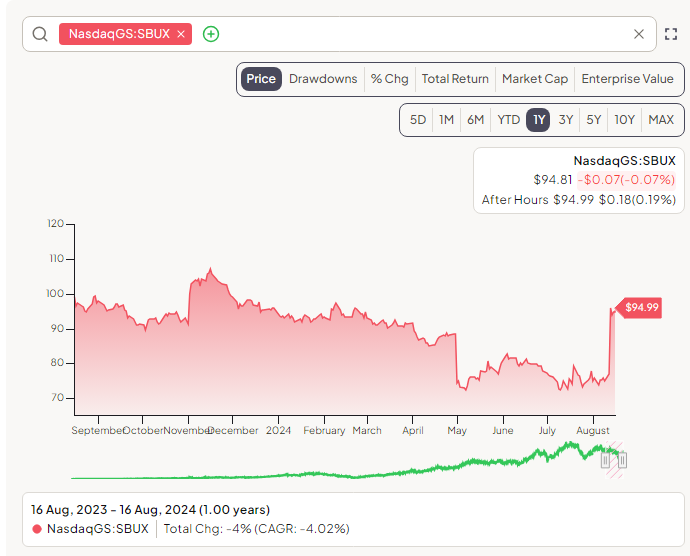
Starbucks has done nothing but decline since November. Yes, there was a little bump this summer, but it didn’t last.
An investor interested in Starbucks that was watching the price movement might have bought in July diring the sdieways action. But if not, things changed quickly when they hired a new CEO.
Ulta may be an even more dramatic example. It’s been selling off since March.
Look at the decline starting in mid-July. Someone watching the price of Ulta would have concluded that there were no buyers to be found. Best to wait until the stock bottoms before you start buying.
But in Berkshire’s 13-F, we found out that there was a buyer. And all of a sudden it became a good idea for everyone else to buy too, sending the stock up 15% in overnight trading. Weeks of decline were reversed in a day.
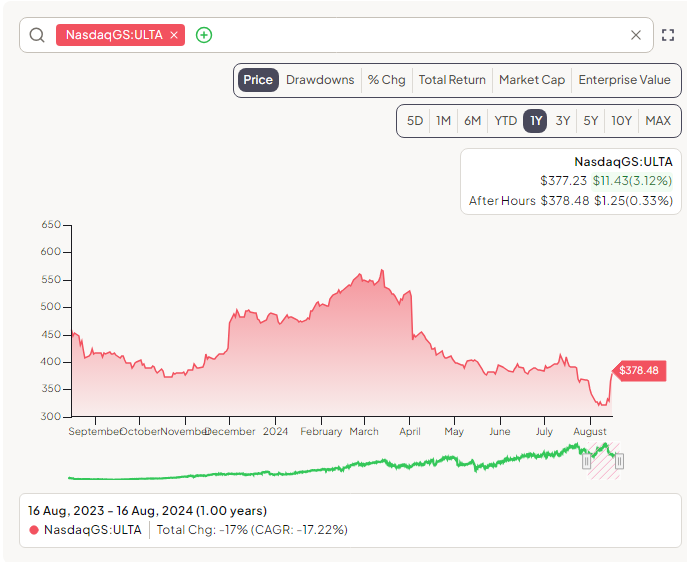
The price on both of these companies changed quickly.
The point is that you don’t know what the price of a company, or the market will do.
The best you can do is decide what you think a business is worth. Then buy it when it’s far enough below that price.
This isn’t going to happen very often for a great company. You’re not going to get a lot of these opportunities.
Great businesses are rare. Great businesses available at bargain prices are really rare. Don’t sell out of them too cheaply.
I’ll leave you with a quote from Benjamin Graham:
The investor with a portfolio of sound stocks should expect their prices to fluctuate and should neither be concerned by sizable declines nor become excited by sizable advances. He should always remember that market quotations are there for his convenience, either to be taken advantage of or to be ignored.
Most of the time, you should ignore the price and watch the business.
Remember:
You Don't Have to Do Anything
·
September 9, 2023

I took a few weeks off from writing this newsletter, initially because I didn’t think I had anything to say. I had started looking into several cyber security companies. They had good growth numbers and the valuations looked like they might be reasonable. The more I researched them, the more I realized that I didn’t rea…
No posts
Comments
Nothing yet. Say the first thing.
Sign in to join the conversation.