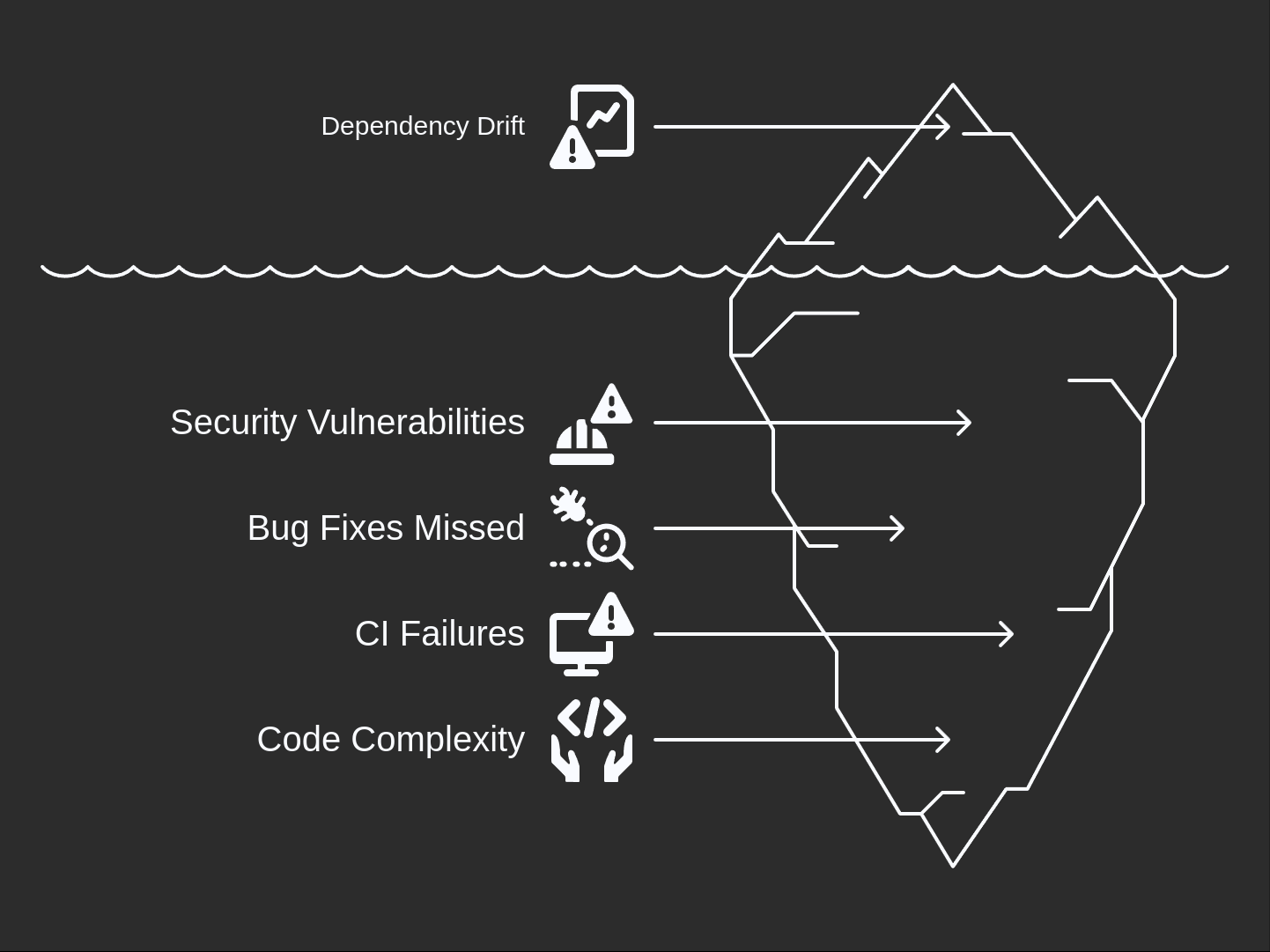
On February 25, 1991, during the Gulf War, a Patriot missile system in Dhahran, Saudi Arabia failed to intercept a Scud missile. The Scud hit a U.S. Army barracks, killing 28 soldiers and injuring over 100 more.
The cause?
A tiny drift in floating-point arithmetic. Over time, the internal clock diverged by just 0.34 seconds - enough to throw off the missile tracking system. A seemingly harmless accumulation of delay.
This wasn't a hardware flaw. It was software drift. And it got people killed.
Now, your JavaScript app probably isn't aiming at anything more dangerous than a div. But the principle stands:
Software that slowly drifts out of alignment - with its ecosystem, dependencies, and updates - will eventually fail.
You just don't know when.
Dependency Drift is when the packages your project relies on fall behind the latest versions. But this isn't just about missing out on shiny features. It's about:
Missing security patches
Falling out of sync with peer dependencies
Suffering from bugs that were already fixed
Accumulating technical debt one day at a time
But here's the kicker: most devs only notice drift when something breaks.
When I first started working on this idea, I assumed this problem was solved.
npm outdated, right?
Wrong.
That just lists version numbers. No context. No timeline. No understanding of how far something has drifted - or how risky that drift really is.
The only real advice it gives you is: "hey, this version is newer".
That's like your doctor saying:
"You're older than last year. Good luck."
We need better diagnostics.
That's the realization that led me to build DepDrift - not out of boredom or brilliance, but because I was tired of firefighting issues that came from ignoring this silent decay.
DepDrift is like a linter for your dependencies - but smarter.
It doesn't just tell you what's outdated - it shows you what's risky, what's safe, and what's silently decaying.
It's not just checking version numbers. It calculates a drift score based on:
Version differences (major, minor, patch)
How long ago the latest version was released
Whether the current version has security vulnerabilities
How frequently the package is maintained
Think of it as a health checkup for your package.json.
Except instead of a doctor saying "You're fine", it says:
"You're running axios@0.21.1, which is 180 days out-of-date and has 1 high-severity CVE. You should probably fix that."
You can install DepDrift globally with a single command:
npm install -g depdrift
# Navigate to your project
cd your-project
# Run analysis
depdrift analyze
You'll instantly get a clean table that looks something like this:
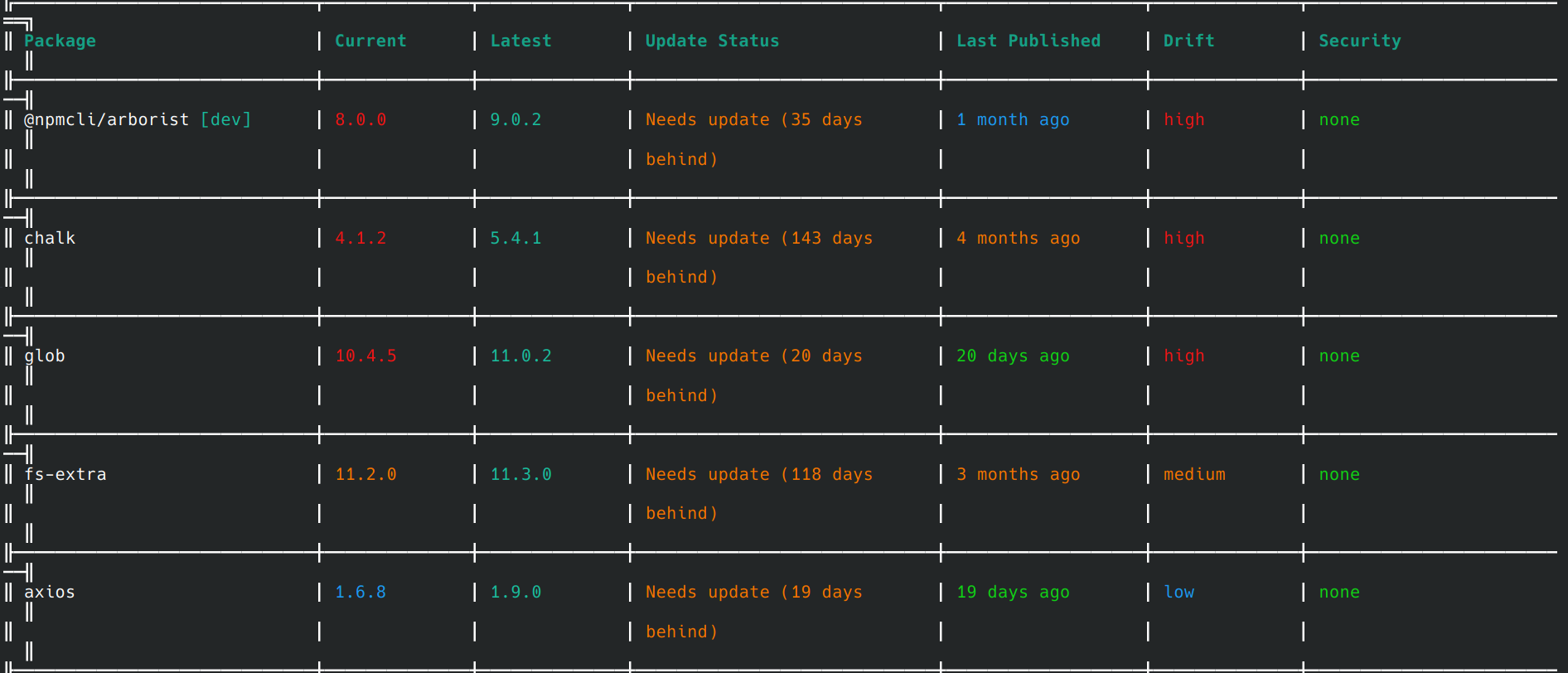
Want JSON instead? Just add --format json:
depdrift analyze --format json
Perfect for CI/CD pipelines or dashboards.
One of the first big questions I faced was:
How do you even represent a modern dependency tree?
At first, I naively tried using a nested object model like how npm ls outputs data. That blew up quickly. Large projects would crash the process - too many recursive calls, circular dependencies, and deeply nested trees.
I had to go back to basics. What are we really dealing with?
We're dealing with a directed graph - where each package (node) depends on other packages (edges). The challenge is that modern dependency graphs are not just deep - they're dense and shared. Multiple packages may rely on the same sub-dependency at different versions.
I ended up building two parallel graphs:
An actual graph: what's installed right now
An ideal graph: what would be installed if we upgraded everything to latest
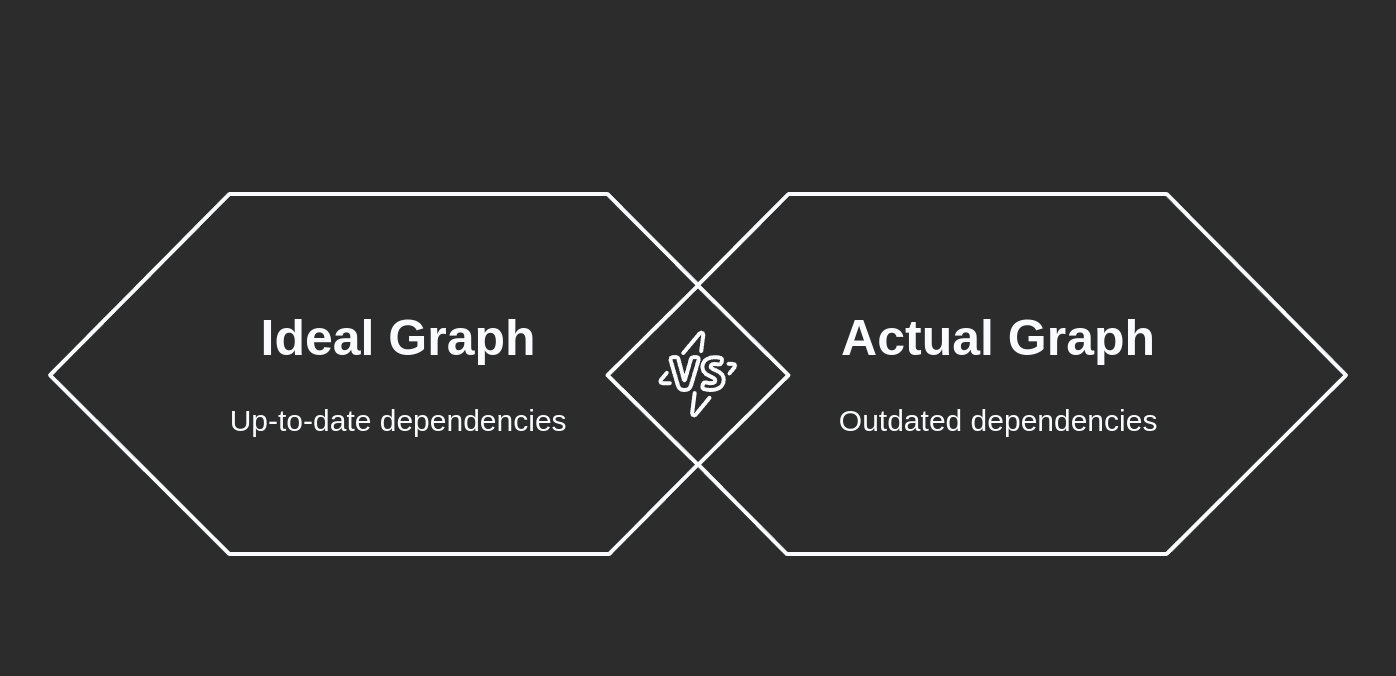
Each graph had its own topology, and I needed to diff them intelligently.
But here's where it got tricky…
Traversing these trees for analysis was painfully slow. Also, I wanted the ability to quickly answer questions like:
"What's the current version of lodash?"
"Which packages depend on axios@0.21.1?"
So I built a flattening function - flattenTree() - which converts the nested graphs into a flat map structure. Each node had:
A unique key (package@version)
A list of parents and children
A reference to its drift score
This gave me:
O(1) lookups for any dependency
Cycle detection without recursion
Easier graph diffing and traversal
The flattening took some iteration. Early versions leaked memory badly due to redundant object references. I had to optimize by using object identity maps and deduplicating shared subtrees.
I learned the hard way: just because your tree works, doesn't mean it scales.
Another philosophical battle: how do you quantify drift?
Initially, I thought semantic version differences would be enough. But that's incomplete. Two patch versions 4 years apart aren't "low drift." One could be full of CVEs.
So I built a multi-dimensional drift score:
Semantic distance: major, minor, patch
Temporal distance: days since last update
Release pattern: is this package well-maintained?
Was this perfect? No.
But it gave me context, not just numbers. And that's what I needed.
Security data was another beast.
npm auditgives inconsistent results.Snyk requires an API key.
GitHub has rate limits.
OSSI is helpful but lacks deep metadata.
So I built a security source adapter layer, where each scanner plugs into a common interface. If one fails, others still run.
Then I normalize all CVEs into a common schema and rank them by severity.
Honestly? This part took weeks longer than expected. I had to cache everything, build retry queues, and handle weird 403s at 2 AM.
But now the system can pull from multiple sources, aggregate the results, and show you:
Total vulnerabilities
Highest severity
Whether the update path fixes the issue
That last part is crucial. A vulnerable version without a fix is a whole different problem than one where a patch is available.
Even with all this data, I faced the biggest product question:
"What should the user do next?"
So I built a recommendations engine that scores each package based on:
Drift level
Security severity
Update complexity (i.e., major version upgrade?)
It then sorts and groups them into critical level, that helps you to decide whether it requires:
Immediate fix
Cann be Reviewed later
Safe to ignore
This system uses a crude but effective value-effort scoring matrix. In the future, I'd love to apply something like constraint optimization (e.g. knapsack problem) to get even smarter.
Some of the bugs and decisions I regret:
Trying to parse version diffs manually
→ Just use a solid semver library. They exist for a reason.
Overengineering the output formatter
→ Initially had nested collapsible tables in terminal. Looked cool. Broke in CI. Simpler is better.
Assuming APIs wouldn't rate-limit me during dev
→ I lost hours to 429s. Cache aggressively. Always.
Letting "perfect" block "done"
→ Some edge cases can wait. Get feedback first.
The purpose for me to work on this was to name a problem that every dev deals with but nobody talks about.
Dependencies don't break in loud, obvious ways. They erode quietly.
Just like that Patriot missile timer, your system drifts - until the day it doesn't work.
Catch it early. Fix it smart. Save yourself days of pain.
To learn more:
- GitHub → https://github.com/tirtha4/DepDrift
- NPM → https://www.npmjs.com/package/depdrift
Every week, I break down complex tech trends, share strategic frameworks, and reveal what's actually working in the trenches of building tomorrow's technology - no hype, no fluff, just actionable intelligence.
👉 Subscribe to The Engineer's Log for the kind of knowledge that actually matters.
No posts
Comments
Nothing yet. Say the first thing.
Sign in to join the conversation.