
A tech leader admitted something to me recently.
His company has its mandated AI tools. The approved stack. The sanctioned platforms.
And he’s running a different one on his personal laptop, because he’s found something better than what his company has approved.
He’s not alone. I’m hearing versions of this everywhere.
Shadow AI. Leaders and their teams quietly using tools the organisation never approved, because what’s out there is moving faster than what’s allowed.
Don’t get me wrong. I love what AI can do. It’s making us capable of things we couldn’t do before, at lightning speed.
But it’s also wearing many leaders out.
AI was supposed to lighten the load. Instead, it’s become another thing to manage. More tools. More agents. More chats to keep on top of. A new layer sitting on an already full plate.
The shiny toy syndrome is real.
The race that has everyone looking sideways
There’s a particular anxiety I’m watching take hold in senior tech leaders right now.
They think everyone else is moving faster than they are.
So they go looking. They trial a platform their company hasn’t sanctioned. They find one that’s better than the approved option. And quietly, the official stack and the real stack start to drift apart.
Multiply that across a team, across a function, across an organisation, and you’ve got a problem nobody’s actually managing.
The pace feels good, but the control disappears.
What the noise is drowning out
While everyone’s focused on keeping up, a deeper shift is going unaddressed.
The way work gets done has changed. Not slightly. Fundamentally.
A year ago, a piece of analysis took a team three days. Now it takes an hour. Decisions that used to move at the speed of a meeting now move at the speed of a prompt. The old rhythms, the old hand-offs, the old assumptions about who does what and how long it takes, a lot of that no longer holds.
This is the part most leaders are missing.
The fundamentals of leading well haven’t disappeared. But the way you apply them has to adapt, because the work itself is different now.
Your leadership operating system was built for how work used to flow. Does your leadership team still have clarity on the handful of things that matter, when the goalposts move this fast? Do your decision rights still make sense, when decisions are being asked to happen quicker and lower down? Do your meeting rhythms fit a world where the work moves at a different speed?
That leadership operating system is what turns effort into outcomes. No tool fixes it for you. And the version that worked eighteen months ago needs a serious look.
Layer the most sophisticated technology in the world on top of a leadership operating system built for a slower era, and all you get is the same chaos, faster.
Leadership is leadership
After 25 years in these rooms, it always comes back to one thing.
We’re in a moment of real disruption. The way we work is changing. The makeup of teams is changing. Soon, many of you won’t just be leading people. You’ll be leading people alongside AI agents (if you’re not already).
That’s new. It matters. It changes things.
It doesn’t change what leadership actually is.
Setting a clear direction. Making good calls and owning them. Creating alignment so everyone’s pulling the same way. Protecting your team’s focus. Holding the standard. Communicating when things shift.
Whether you’re leading twelve humans, or eight humans and a fleet of agents, those fundamentals don’t go away.
They matter more.
Because the faster everything moves, the more valuable the leader who provides the one thing no tool can. Clarity about what matters based on the business context, and the discipline to stay pointed at it.
Leadership is leadership. It needs to adapt, but the fundamentals matter now more than ever.
The leaders who’ll pull ahead
I’m optimistic about the second half of this year. Truly.
Not because the pressure is easing. It isn’t. The headwinds are real. The board expectations are real. The pace isn’t slowing.
I’m optimistic because the path through is clearer than it’s ever been.
While the majority chase the shiny toys, a smaller group is doing the unglamorous work. Getting their leadership operating system right for how work happens now. Leading their people well. Staying ruthlessly focused on the outcomes that matter.
And from that solid base, they bring AI in deliberately. Pointed at real problems. Integrated into a system that actually works.
That’s the combination. Strong fundamentals plus strategic AI. Not one or the other.
The leaders who hold their nerve on the basics while everyone else panics about the tools will look back on this period as the moment they pulled ahead.
Where to point your attention
So as you head into the second half of 2026, an invitation.
Before you trial another tool, look at your foundations.
Is your leadership operating system built for how work actually happens now? Are your people clear, aligned, and focused on what matters? Have you got the rhythms that turn effort into outcomes?
Get that right, and AI becomes rocket fuel.
Get it wrong, and AI just helps you go nowhere faster.
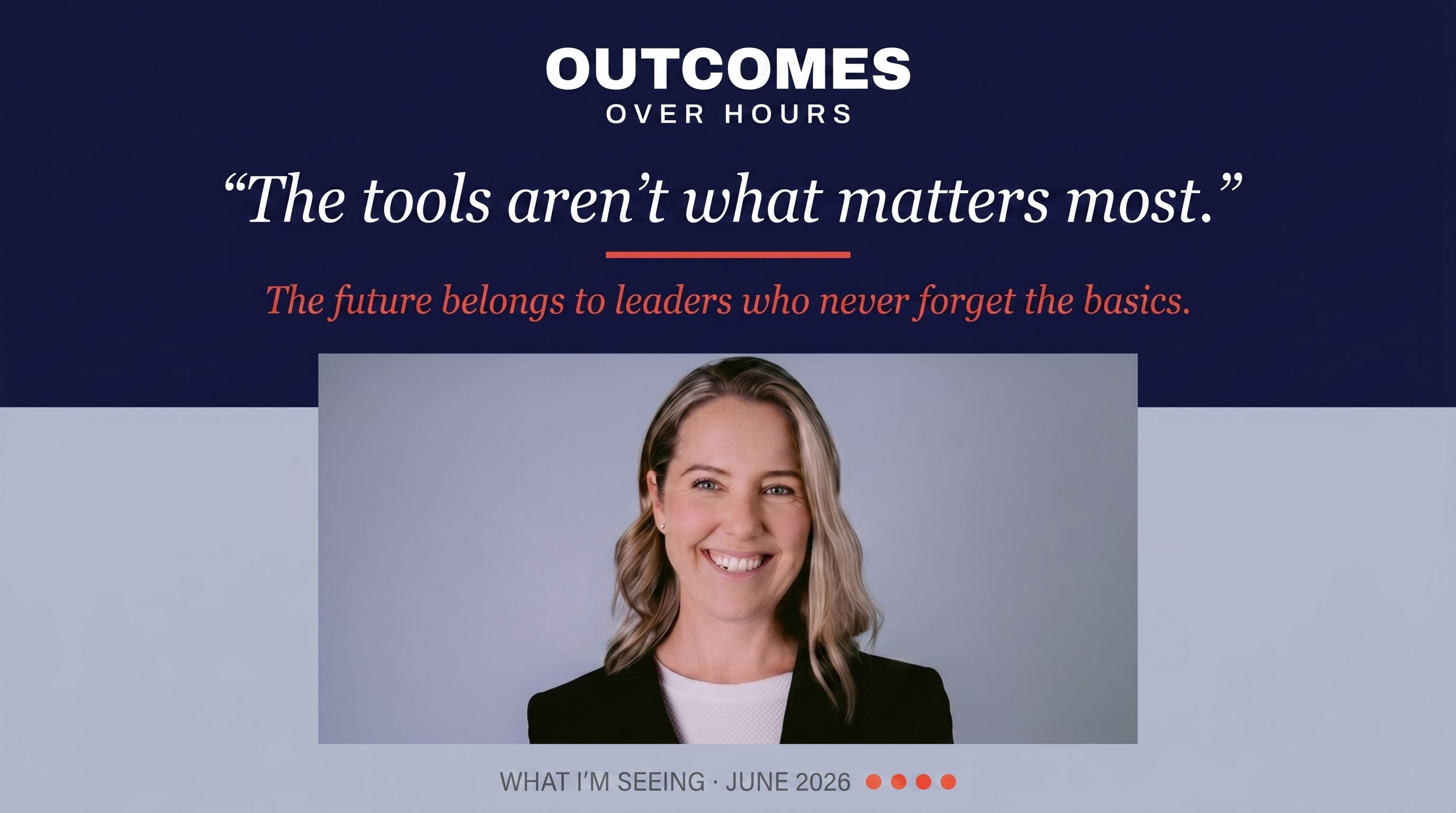
The future belongs to the leaders who don’t forgot the basics, and have the courage to adapt them.
Every week, I share what I see. Subscribe and see it too.
Tina Paterson is the founder of Outcomes Over Hours. She partners with tech leaders and their leadership teams to deliver the right outcomes faster and easier.
Because humans who strategically leverage AI will always win.
No posts
Comments
Nothing yet. Say the first thing.
Sign in to join the conversation.