
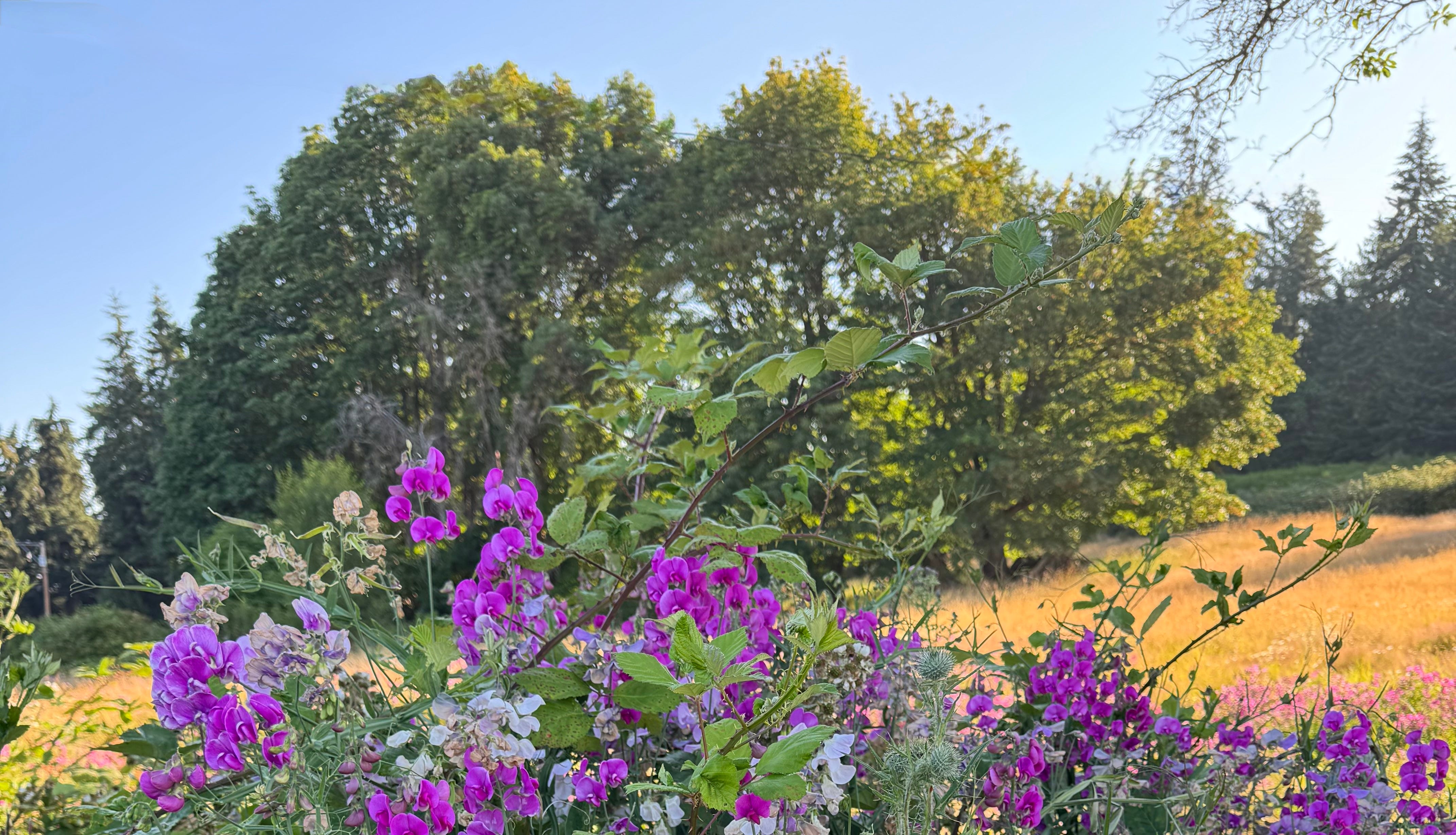
Every time I drive by this field, I’m entranced. The flowers in it are this crazy shade of magenta; and I can’t make out what they are, but they live there free of human intervention. They live there with all their relatives—grasses, insects, worms, soil. Sky, sun. Rain.
Anyway, they lift my heart every time I drive by. I’ve always wanted to make a bouquet to bring into my house. Last week, I walked to the field with my clippers.
Curious what they were, I whipped out my Picture This app, and learned that their name is “Everlasting Pea.” They’re a sweet pea! I love sweet peas.
I went about trying to gather them for my bouquet.
I thought I was just going to cut flowers till I had enough, and walk them home to a vase of water. It turned out to be exponentially harder. They don’t grow like daisies or roses, straight up and individual. They’re abstract expressionist modern dancers— attached to everything near them with loyal, robust, tenacious little green threads.
When I started actually cutting them away, I became aware of several things:
This is all ego.
How Me-centered and imperious! “I want these pretty things in my house.”
Let’s take a close look at that:
A. These flowers are ‘things.’
B. These flowers belongs to me because I want them.
C. I can cut off their lives whenever I want—they’re flowers, not humans or dogs. Under close inspection, those assumptions makes me cringe.My approach began to feel like a form of impending violence.
Maybe Robin Wall Kimmerer’s Braiding Sweetgrass is influencing me. As my clippers came near the first stem, I felt the flower as a living being, when before it was a color I wanted in my house. This flower was drinking the sun and the rain, pulling life up from the soil, singing herself into the world, all without any help from me.I thought I had consciousness and the flowers didn’t.
This makes me laugh. How in hell could I ever know such a thing? Leave me out there in the field without any external support, and I’d be dead within a week. This little sweet pea can thrive for decades, all on her own if left undisturbed. She relies on deep taproots and creeping underground rhizomes that store energy so she can resprout each spring. She knows everything she needs to know.She has no hangups about death.
(I know. That’s another assumption. We don’t know what an everlasting pea feels—but I bet she’s not wringing her leaves about ‘dying.’)
Siri told me, (note: I need Siri. She doesn’t): “Allowing flowers to turn into seed pods signals the annual plant that its life cycle is complete, ending flower production.” No tears. No drama.
What would it be like if we could accept that our life cycle was complete, when we start turning into seed pods?
But no. We resist the natural processes. Instead, we chase hormones, facelifts, anti-aging serums. We wanna pass for fifty when we’re seventy. We wanna have sex in our eighties. We throw insane amounts of energy and money at staving off our mortality.
Nobody wants to suffer, and aging involves a fair amount of it, especially if it includes disease (which it very often does). But it might be a good exercise to practice saying, “I’m an everlasting pea turning into a seed pod. It’s time.” And then just—surrender to that process when the time comes.
I’m sad to say, I still cut the flowers for the bouquet. But they had the last laugh. Here’s what it looked like:
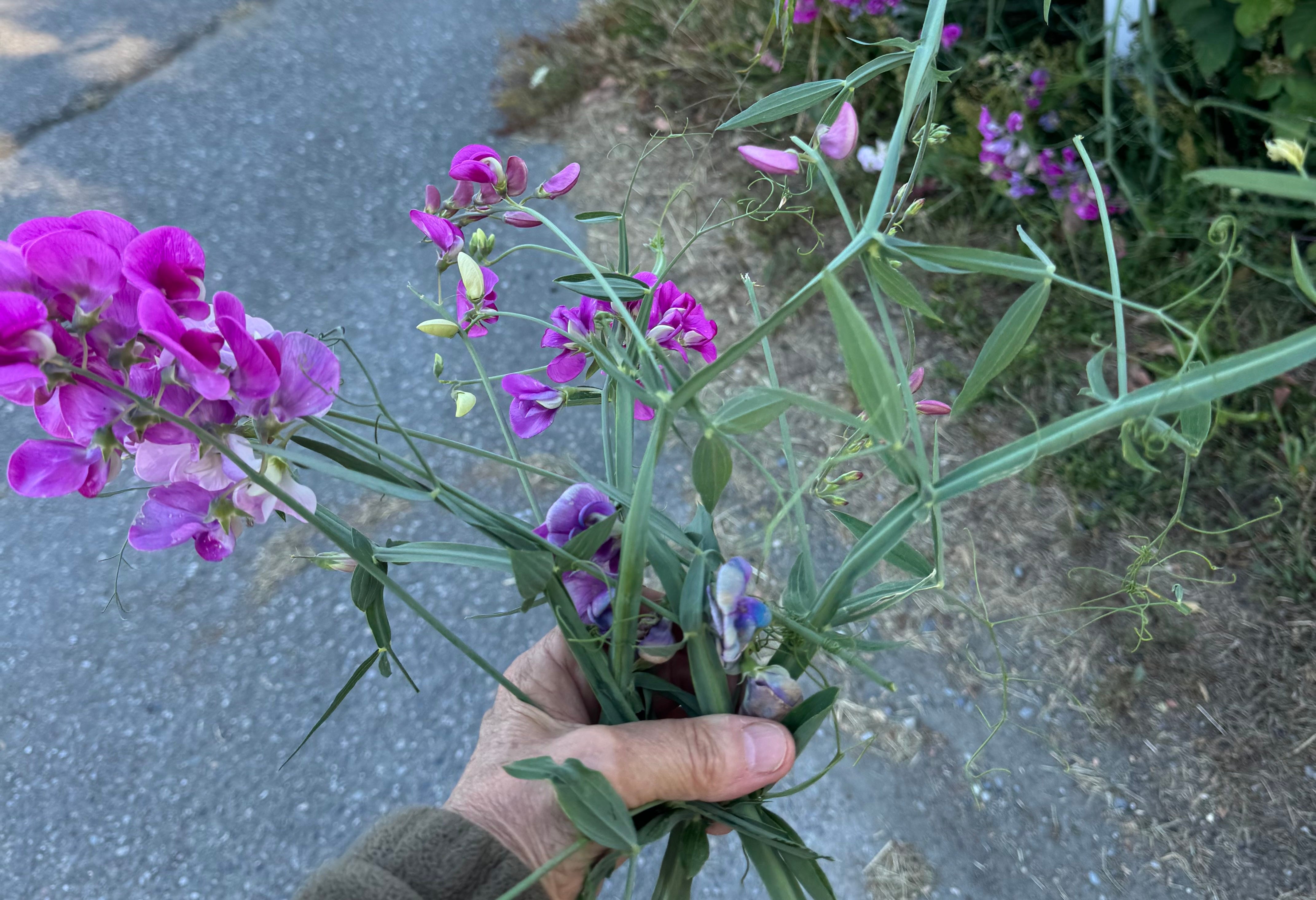
Nothing at all like I’d envisioned it. I made the best of the situation, found my little bud vases, and enjoyed the flowers for a few days. But man did I learn my lesson.
Sometimes, when you see a beautiful field of flowers, the point is to love what you love, leave it alone, and then let it live in you for the rest of your life.
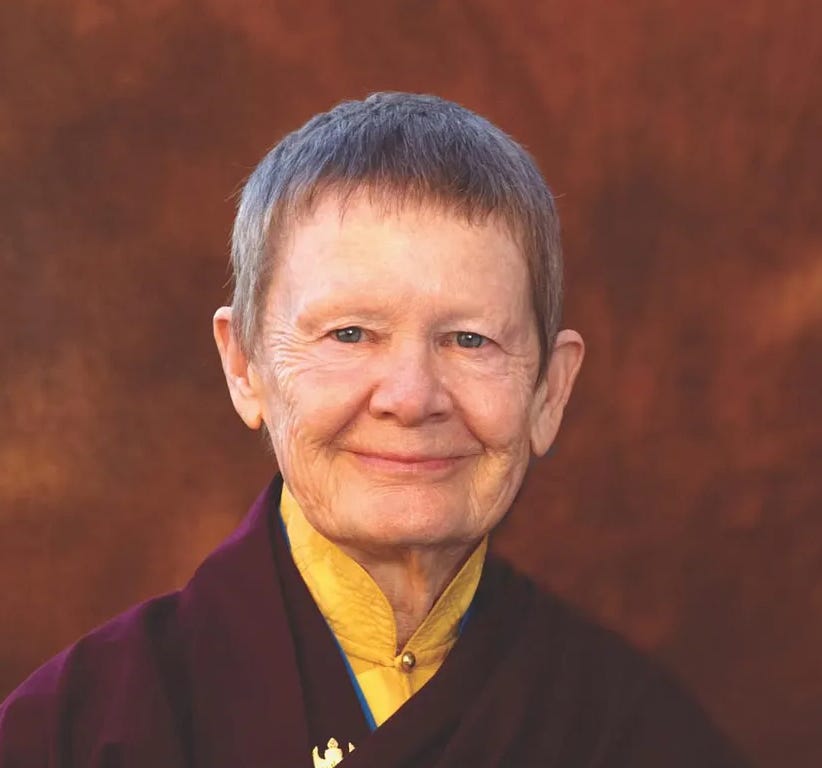
“Things falling apart is a kind of testing and also a kind of healing. We think that the point is to pass the test or to overcome the problem, but the truth is that things don’t really get solved. They come together and they fall apart. Then they come together again and fall apart again.
It’s just like that. The healing comes from letting there be room for all of this to happen: room for grief, for relief, for misery, for joy.”

This is a quick story that has some important information underneath it. Not so much comedy as wry observation.
No posts
Comments
Nothing yet. Say the first thing.
Sign in to join the conversation.