
My last post discussed the threat that jawboning and other forms of pressure pose to the First Amendment rights of law firms, universities, museums, and others. On August 3, the Education Department sent a “National Call to Action” to university leaders, urging them “to reaffirm higher education’s foundational commitments to academic excellence, path-breaking research, and national service.” Secretary McMahon’s letter announces: “Before the end of 2026, I call on every postsecondary institution to describe to the American public your commitments to rigorous teaching, pathbreaking research, and national service— commitments that make our universities a bedrock institution of the American republic.”
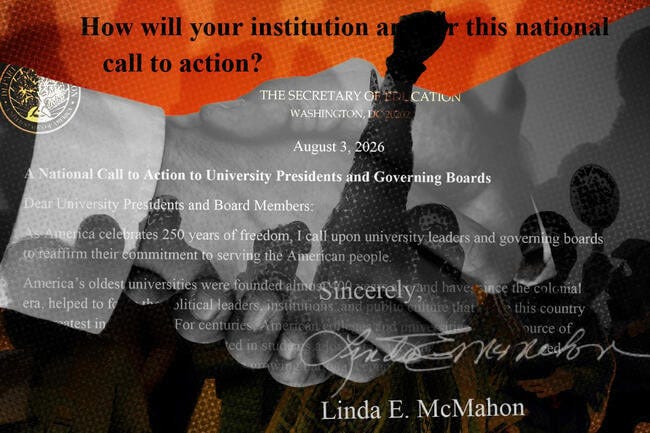
As innocuous as that sounds, universities ought to be very wary of the administration’s latest entreaty.
One thing you can say for the Trump Administration is that it has used nearly every lever of power at its disposal to “reform” universities in its preferred image. Officials have been transparent in terms of their desire to rid campuses of all things “woke,” punish students for protesting in disruptive ways, and ensure that universities add more “conservative” faculty and courses. The administration has terminated billions of dollars in research funding based on pretextual charges of anti-Semitism and questionable readings of anti-discrimination law, retaliated against institutions that refused to bargain away academic freedom and free speech rights for federal dollars, and dangled a “compact” in front of universities that would have provided them a preference when it comes to federal research funding for surrendering their academic independence. This is the proper context in which to view the latest call for university cooperation from the Trump administration.
What does the “Call to Action” propose? Here are the principal issues universities are being invited to consider and propose reforms regarding:
Transparency and Merit in Admissions: How will your institution ensure that admissions criteria are transparent and wholly described to prospective applicants? And how will your institution ensure admissions decisions are based on merit, achievement, and your university’s educational purpose?
Free Speech and Open Inquiry: How will your institution protect the free exchange of ideas, wide-ranging debate, and open-minded campus discourse? And how will you guarantee that unruly and violent protestors do not harass students or disrupt classes, research, public lectures, and campus operations?
Intellectual Pluralism and Academic Vitality: How will your institution encourage intellectual pluralism in all its academic units? How will your faculty hiring and evaluation practices support academic vitality and ensure that all relevant perspectives are taken seriously? And how will your institution ensure the research enterprise is dedicated to advancing knowledge, deepening understanding, and serving the American people who fund it?
Affordability, Value, and Student Outcomes: How will your institution ensure that families can access affordable, high-return, degrees? And what will your institution do to contain costs, improve pricing transparency, and ensure that every academic program equips students to repay their loans?
Academic Standards and Rigor in the Age of AI: How will your institution incentivize rigor in the age of AI, combat grade inflation, and prioritize excellence in teaching and learning?
Safeguarding Research Integrity from Malign Foreign Influence: How will your institutions protect academic programs from foreign influence, and safeguard the integrity of the research enterprise?
Prioritizing American Interests: How will your institution answer this national call to action? How can your campus and faculty advance American security interests, deliver academic programs that meet urgent workforce needs, and contribute materially to the Nation’s prosperity?
Restoring public trust in universities is a laudable goal, to be sure. Many universities support and are already making efforts to address things like affordability and AI. The modern university does have its challenges. It seems everyone - especially those who do not teach or work at these institutions - has ideas about how to “reform” campuses. But a government that announces its intent to turn campuses rightward for partisan purposes should be distrusted. The fundamental problem is that who teaches, what they teach, how they teach, and who is punished for what campus infractions are aspects of academic freedom and free speech. Governments cannot simply dictate these things. Nor can they bring them about through coercion. The impetus for reforms relating to “merit” in admissions, “intellectual pluralism” (whatever that means to the White House and Ed Department), and measures addressing “unruly” protests must come from the universities themselves.
One might argue that there is no pressure or coercion here, merely broad guidelines for reform and improvement and a call to address some issues many acknowledge are of concern. It is true that at first glance, Secretary McMahon’s “Call to Action” does not seem to come with any strings. Perhaps the administration, chastened by the fact the universities overwhelmingly rejected its “compact,” have decided to engage in dialog rather than try to jawbone or coerce compliance.
However, a White House official suggested that universities that answered the “Call to Action” might be more involved in discussions about federal funding than those that did not. The Trump administration’s M.O. has not been one of cooperation and dialogue. And especially where universities are concerned, it has taken an aggressive and transactional approach. In short, it has shown little to no respect for academic institutions or their leaders. The “Call to Action” is not (yet) “we can do this the easy way or the hard way.” But universities ought to be concerned about unspecified sticks and carrots. The administration traffics in and leverages vagueness.
If the administration had been interested in having a dialogue, it could have started with the “Call to Action” rather than ginned-up investigations and retaliatory funding terminations. In a normal administration, one might not have reason to be suspicious of cynical about a “Call to Action” to improve universities. However, the administration’s prior bad faith and violations of law are unsettling. Secretary McMahon calls on every postsecondary institution “to publish, by the end of 2026, a clear public statement outlining its commitment to implementing reforms that will help restore public trust in higher education.” But which reforms? And who decides whether they will “help restore trust in higher education” - a trust, by he way, this administration has done everything it can to undermine. Are the “best” reforms, in terms of things like “free speech and open inquiry,” “intellectual pluralism,” and student codes of conduct likely to be those that produce the rightward turn the Trump administration has been openly advocating for? Has the administration ever signaled otherwise?
The administration’s own commitment to “free speech and open inquiry” is suspect. I’ve already published a book detailing the many ways in which the second Trump administration has threatened or violated First Amendment rights across a range of areas. Its interpretation of “free speech and open inquiry” would allow government to censor certain disfavored views regarding gender, race, and American history, prosecute critics and protesters based on their protected expression, characterize factual reporting as “treason,” and use executive power to broadly control narratives at museums, national parks, and other institutions. How, then, can it be trusted when it comes to influencing who is hired, what they teach, and which protests are considered “unruly” forms of harassment at universities?
Simply put, the administration has lost all credibility when it comes to calling on others to support “free and open inquiry.” This is a significant problem - not only for the universities and other regulated entities but also for the federal government. An administration that has dedicated so much power and energy to destroying trust in universities and other institutions (the press, the Bar, museums, etc.) that can check its narratives is not a credible messenger when it comes to proposing academic reforms.
What are universities to do? They could collectively reject the “call,” as they did the earlier “compact.” I have argued that targets have a duty to demonstrate backbone when they are subject to pressure campaigns. If all universities refused the “call,” there may be some safety in numbers. That collective response would still require fortitude and civic courage. The administration has demonstrated the retaliatory and coercive tactics it is willing to deploy, and it may seek to make examples of some of the refusing institutions.
Universities could also respond in ways that seek to preserve academic and institutional independence. The Alliance for Higher Education and PEN America have compiled a useful toolkit for universities that take this direction. The gist is to take control of the narrative regarding federal funding of higher education, free speech on campus, and the need to maintain research independence. I suppose one could view that as a form of what my new article calls “backboning.” It is better, in any event, than simply capitulating to the administration’s effort to exert political control over higher education.
No posts
Comments
Nothing yet. Say the first thing.
Sign in to join the conversation.