
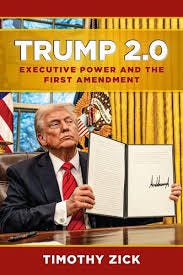
We have reached nearly the eighteen month mark of the second Trump presidency. That seems as good a time as any to consider how the second Trump administration has affected freedom of speech and press. My book on the subject was published early in early 2026. It examines many of the Executive Orders impacting free speech and press and early judicial decisions assessing First Amendment challenges. The book also contains excerpts from some of the briefs, submissions to federal agencies, and other materials. So far, I think it has held up well - especially considering the firehose of First Amendment conflicts during the second Trump term.
As readers know, I’ve also been maintaining a repository or record at the First Amendment Watch website. There you will find an up-to-date collection of Executive Orders, lawsuits challenging the Orders and related Trump Administration actions, and links to commentary on the many First Amendment-related conflicts that have occurred during Trump 2.0. While there are other repositories and websites that track litigation against the second Trump Administration, mine is unique in that it focuses solely on First Amendment issues. It collects court cases, but also identifies executive documents and commentary by journalists, legal scholars, and others concerning threats to First Amendment freedoms during this extraordinary period.
My intent is to create a real-time record of the free speech and press controversies of this era. I envision the repository as a resource for those who are interested in studying and learning about the free expression controversies of the era, whether in the present or looking back as a matter of history once the Trump era is (finally) over.
Although I encourage you to visit the repository, given all that has happened I wanted to provide a summary of the past eventful year and a half. One of the reasons I decided to take on the repository was to respond to the predictable argument that “every presidency gives rise to First Amendment controversies.” That’s undoubtedly true. But there is no comparison to past presidencies when it comes to the sheer number of threats to First Amendment freedoms, the variety of contexts in which those threats have arisen, and the president’s own direct participation - not only through Executive Orders but also lawsuits against the press, weaponization of the Department of Justice against critics, and incessant jawboning and threatening of individuals and institutions. Let me put it this way: I could not have filled a single chapter, much less an entire book (two if you count my book on the first Trump Administration and the First Amendment), with the First Amendment controversies of the Obama and Biden presidencies combined (or, for that matter, the many administrations that preceded them).
So no, just no. This is not some ordinary period of presidentially-inspired free expression conflicts. If you doubt it, I have receipts.
Whether this is the worst, or one of the worst, eras for First Amendment freedoms is an interesting question, as is whether President Trump is the “worst” president for free speech in the nation’s history. I offer some tentative thoughts on that question below, and intend to return to it at the end of Trump’s second term.
Let me start some numbers. I cannot be certain I have collected or noticed every lawsuit and certainly cannot begin to collect all the essays, opinion pieces, and other writings on Trump 2.0 and the First Amendment. My repository Word document is currently 132 single-spaced pages (and counting). I am confident I have identified and catalogued the major lawsuits and much of the insightful reporting and commentary.
Executive Orders, Presidential Memoranda, and Fact Sheets
After issuing an Executive Order promising to “end governmental censorship” and and the weaponization of government to suppress speech, guess what President Trump did? He issued fifty seven (57) Executive Orders, Presidential Memoranda, and Fact Sheets that sanction speakers based on expression, target disfavored ideologies and viewpoints, and otherwise threaten expressive freedoms. These documents, which direct federal agencies and officials to take various actions against federal contractors, law firms, museums, libraries, universities, and others, relate to an extraordinary variety of subject matters including the following:
Foreign Terrorism and National Security
Immigration
Sanctioning Law Firms
Retribution Against Former Government Officials
Federal Funding and “Diversity, Equity, and Inclusion”
Federal Funding and “Gender Ideology”
Gender and Gender Identity
The Content of K-12 Education
Museums and Library Displays
Public Broadcasting
Political Donations
University Accreditors
Prosecutions at the International Criminal Court
Deployment of Military Forces During Public Protests
Scientific Research
Artificial Intelligence
Prescription Drug Advertising
Instruction at Service Academies
Antifa and “Domestic Terrorism”
Lawsuits
These directives, along with other actions taken against international students, protesters, and others, have given rise to at least eighty four (84) lawsuits. Again, these are the ones I have been able to identify so far. That’s about five First Amendment lawsuits per month.
In addition, President Trump has contributed another six (6) lawsuits of his own to the tally, in which he has sued The New York Times, Wall Street Journal, BBC, and other media outlets for defamation and other supposed civil harms. A sitting president suing media is notable and not normal. Prior to Trump’s second term, I believe there had been a grand total of one such lawsuit in the history of the Republic. And the president’s lawsuits have sometimes been accompanied by parallel regulatory proceedings in which defendant media companies were seeking approval for mergers and other benefits from the Executive Branch.
Although they have not won all their cases, plaintiffs have been very successful when they’ve challenged Trump Administration actions and policies on First Amendment grounds. In fact, plaintiffs have lost only a handful of the 84 lawsuits I’ve identified. We need to keep in mind that these court decisions have mostly issued from federal district courts; results may vary on appeal. But there is no question that federal courts have concluded that many of the administration’s actions and policies violate the First Amendment (or likely do so).
Here are just a few highlights (or lowlights from the administration’s perspective):
All four of the law firms that stood up and challenged Executive Orders targeting them based on prior representations or support for ideas the president does not like have won their cases in district court. (The cases are now on appeal at the U.S. Court of Appeals for the D.C. Circuit).
The American Bar Association obtained an injunction prohibiting the administration from terminating funding for its projects based on the association’s viewpoints.
A district court invalidated the administration’s “ideological deportation policy,” which resulted in the arrest and confinement of a group of targeted international students. (Each of the detainees also successfully challenged their confinement.)
Harvard University successfully challenged the administration’s effort to terminate hundreds of billions of dollars in research funding in retaliation for its expression and to prevent it from enrolling international students for the same reason.
The American Association of University Professors obtained an injunction against what the court referred to as “a concerted campaign to purge “woke,” “left,” and “socialist” viewpoints from the University of California.
A court enjoined the Federal Trade Commission from retaliating against Media Matters based on its protected expression.
Scientists have successfully enjoined termination of research projects and deplatforming papers based on forbidden “gender ideology” and “diversity, equity, and inclusion” content.
American citizens who assist prosecutors in the International Criminal Court have obtained an injunction forbidding the administration to punish them based on their work.
A district court ruled that the administration’s decision to terminate funding for PBS and NPR was in retaliation for the stations’ expression.
Several courts have invalidated provisions in Executive Orders that call for terminating federal funding if contractors and other funding recipients support or participate in “diversity, equity, and inclusion” activities.
A court granted summary judgment to The New York Times in its challenge to new Pentagon restrictions on publication of non-classified information.
A court granted an injunction prohibiting the Defense Department from reducing the rank and pay of Senator Mark Kelly in retaliation for his protected expression.
An instructor at West Point obtained an injunction against restrictions on his teaching and public appearances.
A district court enjoined the Defense Department from removing books from schools under its jurisdiction based on the ideas and viewpoints contained in the materials (you guessed it - mostly books addressing gender and race).
Courts enjoined enforcement of an Education Department policy that prohibited teaching about certain forbidden topics or ideas including structural racism.
A court ruled that ICE violated the First Amendment when it detained individuals without providing notice of their whereabouts, which prevented them from speaking to counsel.
A court enjoined the federal government from declaring that Anthropic was a “supply chain risk” in retaliation for its public criticism of the administration.
A court invalidated a Department of Justice stop work order that affected advocacy on behalf of undocumented persons.
A district court granted summary judgment to federal employees who were compelled by federal agencies to use partisan out-of-office messages.
Several lower courts have issued injunctions against the use of force by masked and militarized Immigration and Customs Enforcement (ICE) agents during anti-ICE protests.
The Supreme Court held that the president lacked the legal authority to federalize Illinois National Guard troops to respond to protest-related unrest in Los Angeles.
I have calculated that the Trump Administration has prevailed in less than 10% of the cases filed against it so far. Again, some of the district court decisions are being appealed and the administration may have more success in federal appellate course. But so far, its record in First Amendment cases is extraordinarily bad. In many cases, that is in part owing to the fact that the administration has violated fundamental First Amendment principles - including the requirement that it not target speech based on its content, retaliate against speakers based on protected expression, or coerce speakers and speech intermediaries in ways that censor expression.
When it comes to freedom of speech and press, some past presidents stand out as being particularly awful. For example, John Adams had his political opponents jailed for sedition. Richard Nixon compiled an “enemies list” and wanted to use the powers of his office to target opponents based on their expression. During World War I, Woodrow Wilson set up a propaganda committee to suppress anti-war dissent and, far worse, used the Espionage Act of 1917 and Sedition Act of 1917 to arrest, prosecute, and deport thousands of individuals who dared utter or print ideas that criticized the war effort or the administration.
It may be premature to ask where President Trump stands in historical terms when it comes to freedom of expression. However, a recent essay published by the Foundation for Individual Rights and Expression (FIRE) claimed that Woodrow Wilson is “America’s worst president for free speech.” That prompted me to offer some tentative thoughts on whether Trump may yet surpass Wilson for this dishonor.
It is difficult to decide on a metric or set of criteria for deciding which president has been “the worst” in terms of free speech.
Certainly if we consider the number of individuals jailed and deported for their beliefs during Wilson’s presidency, a strong claim can be made on his behalf. However, the current administration has also jailed speakers solely based on their beliefs or viewpoints. The Trump Administration arrested and confined (sometimes in places far from where their arrests occurred) international students based on their pro-Palestine campus speech. At this moment, Trump is pressing a compliant Justice Department to jail his critics. To be sure, President Trump is not likely to jail as many individuals as did the Wilson Administration. But if imprisoning dissenters is a benchmark for “worst,” his hands are not entirely clean either.
Should the duration of the threat to free speech and press count? Wilson’s campaign against antiwar dissent was serious but relatively short-lived. President Trump has been threatening free speech and press rights for an entire decade. Based on what has occurred so far, we can expect more actions against speakers and institutions based on their expression of disfavored ideas and views.
Should we also consider the scope of the threats? President Wilson focused primarily on wartime dissent. Like President Adams, Wilson believed this speech undermined the war effort. By contrast, as the earlier description shows, Trump’s actions have covered a variety of substantive areas and have impacted speech across boardrooms, laboratories, libraries, museums, broadcass, universities, K-12 schools, international courts, social media, and other contexts. He has used executive orders, executive powers, and termination of federal spending to regulate expression in ways no president ever has.
What about understandings of freedom of speech at the time presidential actions occurred? When President Wilson acted, it was not clear the government was prohibited from punishing sedition and speech that had a tendency to interfere with wartime execution. These were the open issues the Supreme Court addressed in its very first decisions on free speech in 1919. That does not excuse Wilson’s aggressive actions. But understandings of the scope of free speech during World War I were far narrower than under modern doctrine, which did not take shape until the 1950s and 1960s. By contrast, President Trump’s actions have occurred in the face of settled First Amendment doctrines that protect robust criticism of government, prohibit officials from discriminating against speakers based on the content of their expression, ban retaliation against critics, and ban government from using threats and intimidation to coerce speakers. Trump has targeted law firms, universities, and many others despite these settled doctrines. Do his basic disregard and disrespect for First Amendment rights render Trump’s actions “worse” than Wilson’s, at least on that score?
Perhaps it is best to leave such rankings to historians, who can apply their expertise to the context and criteria that might determine who is the “worst president for free speech.” And perhaps, no matter who is doing the ranking, the jury is still out on the Trump presidencies. But I would urge anyone thinking about ranking presidents to consider their entire body of work. On that score, Trump has already made a case for himself. And he still has thirty additional months during which to add to his legacy as possibly the “worst president for free speech.”
No posts
Comments
Nothing yet. Say the first thing.
Sign in to join the conversation.