
https://www.pricevaluepartners.com/the-illusion-of-knowledge/
“The greatest obstacle to discovery is not ignorance – it is the illusion of knowledge.”
Daniel Boorstin, Librarian of the US Congress.
Twitter / X occasionally throws out a quotation that is so striking that you have to pause for a while just to let it sink in. Example. Epictetus, a Greek Stoic:
“Happiness and freedom begin with a clear understanding of one principle. Some things are within your control. And some things are not.”
There is a clear line of descent between Epictetus and the Serenity Prayer of Reinhold Niebuhr (1892 – 1971), which begins:
“God grant me the serenity to accept the things I cannot change; courage to change the things I can; and wisdom to know the difference.”
We cannot change the financial markets, for example. The financial markets of the world are an unstoppable force comprised of the interactions of hundreds of millions of people (directly) and of billions of people (indirectly) within the global economy. Governments and their central banks and bureaucrats may have a limited power to interfere with these markets, but they cannot ever fully control them.
A good example of the ultimate powerlessness of government to rig the market came in the ERM crisis of 1992. The British government, by way of the Bank of England, tried to bend the foreign exchange market to its will. It failed. The pound sterling had entered the Exchange Rate Mechanism (a precursor to the euro zone) at the wrong rate, and the forex market knew it. With the Treasury having squandered hundreds of millions of pounds in a futile attempt to buck the market, the Bank hiked interest rates – twice – in a desperate attempt to show the forex market it meant business. The pound fell anyway. Sterling was ultimately ethnically cleansed from the mechanism and, ironically, our economic recovery began almost immediately. Government 0: Markets 1. The cost of this futile defence of the exchange rate was so extreme that one magazine at the time suggested that it was as if the UK Chancellor and the Treasury had spent the afternoon lobbing schools and hospitals into the North Sea.
We cannot change the markets.
What we can change is how we react to those markets.
The good news is that we have more choice today than any investor in history. But this choice is itself something of a double-edged sword.
Grok suggests, based on data from the World Federation of Exchanges, that there are roughly 60,000 listed businesses throughout the world. You would need to be a multi-billionaire to get a sufficiently diversified portfolio comprising just the best of them. The choice is so extreme that a degree of discernment is essential.
Thanks to the rise of low cost exchange traded funds (and free market competition) there have never been more investible choices across multiple asset classes than we have today.
You can buy “biblically responsible” ETFs. CWM Advisors offer the Inspire Small / Mid Cap Impact ETF (ticker symbol: ISMD) and the Inspire Global Hope Large Cap ETF (ticker symbol: BLES).
You can buy the Quincy Jones Streaming Music, Media and Entertainment ETF (ticker symbol: QJ).
You can buy the Obesity ETF (ticker symbol: SLIM).
If you want to be parted especially quickly from your money, you might wish to consider the Global X Millennials Thematic ETF (ticker symbol: MILN) which will take advantage of “millennial-based consumer interests and trends”.
For hardcore fans of social media there is the Buzz US Sentiment Leaders ETF (stock symbol: BUZ).
If you’re interested in livestock you might wish to consider the iPath Livestock Subindex Total Return ETN (ticker symbol: COW).
Then there’s stock sector specific ETFs, inverse ETFs, commodity ETFs, leveraged and triple leveraged ETFs, volatility ETFs..
After a while, the extent of the choice becomes the problem it was presumably initially designed to solve.
So sooner or later we come back to the pragmatic wisdom exemplified by Warren Buffett and his late business partner, Charlie Munger, and their concept of the ‘zone of competence’:
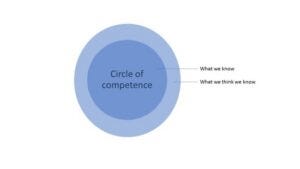
Buffett and Munger have consistently recommended concentrating one’s investments within those areas where one has familiarity and knowledge. As Buffett advises,
“Know your circle of competence, and stick within it. The size of that circle is not very important; knowing its boundaries, however, is vital.”
As Buffett went on to make clear, per his 1996 letter to shareholders, it helps to be able to correctly evaluate certain businesses. Not all businesses, just a sub-set of businesses where one can be broadly familiar with their characteristics and prospects. As he put it then, you don’t have to be an expert on every company, or even many; you just have to be able to evaluate companies within your personal circle of competence.
Bonds, in our analysis, have become uninvestible (at least for us). The game is no longer worth the candle. So bonds no longer feature as part of our asset universe. This isn’t a disaster, it merely means that we think we can do better (for ourselves, and for our clients) by using other assets. Those assets are, in large part, going to be largely defensive value stocks instead. We have been investing in value stocks (and in uncorrelated funds, and in real assets) for the past 25 years. Having started with a base comprising credit instruments, we have tried to widen our circle of competence into other, complementary, asset classes.
In the circle of competence diagram shown above, there are two circles. The smaller, dark blue circle comprises what we know. The wider, lighter blue circumference around it comprises what we might think we know. Among this wider, lighter blue section we might include:
What the profits of our chosen company might be next year (nobody knows for sure);
What will happen to interest rates next year (nobody knows for sure);
What will happen in geopolitics or stock markets next year (nobody knows.. you get the picture);
But within the circle of genuine competence within it, we might be able to identify:
What price / earnings ratio our chosen company’s shares are currently trading at;
What price / book our chosen company’s shares are currently trading at;
What this year’s announced profits by our chosen company already are..
And our standard operating procedure might then be to assume that, all things equal, next year’s profits will simply be the same as this year’s. This being the case, we will be minded to assume that the shares are a steal, because at this year’s prices we are getting this company’s future earnings, and all their subsequent future earnings, for a song.
These are some of the ‘hard’ metrics we typically use, and certainly recommend, to screen for ‘value’ equities (many of them informed by the great value investor, Benjamin Graham):
Price / book ratio of less than 1.5x
Price / earnings ratio of less than 15x
Cash-flow from operations yield of more than 10% per annum
Cash from operations growth over the prior 5 years
Return on equity of more than 8% on average over the prior 5 years.
We then supplement those ‘hard’ metrics with some ‘softer’ (more qualitative) ones, such as:
Management who are exceptional capital allocators (the evidence of which will be visible in their companies’ operational and profits history)
Management with respect for shareholder capital (who don’t squander it on the likes of trophy headquarters or annual reports laden with photographs of themselves)
Management with a history of share buybacks conducted at no great premium to underlying book value.
The combination of the ‘hard’ and ‘soft’ metrics, overlaid with some judicious technical analysis, gives us a variety of characteristics that are likely to lead to a more than satisfactory return over the medium term. Note that not all of these metrics sit well with all types of companies: the likes of software and digital media companies are especially difficult when it comes to book value, as most of their value is wrapped up in intangible assets such as intellectual property and branding. Nevertheless, these metrics are still a great place to start compressing a large universe of potential investments into a far smaller circle of competence.
Now consider how much financial media you consume and where the output of that media sits in relation to the two circles of competence (actual and presumed). By way of example, here are some headlines gleaned from one front page of The Financial Times last week:
Strains spread through private credit portfolios
AI anxiety spurs ministerial review
Monzo chair to step down
Kushner in Israel talks
Ferrari defies EV sceptics
Now ask yourself whether any of these ‘stories’ is likely to help you to be a better investor. Some of them are entirely subjective. Some of them may constitute news that is ‘good to know’ but that offers no inherent value. Some of them are subjective forecasts or statements of simple opinion. Some relate information on economic or political trends that have already occurred. Our suggestion is that most if not all of them provide no ‘edge’ – because even if they offered something with tradeable value, you won’t be the first investor to receive them. Most of them are simple agglomerations of data, or subjective opinion, and what they constitute has questionable value-add. This relates to most of the output from most financial media most of the time. It may be interesting, but does it really help any of us ?
What we want to know amounts to quite a small list. We want to know:
Which companies meet our requirements as defensive value holdings and are likely to remain as such for the long term ? (i.e. they’re not in sectors highly vulnerable to rapid swings in consumer popularity like, say, social media stocks)
Which funds meet our requirements as uncorrelated funds ? (i.e. they’re systematic trend-following funds run by managers who’ve been in business for decades and have outstanding track records over those periods)
This is actually a pretty small list. But it enables us to put together diversified portfolios that we believe will stand a good chance of weathering the storm whatever the financial markets throw at us in the years to come.
Knowing what Fed policy will be, whether Andrew Bailey is staying at the Bank of England (he would appear to be, sadly), or what Elon Musk is planning to do next – these are all entirely irrelevant to us. But then, most of what we’re likely to read in the financial press or watch on TV or hear on the radio is likely to be entirely irrelevant to us, at least as regards populating portfolios of sensible investment choices.
From the perspective of discretionary portfolio managers with a global remit, what we’re trying to say is that we now know what we don’t need to know. Virtually everything to do with macroeconomics is something that we simply don’t need to know. It might well be very interesting to have views about the likely path of inflation (or even deflation) and certain currencies (and we do have views on these topics), but we’re minded to believe that in a world of huge monetary manipulation, and wildly overconfident central banks, trying to forecast macroeconomic conditions is almost entirely a complete waste of time. In other words, we’re now hugely sceptical that top-down portfolio management and investment forecasting is even remotely possible.
But bottom-up investing, on the other hand.. well, bottom-up investing has, we suggest, never been easier. In large part because in a world of extreme overvaluation in most things, the number of objectively cheap and highly attractive things is by definition quite a small one. So why not simply focus on that ?
If we seem jaundiced about the mainstream media, it’s because we are. In particular, we’re tired of the constant ‘social justice warrior’ posturing from the likes of BBC News.
But in all honesty, our hostility to the mainstream media has been brewing for quite some time, and we quite enjoy spending most of our lives managing without it altogether. If you remain to be converted to the cause, we recommend this wonderful, and very amusing, presentation by Hans and Ola Rosling.
One short sequence from the 2001 film The Shipping News makes the point about the news ‘profession’ well. The old newspaper proprietor takes the aspirant journalist, played by Kevin Spacey, out to the shoreline. Have a look, he says, what do you see ? He points out stormclouds gathering on the horizon. What’s the headline ? Spacey hesitates.
‘Horizon fills with dark clouds ?’
The proprietor corrects him:
‘Imminent storm threatens village.
‘Well, what if no storm comes ?’ asks Spacey.
The proprietor casually shrugs.
‘Village spared from deadly storm.’
………….
As you may know, we also manage bespoke investment portfolios for private clients internationally. We would be delighted to help you too. Because of the current heightened market volatility we are offering a completely free financial review, with no strings attached, to see if our value-oriented approach might benefit your portfolio – with no obligation at all:
…………
Tim Price is co-manager of the VT Price Value Portfolio and author of ‘Investing through the Looking Glass: a rational guide to irrational financial markets’. You can access a full archive of these weekly investment commentaries here. You can listen to our regular ‘State of the Markets’ podcasts, with Paul Rodriguez of ThinkTrading.com, here. Email us: info@pricevaluepartners.com.
Price Value Partners manage investment portfolios for private clients. We also manage the VT Price Value Portfolio, an unconstrained global fund investing in Benjamin Graham-style value stocks and real assets, and also in systematic trend-following funds. The fund was “Highly commended” in Investment Week’s 2026 Fund Manager of the Year Awards.
No posts
Comments
Nothing yet. Say the first thing.
Sign in to join the conversation.