

A note on this series: This is Part Two of an eight-part series drawn from my developing book, Dark Tarot: Unleashing the Power of the Tarot for Dark Magick and Self-Discovery. Across the series, I am exploring the Dark Tarot as a practical system of magical divination, moving beyond fortune-telling into the ritual formula of Sigil, Spell and Sorcery. Each article offers a piece of the larger method, while the paid practicum sections provide exercises, worksheets and working material for those who want to engage the Dark Tarot as a lived magical practice.
Before a single card is drawn, the operation has already begun. The first spell is the question.
This may seem too simple at first. In ordinary tarot practice we often think of the question as a practical necessity, a way of telling the reading where to go. We ask about love, work, money, conflict, opportunity, grief, uncertainty, or some half-glimpsed possibility that has begun to trouble the edge of consciousness. The question gives the reader a subject. It frames the spread. It tells the cards what part of life we are peering into.
In the Dark Tarot, the question does more than this. It does not merely introduce the reading; it opens the gate through which the magical operation will emerge. A careless question creates a muddied threshold. A manipulative question distorts the field. A fearful question may produce a reading that simply circles the anxiety that summoned it. But a well-shaped question — one that is honest, ethical and initiatory — can call forth the hidden structure of the work itself.
The Dark Tarot is not concerned with prediction for its own sake. It is not asking the cards to become a parlour oracle, nor to provide the ego with reassurance dressed in occult costume. As we saw in the first article, the Dark Tarot begins where fortune-telling ends. It asks not only what may happen, but what must be formed, spoken and done. Its method is the threefold formula of Sigil, Spell and Sorcery. The cards do not merely describe the weather of fate. They reveal the image, the voice and the act by which the practitioner may participate consciously in the current moving through their life.
For that reason, the question matters profoundly. It is not a neutral sentence. It is an act of magical orientation.
Every question already contains a ritual attitude. Some questions kneel before fate and ask to be spared. Some questions demand that the universe behave like a servant. Some questions are really disguises for fear: Will I be safe? Will I be loved? Will I be chosen? Will I be punished? Some are attempts to control another person while pretending to seek wisdom. Others, more rarely, are thresholds of initiation. They ask not merely for an answer, but for the courage to enter a more truthful relationship with the forces at work.
This does not mean the question must sound grand or mystical. In fact, the best questions are often plain. The unconscious is not impressed by theatrical language. Nor are the gods necessarily moved by elaborate phrasing. A simple, honest question can be more powerful than a page of incense-heavy abstraction.
“What must I do to bring this work into form?”
“What is being asked of me in this transition?”
“How may I protect my home and my spirit without becoming ruled by fear?”
“What ritual action will help me release this grief?”
“How may I obtain the resources necessary for this work in a way that is ethical and grounded?”
These questions are not passive. They assume that the practitioner has a part to play. They do not hand responsibility over to the cards. They invite the cards to reveal the ritual and practical means by which the hidden current may be engaged.
This is the crucial difference. The ordinary question asks, “What will happen?” The Dark Tarot question asks, “How shall I participate?”

A weak question is not necessarily foolish. It is often simply unripe. It arises from genuine distress, but has not yet been brought into magical clarity. The Witch’s task is not to shame the first question, but to refine it.
For example, a person may begin with: “Will I succeed?”
That is understandable. Beneath it may be years of labour, longing, doubt and exhaustion. But as a Dark Tarot question it is limited. It positions success as something outside the practitioner, something that may or may not descend upon them. It asks the cards to predict an outcome rather than reveal an operation.
A stronger question would be: “What operation will help me bring this work into manifestation?”
Now the field changes. The practitioner is no longer merely waiting to be told whether fate approves. They are asking what must be formed, spoken and enacted. The Tarot may then answer through The Geomancer (The Emperor), showing structure, boundary, land and the hidden architecture of the work; through Adjustment (Justice), requiring balance, fair exchange and right proportion; or through The Sorcerer (The Magician), demanding action, projection and the sending forth of intention.
Another common question is: “Will this person love me?”
Again, the longing is human. But magically, the question is dangerous because it tends toward possession. It orbits the desire to control another person’s feeling or choice. A Dark Tarot approach would reframe the question around the practitioner’s own soul, ethics and capacity for relationship.
“What must I heal, reveal or release to enter right relationship?”
This question does not deny desire. It dignifies it. It recognises that longing may be an initiatory fire, but it refuses to turn another person into an object of magical pressure. The cards may answer through The Sex Magicians (The Lovers), pointing toward polarity, consent, attraction and the exchange of subtle force; through The Enchantress (Strength), revealing embodied courage and erotic vitality; or through The Abyss (The Hanged Man), showing that waiting, reversal or surrender may be the true work.
A third example: “Will things get better?”
Most of us have asked some version of this. It is the cry of the tired soul. Yet the Dark Tarot will usually ask for more precision. What things? Better in what sense? What are you prepared to do? What are you refusing to grieve? What must end before anything can improve?
A more useful question might be: “What ritual action will help me move through this difficult transition with courage and clarity?”
Now the field is ready. The Necromancer (Death) may appear, asking for an ending to be honoured. The Alchemist (Temperance) may call for healing, distillation and the creation of medicine from ordeal. Awakening (Judgement) may call the practitioner to rise from an old identity that has become a tomb.
The refinement of a question is therefore not merely editorial. It is magical. It changes the kind of answer that can arrive.
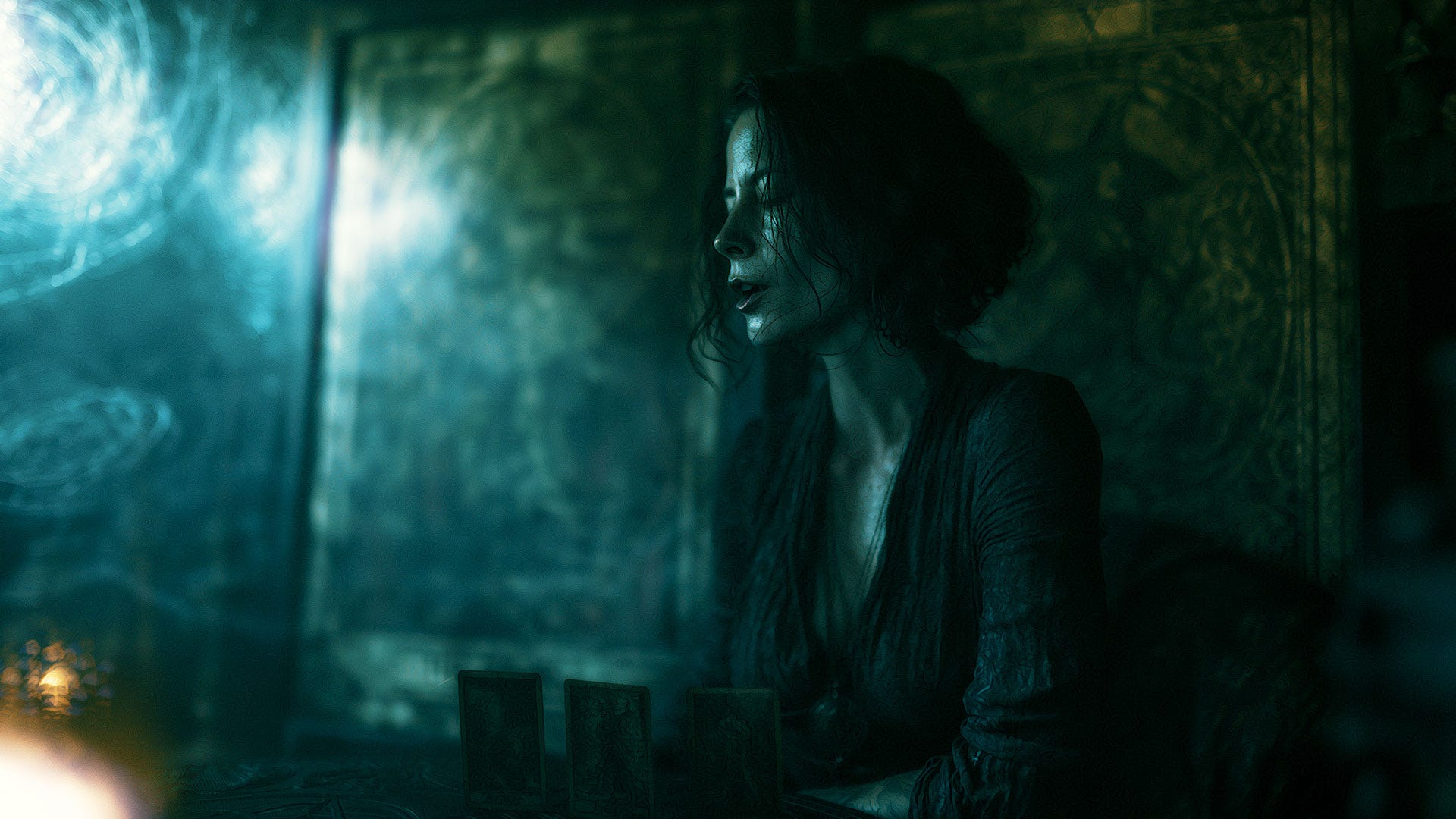
In Dark Tarot work, ethics are not external rules pasted onto the practice after the power has already been summoned. Ethics are part of the magical structure itself. A distorted question opens a distorted gate.
This matters especially in spellcraft. The lower forms of magick — by which I mean practical magick directed toward ordinary life — often deal with money, love, opportunity, protection, success, influence, healing and justice. These are not trivial concerns. They are part of life in the body. A Witch who cannot work with material reality has drifted into abstraction. But practical spellcraft becomes spiritually dangerous when it is used to avoid self-knowledge, override consent, feed obsession or disguise vengeance as righteousness.
A Dark Tarot question should therefore be examined before the cards are drawn. Is it asking for wisdom, or control? Does it concern my own action, or am I trying to compel another person? Am I seeking protection, or indulging paranoia? Am I asking for justice, or permission to harm? Am I invoking destiny, or trying to avoid grief?
Adjustment (Justice) is one of the great guardians of this stage of the work. In the Dark Tarot, Adjustment is not merely legal fairness or moral correctness. It is the invocation of destiny and karmic force, the ancient weighing of the heart, the rite of proportion. Under its gaze, the question must be brought to balance. What belongs to me? What belongs to another? What is mine to do? What must I leave untouched?
The Geomancer (The Emperor) also belongs here, because every question establishes a boundary. A clean question marks the field of operation. It says: this is the land I am working. This is the line I will not cross. This is where my responsibility begins and ends. Without such boundaries, magick becomes leakage. The practitioner may imagine they are working powerfully, when in truth they are simply spilling psychic desire across everything around them.
The Black Magician (The Hierophant) may appear when a question is not yet ready to be spoken. This is not always a refusal. Sometimes knowledge is withheld because the vessel is still being prepared. Sometimes the gate remains closed because the practitioner is asking from curiosity rather than necessity, or from entitlement rather than reverence. The Dark Tarot does not owe us spectacle. It responds best to sincerity.
The Abyss (The Hanged Man) may appear when the question itself must be surrendered. The Spider Sorcerer does not always cut us free at once. Sometimes we hang in the web until the wrong question exhausts itself. Only then does the real one appear.
Although the Dark Tarot can be used for many kinds of workings, there are five broad categories of question that suit the method particularly well. These are not rigid boxes, but gateways. A single operation may contain elements of more than one.
The first is the question of destiny. This asks about the deep pattern of a life, the direction of the soul, the vocation that presses upon the practitioner whether or not they find it convenient. A destiny question might be: “What force seeks fulfilment through my life at this time?” or “How may I align myself more consciously with the work I am here to do?” These questions are not for casual amusement. They may disturb sleep.
The second is the question of initiation. This concerns ordeal, threshold, transformation and the breaking of an old form. It is the kind of question one asks when life has already begun dismantling the familiar world. “What is being asked of me in this difficult transition?” “What must be surrendered for the next stage of my becoming?” “What initiation is concealed within this loss?” Such questions may call forth The Abyss (The Hanged Man), The Necromancer (Death), The Phallus (The Tower), or Awakening (Judgement). They are not comfortable cards, but they are often honest ones.
The third is the question of practical spellcraft. This asks how to bring a necessary material outcome into form. “What operation will help me obtain the resources required for this project?” “How may I protect my home?” “What ritual action will support healing?” “How may I open the road for suitable work?” These questions are grounded. They recognise that the Mysteries must also pass through rent, health, time, tools, bodies and obligations. The Witch (The Empress), The Geomancer (The Emperor), The Sorcerer (The Magician) and The Alchemist (Temperance) may all serve strongly in this field.
The fourth is the question of psychic development. This asks how to deepen intuition, trance, dream, spirit contact, divination or inner perception. “How may I strengthen my capacity to hear the hidden?” “What practice will deepen my relationship with dream?” “How may I enter trance safely and fruitfully?” These questions may call forth The Vampyre (The High Priestess), The Hermeticist (The Hermit), Familiar Spirits (The Moon), or The Underworld (The World). They require patience. Psychic development is not performance. It is relationship.
The fifth is the question of invocation. This concerns communion with the divine, the daemonic, the ancestral, the mythic or the numinous. “How may I encounter the mystery at the centre of my life?” “What form of devotion is being asked of me?” “How may I invoke the power needed to cross this threshold?” These questions may summon The Yoni (The Star), Time (The Wheel of Fortune), The Vortex (The Sun), or The Underworld (The World). They belong to the higher forms of magick, where the purpose is not simply to get something, but to be changed through contact.
Each category asks something different of the practitioner. A practical spellcraft question may require immediate action in the world. An initiatory question may require surrender. A psychic development question may require discipline over months. An invocation question may require humility. To ask the right kind of question is already to accept something of the path it opens.
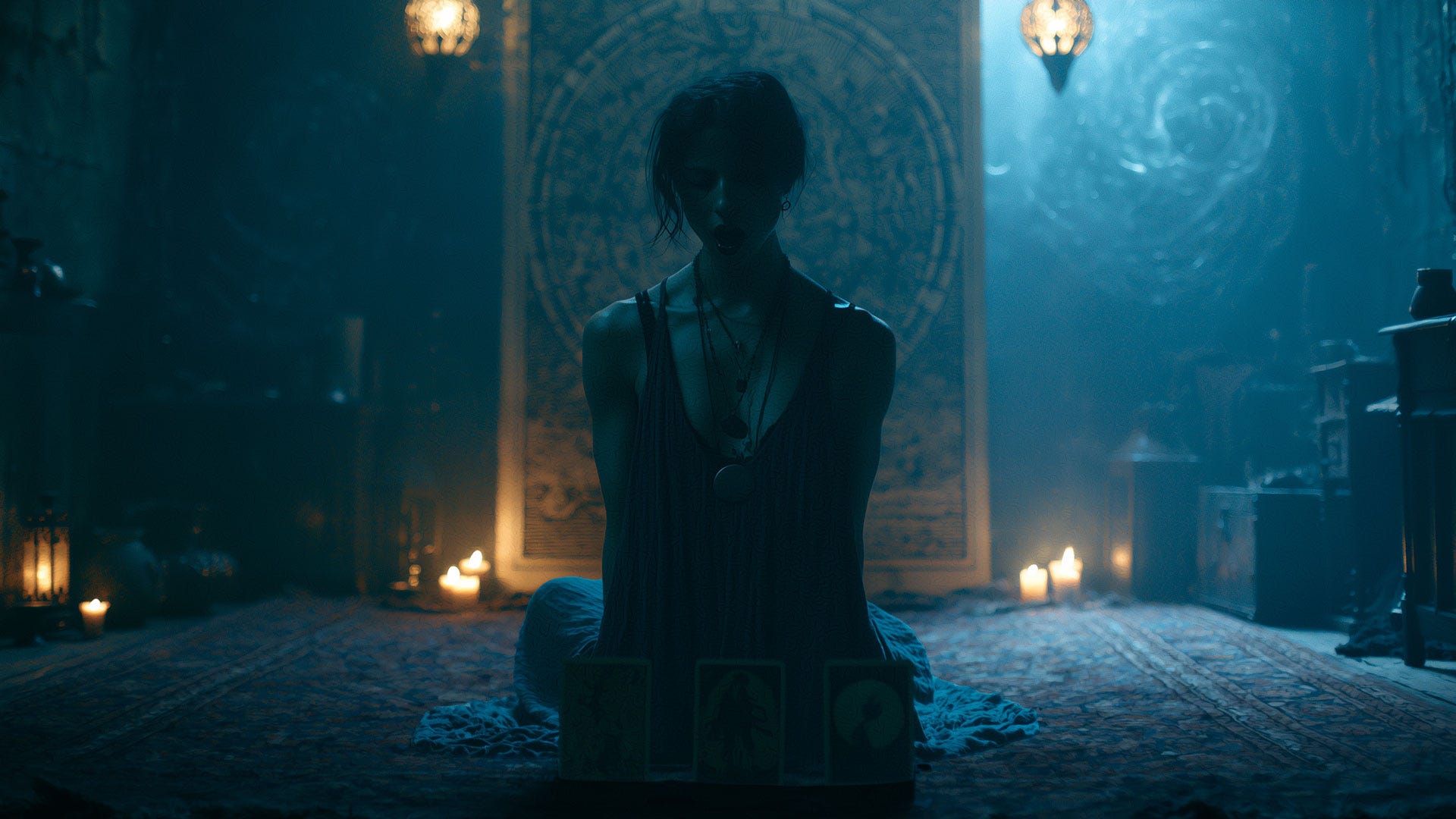
A well-made question is a circle cast in language. It defines the working space. It calls the attention of the practitioner, the cards and the unseen toward a particular field of relationship. It protects the operation from vagueness and intrusion. It also binds the practitioner to a certain honesty.
This is why the question should be written down before the cards are drawn. Do not rely on memory. The ego is a subtle editor and will sometimes change the question after the cards appear in order to avoid the force of the answer. Write the question in your Dark Tarot journal. Let it stand as witness.
Then read it aloud.
Notice what happens in the body. Does the question feel clean? Does it tighten the throat? Does it produce shame, excitement, resistance, grief, heat, or relief? The body is often the first oracle. If the question feels false, revise it. If it feels frightening but true, proceed with respect. If it feels manipulative, stop and rework it. If it feels alive, you may have found the gate.
The Dark Tarot does not require perfect questions. It requires honest ones. The question is allowed to tremble. It is allowed to admit fear. It is allowed to be plain. What matters is that it opens toward participation rather than evasion.
In the next instalment, we will move from the question to the operation itself: the three-card formula of Sigil, Spell and Sorcery. For now, the task is to understand that the cards do not begin the work. The question does. Before the image appears, before the spell is spoken, before the sorcery is enacted, the gate must be named.
And the gate is the question.
Dark Tarot: Unleashing the Power of the Tarot for Dark Magick and Self-Discovery is my current book-in-development, drawn from decades of work with Tarot, Witchcraft, ritual magick, trance practice and the NOX current.
This series of articles is adapted from the developing manuscript and offers a first public glimpse into the Dark Tarot as a practical system of magical divination. Rather than treating the cards as a device for fortune-telling, the Dark Tarot approaches them as operative images: symbols that can reveal not only what is moving beneath the surface of life, but what ritual action may be required in response.
In the paid section below, I continue the discussion with practical exercises and working material from the Dark Tarot practicum.
Comments
Nothing yet. Say the first thing.
Sign in to join the conversation.