
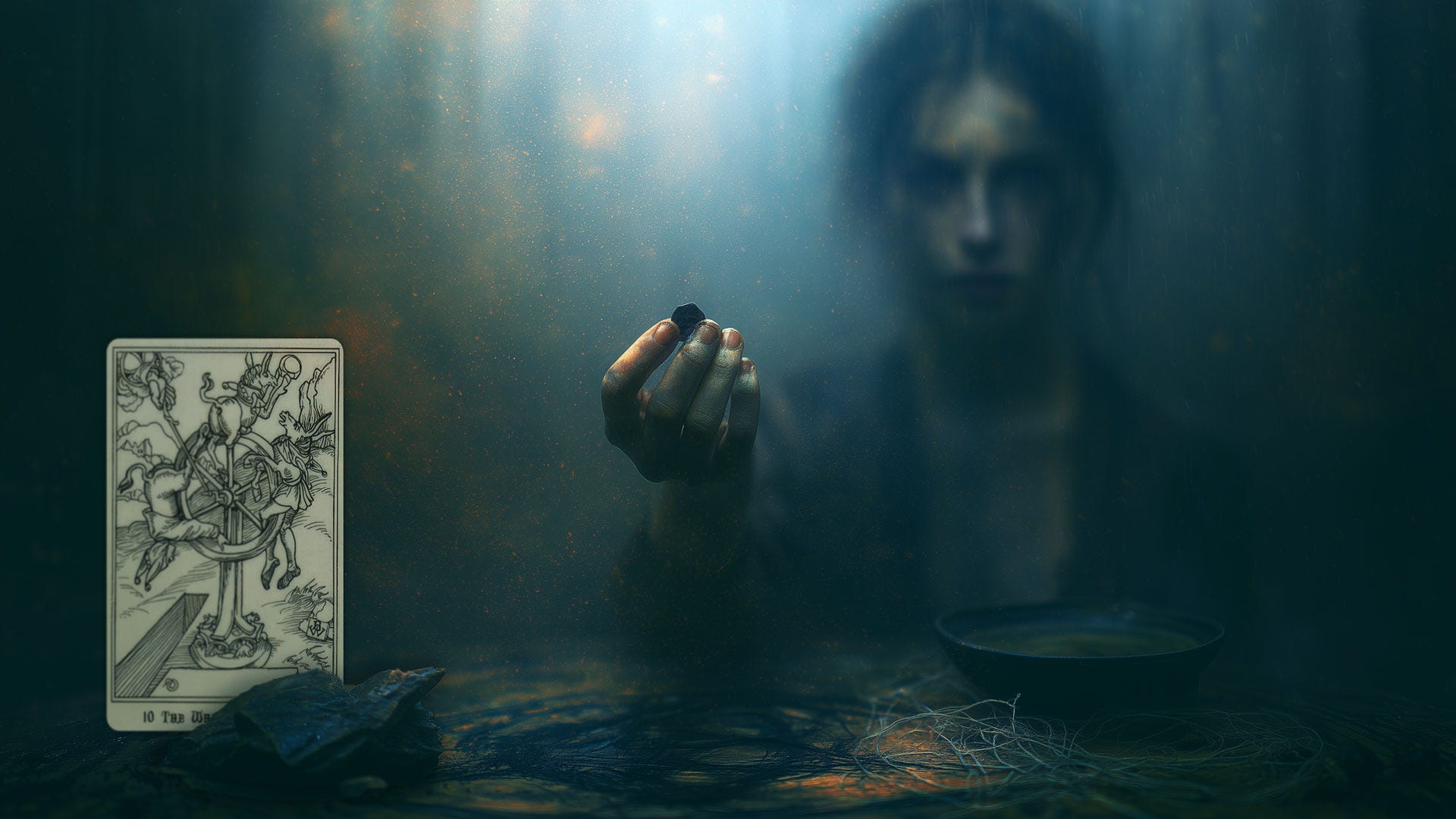
A note on this series: This is Part Four of an eight-part series drawn from my developing book, Dark Tarot: Unleashing the Power of the Tarot for Dark Magick and Self-Discovery. Across the series, I am exploring the Dark Tarot as a practical system of magical divination, moving beyond fortune-telling into the ritual formula of Sigil, Spell and Sorcery. Each article offers a piece of the larger method, while the paid practicum sections provide exercises, worksheets and working material for those who want to engage the Dark Tarot as a lived magical practice.
In the previous article, we looked at the three-card Dark Tarot operation as the central formula of the method. The old divinatory structure of Past, Present and Future was not discarded, but transformed. Instead of asking what has happened, what is happening, and what may happen, the Dark Tarot asks a more practical and magical set of questions: what must be formed, what must be spoken, and what must be done?
These three questions correspond to Sigil, Spell and Sorcery.
The first card is Sigil. The second card is Spell. The third card is Sorcery. Together they form the architecture of the operation. The Sigil card reveals the image-body of the work. The Spell card gives that image breath and voice. The Sorcery card brings the voiced image into action.
In this article, we begin with the first card: the Sigil.
This is where the working first takes shape. Before the words are spoken and before the ritual act is performed, something must hold the current. The hidden force moving through the reading needs a body, a vessel, a form into which it can gather itself. Magick is not only intention. It is intention shaped. It is psychic force given contour. It is desire, dream, fear, destiny or invocation made visible enough to work upon and through.
The Sigil card does not simply tell us what the reading “means.” It shows us what image will contain the operation.
This distinction is essential. In ordinary Tarot interpretation, the first card may be treated as the opening message, the root influence, the situation, or the past. In the Dark Tarot, the first card is more physical than that. It asks: what symbol, object, mark, colour, talisman, fetish, gesture, map, image, altar form or magical body will hold the power of this working?
The first card is the vessel. Without it, the current has nowhere to gather.
There is a temptation in modern spirituality to speak of energy as though it were enough to feel it. We say that something has “good energy” or “dark energy” or “powerful energy,” and while such language may point toward real perception, it can also become vague. A Witch cannot work effectively with vagueness for very long. Sooner or later, the current must be given shape.
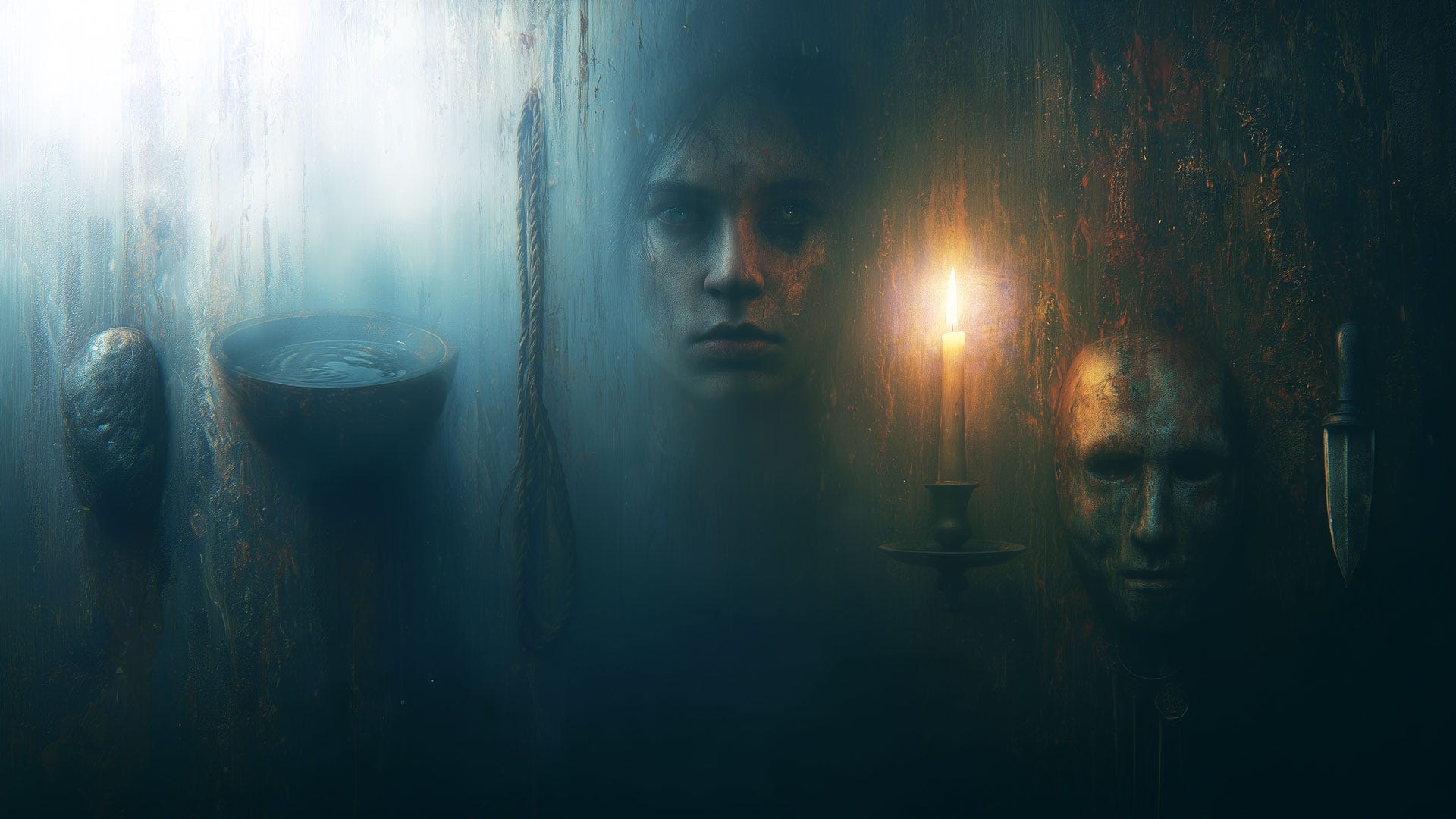
This is why magical traditions are filled with tools and forms: blades, cords, cups, stones, masks, seals, pentacles, dolls, poppets, candles, robes, knots, written names, herbs, bones, bowls, circles, diagrams, images of gods, images of beasts, planetary seals, ancestral photographs, ritual postures and carefully prepared spaces. These are not merely props. At their best, they are bodies for force.
A candle is not only wax. It is a vertical axis of fire. A bowl of water is not only water. It is a receiving vessel, a moon, a dark mirror, a womb, a pool of memory. A stone is not only stone. It is weight, boundary, endurance, land, bone, witness. A mask is not only theatre. It is an agreement that something other than the everyday personality may speak through the face.
The psyche understands form. The body understands form. Spirits, too, often seem to respond to form. The invisible becomes approachable when given a threshold. This does not mean the form imprisons the force. A good magical vessel does not trap the current; it gives it a means of arrival.
The Sigil card in a Dark Tarot operation reveals what kind of vessel is required.
If The Lunatic (The Fool) appears as Sigil, the working may require a moonlit path, a footprint, a staff, a torn map, a white stone carried at night, or a simple line vanishing into darkness. The current is not yet housed in a temple. It is moving, wandering, dreaming itself forward. The sigil may need to feel provisional, like a mark left by a traveller who does not yet know the destination but has already left the old world behind.
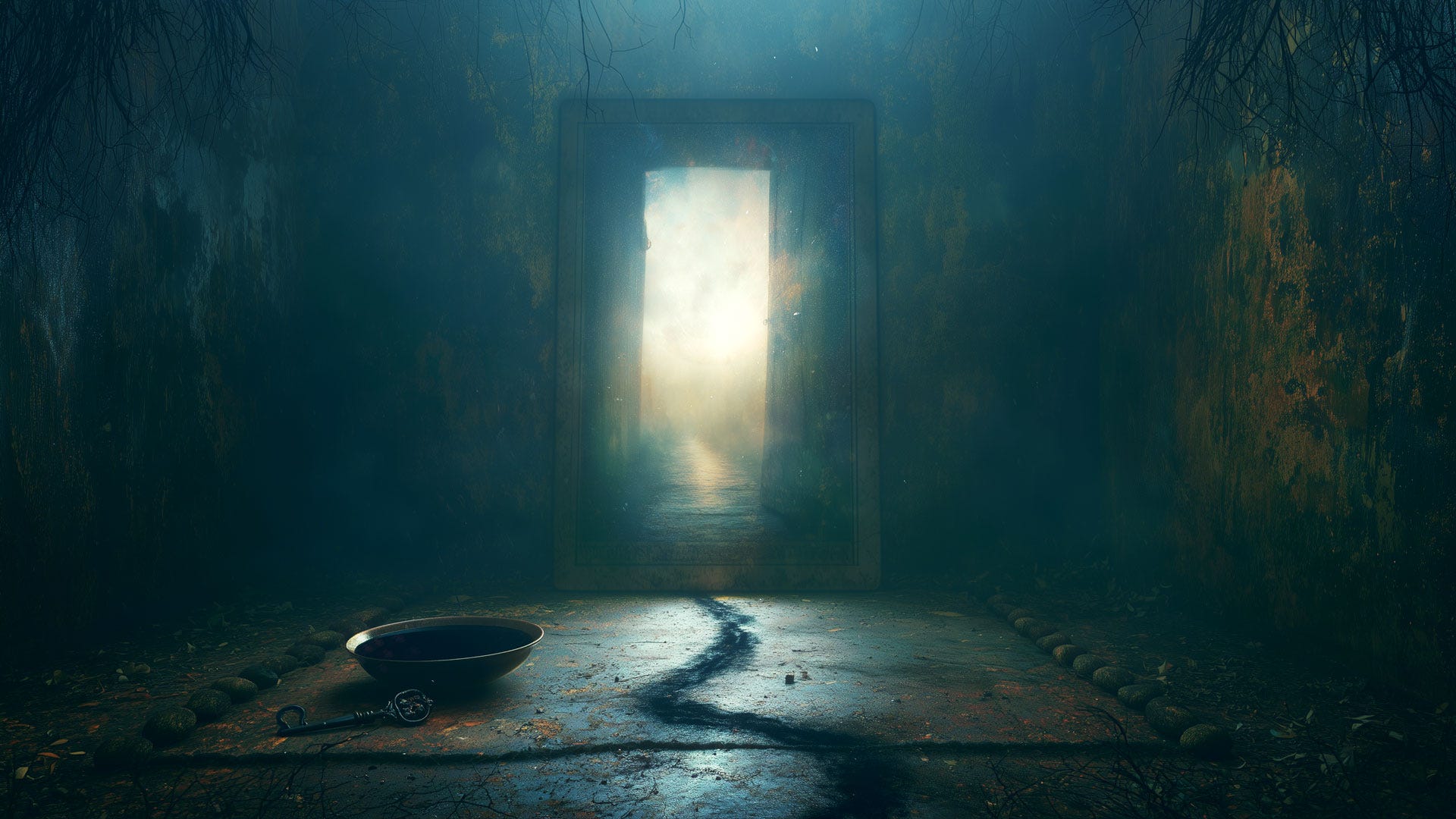
If The Vampyre (The High Priestess) appears as Sigil, the vessel is very different. Here the image may be a coffin, crypt, black mirror, closed book, key, bowl of dark water, or the body held in trance. The current requires enclosure, secrecy, stillness and liminal receptivity. The force does not stride through the front door. It rises in the dark after the ordinary world has fallen silent.
If The Geomancer (The Emperor) appears as Sigil, the image may be a map, square, boundary stone, compass, iron nail, marked threshold or diagram of dragon tracks. The current seeks structure. It wants the hidden lines of force to be traced and named. This is a card of territory, architecture, authority and the invisible pattern beneath the visible landscape.
Already we can see that the Dark Tarot title matters. The Fool and The Lunatic are related, but not identical in atmosphere. The Emperor and The Geomancer share the field of order and authority, but the Geomancer draws our attention away from the throne and toward the living lines beneath land and body. The High Priestess and The Vampyre both guard forbidden knowledge, but the Vampyre insists upon trance, blood-memory, deathlike stillness and nocturnal hunger.
The title changes the magical body of the card.
It may be useful here to distinguish between a sign, a symbol and a sigil.
A sign points to something. It communicates information. A red traffic light tells us to stop. A label on a jar tells us what is inside. A sign may be clear and useful, but it does not necessarily contain mystery. It is mostly exhausted by its function.
A symbol is deeper. It participates in what it reveals. A cup may symbolise water, the womb, the receptive soul, the Grail, the heart, the body of the Goddess, the vessel of offering. It does not merely point to one fixed meaning. It gathers layers. A true symbol cannot be reduced to a definition without losing some of its power. It keeps opening.
A sigil, in magical work, is a symbol that has been made operative. It is not only meaningful; it is charged, directed, inhabited or bound to an intention. It is a mark or form through which force may be concentrated. Sometimes it is consciously designed from letters, images or numerical formulae. Sometimes it emerges through trance. Sometimes it is inherited from tradition. Sometimes the Witch finds it in a dream, in a stone, in the twist of a branch, in the pattern of wax down a candle, or in the way a card refuses to leave the mind.
In the Dark Tarot, the Sigil card does not always give a finished sigil. More often, it gives the image-field from which the sigil must be made. The practitioner then works with the card to discover the form. This may be drawn, assembled, embodied, placed upon an altar, carried as a talisman, or held inwardly as a visualised image.
The important point is that the sigil must be alive enough to contain the current of the operation.
A lifeless sigil is merely design. A living sigil has pressure.
Every Dark Tarot trump can become Sigil, but each does so differently.
The Sorcerer (The Magician) as Sigil often gives us the ritual chamber, the prepared tools, the diagram of desire, the table upon which elemental and familiar spirits are made ready for their errands. The sigil may include the four elements, a central glyph of intention, a wand or blade, a marked paper charm, or a small object charged to carry the work outward. Here the image is active and projective. The current seeks direction.
The Witch (The Empress) as Sigil brings the power of embodied manifestation. This is not the Empress as pleasant fertility alone, but the Witch or Mambo within her ritual chamber preparing to open forces upon the physical plane. The sigil may become a fetish, charm bundle, clay figure, bottle spell, herb packet, consecrated oil, or any object that gathers spiritual force into matter. This card understands that bodies are magical. Matter is not the enemy of spirit; it is one of spirit’s favourite disguises.
The Black Magician (The Hierophant) as Sigil gives the hood, the cowl, the sealed book, the funerary rite, the guarded altar, the door that does not open to casual curiosity. Here the sigil may take the form of a veiled object, a black square, a closed book tied with cord, a candle before an ancestor image, or a hidden mark placed where only the practitioner knows to look. This card teaches that not all knowledge should be displayed. Some powers grow stronger when concealed.
The Necromancer (Death) as Sigil may give the séance circle, the half-open cemetery gate, the ruin, the bone, the photograph, the graveyard earth, the black ribbon, the name of the dead, the key to an old door. If this card appears as Sigil, the operation may require an image of ending, communication, ancestral presence or transition. It is not always literal necromancy, though it can be ancestral work. Often it shows that something dead but still active must be given proper form before it can be addressed.
The Alchemist (Temperance) as Sigil suggests the vessel of transformation: cup, bowl, vial, dew, oil, elixir, mingled waters, joined substances, the shrine where two forces meet and become a third. This card rarely works through harsh force. Its sigils are often subtle: a drop, a vessel, a spiral of mixing, a small bottle prepared over time. It is the card of distillation, healing and the slow art of making medicine from contradiction.
The Underworld (The World) as Sigil gives the dark universe, the mythic descent, the circle of completion, the domain of the living dead, the dreamer awakening inside the eternal pattern. Its sigil may be a black circle, a mandala of descent, a doorway beneath the earth, a spiral into darkness, or a map of the personal underworld. This is not the bright completion of everything resolved. It is wholeness found by including what has been buried.
To work with these cards as Sigil is to stop asking only, “What does this card mean?” and begin asking, “What body does this force require?”
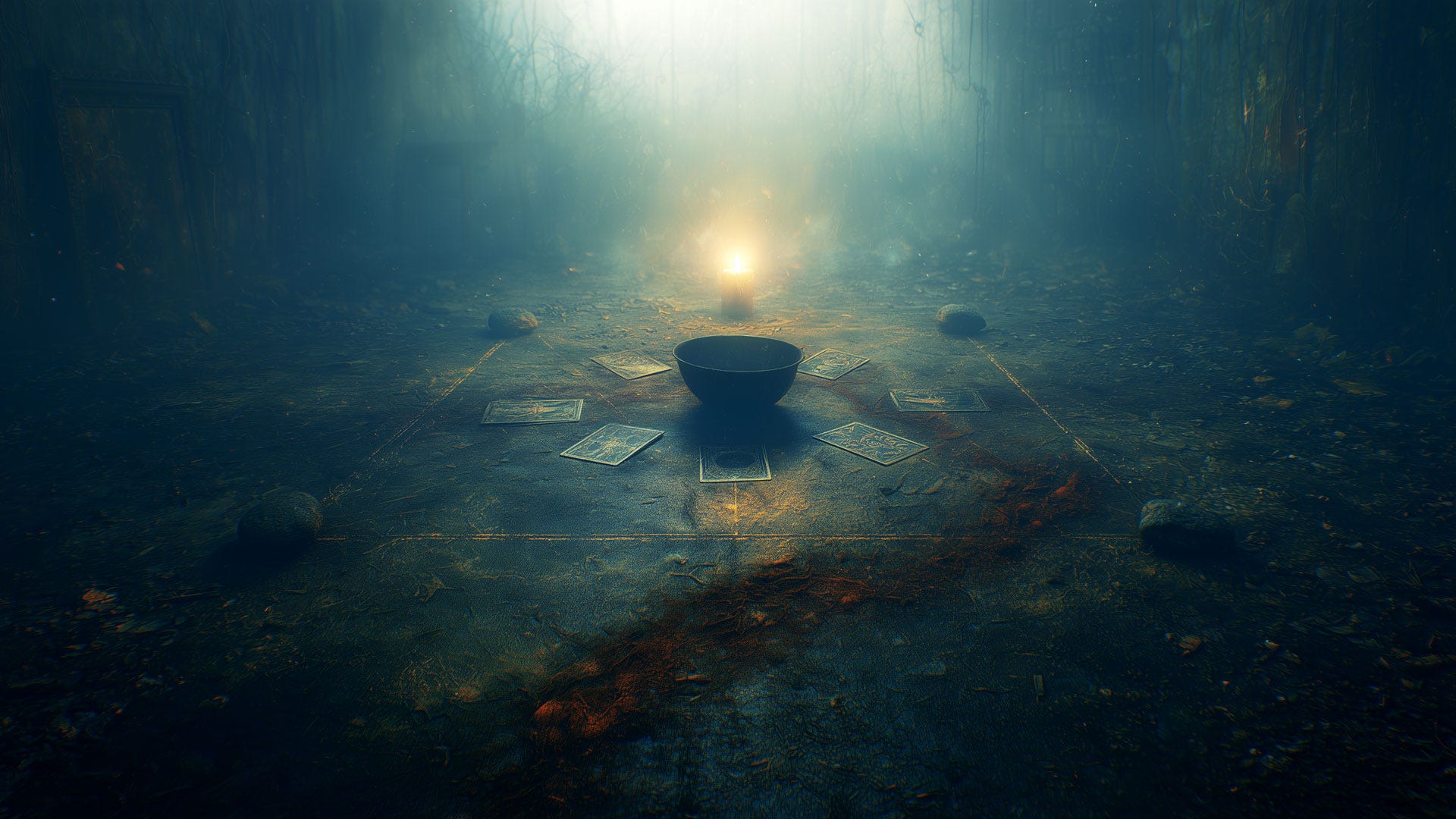
A sigil does not have to be drawn on paper. An altar can be a sigil. A ritual posture can be a sigil. A carefully arranged space can be a sigil through which the whole operation is held.
If The Geomancer (The Emperor) is the Sigil card for a working concerned with material stability, the altar might be arranged as a square. A stone may be placed in each corner. A map, plan or written structure may sit at the centre. The arrangement itself becomes the sigil: boundary, order, land, authority and hidden current brought into visible relationship.
If The Vampyre (The High Priestess) is the Sigil card for a working of psychic development, the altar may be dark and minimal: a black cloth, a bowl of water, a key, a single candle placed behind rather than before the vessel, and perhaps the card itself partly veiled. The altar becomes a crypt or sanctuary. It tells the psyche that the work is not extroverted. It is inward, nocturnal and receptive.
If The Witch (The Empress) is the Sigil card for a spell of manifestation, the altar may be abundant but not cluttered: herbs, oil, thread, clay, a charm bag, red or green cloth, a physical object linked to the desired outcome. The altar becomes a workshop of embodied force. The card has become matter.
This is one of the great strengths of the Sigil position. It reminds us that magick is not only something we think, feel or say. It is something we arrange. It is the art of placing the visible world into a pattern that invites the invisible to move.
The body, too, can become the sigil.
This is sometimes overlooked because modern magical practice can become heavily textual and object-based. We write, draw, read, arrange and recite, but the oldest magical instrument remains the body itself. Breath, posture, gaze, gesture, dance, stillness, touch, voice and rhythm are not secondary. They are primary.
If Initiation (The Chariot) appears as Sigil, the body may need to assume discipline: seated posture, controlled breath, a firm spine, ritual movement, ordeal, training, or a gesture of crossing. The current requires the body to become a vehicle.
If The Enchantress (Strength) appears as Sigil, the body may become a vessel of courage, desire and animal vitality. The sigil may not be a mark on paper, but a posture of embodied power, a hand over the heart and belly, a breath drawn low into the pelvis, a stance that refuses collapse.
If The Hermeticist (The Hermit) appears as Sigil, the body may become stillness itself. A seated figure in darkness, spine upright, attention turned toward the hidden force emanating from beyond. The sigil may be the silhouette of the practitioner before the unseen.
The body as sigil requires honesty. One cannot pretend for long in the body. A drawn sigil may look impressive while the practitioner remains divided. The body reveals fear, hunger, resistance, shame, longing and power. When the body is included, the operation deepens.
This does not mean all Dark Tarot work must be physically intense. Stillness can be as powerful as dance. A single hand gesture, repeated with attention, may carry more magical force than an hour of dramatic movement. The question is not how impressive the action appears, but whether the body has become a true vessel for the current.
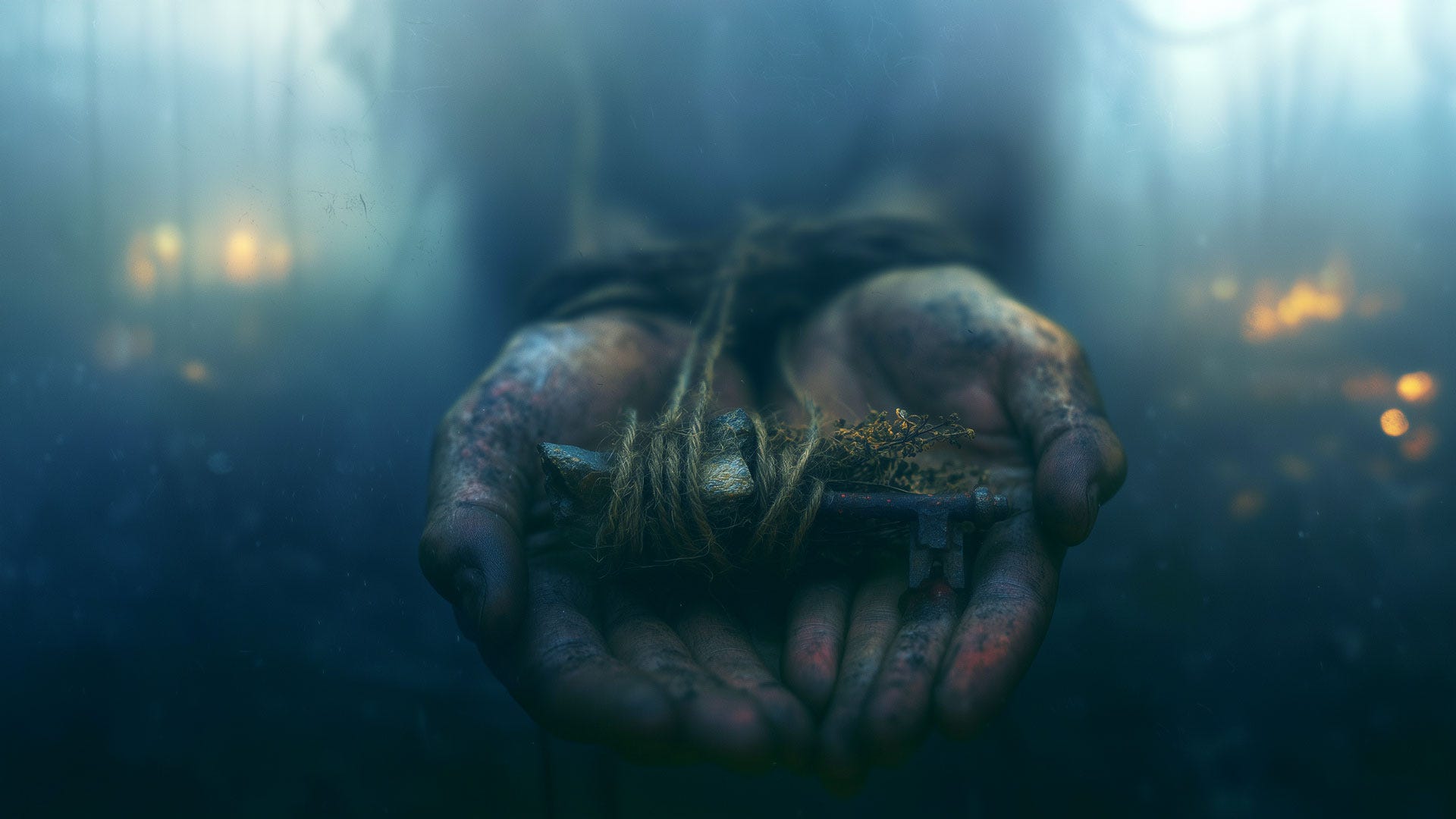
Sometimes the Sigil card asks to become an object that carries the operation beyond the ritual itself. This may be a talisman, charm, fetish, bundle, bottle, stone, written seal, pendant, cord or small object kept on the altar, carried on the body, placed beneath a pillow, buried, hidden, or given a specific magical task.
The word “fetish” has acquired many meanings, some of them distorted through colonial misunderstanding, but within magical practice it may refer to an object inhabited, charged or prepared to hold spiritual force. In the Dark Tarot, The Witch (The Empress) is especially relevant to this kind of work because she opens forces upon the physical plane. The fetish is not a metaphor. It is a body for power.
A talismanic object may be made from the Sigil card’s imagery. For The Lunatic (The Fool), a small stone found on a night walk might be marked with a path glyph and carried during a period of transition. For The Geomancer (The Emperor), a boundary stone might be placed at the threshold of a workspace. For The Vampyre (The High Priestess), a key might be kept beneath the pillow during dream work. For The Alchemist (Temperance), a small vial of oil or water might be prepared as an elixir of healing and integration.
The object should not be chosen merely because it seems aesthetically pleasing. It should answer the card. It should feel as though the image has found a body.
When the talisman is complete, it may be awakened by the Spell card and activated through the Sorcery card. This is why the full three-card formula matters. The Sigil gives the form, but the operation is not complete until the form is given voice and action.
The Sigil card must be approached with patience. Some images are immediate. Others resist. At times the practitioner will draw a card and know instantly what object or form is required. At other times, the card may feel obscure, even irritating. This is not failure. It may mean the image has not yet finished arriving.
Sit with it. Draw it badly. Describe it in words. Enter it in imagination. Ask what object belongs to it. Ask where it lives in the body. Ask what colour it stains the air. Ask what shape remains if all ornament is stripped away.
A useful exercise is to reduce the card to three image elements.
For The Vampyre (The High Priestess), the three elements might be coffin, key and dark water.
For The Geomancer (The Emperor), they might be square, stone and serpent-line.
For The Lunatic (The Fool), they might be moon, path and footprint.
For The Witch (The Empress), they might be vessel, herb and bound charm.
For The Sorcerer (The Magician), they might be table, wand and familiar mark.
From these three elements, the sigil can begin to form. It may become a drawing, an altar, an object or a bodily gesture. The form does not need to be artistically perfect. It needs to be magically accurate. A crude mark made in genuine contact is often more powerful than a beautiful design made at a distance from the current.
In time, each practitioner develops their own visual language. This is part of the Dark Tarot grimoire. The same card may give different sigils in different operations, but patterns will emerge. The Vampyre may repeatedly bring keys, bowls, veils or mirrors. The Geomancer may repeatedly bring stones, maps, squares or boundary lines. The Underworld may bring circles, doors, roots or spirals descending into blackness. These recurring images are not accidents. They are the language of the work becoming personal.
The Sigil card marks the first great movement of the Dark Tarot operation: the movement from hidden current to visible form. This is the beginning of manifestation, but not yet its completion. The image has been given a body. It can now be addressed, awakened, charged, carried, buried, worn, gazed upon, entered, guarded or transformed.
This is why the first card deserves more attention than it is often given. If the Sigil is weak, the operation may remain vague. If the vessel is unclear, the spell may scatter and the sorcery may become unfocused. But when the Sigil is strong, the work has somewhere to gather. The practitioner can feel it. The current settles into the form like breath entering lungs.
In the next article, we will turn to the second card: Spell, the voice of the operation. Once the image has been formed, it must be given breath. It must be spoken, whispered, sung, commanded, lamented or invoked. The Sigil is the body, but the Spell is the word that wakes it.
For now, stay with the first card. Look at it not as an answer, but as a vessel. Ask what shape the unseen wishes to take. Ask what object, mark, gesture or altar will hold the current. Ask what body the operation requires.
The Dark Tarot begins to work when the image stops being an illustration and becomes a presence.
Dark Tarot: Unleashing the Power of the Tarot for Dark Magick and Self-Discovery is my current book-in-development, drawn from decades of work with Tarot, Witchcraft, ritual magick, trance practice and the NOX current.
This series of articles is adapted from the developing manuscript and offers a first public glimpse into the Dark Tarot as a practical system of magical divination. Rather than treating the cards as a device for fortune-telling, the Dark Tarot approaches them as operative images: symbols that can reveal not only what is moving beneath the surface of life, but what ritual action may be required in response.
In the paid section below, I continue the discussion with practical exercises and working material from the Dark Tarot practicum.
Comments
Nothing yet. Say the first thing.
Sign in to join the conversation.